Alone means being by yourself, without other people. Imagine sitting in your room after a long day. The house is quiet. No one is talking. You are alone. Sometimes this feels peaceful. Sometimes it feels sad.
The word “alone” is very common in daily English. We use it in conversations, books, songs, and social media. It describes physical separation and emotional feelings. Learning synonyms of alone helps English learners avoid repeating the same word. It also makes writing deeper and clearer. In this article, we will explore the meaning of alone and its 30 synonyms. We will also explain pronunciation, grammar, tone, word history, and categories in simple English.
Meaning of Alone
Definition
Alone (adjective/adverb):
Without other people; by yourself.
Examples
She was alone at home.
He likes to travel alone.
Connotative Meaning
(Connotation means the emotional feeling or idea a word suggests.)
- Positive tone: peaceful, independent, private
- Negative tone: lonely, isolated, sad
- Neutral tone: simply without others
Etymology
- From Old English all ana, meaning “all one” or “by oneself.”
- “All” + “one” later formed the word “alone.”
Short History
- Old English (450–1100): Used as all ana meaning completely by oneself.
- Middle English (1100–1500): Became “alone” in spelling and pronunciation.
- Modern English (1500–Present): Widely used in emotional and physical contexts.
Pronunciation (US & UK – IPA)
- US: /əˈloʊn/
- UK: /əˈləʊn/
Syllables
a-lone
Affixation Pattern of Alone
- Root: lone
- Prefix: a-
- Suffix: none
Word Formation
- alone (adjective/adverb)
- lonely (adjective)
- loneliness (noun)
- lonesome (adjective)
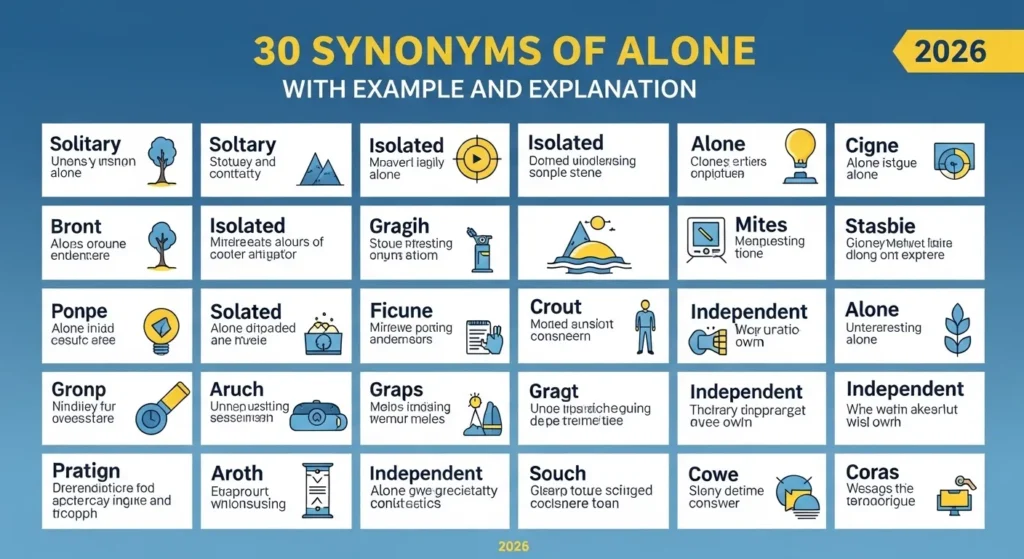
Synonyms of Alone
1. Lonely (adjective) — US /ˈloʊn.li/ | UK /ˈləʊn.li/
Meaning: Feeling sad because you are alone.
Examples:
She felt lonely at night.
He lives in a lonely house.
2. Solo (adjective/adverb) — US /ˈsoʊ.loʊ/ | UK /ˈsəʊ.ləʊ/
Meaning: Done by one person only.
Examples:
She traveled solo.
He performed a solo act.
3. Solitary (adjective) — US /ˈsɑː.lə.ter.i/ | UK /ˈsɒl.ɪ.tər.i/
Meaning: Existing alone; isolated.
Examples:
He lived a solitary life.
A solitary tree stood there.
4. Isolated (adjective) — US /ˈaɪ.sə.leɪ.tɪd/ | UK /ˈaɪ.sə.leɪ.tɪd/
Meaning: Far away from others.
Examples:
The village is isolated.
She felt isolated at school.
5. Secluded (adjective) — US /sɪˈkluː.dɪd/ | UK /sɪˈkluː.dɪd/
Meaning: Quiet and away from people.
Examples:
They found a secluded beach.
He lives in a secluded area.
6. By oneself (phrase) — US /baɪ wʌnˈself/ | UK /baɪ wʌnˈself/
Meaning: Without help or company.
Examples:
She cooked by herself.
He sat by himself.
7. On one’s own (phrase) — US /ɑːn wʌnz oʊn/ | UK /ɒn wʌnz əʊn/
Meaning: Alone and independent.
Examples:
He lives on his own.
She solved it on her own.
8. Lonesome (adjective) — US /ˈloʊn.səm/ | UK /ˈləʊn.səm/
Meaning: Feeling alone and sad.
Examples:
The road looked lonesome.
She felt lonesome abroad.
9. Friendless (adjective) — US /ˈfrend.ləs/ | UK /ˈfrend.ləs/
Meaning: Without friends.
Examples:
He felt friendless.
The child seemed friendless.
10. Companionless (adjective) — US /kəmˈpæn.jən.ləs/ | UK /kəmˈpæn.jən.ləs/
Meaning: Without companions.
Examples:
She walked companionless.
He felt companionless in the city.
11. Unaccompanied (adjective) — US /ˌʌn.əˈkʌm.pə.nid/ | UK /ˌʌn.əˈkʌm.pə.nid/
Meaning: Without someone else present.
Examples:
Children cannot travel unaccompanied.
She arrived unaccompanied.
12. Single (adjective) — US /ˈsɪŋ.ɡəl/ | UK /ˈsɪŋ.ɡəl/
Meaning: Only one; not married.
Examples:
He is single.
A single chair stood there.
13. Independent (adjective) — US /ˌɪn.dɪˈpen.dənt/ | UK /ˌɪn.dɪˈpen.dənt/
Meaning: Not needing help from others.
Examples:
She is independent.
He works independently.
14. Withdrawn (adjective) — US /wɪðˈdrɔːn/ | UK /wɪðˈdrɔːn/
Meaning: Quiet and not social.
Examples:
He became withdrawn.
She seemed withdrawn.
15. Reclusive (adjective) — US /rɪˈkluː.sɪv/ | UK /rɪˈkluː.sɪv/
Meaning: Avoiding other people.
Examples:
The writer is reclusive.
He lives a reclusive life.
16. Deserted (adjective) — US /dɪˈzɝː.tɪd/ | UK /dɪˈzɜː.tɪd/
Meaning: Empty of people.
Examples:
The street was deserted.
A deserted house stood there.
17. Apart (adverb) — US /əˈpɑːrt/ | UK /əˈpɑːt/
Meaning: Separated from others.
Examples:
They live apart.
She stood apart from the group.
18. Sole (adjective) — US /soʊl/ | UK /səʊl/
Meaning: Only one.
Examples:
He was the sole survivor.
She is the sole owner.
19. Only (adjective/adverb) — US /ˈoʊn.li/ | UK /ˈəʊn.li/
Meaning: No others; just one.
Examples:
She was the only person there.
He only wanted peace.
20. Hermit-like (adjective) — US /ˈhɝː.mɪt laɪk/ | UK /ˈhɜː.mɪt laɪk/
Meaning: Living away from society.
Examples:
He lived a hermit-like life.
She stayed hermit-like in the hills.
21. Cloistered (adjective) — US /ˈklɔɪ.stɚd/ | UK /ˈklɔɪ.stəd/
Meaning: Kept away from public life.
Examples:
He had a cloistered life.
The monks lived cloistered lives.
22. Unattended (adjective) — US /ˌʌn.əˈten.dɪd/ | UK /ˌʌn.əˈten.dɪd/
Meaning: Without supervision.
Examples:
The child was unattended.
The bag was unattended.
23. Detached (adjective) — US /dɪˈtætʃt/ | UK /dɪˈtætʃt/
Meaning: Emotionally distant.
Examples:
He felt detached.
She remained detached.
24. Remote (adjective) — US /rɪˈmoʊt/ | UK /rɪˈməʊt/
Meaning: Far away from others.
Examples:
They live in a remote area.
The house is remote.
25. Self-reliant (adjective) — US /ˌself rɪˈlaɪ.ənt/ | UK /ˌself rɪˈlaɪ.ənt/
Meaning: Depending on yourself.
Examples:
She is self-reliant.
He became self-reliant early.
26. Lone (adjective) — US /loʊn/ | UK /ləʊn/
Meaning: Single and alone.
Examples:
A lone wolf howled.
He stood lone in the field.
27. By yourself (phrase) — US /baɪ jɔːrˈself/ | UK /baɪ jɔːˈself/
Meaning: Without company.
Examples:
Can you do it by yourself?
She traveled by herself.
28. Unescorted (adjective) — US /ˌʌn.ɪˈskɔːr.tɪd/ | UK /ˌʌn.ɪˈskɔː.tɪd/
Meaning: Without a guide or partner.
Examples:
She arrived unescorted.
The guest came unescorted.
29. Unshared (adjective) — US /ʌnˈʃerd/ | UK /ʌnˈʃeəd/
Meaning: Not shared with others.
Examples:
He kept unshared secrets.
It was an unshared room.
30. Solely (adverb) — US /ˈsoʊl.li/ | UK /ˈsəʊl.li/
Meaning: Only; without others involved.
Examples:
She was solely responsible.
He worked solely for himself.
Prototype Meaning
When people hear “alone,” they usually imagine a person sitting quietly in a room with no one else around. It often suggests silence and separation.
Prototype Categorization
- Emotional words: lonely, lonesome, friendless
- Physical separation: isolated, secluded, remote
- Independence: solo, independent, self-reliant
- Formal terms: unaccompanied, unescorted, solitary
Categorization helps writers choose the right synonym for emotional, formal, or neutral contexts.
Antonyms
- Together
- Accompanied
- Social
- Surrounded
Short Questions and Answers
- What does alone mean?
It means being without other people. - When should alone be used?
Use it when describing physical or emotional separation. - Is alone positive or negative?
It can be peaceful or sad depending on context. - How is it different from lonely?
Alone means by yourself. Lonely means feeling sad about it.
CONCLUSION
Learning the word alone and its synonyms improves your vocabulary. It strengthens your writing and speaking skills. It helps you avoid repeating the same word. Understanding tone and history builds deeper knowledge. When you practice new words daily, your English becomes clearer and stronger. Keep learning step by step. Confidence grows with practice.

I’m Zahid Abbas, an educator, researcher, and digital publishing strategist with a passion for linguistics, grammar, and clear communication. As a content creator and SEO specialist, I craft research-driven, reader-focused content that empowers learners and makes knowledge accessible worldwide.