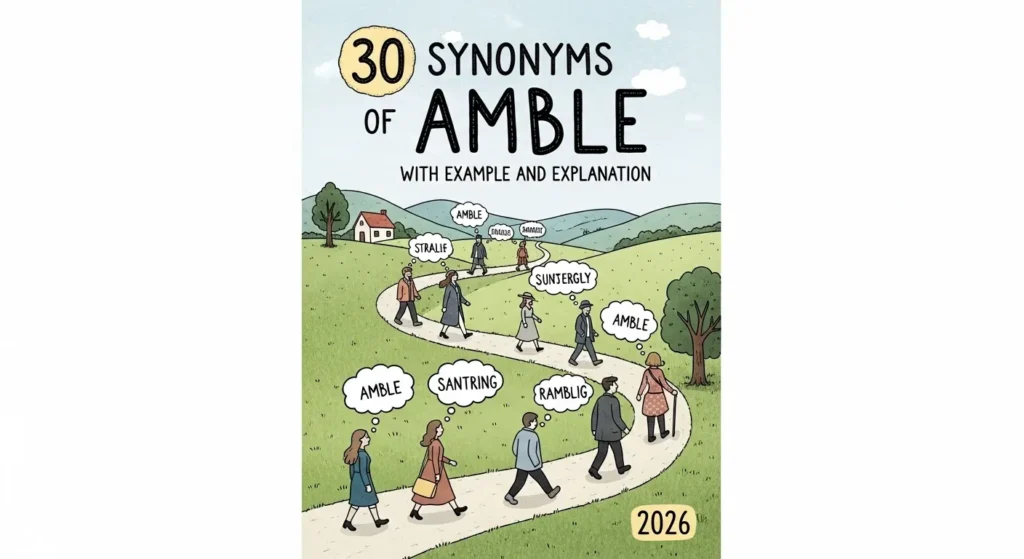
Amble means to walk slowly and in a relaxed way. Imagine a cool evening. You are walking in a park after dinner. There is no hurry.
You look at trees and smile. You are not running.
The word amble is common in stories, daily talk, and descriptive writing. Writers use it to show calm movement.
English learners should learn synonyms because they help avoid repetition. Content writers also need rich vocabulary for better SEO and clear expression.
This article explains the meaning of amble and its synonyms with examples, grammar, history, pronunciation, and categories. Everything is written in simple and clear English.
Meaning of Amble
Definition
Amble (verb): to walk slowly and casually without hurry.
Examples
She likes to amble along the beach at sunset.
The old man ambled through the village market.
Connotative Meaning
(Connotation means the emotional feeling or idea connected to a word.)
- Positive tone: calm, peaceful, relaxed
- Negative tone: lazy, slow (in some contexts)
- Neutral tone: simple slow walking
Etymology
- From Old French ambler (to walk or move gently)
- From Latin ambulare (to walk)
Short History
- Old English (450–1100): Not common in this period.
- Middle English (1100–1500): Entered English from French.
- Modern English (1500–Present): Used to describe relaxed walking.
Pronunciation (US & UK – IPA)
US: /ˈæm.bəl/
UK: /ˈæm.bəl/
Syllables
am-ble
Affixation Pattern of Amble
- Root: amble
- Prefix: none
- Suffix: none
Word Formation
- amble (verb)
- ambling (adjective/verb form)
- ambled (verb – past tense)
- ambler (noun)
Synonyms of Amble
1. Stroll (verb) — US /stroʊl/ | UK /strəʊl/
Meaning: to walk slowly for pleasure.
Examples:
She strolled in the garden.
They strolled after dinner.
2. Saunter (verb) — US /ˈsɔn.tər/ | UK /ˈsɔːn.tə/
Meaning: to walk in a slow, relaxed way.
Examples:
He sauntered into the room.
She sauntered down the street.
3. Wander (verb) — US /ˈwɑːn.dər/ | UK /ˈwɒn.də/
Meaning: to walk without a clear direction.
Examples:
They wandered in the forest.
He wandered around town.
4. Roam (verb) — US /roʊm/ | UK /rəʊm/
Meaning: to move freely without plan.
Examples:
Cows roam in the field.
He roamed the hills.
5. Meander (verb) — US /miˈæn.dər/ | UK /miˈæn.də/
Meaning: to move slowly with turns.
Examples:
The river meanders.
She meandered through shops.
6. Mosey (verb) — US /ˈmoʊ.zi/ | UK /ˈməʊ.zi/
Meaning: to walk slowly and casually.
Examples:
He moseyed home.
She moseyed along the path.
7. Drift (verb) — US /drɪft/ | UK /drɪft/
Meaning: to move slowly without control.
Examples:
Leaves drift in air.
He drifted down the road.
8. Ramble (verb) — US /ˈræm.bəl/ | UK /ˈræm.bəl/
Meaning: to walk for pleasure in countryside.
Examples:
They rambled in hills.
We rambled on Sunday.
9. Traipse (verb) — US /treɪps/ | UK /treɪps/
Meaning: to walk tiredly or heavily.
Examples:
She traipsed home.
He traipsed through mud.
10. Plod (verb) — US /plɑːd/ | UK /plɒd/
Meaning: to walk slowly with effort.
Examples:
He plodded up the hill.
She plodded to work.
11. Shuffle (verb) — US /ˈʃʌf.əl/ | UK /ˈʃʌf.əl/
Meaning: to walk by dragging feet.
Examples:
The old man shuffled.
She shuffled slowly.
12. Trek (verb) — US /trek/ | UK /trek/
Meaning: to make a long slow journey.
Examples:
They trekked mountains.
He trekked across desert.
13. Hike (verb) — US /haɪk/ | UK /haɪk/
Meaning: to walk long distance in nature.
Examples:
We hiked the trail.
She hikes often.
14. Walk (verb) — US /wɔːk/ | UK /wɔːk/
Meaning: to move on foot.
Examples:
She walked home.
They walked slowly.
15. Stray (verb) — US /streɪ/ | UK /streɪ/
Meaning: to move away from place.
Examples:
The dog strayed.
He strayed off path.
16. Glide (verb) — US /ɡlaɪd/ | UK /ɡlaɪd/
Meaning: to move smoothly and softly.
Examples:
She glided across floor.
The swan glides.
17. Cruise (verb) — US /kruːz/ | UK /kruːz/
Meaning: to move smoothly at steady speed.
Examples:
He cruised along road.
They cruised slowly.
18. Linger (verb) — US /ˈlɪŋ.ɡər/ | UK /ˈlɪŋ.ɡə/
Meaning: to stay longer than needed.
Examples:
She lingered outside.
He lingered in park.
19. Pace (verb) — US /peɪs/ | UK /peɪs/
Meaning: to walk back and forth.
Examples:
He paced room.
She paced slowly.
20. Loiter (verb) — US /ˈlɔɪ.t̬ɚ/ | UK /ˈlɔɪ.tə/
Meaning: to stand or walk without purpose.
Examples:
They loitered outside.
He loitered near gate.
21. Driftwalk (verb) — US /ˈdrɪft.wɔːk/ | UK /ˈdrɪft.wɔːk/
Meaning: to walk slowly without plan.
Examples:
He driftwalked home.
She driftwalked along river.
22. Footslog (verb) — US /ˈfʊt.slɒɡ/ | UK /ˈfʊt.slɒɡ/
Meaning: to walk with effort.
Examples:
They footslogged uphill.
He footslogged in rain.
23. Promenade (verb) — US /ˌprɑː.məˈneɪd/ | UK /ˌprɒm.əˈneɪd/
Meaning: to walk for pleasure in public place.
Examples:
Couples promenaded.
She promenaded beach.
24. Drift about (verb) — US /drɪft/ | UK /drɪft/
Meaning: to move slowly here and there.
Examples:
He drifted about town.
They drifted about park.
25. Gallivant (verb) — US /ˈɡæl.ə.vænt/ | UK /ˈɡæl.ɪ.vænt/
Meaning: to travel for pleasure.
Examples:
They gallivanted abroad.
She gallivanted freely.
26. Patrol (verb) — US /pəˈtroʊl/ | UK /pəˈtrəʊl/
Meaning: to walk around for watch.
Examples:
Police patrol streets.
Guards patrolled area.
27. Saunter about (verb) — US /ˈsɔn.tər/ | UK /ˈsɔːn.tə/
Meaning: to walk casually around.
Examples:
He sauntered about yard.
She sauntered about hall.
28. Drift along (verb) — US /drɪft/ | UK /drɪft/
Meaning: to move slowly forward.
Examples:
They drifted along river.
He drifted along path.
29. Perambulate (verb) — US /pəˈræm.bjə.leɪt/ | UK /pəˈræm.bjʊ.leɪt/
Meaning: to walk through an area.
Examples:
He perambulated town.
They perambulated streets.
30. Roister (verb) — US /ˈrɔɪ.stər/ | UK /ˈrɔɪ.stə/
Meaning: to move around in noisy fun way.
Examples:
They roistered in streets.
Youth roistered loudly.
Prototype Meaning
When people hear amble, they imagine a calm person walking slowly in a peaceful place. There is no rush. The movement is easy and relaxed.
Prototype Categorization
Synonyms can be grouped into categories:
- Pleasure walking: stroll, promenade, saunter
- Aimless movement: wander, roam, drift
- Heavy or tired walking: plod, traipse, footslog
- Smooth movement: glide, cruise
- Purposeful walking: patrol, trek
Categorization helps writers choose the correct word. For a happy scene, use stroll. For tired walking, use plod. This makes writing clear and powerful.
Antonyms of Amble
run, rush, sprint, hurry, dash
Short Questions and Answers
- What does amble mean?
It means to walk slowly and calmly. - When should amble be used?
Use it when someone walks without hurry. - Is amble positive or negative?
It is usually positive, but can be neutral. - How is it different from similar words?
Amble shows relaxed walking, while plod shows effort and wander shows no direction.
CONCLUSION
Learning the word amble and its synonyms improves vocabulary. It makes writing richer and clearer. It helps avoid repeating the word “walk.” Strong vocabulary builds confidence in speaking and writing. English learners and content writers both benefit from knowing many synonyms. Daily practice is important. Learn a few new words each day. Use them in sentences. Slowly, your English will grow strong and natural.

I’m Zahid Abbas, an educator, researcher, and digital publishing strategist with a passion for linguistics, grammar, and clear communication. As a content creator and SEO specialist, I craft research-driven, reader-focused content that empowers learners and makes knowledge accessible worldwide.