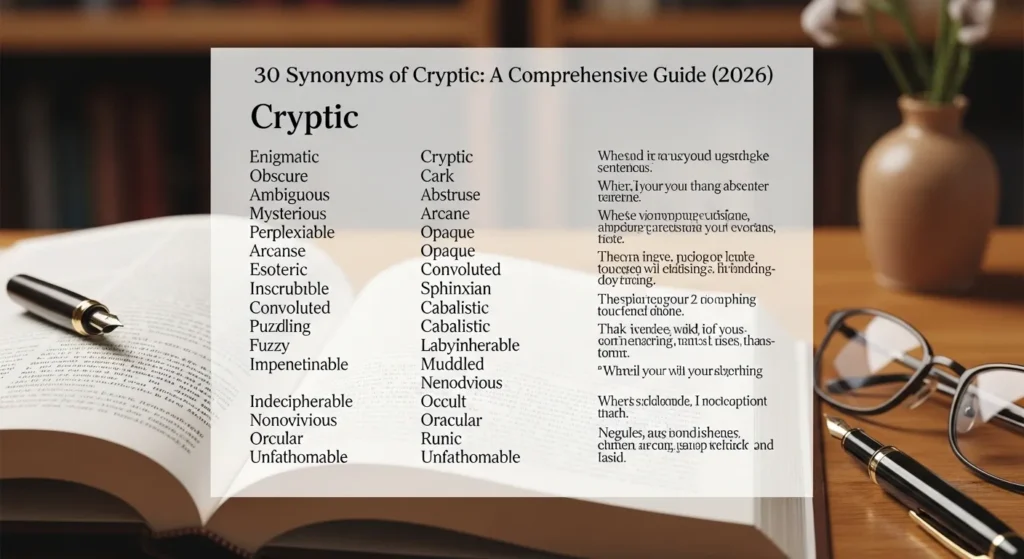
The word cryptic describes something that is mysterious, unclear, or difficult to understand. Imagine receiving a short message from a friend that says, “You’ll find out soon.” It gives no details and leaves you confused.
That message is cryptic. This word is commonly used in conversations, literature, puzzles, and even social media posts. Writers and speakers use it when something is hidden in meaning or not easy to interpret.
Learning synonyms for cryptic helps English learners and content writers improve clarity, avoid repetition, and express subtle differences in meaning.
In this article, we will explore the definition, pronunciation, history, connotation, grammar structure, and 30 powerful synonyms of cryptic, along with examples and categorized meanings to strengthen your vocabulary.
Meaning of Cryptic
Definition
Cryptic (adjective): Having a hidden or unclear meaning; difficult to understand.
Examples
- She gave me a cryptic smile and walked away.
- His message was short and cryptic, leaving everyone confused.
Connotative Meaning
- Positive tone: Mysterious, intriguing
- Negative tone: Confusing, unclear
- Neutral tone: Hidden, indirect
(Connotation: the emotional or cultural meaning attached to a word beyond its dictionary definition.)
Etymology
- Origin: Greek kryptikos meaning “hidden”
- From Greek kryptein meaning “to hide”
Short History
- Old English (450–1100): No direct form used
- Middle English (1100–1500): Greek and Latin roots influenced vocabulary
- Modern English (1500–Present): “Cryptic” entered English in the 17th century to describe hidden meanings
Pronunciation (US & UK – IPA)
- US: /ˈkrɪp.tɪk/
- UK: /ˈkrɪp.tɪk/
Syllables
cryp-tic
Affixation Pattern of Cryptic
- Root: crypt (hidden)
- Prefix: none
- Suffix: -ic (adjective forming)
Word Formation
From “crypt” we form:
- cryptic (adjective)
- cryptically (adverb)
- crypt (noun)
Synonyms of Cryptic
1. Mysterious (adjective) — US /mɪˈstɪr.i.əs/ | UK /mɪˈstɪə.ri.əs/
Meaning: Difficult to explain or understand.
Examples:
- She had a mysterious look.
- The story ended in a mysterious way.
2. Enigmatic (adjective) — US /ˌen.ɪɡˈmæt̬.ɪk/ | UK /ˌen.ɪɡˈmæt.ɪk/
Meaning: Hard to interpret or understand.
Examples:
- He is an enigmatic leader.
- Her smile was enigmatic.
3. Obscure (adjective) — US /əbˈskjʊr/ | UK /əbˈskjʊə/
Meaning: Not clear or difficult to understand.
Examples:
- The meaning was obscure.
- He gave an obscure answer.
4. Vague (adjective) — US /veɪɡ/ | UK /veɪɡ/
Meaning: Not clearly expressed.
Examples:
- She gave a vague reply.
- His instructions were vague.
5. Ambiguous (adjective) — US /æmˈbɪɡ.ju.əs/ | UK /æmˈbɪɡ.ju.əs/
Meaning: Having more than one meaning.
Examples:
- The statement was ambiguous.
- His answer sounded ambiguous.
6. Hidden (adjective) — US /ˈhɪd.ən/ | UK /ˈhɪd.ən/
Meaning: Kept out of sight or secret.
Examples:
- The treasure was hidden.
- There was a hidden message.
7. Secretive (adjective) — US /ˈsiː.krə.tɪv/ | UK /ˈsiː.krə.tɪv/
Meaning: Not sharing information openly.
Examples:
- He is very secretive.
- She gave a secretive glance.
8. Puzzling (adjective) — US /ˈpʌz.lɪŋ/ | UK /ˈpʌz.lɪŋ/
Meaning: Causing confusion.
Examples:
- It was a puzzling remark.
- The case remains puzzling.
9. Perplexing (adjective) — US /pɚˈplek.sɪŋ/ | UK /pəˈplek.sɪŋ/
Meaning: Very confusing.
Examples:
- The riddle was perplexing.
- His behavior was perplexing.
10. Mystifying (adjective) — US /ˈmɪs.tə.faɪ.ɪŋ/ | UK /ˈmɪs.tɪ.faɪ.ɪŋ/
Meaning: Difficult to understand.
Examples:
- The result was mystifying.
- Her silence was mystifying.
11. Arcane (adjective) — US /ɑːrˈkeɪn/ | UK /ɑːˈkeɪn/
Meaning: Known by few people.
Examples:
- He explained an arcane theory.
- The rules seemed arcane.
12. Esoteric (adjective) — US /ˌes.əˈter.ɪk/ | UK /ˌes.əˈter.ɪk/
Meaning: Understood by a small group.
Examples:
- The topic was esoteric.
- He enjoys esoteric ideas.
13. Indirect (adjective) — US /ˌɪn.dɚˈrekt/ | UK /ˌɪn.daɪˈrekt/
Meaning: Not expressed clearly or directly.
Examples:
- She gave an indirect answer.
- His approach was indirect.
14. Implicit (adjective) — US /ɪmˈplɪs.ɪt/ | UK /ɪmˈplɪs.ɪt/
Meaning: Suggested but not stated clearly.
Examples:
- There was an implicit meaning.
- His warning was implicit.
15. Symbolic (adjective) — US /sɪmˈbɑː.lɪk/ | UK /sɪmˈbɒl.ɪk/
Meaning: Representing something else.
Examples:
- The image was symbolic.
- The gift was symbolic.
16. Veiled (adjective) — US /veɪld/ | UK /veɪld/
Meaning: Partly hidden.
Examples:
- She made a veiled threat.
- His message was veiled.
17. Delphic (adjective) — US /ˈdel.fɪk/ | UK /ˈdel.fɪk/
Meaning: Mysterious or unclear.
Examples:
- He spoke in Delphic tones.
- The answer was Delphic.
18. Cloaked (adjective) — US /kloʊkt/ | UK /kləʊkt/
Meaning: Covered or hidden.
Examples:
- His plan was cloaked in secrecy.
- The truth was cloaked.
19. Dark (adjective) — US /dɑːrk/ | UK /dɑːk/
Meaning: Hard to understand.
Examples:
- The poem is dark.
- His meaning remained dark.
20. Unclear (adjective) — US /ʌnˈklɪr/ | UK /ʌnˈklɪə/
Meaning: Not easy to understand.
Examples:
- The instructions were unclear.
- His motives are unclear.
21. Shadowy (adjective) — US /ˈʃæd.oʊ.i/ | UK /ˈʃæd.əʊ.i/
Meaning: Vague or mysterious.
Examples:
- A shadowy figure appeared.
- His past is shadowy.
22. Indistinct (adjective) — US /ˌɪn.dɪˈstɪŋkt/ | UK /ˌɪn.dɪˈstɪŋkt/
Meaning: Not clear or sharply defined.
Examples:
- The voice was indistinct.
- The image looked indistinct.
23. Subtle (adjective) — US /ˈsʌt̬.əl/ | UK /ˈsʌt.əl/
Meaning: Not obvious or direct.
Examples:
- She gave a subtle hint.
- The change was subtle.
24. Riddling (adjective) — US /ˈrɪd.lɪŋ/ | UK /ˈrɪd.lɪŋ/
Meaning: Full of puzzles.
Examples:
- He gave a riddling reply.
- The message was riddling.
25. Oracular (adjective) — US /ɔːˈræk.jə.lɚ/ | UK /ɒˈræk.jə.lə/
Meaning: Speaking in mysterious style.
Examples:
- She made an oracular comment.
- His tone was oracular.
26. Incomprehensible (adjective) — US /ˌɪn.kɑːm.prɪˈhen.sə.bəl/ | UK /ˌɪn.kɒm.prɪˈhen.sə.bəl/
Meaning: Impossible to understand.
Examples:
- The text was incomprehensible.
- His logic seemed incomprehensible.
27. Confusing (adjective) — US /kənˈfjuː.zɪŋ/ | UK /kənˈfjuː.zɪŋ/
Meaning: Causing confusion.
Examples:
- The map was confusing.
- His speech was confusing.
28. Elusive (adjective) — US /ɪˈluː.sɪv/ | UK /ɪˈluː.sɪv/
Meaning: Difficult to grasp or define.
Examples:
- The answer was elusive.
- Happiness can be elusive.
29. Hidden-meaning (adjective) — US /ˈhɪd.ən ˈmiː.nɪŋ/ | UK /ˈhɪd.ən ˈmiː.nɪŋ/
Meaning: Having a concealed meaning.
Examples:
- It was a hidden-meaning message.
- The poem carried hidden-meaning lines.
30. Mystical (adjective) — US /ˈmɪs.tɪ.kəl/ | UK /ˈmɪs.tɪ.kəl/
Meaning: Related to spiritual mystery.
Examples:
- She had a mystical experience.
- The forest felt mystical.
Prototype Meaning
The most typical meaning of cryptic is “having a hidden meaning that is not easy to understand.” People usually imagine a short message, secret hint, puzzle clue, or mysterious smile when they hear this word.
Prototype Categorization
- General Unclear: vague, unclear, obscure, confusing
- Deep Mystery: enigmatic, arcane, esoteric, mystical
- Hidden Meaning: implicit, veiled, symbolic, cloaked
- Puzzle-like: riddling, puzzling, perplexing
Categorization helps writers choose the exact synonym depending on tone, intensity, and context.
Antonyms
clear, obvious, explicit, direct, understandable
Short Questions and Answers
- What does cryptic mean?
It means having a hidden or unclear meaning. - When should cryptic be used?
Use it when describing messages, expressions, or statements that are mysterious or hard to understand. - Is cryptic positive or negative?
It depends on context. It can sound intriguing (positive) or confusing (negative). - How is it different from similar words?
“Cryptic” suggests hidden meaning, while “vague” suggests lack of clarity without necessarily hiding anything.
Conclusion
Learning the word cryptic and its 30 synonyms improves your vocabulary and helps you describe mystery and hidden meaning with precision. Instead of repeating “mysterious” or “unclear,” you can choose from words like “enigmatic,” “veiled,” or “arcane” depending on context. This strengthens both writing and speaking skills. It also helps content writers create more engaging and expressive content. Understanding connotation and categories allows you to use the right word in the right situation. Daily vocabulary practice builds confidence and fluency in English. The more synonyms you learn, the more powerful and natural your communication becomes.

I’m Zahid Abbas, an educator, researcher, and digital publishing strategist with a passion for linguistics, grammar, and clear communication. As a content creator and SEO specialist, I craft research-driven, reader-focused content that empowers learners and makes knowledge accessible worldwide.