The word guise refers to an outward appearance that hides the true nature of someone or something. Imagine a person pretending to be kind, but secretly having selfish motives.
That false appearance is a guise. This word is often used in literature, formal writing, psychology, and everyday speech when describing deception, disguise, or hidden intentions. Learning synonyms for guise helps English learners and content writers express subtle meanings more clearly.
Instead of repeating the same word, you can choose alternatives that better match tone and context. In this article, we will explore the meaning of guise, its pronunciation, origin, connotation, grammar structure, and 30 powerful synonyms with examples.
This will strengthen your vocabulary and improve both writing and speaking skills.
Meaning of Guise
Definition
Guise (noun): An outward appearance or form that hides the true nature of something.
Examples
- He visited in the guise of a friend.
- The policy was introduced under the guise of reform.
Connotative Meaning
- Positive tone: Protective disguise, harmless cover
- Negative tone: Deception, false appearance
- Neutral tone: Form, outward style
Etymology
- Origin: Old French guise, meaning “manner” or “fashion”
- Related to Germanic roots meaning “way” or “style”
Short History
- Old English (450–1100): No direct form used
- Middle English (1100–1500): Borrowed from Old French
- Modern English (1500–Present): Used mainly in formal contexts to describe hidden intentions
Pronunciation (US & UK – IPA)
- US: /ɡaɪz/
- UK: /ɡaɪz/
Syllables
guise (one syllable)
Affixation Pattern of Guise
- Root: guise
- Prefix: none
- Suffix: none
Word Formation
- guise (noun)
- Rare derivative: disguise (verb/noun)
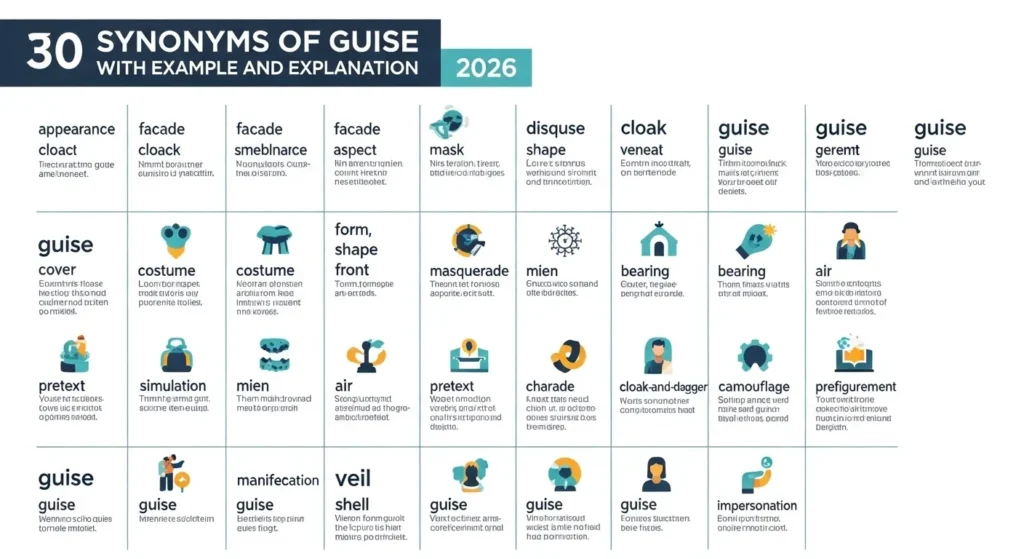
Synonyms of Guise
1. Disguise (noun) — US /dɪsˈɡaɪz/ | UK /dɪsˈɡaɪz/
Meaning: A false appearance to hide identity.
Examples:
- He wore a disguise to avoid attention.
- The truth was hidden under a disguise.
2. Pretense (noun) — US /ˈpriː.tens/ | UK /prɪˈtens/
Meaning: A false claim or appearance.
Examples:
- She left under the pretense of illness.
- His kindness was only a pretense.
3. Pretence (noun) — US /ˈpriː.tens/ | UK /prɪˈtens/
Meaning: British spelling of pretense.
Examples:
- It was done under false pretence.
- His smile was a pretence.
4. Cover (noun) — US /ˈkʌv.ɚ/ | UK /ˈkʌv.ə/
Meaning: Something that hides the real truth.
Examples:
- The trip was a cover for secret talks.
- He used humor as a cover.
5. Mask (noun) — US /mæsk/ | UK /mɑːsk/
Meaning: Something that conceals identity.
Examples:
- She wore a mask of confidence.
- His anger hid behind a polite mask.
6. Facade (noun) — US /fəˈsɑːd/ | UK /fəˈsɑːd/
Meaning: A deceptive outward appearance.
Examples:
- He maintained a calm facade.
- The company’s success was a facade.
7. Cloak (noun) — US /kloʊk/ | UK /kləʊk/
Meaning: Something that hides true intentions.
Examples:
- The decision was a cloak for profit.
- She used silence as a cloak.
8. Front (noun) — US /frʌnt/ | UK /frʌnt/
Meaning: A false appearance hiding real purpose.
Examples:
- The shop was a front for illegal trade.
- His confidence was just a front.
9. Appearance (noun) — US /əˈpɪr.əns/ | UK /əˈpɪə.rəns/
Meaning: Outward look or form.
Examples:
- Appearances can be misleading.
- His calm appearance fooled everyone.
10. Form (noun) — US /fɔːrm/ | UK /fɔːm/
Meaning: Shape or outward expression.
Examples:
- The idea took a new form.
- It came in the form of a warning.
11. Camouflage (noun) — US /ˈkæm.ə.flɑːʒ/ | UK /ˈkæm.ə.flɑːʒ/
Meaning: Concealment by blending in.
Examples:
- The animal used camouflage.
- Lies served as emotional camouflage.
12. Screen (noun) — US /skriːn/ | UK /skriːn/
Meaning: Something that hides truth.
Examples:
- His laughter was a screen.
- The event was a screen for politics.
13. Veil (noun) — US /veɪl/ | UK /veɪl/
Meaning: Something that conceals.
Examples:
- A veil of secrecy covered the plan.
- She spoke behind a veil of politeness.
14. Costume (noun) — US /ˈkɑː.stuːm/ | UK /ˈkɒs.tjuːm/
Meaning: Clothing used to hide identity.
Examples:
- He wore a pirate costume.
- Her kindness felt like a costume.
15. Persona (noun) — US /pɚˈsoʊ.nə/ | UK /pəˈsəʊ.nə/
Meaning: A public identity different from real self.
Examples:
- He created a strong public persona.
- Her online persona differs from reality.
16. Guise (noun) — US /ɡaɪz/ | UK /ɡaɪz/
Meaning: Outward form hiding truth.
Examples:
- He acted in the guise of a helper.
- The idea came in another guise.
17. Shell (noun) — US /ʃel/ | UK /ʃel/
Meaning: Outer covering hiding inner truth.
Examples:
- His confidence was just a shell.
- The house was an empty shell.
18. Dissemblance (noun) — US /dɪˈsem.bləns/ | UK /dɪˈsem.bləns/
Meaning: Concealment of real feelings.
Examples:
- She used dissemblance to hide fear.
- His calm tone was pure dissemblance.
19. Simulation (noun) — US /ˌsɪm.jəˈleɪ.ʃən/ | UK /ˌsɪm.jʊˈleɪ.ʃən/
Meaning: Imitation of something real.
Examples:
- The smile was a simulation.
- It was only a simulation of kindness.
20. Act (noun) — US /ækt/ | UK /ækt/
Meaning: Pretended behavior.
Examples:
- His anger was an act.
- She dropped the polite act.
21. Impression (noun) — US /ɪmˈpreʃ.ən/ | UK /ɪmˈpreʃ.ən/
Meaning: Effect or appearance given to others.
Examples:
- He gave the wrong impression.
- Her calmness was only an impression.
22. Profile (noun) — US /ˈproʊ.faɪl/ | UK /ˈprəʊ.faɪl/
Meaning: Public image or identity.
Examples:
- He kept a low profile.
- The company improved its public profile.
23. Disguise form (noun) — US /dɪsˈɡaɪz fɔːrm/ | UK /dɪsˈɡaɪz fɔːm/
Meaning: Hidden outward structure.
Examples:
- The charity was a disguise form.
- It came in a disguise form.
24. Concealment (noun) — US /kənˈsiːl.mənt/ | UK /kənˈsiːl.mənt/
Meaning: The act of hiding something.
Examples:
- There was deliberate concealment.
- His silence showed concealment.
25. Pretext (noun) — US /ˈpriː.tekst/ | UK /ˈpriː.tekst/
Meaning: A false reason given to hide truth.
Examples:
- He used illness as a pretext.
- It was just a pretext to leave.
26. Guise-like form (noun) — US /ɡaɪz laɪk fɔːrm/ | UK /ɡaɪz laɪk fɔːm/
Meaning: Something appearing in hidden style.
Examples:
- It appeared in a guise-like form.
- The truth came in guise-like form.
27. Shadow (noun) — US /ˈʃæd.oʊ/ | UK /ˈʃæd.əʊ/
Meaning: A faint or deceptive form.
Examples:
- His past was a shadow.
- She lived under a shadow of doubt.
28. Role (noun) — US /roʊl/ | UK /rəʊl/
Meaning: A part someone plays.
Examples:
- He played the role of hero.
- She stepped into a new role.
29. Exterior (noun) — US /ɪkˈstɪr.i.ɚ/ | UK /ɪkˈstɪə.ri.ə/
Meaning: Outer surface or appearance.
Examples:
- His tough exterior hides kindness.
- The building’s exterior was modern.
30. Outward show (noun) — US /ˈaʊt.wɚd ʃoʊ/ | UK /ˈaʊt.wəd ʃəʊ/
Meaning: External display hiding truth.
Examples:
- It was only an outward show.
- Her smile was an outward show.
Prototype Meaning
The most typical meaning of guise is an outward appearance used to hide true intentions. When people hear this word, they usually imagine deception, hidden motives, or a false identity presented to others.
Prototype Categorization
- Direct deception: disguise, pretense, facade, pretext
- Protective hiding: camouflage, veil, cloak
- Public identity: persona, profile, role
- General appearance: form, exterior, appearance
Categorization helps writers choose the exact synonym depending on whether the situation is formal, deceptive, neutral, or dramatic.
Antonyms
reality, truth, honesty, authenticity, openness
Short Questions and Answers
- What does guise mean?
It means an outward appearance that hides the true nature of something. - When should guise be used?
Use it when describing hidden intentions or deceptive appearances. - Is guise positive or negative?
It is usually neutral but often has a negative tone because it suggests deception. - How is it different from similar words?
“Guise” is more formal than “mask” or “cover” and often suggests hidden motive rather than physical disguise.
Conclusion
Learning the word guise and its 30 synonyms improves vocabulary and helps you describe deception, appearance, and hidden intentions with precision. Instead of repeating simple words like “mask” or “cover,” you can use stronger alternatives like “facade,” “pretext,” or “persona.” This strengthens writing, improves clarity, and adds depth to communication. Understanding tone and context allows you to choose the perfect word for each situation. Regular vocabulary practice builds English confidence and fluency. The more synonyms you learn, the more expressive and powerful your language becomes.

I’m Zahid Abbas, an educator, researcher, and digital publishing strategist with a passion for linguistics, grammar, and clear communication. As a content creator and SEO specialist, I craft research-driven, reader-focused content that empowers learners and makes knowledge accessible worldwide.