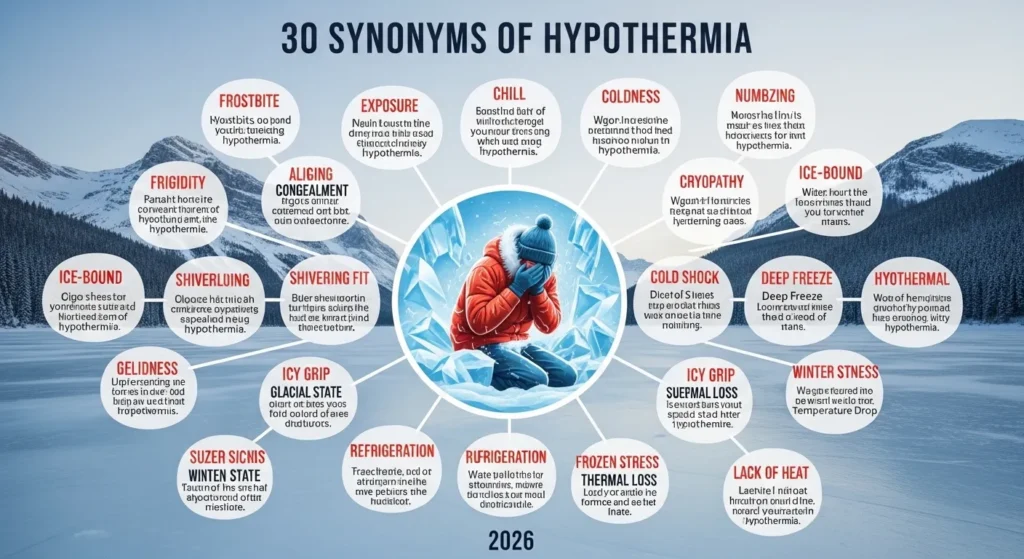
Hypothermia means a dangerous drop in body temperature. Imagine a man lost in snow during winter. He feels very cold. He starts to shake. His speech becomes slow. His body temperature falls too low. This is hypothermia.
The word is common in medical news, survival stories, and winter safety guides. English learners often see it in health topics. Writers also use it in reports and articles.
Learning synonyms helps you avoid repeating the same word. It also improves your writing skills. In this article, you will learn the meaning of hypothermia, its synonyms, pronunciation, grammar, tone, history, and categories. Everything is explained in simple English with clear examples.
Meaning of Hypothermia
Definition
Hypothermia (noun): A medical condition where the body temperature drops below normal because of cold exposure.
Examples
- The climber was treated for hypothermia after the storm.
- Long exposure to icy water can cause hypothermia.
Connotative Meaning
(Connotation means the emotional feeling connected to a word.)
- Positive tone: None (It is a medical emergency.)
- Negative tone: Yes, it suggests danger and illness.
- Neutral tone: In medical writing, it is neutral and factual.
Etymology
- From Greek hypo meaning “under”
- From Greek therme meaning “heat”
- Combined meaning: “under heat”
Short History
- Old English (450–1100): Word not used.
- Middle English (1100–1500): Term did not exist.
- Modern English (1500–Present): First used in medical science in the 19th century.
Pronunciation (US & UK – IPA)
- US: /ˌhaɪpəˈθɝːmiə/
- UK: /ˌhaɪpəˈθɜːmiə/
Syllables
hy-po-ther-mi-a
Affixation Pattern of Hypothermia
- Root: therm (heat)
- Prefix: hypo- (under, below)
- Suffix: -ia (condition)
Word Formation
Words formed from therm root include:
- thermal (adjective)
- thermometer (noun)
- thermostat (noun)
- thermodynamic (adjective)
- thermally (adverb)
Synonyms of Hypothermia
1. Cold Exposure (noun) — US /koʊld ɪkˈspoʊʒər/ | UK /kəʊld ɪkˈspəʊʒə/
Meaning: Being exposed to very cold conditions.
Examples:
- Cold exposure can be life-threatening.
- The hikers suffered from cold exposure.
2. Freezing Condition (noun) — US /ˈfriːzɪŋ kənˈdɪʃən/ | UK /ˈfriːzɪŋ kənˈdɪʃən/
Meaning: A state of extreme cold.
Examples:
- The victim was found in freezing condition.
- Freezing condition affects body organs.
3. Low Body Temperature (noun) — US /loʊ ˈbɑːdi ˈtɛmprətʃər/ | UK /ləʊ ˈbɒdi ˈtemprətʃə/
Meaning: Body temperature below normal.
Examples:
- Low body temperature is dangerous.
- Doctors treated her low body temperature quickly.
4. Frostbite (noun) — US /ˈfrɔːstbaɪt/ | UK /ˈfrɒstbaɪt/
Meaning: Skin damage from extreme cold.
Examples:
- He developed frostbite on his fingers.
- Frostbite often comes with hypothermia.
5. Chill (noun) — US /tʃɪl/ | UK /tʃɪl/
Meaning: A cold feeling in the body.
Examples:
- She felt a deep chill.
- The night air gave him a chill.
6. Severe Cold (noun) — US /sɪˈvɪr koʊld/ | UK /sɪˈvɪə kəʊld/
Meaning: Very intense cold weather.
Examples:
- Severe cold can harm the old people.
- The region faced severe cold.
7. Cold Stress (noun) — US /koʊld strɛs/ | UK /kəʊld stres/
Meaning: Physical stress from cold.
Examples:
- Workers experienced cold stress.
- Cold stress affects health.
8. Exposure Syndrome (noun) — US /ɪkˈspoʊʒər ˈsɪndroʊm/ | UK /ɪkˈspəʊʒə ˈsɪndrəʊm/
Meaning: Illness from harsh weather exposure.
Examples:
- The patient had exposure syndrome.
- Exposure syndrome needs medical care.
9. Subnormal Temperature (noun) — US /sʌbˈnɔːrməl ˈtɛmprətʃər/ | UK /sʌbˈnɔːməl ˈtemprətʃə/
Meaning: Temperature lower than normal.
Examples:
- Subnormal temperature is alarming.
- The nurse recorded subnormal temperature.
10. Thermal Collapse (noun) — US /ˈθɝːməl kəˈlæps/ | UK /ˈθɜːməl kəˈlæps/
Meaning: Body shutdown from cold.
Examples:
- Thermal collapse can be fatal.
- The rescue team prevented thermal collapse.
11. Freezing Illness (noun) — US /ˈfriːzɪŋ ˈɪlnəs/ | UK /ˈfriːzɪŋ ˈɪlnəs/
Meaning: Illness caused by extreme cold.
Examples:
- Freezing illness requires urgent care.
- Many mountaineers fear freezing illness.
12. Cold Injury (noun) — US /koʊld ˈɪndʒəri/ | UK /kəʊld ˈɪndʒəri/
Meaning: Damage from cold exposure.
Examples:
- Cold injury affects tissues.
- The soldier suffered cold injury.
13. Cryopathy (noun) — US /kraɪˈɑːpəθi/ | UK /kraɪˈɒpəθi/
Meaning: Disease caused by cold.
Examples:
- Cryopathy is rare.
- Severe weather increases cryopathy cases.
14. Cold Trauma (noun) — US /koʊld ˈtrɔːmə/ | UK /kəʊld ˈtrɔːmə/
Meaning: Shock from extreme cold.
Examples:
- Cold trauma affects the heart.
- Climbers risk cold trauma.
15. Arctic Exposure (noun) — US /ˈɑːrktɪk ɪkˈspoʊʒər/ | UK /ˈɑːktɪk ɪkˈspəʊʒə/
Meaning: Exposure to freezing arctic conditions.
Examples:
- Arctic exposure is dangerous.
- The team survived arctic exposure.
16. Body Cooling (noun) — US /ˈbɑːdi ˈkuːlɪŋ/ | UK /ˈbɒdi ˈkuːlɪŋ/
Meaning: Loss of body heat.
Examples:
- Body cooling can be fatal.
- Doctors monitor body cooling carefully.
17. Icy Shock (noun) — US /ˈaɪsi ʃɑːk/ | UK /ˈaɪsi ʃɒk/
Meaning: Shock from icy temperature.
Examples:
- Icy shock affects breathing.
- Swimmers may face icy shock.
18. Chill Shock (noun) — US /tʃɪl ʃɑːk/ | UK /tʃɪl ʃɒk/
Meaning: Sudden reaction to cold water.
Examples:
- Chill shock can stop breathing.
- Divers fear chill shock.
19. Hypothermic State (noun) — US /ˌhaɪpəˈθɝːmɪk steɪt/ | UK /ˌhaɪpəˈθɜːmɪk steɪt/
Meaning: Condition of having hypothermia.
Examples:
- The patient was in a hypothermic state.
- Immediate help is needed in hypothermic state.
20. Extreme Chill (noun) — US /ɪkˈstriːm tʃɪl/ | UK /ɪkˈstriːm tʃɪl/
Meaning: Very intense cold.
Examples:
- Extreme chill affects survival.
- The cave had extreme chill.
21. Ice Exposure (noun) — US /aɪs ɪkˈspoʊʒər/ | UK /aɪs ɪkˈspəʊʒə/
Meaning: Contact with icy surroundings.
Examples:
- Ice exposure led to illness.
- Long ice exposure is risky.
22. Cold Collapse (noun) — US /koʊld kəˈlæps/ | UK /kəʊld kəˈlæps/
Meaning: Fainting due to cold.
Examples:
- Cold collapse is serious.
- The runner suffered cold collapse.
23. Thermal Shock (noun) — US /ˈθɝːməl ʃɑːk/ | UK /ˈθɜːməl ʃɒk/
Meaning: Sudden change in temperature affecting the body.
Examples:
- Thermal shock damages tissues.
- Sudden ice baths cause thermal shock.
24. Deep Chill (noun) — US /diːp tʃɪl/ | UK /diːp tʃɪl/
Meaning: Strong internal cold feeling.
Examples:
- A deep chill ran through him.
- She felt deep chill in winter.
25. Cold-Induced Condition (noun) — US /koʊld ɪnˈduːst kənˈdɪʃən/ | UK /kəʊld ɪnˈdjuːst kənˈdɪʃən/
Meaning: Condition caused by cold.
Examples:
- Hypothermia is a cold-induced condition.
- Cold-induced condition needs treatment.
26. Cryogenic Exposure (noun) — US /ˌkraɪəˈdʒɛnɪk ɪkˈspoʊʒər/ | UK /ˌkraɪəˈdʒenɪk ɪkˈspəʊʒə/
Meaning: Exposure to extremely low temperatures.
Examples:
- Cryogenic exposure is rare.
- Scientists study cryogenic exposure.
27. Cold Distress (noun) — US /koʊld dɪˈstrɛs/ | UK /kəʊld dɪˈstres/
Meaning: Suffering from cold.
Examples:
- The child showed cold distress.
- Cold distress affects survival.
28. Subzero Condition (noun) — US /sʌbˈzɪroʊ kənˈdɪʃən/ | UK /sʌbˈzɪərəʊ kənˈdɪʃən/
Meaning: Condition below zero temperature.
Examples:
- Subzero condition is harmful.
- They survived subzero condition.
29. Cold Impairment (noun) — US /koʊld ɪmˈpɛrmənt/ | UK /kəʊld ɪmˈpeəmənt/
Meaning: Reduced body function from cold.
Examples:
- Cold impairment affects memory.
- Workers faced cold impairment.
30. Hypothermal Condition (noun) — US /ˌhaɪpəˈθɝːməl kənˈdɪʃən/ | UK /ˌhaɪpəˈθɜːməl kənˈdɪʃən/
Meaning: Condition of low body heat.
Examples:
- The doctor diagnosed hypothermal condition.
- Hypothermal condition needs warmth.
Prototype Meaning
When people hear hypothermia, they imagine a person lost in snow, shaking, weak, and in danger. It usually connects with winter, mountains, cold water, and medical emergency.
Prototype Categorization
Synonyms can be grouped into:
- Medical terms: hypothermic state, cryopathy, thermal shock
- Weather-related: severe cold, arctic exposure, subzero condition
- General cold terms: chill, deep chill, extreme chill
- Injury terms: frostbite, cold injury, cold trauma
Categorization helps writers choose the correct word. A doctor may use “hypothermic state,” but a storyteller may use “deep chill.”
Antonyms of Hypothermia
- Hyperthermia
- Overheating
- Heatstroke
- Warmth
Short Questions and Answers
- What does hypothermia mean?
It means dangerously low body temperature. - When should hypothermia be used?
Use it in medical, health, and cold weather situations. - Is hypothermia positive or negative?
It is negative because it describes danger. - How is it different from similar words?
Hypothermia is a full medical condition, while “chill” is mild cold feeling.
CONCLUSION
Learning the word hypothermia and its synonyms improves your vocabulary. It helps you understand medical texts and winter safety topics. It also makes your writing stronger and clearer. When you know many synonyms, you avoid repetition. You can choose the best word for each situation. This builds confidence in speaking and writing English. Practice one new word daily. Use it in sentences. Soon, your vocabulary will grow naturally.

I’m Zahid Abbas, an educator, researcher, and digital publishing strategist with a passion for linguistics, grammar, and clear communication. As a content creator and SEO specialist, I craft research-driven, reader-focused content that empowers learners and makes knowledge accessible worldwide.