Insignia means a badge, symbol, or sign that shows rank, group, or authority. Imagine a police officer wearing a badge on the uniform. That badge is an insignia. It tells people about the officer’s role and power. Schools, armies, clubs, and companies often use insignia.
This word is common in books, history lessons, and official speech. Learning synonyms of insignia helps English learners understand news, uniforms, logos, and symbols better. It also helps writers avoid repeating the same word again and again. In this article, you will learn the meaning of insignia, its examples, tone, origin, pronunciation, grammar, and 30 useful synonyms. Everything is explained in simple English with clear examples and helpful word groups.
Meaning of Insignia
Definition
Insignia (Noun):
A badge, mark, or symbol that shows rank, membership, or authority.
Examples
The soldier wore his insignia with pride.
The school insignia was printed on every uniform.
Connotative Meaning
- Positive tone: Honor, pride, authority.
- Negative tone: Power control, strict rule (in some contexts).
- Neutral tone: Official symbol or mark.
(Connotation means the emotional feeling or idea connected to a word.)
Etymology
- From Latin insignia, meaning “marks” or “signs.”
- Related to the word signum, meaning “sign.”
Short History:
- Old English (450–1100): Similar ideas existed, but the word was not used.
- Middle English (1100–1500): Borrowed from Latin through French.
- Modern English (1500–Present): Used for military, royal, and official symbols.
Pronunciation (US & UK – IPA)
US: /ɪnˈsɪɡniə/
UK: /ɪnˈsɪɡniə/
Syllables
in-sig-ni-a
Affixation Pattern of Insignia
- Root: sign (from Latin signum)
- Prefix: in-
- Suffix: -ia
Word Formation
- insignial (adjective – rare)
- insignificant (adjective – different meaning)
- sign (noun/verb – related root)
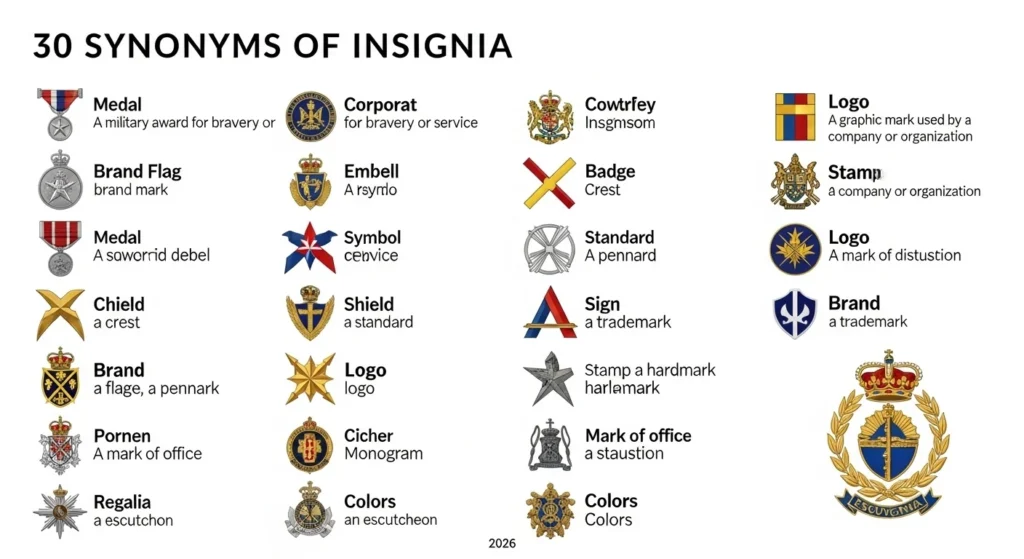
Synonyms of Insignia
1. Badge (Noun) — US /bædʒ/ | UK /bædʒ/
Meaning: A small symbol worn to show rank or group.
Examples:
She wore a police badge.
The badge showed his name.
2. Emblem (Noun) — US /ˈembləm/ | UK /ˈembləm/
Meaning: A symbol that represents an idea or group.
Examples:
The lion is an emblem of strength.
The school emblem is on the gate.
3. Symbol (Noun) — US /ˈsɪmbəl/ | UK /ˈsɪmbəl/
Meaning: A sign that stands for something.
Examples:
The dove is a symbol of peace.
The logo is a company symbol.
4. Logo (Noun) — US /ˈloʊɡoʊ/ | UK /ˈləʊɡəʊ/
Meaning: A design that represents a company.
Examples:
The logo is simple and clean.
I like the new logo.
5. Crest (Noun) — US /krest/ | UK /krest/
Meaning: A special design on a shield or badge.
Examples:
The family crest is old.
The crest shows a lion.
6. Seal (Noun) — US /siːl/ | UK /siːl/
Meaning: An official mark or stamp.
Examples:
The letter had a royal seal.
The seal showed authority.
7. Mark (Noun) — US /mɑːrk/ | UK /mɑːk/
Meaning: A visible sign.
Examples:
The uniform had a mark of rank.
That mark means quality.
8. Token (Noun) — US /ˈtoʊkən/ | UK /ˈtəʊkən/
Meaning: A sign of something.
Examples:
The medal is a token of honor.
She gave a token gift.
9. Standard (Noun) — US /ˈstændərd/ | UK /ˈstændəd/
Meaning: A flag or symbol of a group.
Examples:
The army carried its standard.
The standard waved high.
10. Flag (Noun) — US /flæɡ/ | UK /flæɡ/
Meaning: A piece of cloth symbolizing a country or group.
Examples:
The flag shows national pride.
They raised the flag.
11. Banner (Noun) — US /ˈbænər/ | UK /ˈbænə/
Meaning: A long sign or flag.
Examples:
The banner showed the team name.
They carried a banner.
12. Device (Noun) — US /dɪˈvaɪs/ | UK /dɪˈvaɪs/
Meaning: A design used as a symbol.
Examples:
The shield had a royal device.
The device showed power.
13. Inscription (Noun) — US /ɪnˈskrɪpʃən/ | UK /ɪnˈskrɪpʃən/
Meaning: Words written on an object.
Examples:
The ring had an inscription.
The stone carried an inscription.
14. Medal (Noun) — US /ˈmedl/ | UK /ˈmedl/
Meaning: A metal award sign of honor.
Examples:
He won a gold medal.
The medal showed bravery.
15. Decoration (Noun) — US /ˌdekəˈreɪʃən/ | UK /ˌdekəˈreɪʃən/
Meaning: An award or honor symbol.
Examples:
He received a military decoration.
The decoration showed courage.
16. Coat of Arms (Noun) — US /ˌkoʊt əv ˈɑːrmz/ | UK /ˌkəʊt əv ˈɑːmz/
Meaning: A family or state symbol on a shield.
Examples:
The castle showed a coat of arms.
Each family had its coat of arms.
17. Patch (Noun) — US /pætʃ/ | UK /pætʃ/
Meaning: A cloth badge on clothing.
Examples:
The scout wore a patch.
The patch showed rank.
18. Identifier (Noun) — US /aɪˈdentɪfaɪər/ | UK /aɪˈdentɪfaɪə/
Meaning: Something that shows identity.
Examples:
The number is an identifier.
The badge acts as an identifier.
19. Trademark (Noun) — US /ˈtreɪdmɑːrk/ | UK /ˈtreɪdmɑːk/
Meaning: A legally protected symbol.
Examples:
The brand has a trademark.
That design is a trademark.
20. Sign (Noun) — US /saɪn/ | UK /saɪn/
Meaning: A visible symbol.
Examples:
The sign showed danger.
The crown is a sign of royalty.
21. Monogram (Noun) — US /ˈmɑːnəɡræm/ | UK /ˈmɒnəɡræm/
Meaning: A design of letters as a symbol.
Examples:
The towel had a monogram.
Her bag shows her monogram.
22. Label (Noun) — US /ˈleɪbəl/ | UK /ˈleɪbəl/
Meaning: A tag showing name or brand.
Examples:
The label shows the brand.
Check the label carefully.
23. Tag (Noun) — US /tæɡ/ | UK /tæɡ/
Meaning: A small piece showing information.
Examples:
The tag shows the price.
The dog wore a name tag.
24. Symbolism (Noun) — US /ˈsɪmbəˌlɪzəm/ | UK /ˈsɪmbəlɪzəm/
Meaning: The use of symbols.
Examples:
The art shows deep symbolism.
Symbolism adds meaning.
25. Hallmark (Noun) — US /ˈhɔːlmɑːrk/ | UK /ˈhɔːlmɑːk/
Meaning: A special mark of quality.
Examples:
Quality is the hallmark of the brand.
The ring has a hallmark.
26. Stamp (Noun) — US /stæmp/ | UK /stæmp/
Meaning: An official mark.
Examples:
The paper had a stamp.
The stamp showed approval.
27. Cipher (Noun) — US /ˈsaɪfər/ | UK /ˈsaɪfə/
Meaning: A coded symbol.
Examples:
The king used a cipher.
The coin showed a cipher.
28. Sigil (Noun) — US /ˈsɪdʒɪl/ | UK /ˈsɪdʒɪl/
Meaning: A magical or special symbol.
Examples:
The book had a strange sigil.
The sigil meant power.
29. Badge of Office (Noun) — US /bædʒ əv ˈɔːfɪs/ | UK /bædʒ əv ˈɒfɪs/
Meaning: A symbol showing official position.
Examples:
The mayor wore a badge of office.
It showed authority.
30. Identification Mark (Noun) — US /aɪˌdentɪfɪˈkeɪʃən mɑːrk/ | UK /aɪˌdentɪfɪˈkeɪʃən mɑːk/
Meaning: A sign that shows identity.
Examples:
The car has an identification mark.
The animal carried a mark.
Prototype Meaning
When people hear insignia, they usually imagine a badge on a uniform or a royal symbol on a shield. It suggests authority, rank, and official identity.
Prototype Categorization
- Military and Rank: badge, medal, decoration, patch
- National Symbols: flag, banner, standard
- Brand Identity: logo, trademark, label
- Family and Royal Signs: crest, coat of arms, seal
Categorization helps writers choose the right synonym. For business, use logo. For army context, use medal or badge.
Antonyms of Insignia
Plainness, anonymity, lack of symbol, unmarked object.
Short Questions and Answers
- What does insignia mean?
It means a symbol showing rank or identity. - When should insignia be used?
Use it for official badges, emblems, and symbols. - Is insignia positive or negative?
It is mostly positive or neutral. - How is it different from similar words?
Insignia shows rank or authority, while logo mainly represents a company.
CONCLUSION
Learning the word insignia and its synonyms improves vocabulary. It helps you understand uniforms, brands, history, and official symbols. It also strengthens writing and speaking skills by avoiding repetition.When you know many related words, you can choose the most accurate term for each situation. This builds confidence in English. Practice using new words daily. Step by step, your vocabulary will grow stronger and clearer.

I’m Zahid Abbas, an educator, researcher, and digital publishing strategist with a passion for linguistics, grammar, and clear communication. As a content creator and SEO specialist, I craft research-driven, reader-focused content that empowers learners and makes knowledge accessible worldwide.