Snitch means a person who secretly tells information about someone’s wrongdoing, usually to an authority. Imagine a student who sees his friend cheating in an exam.
Later, he quietly informs the teacher. Soon, everyone calls him a “snitch.” The word is common in schools, offices, streets, and even movies.
People use this word often in informal English. It usually carries a negative feeling. Learning synonyms of snitch is important for English learners and writers. It helps you avoid repeating the same word. It also helps you choose the right tone.
In this article, you will learn the meaning of snitch, its synonyms, pronunciation, grammar, history, and usage. Everything is explained in clear and simple English.
Meaning of Snitch
Definition
Snitch (noun / verb):
A person who secretly informs on someone; to secretly report someone’s wrongdoing.
Examples
He was called a snitch after he told the police about the theft.
She decided to snitch on her coworker for breaking company rules.
Connotative Meaning
(Connotation means the emotional feeling or idea connected to a word beyond its basic meaning.)
- Positive tone: Rarely positive; may be seen as brave in some contexts.
- Negative tone: Often negative; suggests betrayal or disloyalty.
- Neutral tone: Can be neutral in legal or formal reporting situations.
Etymology
- Origin: 18th century British slang
- Possibly from the word “snitch” meaning “nose,” suggesting someone who pokes into others’ business
Short History
- Old English (450–1100): Word did not exist.
- Middle English (1100–1500): No recorded use.
- Modern English (1500–Present): Appeared in British slang in the 1700s, later common in American English.
Pronunciation (US & UK – IPA)
US: /snɪtʃ/
UK: /snɪtʃ/
Syllables
snitch
Affixation Pattern of Snitch
- Root: snitch
- Prefix: None
- Suffix: None
Word Formation
- Snitch (noun)
- Snitch (verb)
- Snitching (gerund/noun)
- Snitched (verb, past tense)
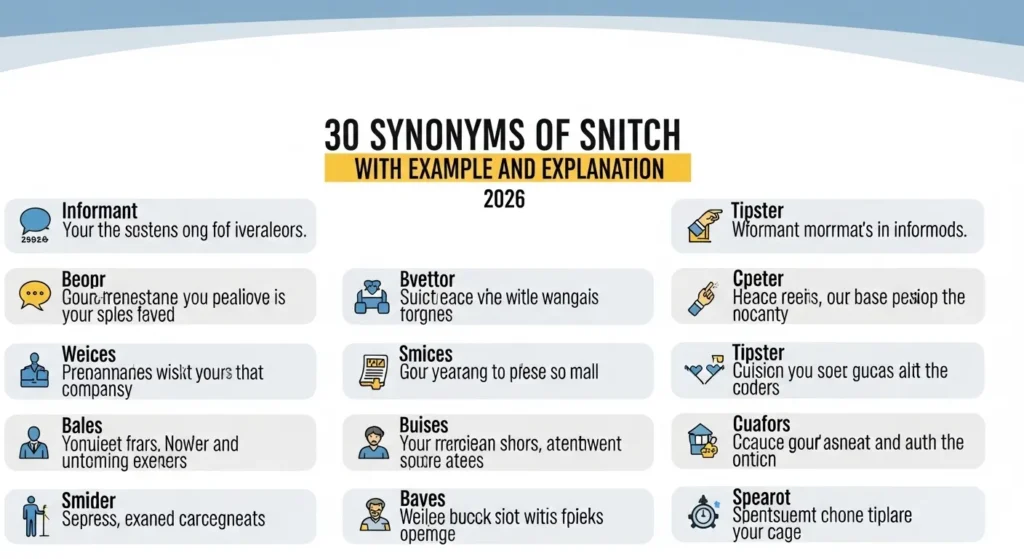
Synonyms of Snitch
1. Informer (noun) — US /ɪnˈfɔːrmər/ | UK /ɪnˈfɔːmə/
Meaning: A person who gives information secretly.
Examples:
He acted as an informer for the police.
The informer stayed anonymous.
2. Tattletale (noun) — US /ˈtætəlteɪl/ | UK /ˈtætəlteɪl/
Meaning: A person who reports others’ small wrong actions.
Examples:
Stop being a tattletale.
Children dislike a tattletale.
3. Rat (noun) — US /ræt/ | UK /ræt/
Meaning: Slang for a traitor who informs.
Examples:
They called him a rat.
Nobody trusts a rat.
4. Stool pigeon (noun) — US /ˈstuːl pɪdʒɪn/ | UK /ˈstuːl pɪdʒɪn/
Meaning: A person who secretly informs for police.
Examples:
The thief was a stool pigeon.
The gang suspected a stool pigeon.
5. Betrayer (noun) — US /bɪˈtreɪər/ | UK /bɪˈtreɪə/
Meaning: Someone who breaks trust.
Examples:
He felt hurt by the betrayer.
A betrayer loses friends.
6. Whistleblower (noun) — US /ˈwɪsəlbloʊər/ | UK /ˈwɪsəlbləʊə/
Meaning: A person who reports illegal acts publicly.
Examples:
The whistleblower exposed corruption.
She became a whistleblower.
7. Informant (noun) — US /ɪnˈfɔːrmənt/ | UK /ɪnˈfɔːmənt/
Meaning: A person who supplies information.
Examples:
The police trusted the informant.
The informant gave details.
8. Squealer (noun) — US /ˈskwiːlər/ | UK /ˈskwiːlə/
Meaning: Someone who reveals secrets.
Examples:
Don’t be a squealer.
He became the squealer.
9. Tell-tale (noun) — US /ˈtelteɪl/ | UK /ˈtelteɪl/
Meaning: One who tells secrets.
Examples:
The tell-tale was punished.
Nobody liked the tell-tale.
10. Spy (noun) — US /spaɪ/ | UK /spaɪ/
Meaning: A person who secretly collects information.
Examples:
The spy worked undercover.
He acted like a spy.
11. Traitor (noun) — US /ˈtreɪtər/ | UK /ˈtreɪtə/
Meaning: A person who betrays trust or country.
Examples:
The traitor was punished.
He was called a traitor.
12. Leaker (noun) — US /ˈliːkər/ | UK /ˈliːkə/
Meaning: Someone who reveals secret information.
Examples:
The leaker shared documents.
They searched for the leaker.
13. Narc (noun) — US /nɑːrk/ | UK /nɑːk/
Meaning: Informal term for a police informer.
Examples:
He was a narc.
Nobody trusted the narc.
14. Backstabber (noun) — US /ˈbækstæbər/ | UK /ˈbækstæbə/
Meaning: A person who betrays secretly.
Examples:
She felt betrayed by the backstabber.
A backstabber hurts trust.
15. Accuser (noun) — US /əˈkjuːzər/ | UK /əˈkjuːzə/
Meaning: Someone who blames another.
Examples:
The accuser spoke loudly.
The accuser gave proof.
16. Reporter (noun) — US /rɪˈpɔːrtər/ | UK /rɪˈpɔːtə/
Meaning: A person who reports information.
Examples:
The reporter shared the news.
She acted as a reporter.
17. Witness (noun) — US /ˈwɪtnəs/ | UK /ˈwɪtnəs/
Meaning: A person who sees and reports an event.
Examples:
The witness told the truth.
The witness spoke in court.
18. Eavesdropper (noun) — US /ˈiːvzdrɑːpər/ | UK /ˈiːvzdrɒpə/
Meaning: One who secretly listens.
Examples:
The eavesdropper hid nearby.
Nobody likes an eavesdropper.
19. Canary (noun, slang) — US /kəˈneri/ | UK /kəˈneəri/
Meaning: Slang for someone who “sings” to police.
Examples:
He turned into a canary.
The gang feared a canary.
20. Grass (noun, slang) — US /ɡræs/ | UK /ɡrɑːs/
Meaning: British slang for informer.
Examples:
They called him a grass.
A grass loses trust.
21. Fed (noun, slang) — US /fed/ | UK /fed/
Meaning: Informal word for federal agent.
Examples:
They suspected he was a fed.
A fed gathered information.
22. Double-crosser (noun) — US /ˌdʌbəl ˈkrɔːsər/ | UK /ˌdʌbəl ˈkrɒsə/
Meaning: One who betrays secretly.
Examples:
The double-crosser was exposed.
Nobody forgave the double-crosser.
23. Turncoat (noun) — US /ˈtɜːrnkoʊt/ | UK /ˈtɜːnkəʊt/
Meaning: A person who changes sides.
Examples:
The turncoat switched teams.
They hated the turncoat.
24. Faultfinder (noun) — US /ˈfɔːltfaɪndər/ | UK /ˈfɔːltfaɪndə/
Meaning: One who reports others’ faults.
Examples:
He was known as a faultfinder.
Nobody liked the faultfinder.
25. Sneak (noun) — US /sniːk/ | UK /sniːk/
Meaning: A secretive betrayer.
Examples:
Don’t be a sneak.
The sneak told everything.
26. Delator (noun) — US /dɪˈleɪtər/ | UK /dɪˈleɪtə/
Meaning: A formal term for informer.
Examples:
The delator gave evidence.
History mentions many delators.
27. Collaborator (noun) — US /kəˈlæbəreɪtər/ | UK /kəˈlæbəreɪtə/
Meaning: One who cooperates with the enemy.
Examples:
He was labeled a collaborator.
The collaborator lost respect.
28. Talebearer (noun) — US /ˈteɪlˌberər/ | UK /ˈteɪlˌbeərə/
Meaning: A person who spreads stories.
Examples:
The talebearer caused trouble.
People avoid a talebearer.
29. Gossip (noun) — US /ˈɡɑːsɪp/ | UK /ˈɡɒsɪp/
Meaning: A person who spreads rumors.
Examples:
The gossip shared secrets.
Nobody trusts a gossip.
30. Tipster (noun) — US /ˈtɪpstər/ | UK /ˈtɪpstə/
Meaning: A person who gives inside information.
Examples:
The tipster warned police.
A tipster gave clues.
Prototype Meaning
The typical meaning of snitch is a person who secretly tells authorities about someone’s wrongdoing. People usually imagine a disloyal person who breaks trust to avoid punishment or gain reward.
Prototype Categorization
Synonyms can be grouped into categories:
- Crime-related informers: informer, informant, stool pigeon, narc
- Betrayal-focused words: traitor, backstabber, double-crosser
- Neutral reporters: witness, reporter, whistleblower
- Childish reporting: tattletale, tell-tale
Categorization helps writers choose the correct word. Some words are very negative, while others are neutral or formal.
Short Questions and Answers
- What does snitch mean?
It means a person who secretly informs on someone. - When should snitch be used?
Use it in informal situations when talking about betrayal or secret reporting. - Is snitch positive or negative?
Usually negative, but can be neutral in legal cases. - How is it different from similar words?
Some words like whistleblower are more formal and positive. Snitch is informal and often negative.
CONCLUSION
Learning the word snitch and its synonyms improves your vocabulary. It helps you speak and write with variety. You avoid repeating the same word again and again. You also understand tone better. Some synonyms are formal. Some are slang. Knowing these differences builds strong English skills. Practice new words daily. Try using them in sentences. Over time, your confidence will grow. Strong vocabulary makes communication clear and powerful.

I’m Zahid Abbas, an educator, researcher, and digital publishing strategist with a passion for linguistics, grammar, and clear communication. As a content creator and SEO specialist, I craft research-driven, reader-focused content that empowers learners and makes knowledge accessible worldwide.