The word Synonyms of Strike means to hit something or someone with force. Imagine a cricketer hitting the ball hard, or lightning hitting a tall tree during a storm. In both cases, something is struck. The word is common in daily English. It is also used in news, sports, business, and casual speech.
But “strike” has many meanings. It can mean to hit, attack, protest, discover, or even remove something. That is why learning its synonyms is very important. English learners and content writers need variety in vocabulary to avoid repetition and sound more natural.
In this article, we will explore the meaning of strike, its pronunciation, history, grammar, tone, and 30 powerful synonyms with examples. This guide will help you improve your vocabulary and writing skills step by step.
Meaning of Strike
Definition
Strike (Verb / Noun):
To hit something with force, or to stop working as a protest; it can also mean to discover or affect suddenly.
Examples
- The boxer tried to strike his opponent quickly.
- Workers decided to strike for better pay.
Connotative Meaning
(Connotation means the emotional feeling or tone a word carries beyond its basic meaning.)
- Positive tone: When used for achievement or discovery (e.g., strike gold).
- Negative tone: When it means attack, disaster, or violence.
- Neutral tone: When used in sports or general action.
Etymology
- From Old English “strīcan” meaning “to stroke, rub, or move lightly.”
- Later developed into meanings like hit, attack, or protest.
Short History
- Old English (450–1100): Meant to stroke or move lightly.
- Middle English (1100–1500): Began to mean hit or attack.
- Modern English (1500–Present): Expanded to include protest, discovery, and emotional impact.
Pronunciation (US & UK – IPA)
US: /straɪk/
UK: /straɪk/
Syllables
strike (one syllable)
Affixation Pattern of Strike
- Root: strike
- Prefix: None
- Suffix: None
Word Formation
- Striking (Adjective / Verb)
- Striker (Noun)
- Struck (Past tense verb)
- Strikes (Verb / Noun plural)
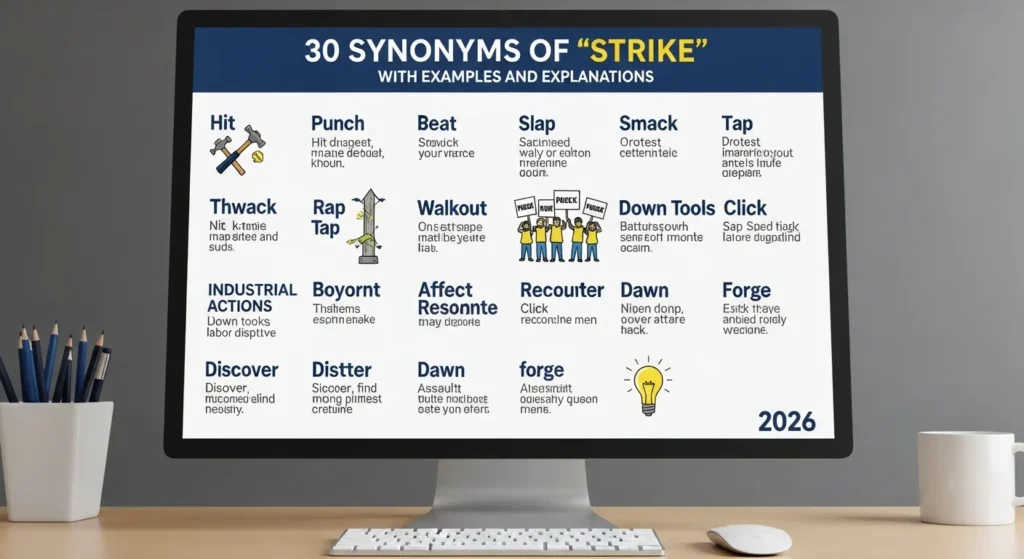
Synonyms of Strike
1. Hit (Verb) — US /hɪt/ | UK /hɪt/
Meaning: To touch or impact with force.
Examples:
- The ball hit the window.
- He hit the drum loudly.
2. Smash (Verb) — US /smæʃ/ | UK /smæʃ/
Meaning: To break or hit violently.
Examples:
- She smashed the glass.
- The car smashed into the wall.
3. Punch (Verb) — US /pʌntʃ/ | UK /pʌntʃ/
Meaning: To hit with a closed fist.
Examples:
- He punched the punching bag.
- She punched him in anger.
4. Beat (Verb) — US /biːt/ | UK /biːt/
Meaning: To hit repeatedly.
Examples:
- The rain beat against the roof.
- He beat the drum.
5. Knock (Verb) — US /nɑːk/ | UK /nɒk/
Meaning: To hit lightly.
Examples:
- Someone knocked on the door.
- The branch knocked the window.
6. Slap (Verb) — US /slæp/ | UK /slæp/
Meaning: To hit with an open hand.
Examples:
- She slapped his face.
- The waves slapped the shore.
7. Attack (Verb) — US /əˈtæk/ | UK /əˈtæk/
Meaning: To act against with force.
Examples:
- The army attacked at dawn.
- The dog attacked the intruder.
8. Assault (Verb/Noun) — US /əˈsɔːlt/ | UK /əˈsɒlt/
Meaning: A violent physical attack.
Examples:
- He was charged with assault.
- The group assaulted the guard.
9. Crash (Verb) — US /kræʃ/ | UK /kræʃ/
Meaning: To collide loudly.
Examples:
- The car crashed into a tree.
- Waves crashed on the rocks.
10. Collide (Verb) — US /kəˈlaɪd/ | UK /kəˈlaɪd/
Meaning: To hit accidentally.
Examples:
- Two bikes collided.
- The cars collided at the crossing.
11. Impact (Verb/Noun) — US /ˈɪmpækt/ | UK /ˈɪmpækt/
Meaning: A strong effect or forceful contact.
Examples:
- The impact was strong.
- The decision impacted many lives.
12. Thump (Verb) — US /θʌmp/ | UK /θʌmp/
Meaning: To hit heavily.
Examples:
- He thumped the table.
- The ball thumped the ground.
13. Whack (Verb) — US /wæk/ | UK /wæk/
Meaning: To hit forcefully.
Examples:
- He whacked the ball.
- She whacked the pillow.
14. Clobber (Verb) — US /ˈklɑːbər/ | UK /ˈklɒbə/
Meaning: To hit very hard.
Examples:
- He clobbered the opponent.
- The storm clobbered the town.
15. Strike down (Verb) — US /straɪk daʊn/ | UK /straɪk daʊn/
Meaning: To defeat or kill.
Examples:
- The law was struck down.
- Lightning struck down the tree.
16. Protest (Verb/Noun) — US /ˈproʊtest/ | UK /ˈprəʊtest/
Meaning: To refuse to work or show disagreement.
Examples:
- Workers protested unfair rules.
- They went on strike.
17. Walkout (Noun) — US /ˈwɔːkˌaʊt/ | UK /ˈwɔːkˌaʊt/
Meaning: Leaving work as protest.
Examples:
- The workers staged a walkout.
- The walkout lasted two days.
18. Discover (Verb) — US /dɪˈskʌvər/ | UK /dɪˈskʌvə/
Meaning: To find something unexpectedly.
Examples:
- They discovered oil.
- She discovered a new talent.
19. Encounter (Verb) — US /ɪnˈkaʊntər/ | UK /ɪnˈkaʊntə/
Meaning: To meet unexpectedly.
Examples:
- He encountered a problem.
- She encountered an old friend.
20. Affect (Verb) — US /əˈfekt/ | UK /əˈfekt/
Meaning: To influence.
Examples:
- The news affected him.
- The storm affected many houses.
21. Remove (Verb) — US /rɪˈmuːv/ | UK /rɪˈmuːv/
Meaning: To take away.
Examples:
- He removed his hat.
- The judge struck his name off.
22. Delete (Verb) — US /dɪˈliːt/ | UK /dɪˈliːt/
Meaning: To erase.
Examples:
- She deleted the file.
- Delete that message.
23. Cancel (Verb) — US /ˈkænsəl/ | UK /ˈkænsəl/
Meaning: To stop something officially.
Examples:
- They canceled the event.
- The meeting was canceled.
24. Ignite (Verb) — US /ɪɡˈnaɪt/ | UK /ɪɡˈnaɪt/
Meaning: To set on fire.
Examples:
- The spark ignited the fire.
- The match ignited quickly.
25. Spark (Verb/Noun) — US /spɑːrk/ | UK /spɑːk/
Meaning: To cause something to start.
Examples:
- The comment sparked debate.
- A spark started the fire.
26. Hammer (Verb) — US /ˈhæmər/ | UK /ˈhæmə/
Meaning: To hit repeatedly.
Examples:
- He hammered the nail.
- Rain hammered the roof.
27. Lash (Verb) — US /læʃ/ | UK /læʃ/
Meaning: To hit violently.
Examples:
- Waves lashed the shore.
- He lashed out in anger.
28. Slam (Verb) — US /slæm/ | UK /slæm/
Meaning: To shut or hit hard.
Examples:
- She slammed the door.
- The ball slammed into the net.
29. Strike out (Verb) — US /straɪk aʊt/ | UK /straɪk aʊt/
Meaning: To fail or remove.
Examples:
- The batter struck out.
- The judge struck out the claim.
30. Strike up (Verb) — US /straɪk ʌp/ | UK /straɪk ʌp/
Meaning: To begin suddenly.
Examples:
- They struck up a conversation.
- The band struck up a tune.
Prototype Meaning
The most typical meaning of strike is to hit something with force. Most people imagine a fist hitting a surface, lightning hitting the ground, or a hammer striking a nail.
Prototype Categorization
Synonyms can be grouped into categories:
- Physical hitting: hit, punch, slap, smash, hammer
- Collision: crash, collide, impact
- Attack: assault, attack, clobber
- Protest action: protest, walkout
- Sudden effect or start: spark, ignite, affect
- Removal: cancel, delete, remove
Categorization helps writers choose the right synonym depending on context. For example, “smash” sounds violent, while “knock” sounds light.
Antonyms of Strike
- Miss
- Protect
- Defend
- Save
- Support
Short Questions and Answers
- What does strike mean?
It means to hit, attack, protest, or affect suddenly. - When should strike be used?
Use it when talking about hitting, protesting, discovering, or sudden impact. - Is strike positive or negative?
It can be positive (strike gold), negative (strike someone), or neutral (strike a match). - How is it different from similar words?
“Hit” is general. “Smash” is violent. “Strike” can also mean protest or discovery.
CONCLUSION
Learning the word strike and its synonyms helps you understand English better. It improves your vocabulary and gives you more options in speaking and writing. Instead of repeating “hit” again and again, you can use smash, slam, impact, or lash. This makes your writing stronger and clearer.Knowing different meanings of one word also builds confidence. You can understand news, books, and conversations more easily. Daily vocabulary practice is the key. Learn one word, explore its synonyms, and use them in sentences. Step by step, your English will become powerful and natural.

I’m Zahid Abbas, an educator, researcher, and digital publishing strategist with a passion for linguistics, grammar, and clear communication. As a content creator and SEO specialist, I craft research-driven, reader-focused content that empowers learners and makes knowledge accessible worldwide.