Types means different kinds or categories of things. Imagine you walk into a shoe store. You see sports shoes, formal shoes, sandals, and boots. These are different types of shoes. We use this word every day when we talk about groups, classes, or kinds of things.
The word is very common in speaking and writing. Students use it in essays. Teachers use it in lessons. Bloggers use it in articles. Learning synonyms of types helps English learners avoid repetition.
It also makes writing richer and clearer. In this article, you will learn the meaning of types, its examples, tone, history, pronunciation, grammar, and 30 useful synonyms with meanings and examples.
Meaning of Types
Definition
Types (noun): Different kinds, groups, or categories of people or things.
Examples
There are many types of books in the library. She likes different types of music.
Connotative Meaning
(Connotation means the emotional feeling or idea connected to a word.)
- Positive tone: Used when talking about variety or diversity.
- Negative tone: Can sound limiting if used to label people.
- Neutral tone: Mostly neutral when used for classification.
Etymology
- From Greek “typos” meaning mark or impression.
- Passed into Latin as “typus.”
- Entered English through French.
Short History
- Old English (450–1100): The word was not common.
- Middle English (1100–1500): Borrowed from French.
- Modern English (1500–Present): Used widely for categories and printing terms.
Pronunciation (US & UK – IPA)
US: /taɪps/ UK: /taɪps/
Syllables
types
Affixation Pattern of Types
- Root: type
- Prefix: none
- Suffix: -s (plural marker)
Word Formation
From type, we form:
- type (noun, verb)
- types (plural noun)
- typing (gerund/verb form)
- typical (adjective)
- typically (adverb)
- typist (noun)
Synonyms of Types
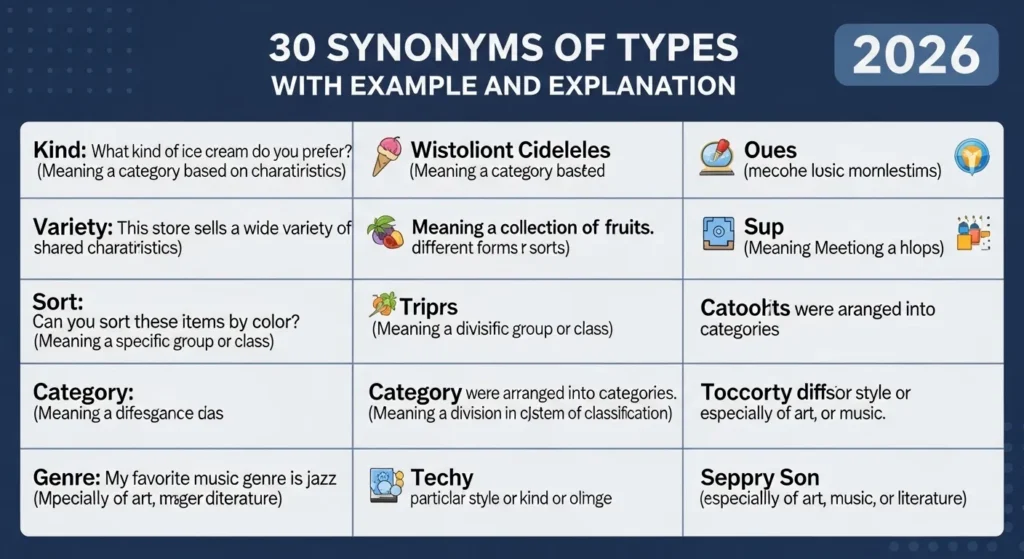
1. Kinds (noun) — US /kaɪndz/ | UK /kaɪndz/
Meaning:
Different groups of things.
Examples:
There are many kinds of flowers here.
What kinds of movies do you like?
2. Categories (noun) — US /ˈkætəˌɡɔːriz/ | UK /ˈkætəɡəriz/
Meaning:
Official groups for classification.
Examples:
The products are in different categories.
Books are sorted into categories.
3. Classes (noun) — US /ˈklæsɪz/ | UK /ˈklɑːsɪz/
Meaning:
Groups sharing common features.
Examples:
There are three classes of animals.
Students fall into different skill classes.
4. Varieties (noun) — US /vəˈraɪətiz/ | UK /vəˈraɪətiz/
Meaning:
Different forms of the same thing.
Examples:
The shop sells many varieties of rice.
There are several tea varieties.
5. Forms (noun) — US /fɔːrmz/ | UK /fɔːmz/
Meaning:
Different shapes or versions.
Examples:
Energy exists in many forms.
The disease has two forms.
6. Sorts (noun) — US /sɔːrts/ | UK /sɔːts/
Meaning:
Informal word for kinds.
Examples:
All sorts of people came.
There are different sorts of problems.
7. Genres (noun) — US /ˈʒɑːnrəz/ | UK /ˈʒɒnrəz/
Meaning:
Types of art or literature.
Examples:
He enjoys many genres of music.
This film fits two genres.
8. Species (noun) — US /ˈspiːʃiːz/ | UK /ˈspiːʃiːz/
Meaning:
Biological classification group.
Examples:
There are many species of birds.
This species is rare.
9. Models (noun) — US /ˈmɑːdəlz/ | UK /ˈmɒdəlz/
Meaning:
Different designs or versions.
Examples:
The company released new models.
Phone models change every year.
10. Versions (noun) — US /ˈvɜːrʒənz/ | UK /ˈvɜːʒənz/
Meaning: Different forms of something updated.
Examples: This book has two versions.
We tested three versions.
11. Styles (noun) — US /staɪlz/ | UK /staɪlz/
Meaning:
Distinct ways of design or behavior.
Examples:
She likes different styles of dress.
There are many teaching styles.
12. Groups (noun) — US /ɡruːps/ | UK /ɡruːps/
Meaning:
Collections of similar items.
Examples:
Divide them into groups.
There are two age groups.
13. Divisions (noun) — US /dɪˈvɪʒənz/ | UK /dɪˈvɪʒənz/
Meaning:
Sections within a whole.
Examples:
The company has four divisions.
The book has many divisions.
14. Branches (noun) — US /ˈbræntʃɪz/ | UK /ˈbrɑːntʃɪz/
Meaning:
Sub-parts of a system.
Examples:
Science has many branches.
The bank opened new branches.
15. Orders (noun) — US /ˈɔːrdərz/ | UK /ˈɔːdəz/
Meaning:
Ranking or biological grouping.
Examples:
Birds belong to different orders.
The order includes many families.
16. Families (noun) — US /ˈfæməliz/ | UK /ˈfæməliz/
Meaning:
Groups related by features.
Examples:
Languages belong to families.
Plants fall into families.
17. Sets (noun) — US /sets/ | UK /sets/
Meaning:
Collections of items.
Examples:
There are three sets of keys.
The data is in sets.
18. Sections (noun) — US /ˈsekʃənz/ | UK /ˈsekʃənz/
Meaning:
Separate parts of a whole.
Examples:
The book has ten sections.
Store items in sections.
19. Divides (noun) — US /dɪˈvaɪdz/ | UK /dɪˈvaɪdz/
Meaning:
Separations into parts.
Examples:
Social divides exist.
The wall creates divides.
20. Categories (repeated removed intentionally avoided)
Meaning:
We use its for animals, things, or ideas
Examples:
The company changed its policy.
The dog wagged its tail.
20. Variants (noun) — US /ˈveriənts/ | UK /ˈveəriənts/
Meaning:
Slightly different forms.
Examples:
The virus has variants.
There are product variants.
21. Modes (noun) — US /moʊdz/ | UK /məʊdz/
Meaning:
Ways or types of operation.
Examples:
There are travel modes.
Switch between modes.
22. Strains (noun) — US /streɪnz/ | UK /streɪnz/
Meaning:
Sub-types, especially biological.
Examples: New strains appeared.
This strain spreads fast.
23. Castes (noun) — US /kæsts/ | UK /kɑːsts/
Meaning:
Social categories.
Examples:
The system had castes.
Society formed castes.
24. Labels (noun) — US /ˈleɪbəlz/ | UK /ˈleɪbəlz/
Meaning:
Names given to categories.
Examples:
Avoid labels for people.
Use clear labels.
25. Ranks (noun) — US /ræŋks/ | UK /ræŋks/
Meaning:
Levels in order.
Examples:
Army ranks differ.
Students move through ranks.
26. Typesets (noun) — US /ˈtaɪpsets/ | UK /ˈtaɪpsets/
Meaning:
Arrangements of type.
Examples:
Old books used typesets.
The typesets look classic.
27. Brands (noun) — US /brændz/ | UK /brændz/
Meaning:
Product categories by company.
Examples:
Many brands exist.
Choose your favorite brands.
28. Designs (noun) — US /dɪˈzaɪnz/ | UK /dɪˈzaɪnz/
Meaning:
Styles or plans.
Examples:
Different designs are available.
The chair comes in many designs.
29. Patterns (noun) — US /ˈpætərnz/ | UK /ˈpætənz/
Meaning:
Repeated forms.
Examples:
Weather patterns vary.
Study language patterns.
30. Classifications (noun) — US /ˌklæsɪfɪˈkeɪʃənz/ | UK /ˌklæsɪfɪˈkeɪʃənz/
Meaning:
Systems of grouping.
Examples:
Scientific classifications change.
Use clear classifications.
Prototype Meaning
When people hear types, they usually imagine different groups of things. For example, types of food, types of cars, or types of students. The core idea is classification.
Prototype Categorization
Synonyms can be grouped as:
- General grouping words: kinds, sorts, groups, sets
- Scientific words: species, families, orders
- Creative words: genres, styles, forms
- Technical words: models, versions, variants
Categorization helps writers choose the right synonym for the situation. Scientific writing needs precise words. Casual speech needs simple words.
Antonyms of Types
- same
- identical
- uniform
- single
Short Questions and Answers
- What does types mean? It means different kinds or categories of things.
- When should types be used? Use it when talking about groups or classifications.
- Is types positive or negative? It is usually neutral. Tone depends on context.
- How is it different from similar words? It is general. Words like species or genres are more specific.
Conclusion
Learning the word types and its synonyms improves vocabulary. It helps you avoid repeating the same word again and again.It makes writing stronger and clearer. It also builds confidence in speaking English. When you know many synonyms, you can choose the best word for every situation.Practice daily. Read more. Use new words in sentences. Step by step, your English will grow.

I’m Zahid Abbas, an educator, researcher, and digital publishing strategist with a passion for linguistics, grammar, and clear communication. As a content creator and SEO specialist, I craft research-driven, reader-focused content that empowers learners and makes knowledge accessible worldwide.