Darkness means the absence of light. It is a common word in English and appears in daily conversation, literature, science, religion, and storytelling. Imagine a person walking through a park after sunset when the streetlights suddenly go out. The area becomes difficult to see, and everything is covered in darkness. This simple situation shows how naturally the word fits into everyday life.
The word is commonly used to describe physical lack of light, mystery, fear, sadness, or the unknown. Learning synonyms of darkness helps English learners express ideas more clearly and avoid repeating the same word. It also helps writers create stronger descriptions and richer content. In this article, you will learn the meaning of darkness, its pronunciation, history, grammar, connotations, semantic categories, and 30 useful Synonyms of Darkness with examples to improve your vocabulary.
Meaning of Darkness
Darkness (Noun):
The state or condition of having little or no light.
Examples
- The room was filled with darkness after the power went out.
- We could not see the path clearly because of the darkness.
Connotative Meaning
(Connotation: the emotional or cultural feeling associated with a word beyond its dictionary meaning.)
- Positive tone: Rest, peace, privacy, mystery, reflection.
- Negative tone: Fear, danger, sadness, evil, uncertainty.
- Neutral tone: Absence of light or visibility.
Etymology
- Origin: Old English deorcnes.
- Source language: Germanic languages.
- Original meaning: The state of being dark or without light.
Short History of the Keyword
- Old English (450–1100): Used as deorcnes to describe lack of light.
- Middle English (1100–1500): Spelling and pronunciation gradually changed to darknesse.
- Modern English (1500–Present): Became the modern form darkness and gained both literal and figurative meanings.
Pronunciation (US & UK – IPA)
US: /ˈdɑːrk.nəs/
UK: /ˈdɑːk.nəs/
Syllables
dark-ness
Affixation Pattern of Darkness
Root: dark
Prefix: None
Suffix: -ness
Word Formation of Darkness
- Dark (Adjective)
- Darkness (Noun)
- Darken (Verb)
- Darkened (Verb)
- Darkening (Verb/Noun)
- Darkly (Adverb)
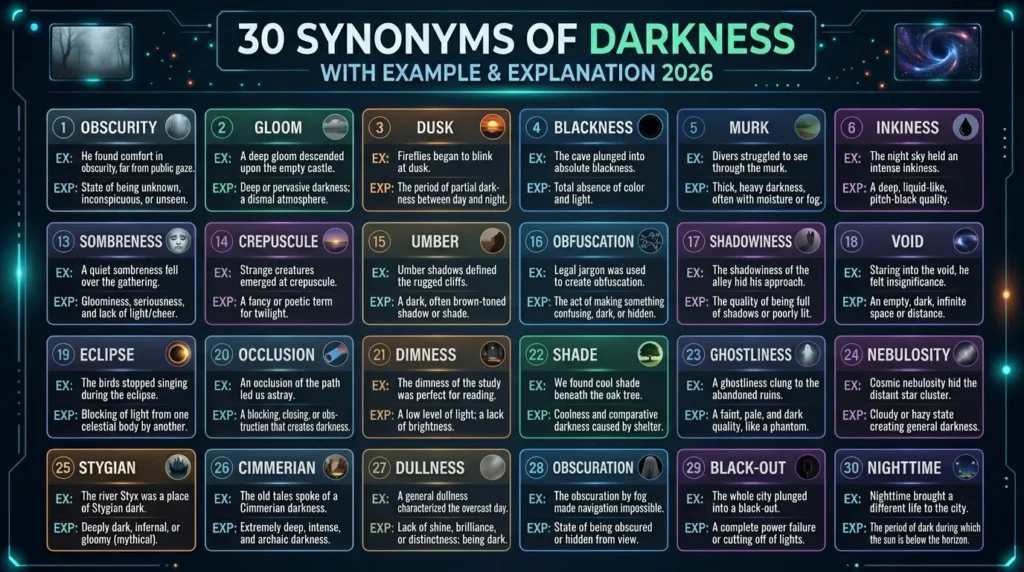
30 Synonyms of Darkness
1. Gloom (Noun)
US: /ɡluːm/ | UK: /ɡluːm/
Meaning: Partial darkness that creates a sad feeling.
Examples:
- The forest was covered in gloom.
- A sense of gloom filled the old house.
2. Shadow (Noun)
US: /ˈʃæd.oʊ/ | UK: /ˈʃæd.əʊ/
Meaning: A dark area caused by blocked light.
Examples:
- The tree cast a long shadow.
- She stood in the shadow of the building.
3. Dimness (Noun)
US: /ˈdɪm.nəs/ | UK: /ˈdɪm.nəs/
Meaning: A condition of weak or low light.
Examples:
- The dimness made reading difficult.
- We walked through the dimness carefully.
4. Murk (Noun)
US: /mɜːrk/ | UK: /mɜːk/
Meaning: Thick darkness with poor visibility.
Examples:
- The boat disappeared into the murk.
- The road was hidden by murk.
5. Murkiness (Noun)
US: /ˈmɜːr.ki.nəs/ | UK: /ˈmɜː.ki.nəs/
Meaning: The quality of being dark or unclear.
Examples:
- The murkiness covered the valley.
- The room’s murkiness felt strange.
6. Obscurity (Noun)
US: /əbˈskjʊr.ə.ti/ | UK: /əbˈskjʊə.rə.ti/
Meaning: A state of being hidden or difficult to see.
Examples:
- The mountain remained in obscurity.
- Darkness pushed the path into obscurity.
7. Blackness (Noun)
US: /ˈblæk.nəs/ | UK: /ˈblæk.nəs/
Meaning: Complete darkness or deep black color.
Examples:
- The cave was filled with blackness.
- Blackness surrounded the travelers.
8. Night (Noun)
US: /naɪt/ | UK: /naɪt/
Meaning: The dark period between sunset and sunrise.
Examples:
- The night was calm and quiet.
- Animals became active during the night.
9. Shade (Noun)
US: /ʃeɪd/ | UK: /ʃeɪd/
Meaning: An area protected from direct light.
Examples:
- We rested in the shade.
- The garden offered plenty of shade.
10. Twilight (Noun)
US: /ˈtwaɪ.laɪt/ | UK: /ˈtwaɪ.laɪt/
Meaning: The soft light before sunrise or after sunset.
Examples:
- Birds sang during twilight.
- The town looked beautiful at twilight.
11. Dusk (Noun)
US: /dʌsk/ | UK: /dʌsk/
Meaning: The darker stage of evening.
Examples:
- We arrived at dusk.
- The sky turned purple at dusk.
12. Gloaming (Noun)
US: /ˈɡloʊ.mɪŋ/ | UK: /ˈɡləʊ.mɪŋ/
Meaning: Twilight or evening darkness.
Examples:
- The gloaming covered the hills.
- They walked home in the gloaming.
13. Nightfall (Noun)
US: /ˈnaɪt.fɔːl/ | UK: /ˈnaɪt.fɔːl/
Meaning: The beginning of night.
Examples:
- We returned before nightfall.
- The animals appeared at nightfall.
14. Shadowiness (Noun)
US: /ˈʃæd.oʊ.i.nəs/ | UK: /ˈʃæd.əʊ.i.nəs/
Meaning: The quality of being shadowy.
Examples:
- The shadowiness added mystery.
- The hallway’s shadowiness felt eerie.
15. Shadiness (Noun)
US: /ˈʃeɪ.di.nəs/ | UK: /ˈʃeɪ.di.nəs/
Meaning: The condition of being shaded or dark.
Examples:
- The shadiness kept the area cool.
- We enjoyed the shadiness of the trees.
16. Penumbra (Noun)
US: /pəˈnʌm.brə/ | UK: /pəˈnʌm.brə/
Meaning: Partial shadow around a darker area.
Examples:
- The eclipse created a penumbra.
- A penumbra surrounded the object.
17. Umbra (Noun)
US: /ˈʌm.brə/ | UK: /ˈʌm.brə/
Meaning: The darkest part of a shadow.
Examples:
- The moon entered Earth’s umbra.
- The umbra was clearly visible.
18. Tenebrosity (Noun)
US: /ˌten.əˈbrɑː.sə.ti/ | UK: /ˌten.əˈbrɒs.ə.ti/
Meaning: Deep darkness.
Examples:
- The cave’s tenebrosity was frightening.
- Tenebrosity filled the old tunnel.
19. Tenebrousness (Noun)
US: /ˈten.ə.brəs.nəs/ | UK: /ˈten.ə.brəs.nəs/
Meaning: The state of being dark.
Examples:
- The tenebrousness hid the details.
- The room’s tenebrousness felt unsettling.
20. Opacity (Noun)
US: /oʊˈpæs.ə.ti/ | UK: /əʊˈpæs.ə.ti/
Meaning: The quality of blocking light.
Examples:
- The glass had high opacity.
- Opacity prevented visibility.
21. Cloudiness (Noun)
US: /ˈklaʊ.di.nəs/ | UK: /ˈklaʊ.di.nəs/
Meaning: A dark or overcast condition.
Examples:
- Cloudiness covered the sky.
- The day’s cloudiness reduced sunlight.
22. Overcast (Noun)
US: /ˈoʊ.vər.kæst/ | UK: /ˈəʊ.və.kɑːst/
Meaning: A sky covered with clouds.
Examples:
- The overcast made the afternoon dark.
- An overcast hung above the city.
23. Fog (Noun)
US: /fɑːɡ/ | UK: /fɒɡ/
Meaning: Thick mist that reduces visibility.
Examples:
- The fog covered the road.
- Drivers slowed down in the fog.
24. Haze (Noun)
US: /heɪz/ | UK: /heɪz/
Meaning: Light obscurity caused by particles in the air.
Examples:
- Haze covered the mountains.
- The city disappeared into the haze.
25. Mist (Noun)
US: /mɪst/ | UK: /mɪst/
Meaning: Fine water droplets creating slight darkness.
Examples:
- Mist floated over the lake.
- The hills vanished into mist.
26. Obfuscation (Noun)
US: /ˌɑːb.fəˈskeɪ.ʃən/ | UK: /ˌɒb.fʌˈskeɪ.ʃən/
Meaning: The act of making something unclear.
Examples:
- The smoke caused obfuscation.
- Obfuscation hid the details.
27. Concealment (Noun)
US: /kənˈsiːl.mənt/ | UK: /kənˈsiːl.mənt/
Meaning: The act of hiding something.
Examples:
- Darkness provided concealment.
- The bushes offered concealment.
28. Secrecy (Noun)
US: /ˈsiː.krə.si/ | UK: /ˈsiː.krə.si/
Meaning: A state of being hidden from view.
Examples:
- The meeting occurred in secrecy.
- Darkness supported secrecy.
29. Eclipse (Noun)
US: /ɪˈklɪps/ | UK: /ɪˈklɪps/
Meaning: Temporary darkening caused by one object blocking another.
Examples:
- We watched the eclipse carefully.
- The eclipse darkened the sky.
30. Dark (Noun/Adjective)
US: /dɑːrk/ | UK: /dɑːk/
Meaning: Having little or no light.
Examples:
- The room became dark quickly.
- Dark clouds covered the sky.
Prototype Meaning
The most typical meaning of darkness is the complete or partial absence of light. When people hear the word, they usually imagine a dark room, a night sky, a cave, or any place where visibility is reduced because light is missing.
Prototype Categorization
- Lack of Light: darkness, blackness, dimness, dark
- Night and Evening: night, dusk, twilight, gloaming, nightfall
- Shadows: shadow, shade, penumbra, umbra
- Atmospheric Darkness: fog, haze, mist, overcast, cloudiness
- Deep or Mysterious Darkness: murk, murkiness, gloom, tenebrosity, tenebrousness
- Hiddenness and Uncertainty: obscurity, concealment, secrecy, obfuscation
Antonyms of Darkness
- Light (Noun): Natural or artificial brightness.
- Brightness (Noun): Strong light.
- Illumination (Noun): The act of lighting something.
- Radiance (Noun): Bright shining light.
- Glow (Noun): Soft steady light.
- Sunshine (Noun): Light from the sun.
- Daylight (Noun): Natural light during the day.
- Clarity (Noun): The quality of being clear and easy to see.
- Luminosity (Noun): The state of giving off light.
- Brilliance (Noun): Intense brightness.
Short Questions and Answers
- What does darkness mean?Darkness means the absence of light or a condition where little can be seen.
- When should darkness be used?Use darkness when describing places, situations, emotions, or scenes with little or no light.
- Is darkness positive or negative?It can be positive, negative, or neutral depending on context. It may suggest peace, fear, mystery, or simply lack of light.
- How is it different from similar words?Darkness is the general term. Words like gloom suggest sadness, shadow refers to blocked light, and murk suggests thick darkness and poor visibility.
Conclusion
Learning Synonyms of Darkness and Synonyms of Darkness is a valuable way to expand your English vocabulary. Understanding different words such as gloom, shadow, obscurity, and twilight helps you express ideas more accurately and creatively. These synonyms strengthen both writing and speaking by providing variety and reducing repetition. They also help readers better understand the exact mood, setting, or meaning you want to communicate. By studying pronunciation, history, connotations, and usage examples, you gain a deeper understanding of the language. Make vocabulary practice a daily habit, and you will gradually become a more confident English speaker, writer, and communicator.

I’m Zahid Abbas, an educator, researcher, and digital publishing strategist with a passion for linguistics, grammar, and clear communication. As a content creator and SEO specialist, I craft research-driven, reader-focused content that empowers learners and makes knowledge accessible worldwide.