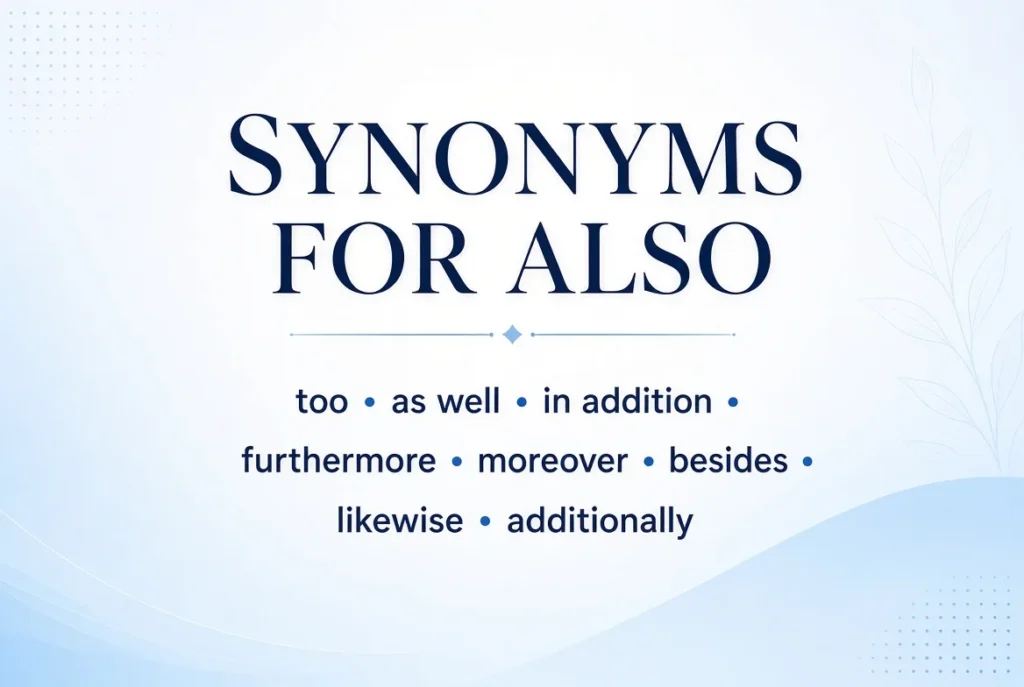

A synonym for also is additionally, too, as well, in addition, furthermore, or moreover. These words express the idea of adding information, another fact, or another point. The best choice depends on your sentence and tone. Use too or as well in everyday conversation, and choose additionally, furthermore, or moreover when a more formal style fits your writing.
Key Takeaways
- Additionally and in addition work well when introducing extra information.
- Furthermore and moreover suit formal writing and academic arguments.
- Too and as well sound natural in everyday English.
- Likewise emphasizes similarity, not simply an additional fact.
- Choose synonyms based on meaning, sentence structure, and tone rather than replacing every use of also.
What Does “Also” Mean?
The word also is an adverb that means “in addition” or “too.” Writers and speakers use it to add information, mention another quality, or show that a statement applies to someone or something else.
For example:
- Original: Maria speaks English and also speaks Spanish.
- Alternative: Maria speaks English and speaks Spanish as well.
Both sentences communicate the same basic idea.
According to Cambridge Dictionary, also can introduce additional information or indicate that something is true in another case. However, its alternatives do not always have identical meanings or fit in the same position.
Understanding these differences helps you choose a word that sounds natural instead of simply exchanging one word for another.
15 Useful Synonyms for Also
Here are 15 alternatives, along with their meanings, typical uses, and examples.
| Synonym | Best use | Example |
|---|---|---|
| Additionally | Adding another fact | Additionally, the course includes weekly exercises. |
| In addition | Introducing extra information | In addition, students receive study guides. |
| Furthermore | Developing a formal argument | Furthermore, the results support our conclusion. |
| Moreover | Emphasizing another supporting point | Moreover, the plan saves time. |
| Too | Everyday conversation | I want to come, too. |
| As well | Natural, friendly communication | She plays the piano as well. |
| Likewise | Showing similarity | He enjoys reading; likewise, his sister loves books. |
| Besides | Adding a reason or point | Besides, we have enough supplies. |
| Plus | Casual speech and writing | The apartment is affordable, plus it is close to work. |
| What’s more | Emphasizing an additional point | What’s more, the tickets are free. |
| On top of that | Informal emphasis | On top of that, the hotel offers free breakfast. |
| To boot | Informal emphasis, sometimes playful | The jacket is warm and stylish to boot. |
| Further | Continuing an argument or discussion | Further, the report identifies several risks. |
| Along with | Connecting related people or things | She submitted the form along with her application. |
| Together with | Indicating something accompanies another thing | The package arrived together with the instructions. |
Important: These alternatives are not all interchangeable. Additionally and furthermore usually introduce extra information, while likewise highlights similarity. Along with and together with connect related items or actions and may require a different sentence structure.
Best Everyday Alternatives
1. Too
Use too when adding a person, action, or fact. It often appears at the end of a clause.
- Also: I enjoy playing soccer also.
- Better: I enjoy playing soccer, too.
2. As well
Use as well to add information in a natural, conversational way. It commonly appears at the end of a clause.
- Also: He ordered a sandwich also.
- Better: He ordered a sandwich as well.
3. In addition
Use in addition when you want to make the connection between two facts clear.
- Also: The library offers free books. It also provides computer access.
- Alternative: The library offers free books. In addition, it provides computer access.
4. Additionally
Choose additionally when introducing another point in an explanation, report, or professional message.
Example: Additionally, all applicants must submit a completed form.
Formal and Academic Alternatives
5. Furthermore
Furthermore introduces another point that supports or develops the preceding idea.
Example: The study found a connection between sleep and concentration. Furthermore, it identified several factors that may affect sleep quality.
6. Moreover
Moreover adds a point that strengthens the argument. It often sounds more formal than also.
Example: The proposed solution is affordable. Moreover, it can be implemented quickly.
7. Further
Further can introduce an additional point in formal discussions, as in “Further, the report recommends a review.” However, it also has other meanings, so use it only when the sentence sounds natural.
Casual Alternatives
8. Plus
Plus works well in informal conversations, friendly emails, and straightforward explanations.
Example: Let’s walk to the restaurant. Plus, the weather is nice.
9. What’s more
Use this phrase when the additional information deserves attention.
Example: The laptop is lightweight. What’s more, its battery lasts through a full workday.
10. On top of that
This phrase adds another point with emphasis. It is particularly useful when listing benefits, problems, or surprising facts.
Example: The bus was late, and on top of that, it started raining.
11. To boot
This expression means “in addition” and often adds a playful or conversational tone.
Example: The meal was delicious and inexpensive to boot.
12. Besides
Besides can introduce an extra reason or argument.
Example: I don’t want to drive tonight. Besides, parking is difficult downtown.
Use besides carefully because it can mean “apart from” in other contexts.
Alternatives That Show Similarity or Connection
13. Likewise
Use likewise when something is true in a similar way or when two situations share a quality.
Example: Daniel enjoys solving puzzles. Likewise, his brother loves logic games.
14. Along with
Use along with to connect people, things, or activities.
Example: The teacher submitted the grades along with written feedback.
15. Together with
Use together with when one item accompanies another.
Example: The invitation arrived together with a map of the venue.
Neither along with nor together with is a direct substitute for also in every sentence. Choose them when the relationship between the items makes sense.
Which Synonym for Also Should You Choose?
The right synonym depends on your purpose and audience.
| Your situation | Recommended word or phrase |
|---|---|
| Everyday conversation | Too, as well |
| School assignment | In addition, additionally |
| Academic essay | Furthermore, moreover |
| Business email | Additionally, in addition |
| Adding a similar idea | Likewise |
| Giving another reason | Besides, what’s more |
| Casual social media post | Plus, on top of that |
| Connecting related items | Along with, together with |
For example, imagine you are writing about the benefits of exercise.
Basic sentence: Exercise improves physical health. It also supports mental well-being.
More formal version: Exercise improves physical health. Furthermore, it supports mental well-being.
Everyday version: Exercise improves physical health and supports mental well-being, too.
All three versions communicate related information, but they create slightly different tones and sentence rhythms.
Also vs. Too vs. As Well
Also, too, and as well share a similar meaning, but their usual positions differ.
| Word or phrase | Common position | Example |
|---|---|---|
| Also | Before the main verb, but after forms of be and many auxiliary verbs | She also works on weekends. |
| Too | Usually at the end of a clause | She works on weekends, too. |
| As well | Usually at the end of a clause | She works on weekends as well. |
Compare these examples:
- Natural: I also want to visit New York.
- Natural: I want to visit New York, too.
- Natural: I want to visit New York as well.
All three are correct. However, “I want also to visit New York” sounds less natural in ordinary American English than the other options.
You can also begin a sentence with also when the context supports it. For example: “The hotel offers free parking. Also, guests can use the fitness center.” In formal writing, additionally or furthermore may provide a smoother transition.
For more examples, see Cambridge Dictionary’s explanation of also.
How to Replace “Also” in a Sentence
Follow these three steps to find a suitable alternative.
Step 1: Identify what you want to add.
Are you adding a fact, strengthening an argument, showing similarity, or connecting two items? Your answer helps determine the best word.
Step 2: Match the tone.
Use too or as well for casual communication. Choose additionally or furthermore for a formal report when the context calls for it.
Step 3: Check the sentence structure.
Some alternatives fit at the beginning of a sentence, while others usually appear at the end or connect nouns and phrases.
Try these examples:
- Original: The app is easy to use. It also saves time.
- Improved: The app is easy to use. Additionally, it saves time.
- Original: My brother likes basketball, and I also like basketball.
- Improved: My brother likes basketball, and I do, too.
- Original: The policy reduces waste. It also lowers costs.
- Improved: The policy reduces waste. Moreover, it lowers costs.
Do not change a sentence just to avoid repeating also. Repetition can be perfectly acceptable when the meaning is clear.
Common Mistakes When Using Synonyms for Also
Mistake 1: Using a formal transition in every sentence
Example: “Furthermore, I like coffee. Furthermore, I like tea.”
Better: “I like coffee, and I enjoy tea as well.”
Choose transitions that fit the relationship between ideas.
Mistake 2: Treating every synonym as identical
Likewise suggests similarity, while in addition simply introduces another point. Using the wrong expression can change your intended meaning.
Mistake 3: Using “as well” at the beginning of a sentence
In standard everyday English, as well usually appears at the end of a clause.
Less natural: “As well, she teaches science.”
Better: “She teaches science as well.”
For a sentence-opening transition, try “Additionally, she teaches science.”
Mistake 4: Adding unnecessary transitions
A sentence may already flow well without an extra transition.
Wordy: “The service is affordable. Additionally, it is also reliable.”
Clearer: “The service is affordable and reliable.”
Removing unnecessary words often improves readability more than replacing them with longer alternatives.
Frequently Asked Questions
What is the best synonym for also?
Additionally is a strong general choice when you want to introduce extra information. However, too and as well are often more natural in conversation, while furthermore and moreover suit formal arguments.
What is another word for also in an essay?
Try additionally, furthermore, moreover, or in addition. Choose the expression that matches your argument and sentence structure. Avoid using a formal transition at the start of every paragraph because varied, clear connections make academic writing easier to read.
What is a formal word for also?
Additionally is a useful formal alternative. Furthermore and moreover also work well when you want to introduce another point that supports your discussion. The best choice depends on whether you are simply adding information or strengthening an argument.
Is “too” the same as “also”?
They often mean the same thing, but they usually appear in different positions. Also commonly comes before the main verb, as in “She also works here.” Too commonly comes at the end: “She works here, too.” Both sentences express an additional fact.
Can I start a sentence with “also”?
Yes. You can write, “The program teaches grammar. Also, it helps students improve their writing.” This is acceptable English. In a formal report, additionally or furthermore may be a better stylistic choice, depending on the relationship between the ideas.
How can I avoid repeating “also” in writing?
First, check whether you need the word at all. Then consider too, as well, additionally, or in addition. Use likewise only when you mean that something is similar. You can also combine related ideas into one clear sentence instead of adding another transition.
Conclusion
The best synonym for also depends on what you want to communicate. Use too or as well for everyday English, additionally or in addition to introduce another fact, and furthermore or moreover to develop a formal argument. Choose likewise when you want to show similarity.
When deciding what is a synonym for also, focus on meaning, tone, and sentence structure. The goal is not to replace every occurrence of also, but to make your writing clear, natural, and easy to follow.