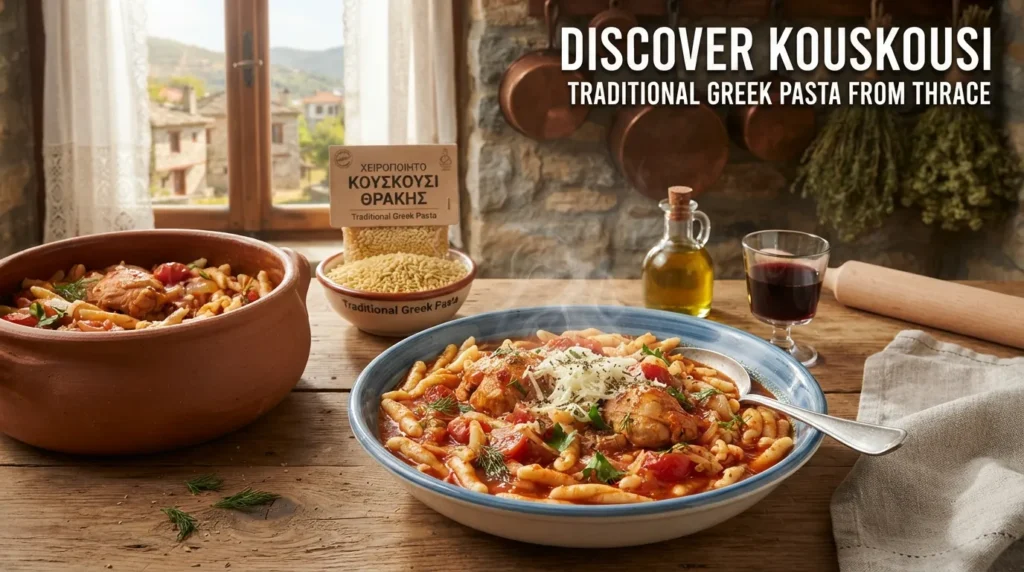
Kouskousi (κουσκούσι) is a traditional small, bead-like pasta native to Greek home cooking, particularly in the northern region of Thrace. While visually similar to North African couscous, Greek kouskousi is made from durum wheat semolina combined with milk and eggs, and it is boiled like pasta rather than steamed.
Key Takeaways
- Traditional Greek Pasta: A small, grain-shaped pasta closely tied to the rural food heritage of Thrace, Greece.
- Rich Ingredients: Often rolled using coarse semolina flour, fresh milk, and eggs, giving it a rich, hearty flavor.
- Distinct Preparation: Unlike Maghrebi couscous which is rehydrated or steamed, kouskousi is boiled directly in water, broth, or sauce.
- Versatile Kitchen Base: Ideal for absorbing flavors in chicken soups, tomato-braised meats, baked casseroles, and cold pasta salads.
What Is Kouskousi?
In Mediterranean cooking, few ingredients spark as much culinary confusion as kouskousi. At first glance, a handful of dried kouskousi looks like a collection of tiny, golden wheat beads. Because its name sounds nearly identical to couscous, many cooks assume they are dealing with the famous North African staple.
However, in the context of Greek gastronomy, kouskousi refers to a traditional, artisan-made pasta shape. It features tiny, irregular spheres that cook up tender yet firm to the bite. Rather than acting as a light, fluffy bed for stews, Greek kouskousi functions as an absorbent pasta base that thickens soups, enriches braises, and catches sauces with ease.
Kouskousi vs. Couscous: Key Differences Explained
Understanding the distinction between kouskousi and North African couscous is essential for getting your cooking times and water ratios right in the kitchen.
Comparison Overview Table
| Feature | Greek Kouskousi | North African Couscous |
| Primary Category | Small pasta shape | Steamed semolina granules |
| Regional Origin | Greece (specifically Thrace) | North Africa / The Maghreb |
| Typical Ingredients | Durum semolina, milk, eggs, salt | Durum semolina, water, salt |
| Cooking Technique | Boiled directly in broth, water, or sauce | Steamed or rehydrated in hot water |
| Final Texture | Chewy, toothsome, pasta-like bite | Light, airy, fluffy granules |
Culinary Roots and Ingredients
Traditional Maghrebi couscous is formed by dampening coarse semolina with water and rolling it into microscopic pellets before drying.
Greek kouskousi shares linguistic roots with Ottoman and Arabic terminology, but its dough formulation developed along Greek agrarian lines. In rural Greek villages, home cooks added fresh farm eggs and warm cow’s or goat’s milk to the semolina dough. This rich dough was then worked through special copper or wooden sieves to form small, uneven pasta beads before sun-drying for long-term pantry storage.
Boiling vs. Steaming Methods
The most critical difference lies in how you cook them:
- North African Couscous: Traditionally placed in a steamer called a couscoussier above a simmering stew, or rehydrated by pouring boiling water over the grains and letting them steam under a tight lid for 5 minutes.
- Greek Kouskousi: Treated like traditional pasta. It requires active boiling in salted liquid for 8 to 12 minutes until it reaches an al dente texture.
Regional Origins: The Thracian Connection
While kouskousi can be found across various pockets of Greece, its true heartland is Thrace (in northeastern Greece). In towns like Soufli and Alexandroupoli, kouskousi is listed alongside other beloved artisan food products, such as trachanas (fermented grain pasta), handmade phyllo sheets, and cured meats.
+------------------------------------------------------------------+
|                   TRADITIONAL THRACIAN PANTRY                    |
+-------------------+----------------------------------------------+
| Kouskousi         | Egg & milk semolina pasta beads              |
| Trachanas         | Fermented grain & dairy soup base            |
| Hilopites         | Square or ribbon-cut egg noodles             |
| Kritharaki        | Rice-shaped orzo pasta                       |
+-------------------+----------------------------------------------+
How Traditional Kouskousi Is Made
Making kouskousi was historically a communal late-summer event in Thracian villages. Families gathered to turn fresh dairy and harvest wheat into shelf-stable winter provisions:
- Dough Mixing: Coarse durum semolina flour is combined with fresh milk, eggs, and a pinch of salt.
- Bead Formation: The dough is rolled continuously against textured brass sieves (kosskina) to yield small, round droplets.
- Sun Drying: The fresh beads are spread out on clean cotton sheets in well-ventilated rooms or under direct sunshine for several days until fully dry.
- Storage: Dried kouskousi is packed in cloth sacks, ready to nourish families through cold winter months.
Related Information https://synonymhubb.com/laura-cover/
Kouskousi vs. Orzo (Kritharaki): What Sets Them Apart?
Greek cuisine features several small pasta shapes, with orzo—known in Greece as kritharaki—being the most widely available.
- Shape: Orzo is cut to mimic large grains of rice or barley. Kouskousi is explicitly spherical or pebble-like.
- Texture in Sauce: Because kouskousi has a round shape, it creates a unique mouthfeel in soups. The round beads roll lightly over the tongue and hold their structural integrity without getting mushy as quickly as flat or long pasta varieties.
How to Cook Kouskousi Step-by-Step
Because kouskousi is a dense, egg-and-wheat pasta, it needs plenty of liquid and active heat to soften properly. Here are the two best techniques for preparing it at home.
Basic Boiling Method
This standard method yields perfectly tender pasta beads ready for saucing or tossing into salads.
- Bring Liquid to a Boil: Bring 4 cups of salted water, chicken stock, or vegetable broth to a rolling boil in a medium saucepan.
- Add Pasta: Stir in 1 cup of dry kouskousi.
- Simmer: Reduce heat to medium and let it boil uncovered for 8 to 10 minutes, stirring occasionally to prevent the beads from sticking to the bottom.
- Drain and Season: Drain excess liquid in a fine-mesh strainer. Return the hot pasta to the pot, toss with a tablespoon of extra virgin olive oil or butter, and serve immediately.
The Toasting Method for Maximum Flavor
Toasting dry kouskousi before adding liquid gives the pasta a rich, nutty depth.
- Sauté Aromatics: Heat 1 tablespoon of olive oil in a saucepan over medium heat. Add 1 cup of dry kouskousi.
- Toast: Cook for 2 to 3 minutes, stirring constantly until the pasta beads turn a warm golden-brown shade.
- Add Liquid: Carefully pour in 2 cups of hot stock.
- Absorb: Lower the heat, cover tightly with a lid, and let it simmer gently for 10 minutes until all liquid is absorbed and the pasta is tender. Fluff gently with a fork.
Popular Ways to Serve Greek Kouskousi
Thanks to its mild, comforting flavor profile, kouskousi pairs effortlessly with standard Mediterranean pantry items.
In Soups and Broths
Kouskousi is an outstanding addition to traditional Greek chicken lemon soup (Avgolemono) or rustic winter vegetable soups. As it simmers in the pot, its starch naturally thickens the broth while the beads soak up savory garlic, onion, and herb notes.
Tomato-Based Stews and Braised Meats
In Greek home kitchens, small pasta is often cooked alongside slow-braised beef, lamb, or rooster in a rich tomato sauce (Kokkinisto). Adding dry kouskousi during the final 15 minutes of braising allows the pasta beads to swell with warm cinnamon, clove, and tomato juices.
Cold Mediterranean Pasta Salads
Once boiled and cooled, kouskousi makes an excellent base for summer salads. Toss the cooled beads with:
- Diced cucumbers, cherry tomatoes, and red onion
- Crumbled Greek feta cheese
- Kalamata olives and capers
- Fresh chopped parsley, mint, and dill
- A simple dressing of extra virgin olive oil, fresh lemon juice, and dried oregano
Fast Facts & Kitchen Breakdown
| Quick Details | Summary Information |
| Food Type | Traditional small pasta |
| Main Ingredients | Durum semolina flour, water/milk, eggs, salt |
| Dietary Profile | Contains gluten and wheat; non-vegan when made with eggs/milk |
| Cook Time | 8 to 12 minutes (boiling) |
| Storage Life | Up to 12–18 months in a cool, dry pantry |
| Best Substitutes | Israeli pearl couscous, ditalini, acini di pepe, orzo |
Questions About Kouskousi
Is kouskousi gluten-free?
No. Authentic Greek kouskousi is made from durum wheat semolina flour, which naturally contains gluten. Those with celiac disease or gluten sensitivity should look for specialized gluten-free small pasta substitutes made from corn or rice flour.
Is kouskousi a grain or a pasta?
Kouskousi is a pasta. Although its tiny size makes it look like a whole grain like wheat or bulgur, it is made by mixing ground wheat flour with liquids and shaping the dough into dried pasta beads.
Can I replace couscous with kouskousi in a recipe?
Yes, but you must alter the cooking method. You cannot simply pour boiling water over kouskousi and let it sit like instant couscous. It must be boiled in liquid for 8 to 10 minutes to cook through completely.
Where can you buy authentic Greek kouskousi?
Authentic Greek kouskousi can be found at specialty Mediterranean grocers, European markets, and online Greek food importers. Look for imported brands originating from Thrace or Northern Greece. If unavailable, Israeli pearl couscous or acini di pepe pasta can work as culinary substitutes in a pinch.
Conclusion
Greek kouskousi demonstrates how a humble regional staple can bring warmth, comfort, and rich texture to everyday meals. Far more than a simple alternative to couscous, this egg-and-milk semolina pasta carries the authentic food traditions of Thrace straight to your dinner table. Whether tossed in a bright lemon dressing or stirred into a simmering pot of stew, kouskousi is a versatile Greek pantry essential worth exploring.

I’m Zahid Abbas, an educator, researcher, and digital publishing strategist with a passion for linguistics, grammar, and clear communication. As a content creator and SEO specialist, I craft research-driven, reader-focused content that empowers learners and makes knowledge accessible worldwide.