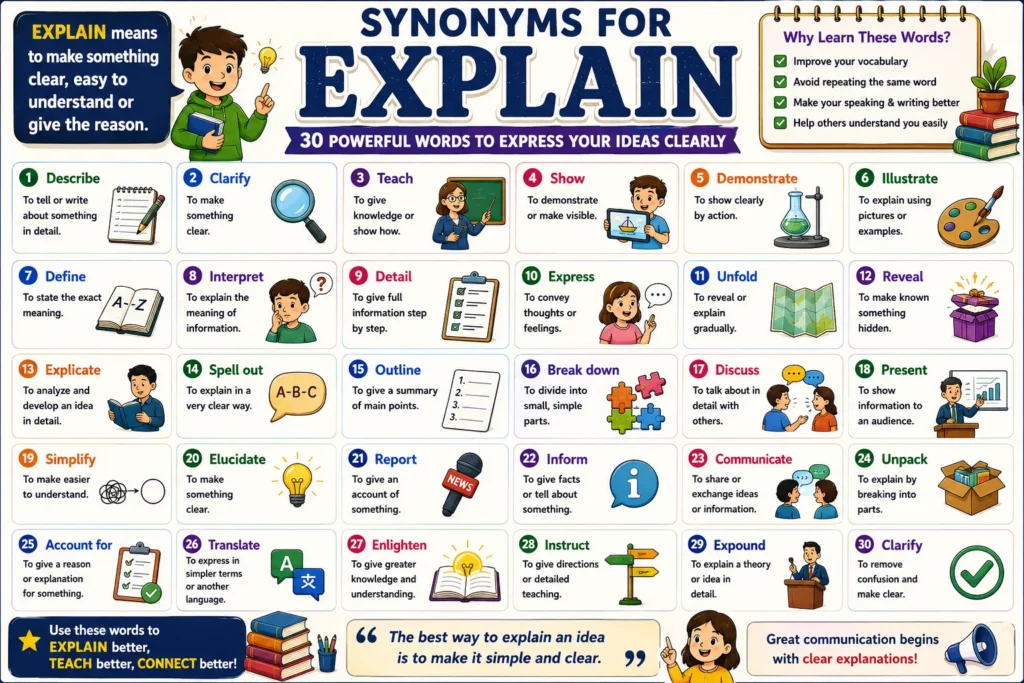
The word explain means to make something clear or easy to understand by describing it in detail. Imagine trying to solve a tricky puzzle or learn a brand-new game. When a friend shows you step-by-step how the pieces fit together until a lightbulb turns on in your head, that helpful action is what we call explain.
We use synonyms for explain every day to talk about teachers teaching a lesson. Scientists sharing how things work, or friends telling the rules of a sport. Learning new ways to say explain and synonyms for explain helps make their writing detailed and clear.
This guide gives you 30 simple synonyms for explain. Along with easy sentences, word origins, pronunciation guides, and clear categories designed just for young learners.
Meaning of Explain
Definition
Explain (Verb): To make an idea, situation, or problem clear to someone by describing it in detail or giving relevant facts.
Examples
- Please explain how to solve this math problem.
- The teacher used a diagram to explain the water cycle.
Connotative Meaning
- Positive tone: Shows helpfulness, clarity, learning, wisdom, and patience.
- Negative tone: None (it is a constructive educational action).
- Neutral tone: Describes sharing facts, giving steps, or presenting information.
Etymology
- Source language: Came from the Latin word explanare (meaning to make plain or flatten out).
- Latin: Made from ex- (meaning out) and planus (meaning flat or plain).
- Middle English (1350–1600): Adapted into English to mean making something smooth or plain to understand!
- Modern English (1500–Present): Used globally to mean making ideas clear to others.
Pronunciation
- US: /ɪkˈspleɪn/
- UK: /ɪkˈspleɪn/
Syllables
ex-plain (2 parts)
Affixation Pattern of Explain
- Root: Plain / Plan (meaning flat or clear)
- Prefix: Ex- (meaning out or thoroughly)
- Suffix: None
- Word Formation:
- Noun: Explanation, Explaining, Explainer
- Verb: Explain
- Adjective: Explanatory, Explainable, Unexplainable
- Adverb: Explainably
Also read more about https://synonymhubb.com/synonyms-for-persistent/
Synonyms for Explain
1. Describe (Verb) — US: /dɪˈskraɪb/ | UK: /dɪˈskraɪb/
Meaning: To tell or write about something in detail.
Examples:
Can you describe what your new puppy looks like?
She described her fun trip to the zoo.
2. Clarify (Verb) — US: /ˈklærəfaɪ/ | UK: /ˈklærɪfaɪ/
Meaning: To make something clear and easier to understand.
Examples:
The teacher helped clarify the homework rules.
Please clarify your answer so everyone understands.
3. Teach (Verb) — US: /tiːtʃ/ | UK: /tiːtʃ/
Meaning: To give knowledge or show how to do something.
Examples:
My brother will teach me how to ride a bicycle.
She loves to teach science to young children.
4. Show (Verb) — US: /ʃoʊ/ | UK: /ʃəʊ/
Meaning: To demonstrate or make something visible and clear.
Examples:
He will show us how to fold a paper airplane.
The map shows the path to the park.
5. Demonstrate (Verb) — US: /ˈdɛmənstreɪt/ | UK: /ˈdemənstreɪt/
Meaning: To show clearly by giving proof or taking action.
Examples:
The chef will demonstrate how to bake a cake.
She demonstrated proper swimming technique.
6. Illustrate (Verb) — US: /ˈɪləstreɪt/ | UK: /ˈɪləstreɪt/
Meaning: To explain or make clear using pictures or examples.
Examples:
He used a drawing to illustrate his story.
The chart illustrates how plants grow over time.
7. Define (Verb) — US: /dɪˈfaɪn/ | UK: /dɪˈfaɪn/
Meaning: To state the exact meaning of a word or idea.
Examples:
A dictionary helps define new vocabulary words.
The rulebook will define how points are scored.
8. Interpret (Verb) — US: /ɪnˈtɜːrprət/ | UK: /ɪnˈtɜːprɪt/
Meaning: To explain the meaning of information or actions.
Examples:
She helped interpret the ancient symbols in the museum.
The guide will interpret the history of the castle.
9. Detail (Verb) — US: /dɪˈteɪl/ | UK: /ˈdiːteɪl/
Meaning: To give full information step by step.
Examples:
The manual will detail how to set up the toy.
She detailed her entire schedule for the week.
10. Express (Verb) — US: /ɪkˈsprɛs/ | UK: /ɪkˈspres/
Meaning: To convey thoughts or feelings in words.
Examples:
It is important to express your feelings clearly.
He expressed his ideas during the team meeting.
11. Unfold (Verb) — US: /ʌnˈfoʊld/ | UK: /ʌnˈfəʊld/
Meaning: To reveal or explain gradually over time.
Examples:
The author will unfold the mystery in the next chapter.
Let the story unfold step by step.
12. Reveal (Verb) — US: /rɪˈviːl/ | UK: /rɪˈviːl/
Meaning: To make known something that was hidden or secret.
Examples:
The magician will reveal how the trick works.
Science experiments reveal facts about nature.
13. Explicate (Verb) — US: /ˈɛksplɪkeɪt/ | UK: /ˈeksplɪkeɪt/
Meaning: To analyze and develop an idea in detail.
Examples:
The professor will explicate the poem line by line.
They tried to explicate the complicated theory.
14. Spell out (Phrasal Verb) — US: /spɛl aʊt/ | UK: /spel aʊt/
Meaning: To explain something in a very clear and explicit way.
Examples:
Do I need to spell out the safety guidelines again?
She spelled out the instructions so no one made mistakes.
15. Outline (Verb) — US: /ˈaʊtlaɪn/ | UK: /ˈaʊtlaɪn/
Meaning: To give a summary of the main points.
Examples:
The coach will outline the plan for the match.
She outlined her speech before presenting it.
16. Break down (Phrasal Verb) — US: /breɪk daʊn/ | UK: /breɪk daʊn/
Meaning: To divide information into small, simple parts.
Examples:
Let us break down this hard math topic together.
He broke down the steps for building the Lego set.
17. Discuss (Verb) — US: /dɪˈskʌs/ | UK: /dɪˈskʌs/
Meaning: To talk about something in detail with others.
Examples:
We will discuss the novel in our reading group.
The family met to discuss their vacation plans.
18. Present (Verb) — US: /prɪˈzɛnt/ | UK: /prɪˈzent/
Meaning: To offer or show information to an audience.
Examples:
She will present her science project to the class.
He presented his ideas clearly on the poster board.
19. Simplify (Verb) — US: /ˈsɪmpləfaɪ/ | UK: /ˈsɪmplɪfaɪ/
Meaning: To make something easier to understand or do.
Examples:
Try to simplify your answer so younger kids understand.
The teacher simplified the long lesson.
20. Elucidate (Verb) — US: /ɪˈluːsədeɪt/ | UK: /ɪˈluːsɪdeɪt/
Meaning: To make something clear; to throw light upon.
Examples:
The diagram helped elucidate the difficult scientific law.
He spoke clearly to elucidate his point.
21. Report (Verb) — US: /rɪˈpɔːrt/ | UK: /rɪˈpɔːt/
Meaning: To give a spoken or written account of something.
Examples:
She will report on the events of sports day.
The news anchor reported the daily weather update.
22. Inform (Verb) — US: /ɪnˈfɔːrm/ | UK: /ɪnˈfɔːm/
Meaning: To give facts or tell someone about something.
Examples:
Please inform the principal if you feel unwell.
The poster will inform students about the book fair.
23. Communicate (Verb) — US: /kəˈmjuːnəkeɪt/ | UK: /kəˈmjuːnɪkeɪt/
Meaning: To share or exchange information or ideas.
Examples:
Dolphins use sounds to communicate with each other.
Good writers know how to communicate clearly.
24. Unpack (Verb) — US: /ʌnˈpæk/ | UK: /ʌnˈpæk/
Meaning: To analyze and explain an idea in smaller parts.
Examples:
Let us unpack the main theme of this story.
The group will unpack the clues in the riddle.
25. Account for (Phrasal Verb) — US: /əˈkaʊnt fɔːr/ | UK: /əˈkaʊnt fɔː/
Meaning: To give a reason or explanation for something.
Examples:
He had to account for his late arrival to class.
Can you account for the missing game piece?
26. Translate (Verb) — US: /trænzˈleɪt/ | UK: /trænzˈleɪt/
Meaning: To express something in simpler terms or another language.
Examples:
She helped translate the hard words into simple terms.
He can translate Spanish storybooks into English.
27. Enlighten (Verb) — US: /ɪnˈlaɪtn/ | UK: /ɪnˈlaɪtn/
Meaning: To give someone greater knowledge and understanding.
Examples:
The documentary will enlighten viewers about space.
She hoped to enlighten her classmates about recycling.
28. Instruct (Verb) — US: /ɪnˈstrʌkt/ | UK: /ɪnˈstrʌkt/
Meaning: To give directions, orders, or detailed teaching.
Examples:
The coach will instruct us on proper running form.
Read the manual to see how it instructs you to build it.
29. Expound (Verb) — US: /ɪkˈspaʊnd/ | UK: /ɪkˈspaʊnd/
Meaning: To present and explain a theory or idea in detail.
Examples:
The speaker began to expound on environmental protection.
She loved to expound on her passion for art.
30. Clarify (Verb) — US: /ˈklærəfaɪ/ | UK: /ˈklærɪfaɪ/
Meaning: To remove confusion and make something easy to grasp.
Examples:
A quick example will clarify any confusion.
She called to clarify the location of the party.
Prototype Meaning
When children hear explain, they picture a teacher standing by a whiteboard. A helpful friend showing step-by-step how a gadget or game works until everything makes sense.
Prototype Categorization
- Everyday Teaching & Showing: Teach, Show, Demonstrate, Describe, Instruct, Inform.
- Making Things Simple & Clear: Clarify, Simplify, Spell out, Break down, Unpack, Translate.
- Giving Pictures & Details: Illustrate, Detail, Outline, Define, Present, Report.
- Deep & Academic Explanations: Interpret, Reveal, Unfold, Elucidate, Explicate, Expound, Enlighten, Account for.
- Sharing Ideas & Thoughts: Express, Discuss, Communicate.
Antonyms of Explain
- Confuse
- Hide
- Obscure
- Complicate
- Cover
- Conceal
Short Questions and Answers
- What does explain mean?
- It means to make an idea or situation clear by describing it in detail.
- When should I use explain?
- Use it when showing someone how something works, giving directions, or sharing facts.
- Is explain a good or bad word?
- It is a very positive and helpful word that promotes learning and communication.
- How is it different from similar words?
- Explain means making an idea clear, describe means giving details about how something looks or feels, and demonstrate means physically showing how to do it.
Conclusion
Synonyms of explain can help you share ideas in a clear and simple way. Words like clarify, describe, tell, show, and define can make your speaking and writing natural. Each synonym has a slightly different use so choosing the right word helps you express your meaning better. For English learners,synonyms for explain can improve vocabulary, communication, and confidence. Content writers can also use them to avoid repeating the same word in their articles. Try to learn a few synonyms each day and use them in simple sentences. With regular practice, you can use explain and its synonyms correctly.

I’m Zahid Abbas, an educator, researcher, and digital publishing strategist with a passion for linguistics, grammar, and clear communication. As a content creator and SEO specialist, I craft research-driven, reader-focused content that empowers learners and makes knowledge accessible worldwide.