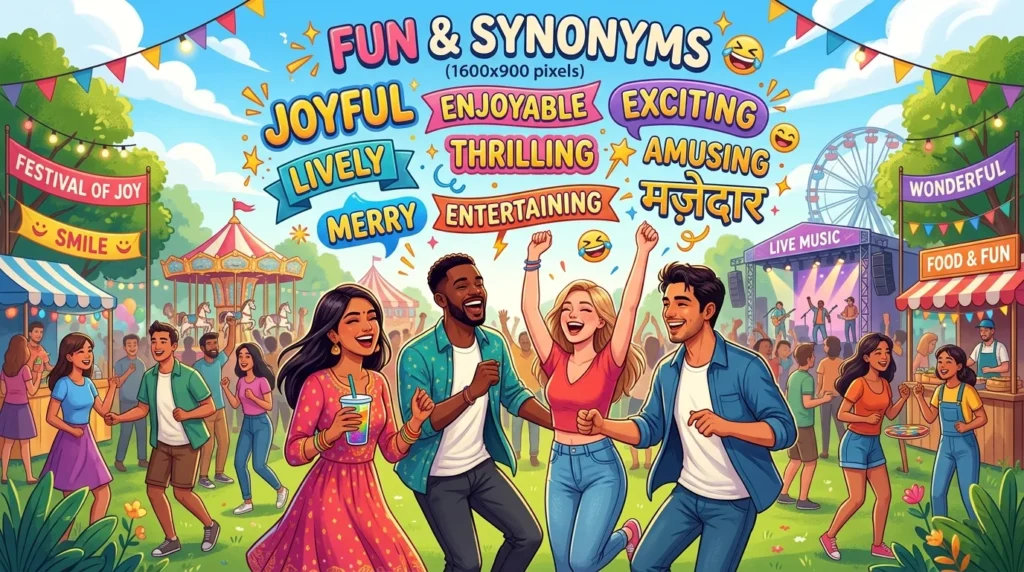

A synonym for fun is enjoyment, amusement, pleasure, entertainment, or delight. The best choice depends on the context. Use enjoyment for the feeling of having a good time, amusement for something entertaining, pleasure for a positive experience, and entertainment for an activity that interests or engages people.
Key Takeaways
- Enjoyment and amusement are two of the closest synonyms for fun.
- Use pleasure in more formal writing and entertainment when discussing activities or performances.
- Words such as thrill, excitement, and delight express more specific kinds of enjoyment.
- When describing an activity, use adjectives such as enjoyable, entertaining, or amusing.
- Choose a synonym based on your sentence, not simply because it appears in a thesaurus.
What Does Fun Mean?
The word fun describes enjoyment, pleasure, amusement, or an activity that people find entertaining. It can refer to a positive experience, an enjoyable activity, or playful behavior.
For example:
- We had fun at the beach.
- Playing video games is fun.
- The children filled the room with laughter and fun.
In the first sentence, fun describes an enjoyable experience. In the second, it describes an activity that gives pleasure. And in the third, it suggests playful behavior and happiness.
Cambridge Dictionary recognizes fun as both a noun and an informal adjective. Its meaning can change slightly depending on how it appears in a sentence.
definition in the Cambridge English Dictionary
+1
This distinction matters when choosing a synonym. You might replace the noun fun with enjoyment, but you would usually replace the adjective in “a fun activity” with enjoyable or entertaining.
25 Useful Synonyms for Fun
The following words offer different ways to express enjoyment, amusement, excitement, and pleasure.
Common Synonyms for Everyday Use
| Synonym | Meaning | Example sentence |
|---|---|---|
| 1. Enjoyment | The feeling of enjoying something | She gets great enjoyment from reading. |
| 2. Amusement | Enjoyment, often from something funny | His story provided plenty of amusement. |
| 3. Pleasure | A feeling of happiness or satisfaction | It was a pleasure to spend time with friends. |
| 4. Entertainment | Something that interests or engages people | The concert provided excellent entertainment. |
| 5. Delight | Strong happiness or pleasure | The children played with delight. |
| 6. Recreation | Activities done for relaxation | Hiking is her favorite form of recreation. |
| 7. Excitement | A feeling of enthusiasm or anticipation | The trip brought excitement to the whole family. |
| 8. Laughter | The sound or act of laughing | Their conversation was filled with laughter. |
| 9. Merriment | Cheerful, lively enjoyment | Music and merriment filled the hall. |
| 10. Good time | An enjoyable experience | We had a good time at the party. |
| 11. Playfulness | A lighthearted, playful quality | Her playfulness made the game more enjoyable. |
| 12. Diversion | An activity that takes your mind off routine | A short walk offered a welcome diversion. |
These words are not identical in every situation. Enjoyment and pleasure focus on the positive experience, while recreation refers to activities undertaken for relaxation. Merriment often suggests cheerful social activity.
Stronger and More Expressive Alternatives
| Synonym | Best use | Example sentence |
|---|---|---|
| 13. Thrill | A strong feeling of excitement | Riding the roller coaster was a thrill. |
| 14. Adventure | An exciting or unusual experience | Our camping trip became a real adventure. |
| 15. Blast | Informal expression for a very good time | We had a blast at the festival. |
| 16. Riot | Informal description of something extremely funny | The comedy show was a riot. |
| 17. Frolic | Playful, energetic activity | The puppies enjoyed a frolic in the yard. |
| 18. Revelry | Noisy celebration or lively enjoyment | The streets echoed with revelry after the victory. |
| 19. Good cheer | A cheerful, positive mood | The gathering was full of good cheer. |
| 20. Joy | A strong feeling of happiness | She found joy in playing music. |
| 21. Delightfulness | The quality of being delightful | The delightfulness of the experience surprised us. |
| 22. Recreation time | Time set aside for leisure activities | The school provides recreation time after lunch. |
| 23. Play | An activity done for enjoyment | The children spent the afternoon at play. |
| 24. Merrymaking | Lively celebration and social enjoyment | The wedding continued with music and merrymaking. |
| 25. Lightheartedness | A relaxed, cheerful attitude | His lightheartedness helped everyone feel comfortable. |
Quick tip: For everyday American English, start with enjoyment, amusement, pleasure, enjoyable, and entertaining. Choose more expressive words such as blast or thrill when the situation calls for them.
Best Synonyms for Fun by Context
The most suitable synonym depends on what you are describing and who will read your writing.
Synonyms for Fun in Formal Writing
In essays, reports, professional communication, or academic writing, fun may sound too casual for some situations. These alternatives can express the same general idea more precisely.
| Word | Best context | Example |
|---|---|---|
| Enjoyment | General positive experience | Participants reported high levels of enjoyment. |
| Pleasure | Personal satisfaction | She takes pleasure in learning new skills. |
| Recreation | Leisure activities | The park offers recreational opportunities. |
| Entertainment | Shows, events, and engaging activities | The program provides entertainment for visitors. |
| Satisfaction | A feeling that something meets your needs | Completing the project brought a sense of satisfaction. |
| Engagement | Active interest or involvement | The activity increased student engagement. |
Note that satisfaction and engagement are related concepts rather than exact synonyms for every meaning of fun. For example, a task can be engaging without being particularly enjoyable.
Synonyms for Fun as an Adjective
Sometimes, you need a word to describe a person, event, activity, or experience rather than the feeling itself.
Consider these alternatives:
- Enjoyable: A pleasant experience. Example: “We had an enjoyable afternoon.”
- Entertaining: Something that holds attention. Example: “The movie was entertaining.”
- Amusing: Something that makes people smile or laugh. Example: “He shared an amusing story.”
- Exciting: Something that creates enthusiasm or anticipation. Example: “It was an exciting game.”
- Engaging: Something that keeps people interested. Example: “The teacher planned an engaging lesson.”
- Lively: Full of energy and activity. Example: “The party had a lively atmosphere.”
- Playful: Showing a lighthearted or mischievous quality. Example: “The puppy has a playful personality.”
- Delightful: Something that gives considerable pleasure. Example: “We had a delightful evening.”
These alternatives help you avoid repeating fun in every sentence while keeping your meaning clear.
Fun vs. Enjoyment vs. Entertainment
Although these words overlap, they emphasize different aspects of a positive experience.
| Word | Main focus | Example |
|---|---|---|
| Fun | Informal, enjoyable experiences or activities | The game was fun. |
| Enjoyment | The feeling of liking an experience | She gets enjoyment from gardening. |
| Entertainment | Something that interests or amuses an audience | The show provided entertainment. |
| Pleasure | A positive feeling or satisfaction | It was a pleasure to meet you. |
| Amusement | Enjoyment, often through humor | The cartoon caused great amusement. |
| Excitement | Strong enthusiasm or anticipation | The announcement created excitement. |
For example, watching a movie can be fun, the feeling you get from watching it can be enjoyment, and the movie itself can be a form of entertainment.
The words sometimes work interchangeably, but their emphasis differs. Oxford Learner’s Dictionaries also distinguishes the informal use of fun from the more formal words pleasure and enjoyment.
Oxford Learner’s Dictionaries
+1
How to Use Synonyms for Fun in a Sentence
Replacing fun with a more precise word can make your writing clearer and more natural. Here are examples for everyday situations.
1. Talking about a party
- Original: “We had so much fun at the party.”
- Alternative: “We had a wonderful time at the party.”
- More expressive: “We had a blast at the party.”
2. Describing a school activity
- Original: “The science experiment was fun.”
- Alternative: “The science experiment was enjoyable.”
- More specific: “The science experiment was engaging.”
3. Describing a movie
- Original: “The movie was fun.”
- Alternative: “The movie was entertaining.”
- If it made you laugh: “The movie was amusing.”
4. Writing a professional message
- Original: “I had fun working with your team.”
- Alternative: “I enjoyed working with your team.”
- More formal: “It was a pleasure working with your team.”
5. Describing a vacation
- Original: “We had fun during our vacation.”
- Alternative: “We had a wonderful time during our vacation.”
- More expressive: “Our vacation was an exciting adventure.”
The key is to preserve the original meaning. A relaxing afternoon might be pleasant without being exciting, while a roller coaster ride might be thrilling rather than simply enjoyable.
Common Mistakes When Choosing a Synonym for Fun
1. Using “Funny” When You Mean “Fun”
Fun and funny have different meanings.
- “The party was fun.” This means the party was enjoyable.
- “The comedian was funny.” This means the comedian made people laugh.
A party can be fun without being funny, and a joke can be funny without creating an enjoyable experience for everyone.
Cambridge Dictionary specifically distinguishes fun as enjoyment from funny as something humorous.
definition in the Cambridge English Dictionary
+1
2. Assuming Every Synonym Fits Every Sentence
Consider these examples:
- Natural: “The children enjoyed the playground.”
- Natural: “The children had fun at the playground.”
- Less natural: “The children had entertainment at the playground.”
Entertainment is usually a better fit when describing a show, performance, or activity provided for an audience. It does not replace fun naturally in every sentence.
3. Using Informal Words in Formal Writing
Expressions such as a blast and a riot are common in casual American English, but they may not suit a formal report.
Instead of writing “The workshop was a blast,” you could write “The workshop was engaging and enjoyable.”
4. Confusing Excitement With Enjoyment
An exciting activity creates enthusiasm or anticipation. An enjoyable activity gives pleasure. The two often overlap, but they are not identical.
For example, a peaceful walk through a garden may be enjoyable without being exciting. Choose the word that reflects the actual experience.
Frequently Asked Questions
What is the best synonym for fun?
Enjoyment is one of the closest synonyms for fun when describing a positive experience. Amusement works well when humor is involved, while pleasure is useful in more formal writing. The best choice depends on the sentence and the type of experience you want to describe.
What is another word for fun and exciting?
Words such as thrilling, exhilarating, and adventurous can describe experiences that are both enjoyable and exciting. For casual conversation, you could say “a blast” or “an amazing time.” For example, “The trip was thrilling” emphasizes excitement more strongly than the general word fun.
What is a formal word for fun?
Enjoyment, pleasure, and recreation are useful alternatives in formal writing. Use enjoyment for the experience of liking something, pleasure for a positive feeling, and recreation for leisure activities. Choose the word that matches the sentence rather than replacing fun automatically.
What is a synonym for fun as an adjective?
Common adjective alternatives include enjoyable, entertaining, amusing, engaging, delightful, and exciting. For example, instead of “We had a fun evening,” you could write “We had an enjoyable evening.” If the evening involved a great performance, entertaining may be more precise.
Is fun the same as funny?
No. Fun means enjoyable or entertaining, while funny usually means humorous or laugh-inducing. A day at the beach can be fun even if nobody tells a joke. Likewise, a joke can be funny even if you do not enjoy the situation in which it is told.
What is a stronger word for fun?
The best stronger alternative depends on the experience. Thrilling emphasizes excitement, delightful expresses strong pleasure, and exhilarating suggests intense energy or excitement. In casual American English, a blast is a natural expression for a particularly enjoyable time.
What are some positive words similar to fun?
Positive alternatives include joyful, enjoyable, delightful, entertaining, amusing, lively, and exciting. Each highlights a different quality. Joyful emphasizes happiness, lively suggests energy, and entertaining means something holds people’s attention or provides amusement.
Conclusion
The best answer to “what is a synonym for fun?” is usually enjoyment, amusement, or pleasure. However, the right word depends on the context. Use entertaining for something that holds attention, thrilling for an exciting experience, and enjoyable to describe an activity that gives pleasure.
Instead of repeating fun throughout your writing, choose words that express exactly what you mean. This small change can make your conversations, school assignments, professional messages, and creative writing clearer and more natural.

Samuel T. Brooks.I am presented as a calm and knowledgeable English language expert with a sharp focus on vocabulary and synonyms. My profile image reflects clarity, trust, and academic confidence. The book-lined background and natural lighting give a scholarly yet friendly impression, ideal for an educational English content platform.