The word please is one of the most common words in the English language. It is primarily used as an adverb or interjection to express politeness, courtesy, or respect when making a request or asking for assistance. Imagine a customer ordering coffee at a busy cafe saying “A cup of coffee, please” immediately transforms a direct demand into a polite interaction. Beyond polite requests, please also functions as a verb meaning to give pleasure, satisfaction, or delight to someone. Learning synonyms for please helps writers, students, and professionals vary their tone. Write more persuasive requests, and communicate effectively across formal, casual, and professional contexts. This comprehensive guide covers the meaning of please. Its history, pronunciations, grammar rules, and thirty useful synonyms for please and courteous alternatives.
Meaning of Please
Definition
Please (Adverb / Interjection / Verb):
- As an adverb/interjection: Used as a polite addition to requests, commands, or offers.
- As a verb: To cause satisfaction, pleasure, or delight; to give enjoyment to someone.
Examples
- Could you please pass the salt across the dining table?
- The musician played a lively song that managed to please the entire audience.
Connotative Meaning
- Positive tone:
- Expresses respect, good manners, friendliness, empathy, and satisfaction.
- Negative tone:
- Can sound sarcastic, exasperated, or passive-aggressive when spoken with irritation (e.g., “Oh, please!”).
- Neutral tone:
- Functions as a standard marker of polite social etiquette in daily interactions.
Etymology
- Origin: Derived from the Anglo-French plaisir and Old French plaisir (to please), coming from the Latin placere (to be acceptable or agreeable).
- Old English (450–1100): Early speakers used phrases like seðe wile (if it be your will) or Germanic polite phrasing rather than the word please.
- Middle English (1100–1500): Adopted as plesen, meaning to satisfy or be agreeable to someone.
- Modern English (1500–Present): Shortened from historical polite conditional phrases like “if it please you” into the standalone polite adverb used globally.
Pronunciation
- US: /pliːz/
- UK: /pliːz/
Syllables
please (1 part)
Affixation Pattern of Please
- Root: Please
- Prefix: Dis- (Displease)
- Suffix: -ant (Pleasant), -ed (Pleased), -ure (Pleasure), -ing (Pleasing)
- Word Formation:
- Noun: Pleasure, Pleasantness
- Verb: Please, Displease
- Adjective: Pleased, Pleasing, Pleasant, Pleasurable
- Adverb: Pleasantly, Pleasurably
Also get more information about https://synonymhubb.com/synonyms-for-required/
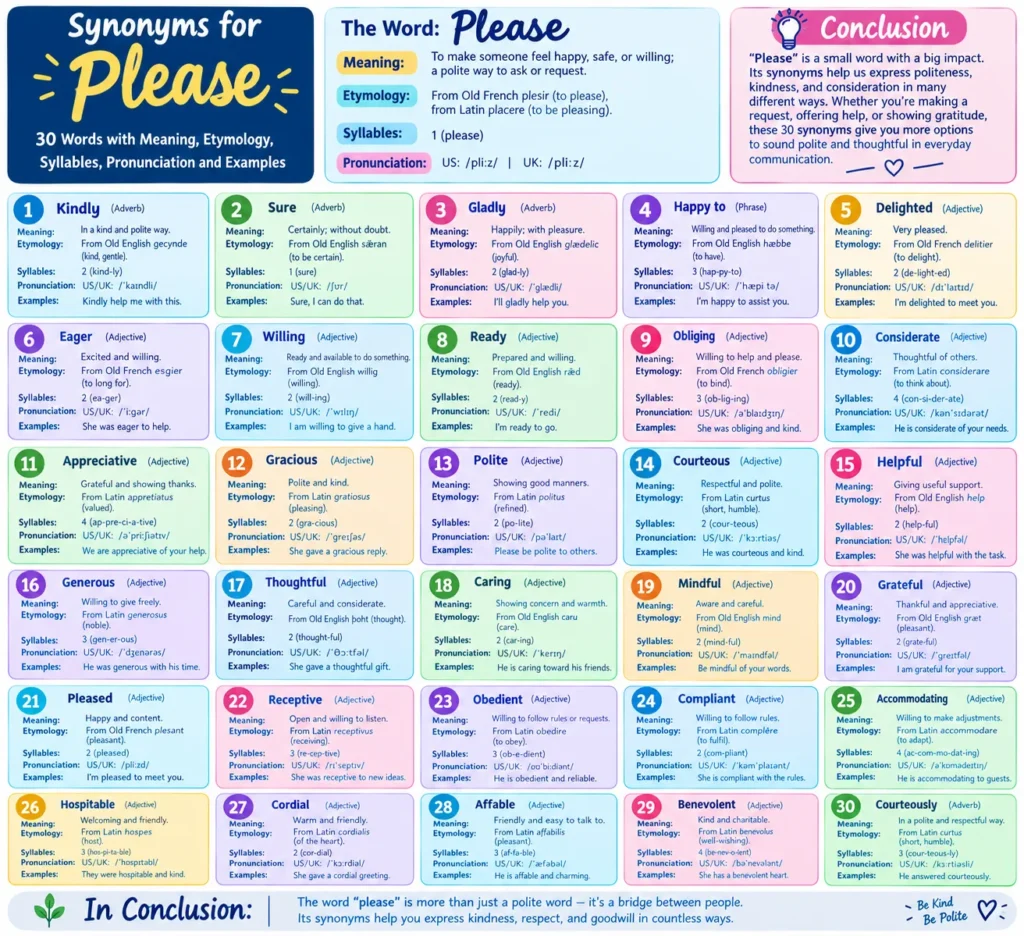
Synonyms and Polite Alternatives for Please
1. Kindly (Adverb) — US: /ˈkaɪndli/ | UK: /ˈkaɪndli/
Meaning: Used as a polite demand or request phrase.
Examples:
Kindly submit your completed forms by Friday afternoon.
Would you kindly refrain from talking during the movie?
2. If You Mind (Phrase) — US: /ɪf juː maɪnd/ | UK: /ɪf juː maɪnd/
Meaning: Used in negative conditional questions to ask permission politely.
Examples:
If you wouldn’t mind, could you open the window?
Let me know if you mind sharing the project notes.
3. Be So Kind As To (Phrase) — US: /biː soʊ kaɪnd æz tuː/ | UK: /biː səʊ kaɪnd æz tuː/
Meaning: A formal and traditional phrase used for requesting help.
Examples:
Would you be so kind as to hold the elevator door?
Please be so kind as to review the attached contract.
4. Delight (Verb) — US: /dɪˈlaɪt/ | UK: /dɪˈlaɪt/
Meaning: To give great pleasure or satisfaction to someone.
Examples:
The surprising puppet show managed to delight the young children.
Her wonderful singing voice continues to delight audiences everywhere.
5. Gratify (Verb) — US: /ˈɡrætɪfaɪ/ | UK: /ˈɡrætɪfaɪ/
Meaning: To give pleasure or satisfaction to a desire or person.
Examples:
It will gratify the parents to see their daughter graduate today.
He worked hard to gratify his client’s specific expectations.
6. Satisfy (Verb) — US: /ˈsætɪsfaɪ/ | UK: /ˈsætɪsfaɪ/
Meaning: To meet expectations, desires, or needs completely.
Examples:
The new lunch menu aims to satisfy every guest.
This explanation should satisfy all of your remaining questions.
7. Charm (Verb) — US: /tʃɑːrm/ | UK: /tʃɑːm/
Meaning: To attract, delight, or please someone greatly with personality.
Examples:
The friendly host tried to charm every guest in attendance.
Her warm smile helped charm the entire interviewing panel.
8. Gladden (Verb) — US: /ˈɡlædn/ | UK: /ˈɡlædn/
Meaning: To make someone glad or bring joy to their heart.
Examples:
The uplifting news will gladden the hearts of community members.
It will gladden him to know his team won the trophy.
9. Content (Verb) — US: /kənˈtɛnt/ | UK: /kənˈtent/
Meaning: To make someone feel peaceful, happy, and satisfied.
Examples:
A warm cup of tea can content a tired worker.
She was happy to content herself with a good book.
10. Indulge (Verb) — US: /ɪnˈdʌldʒ/ | UK: /ɪnˈdʌldʒ/
Meaning: To yield to or satisfy a desire or request patiently.
Examples:
Please indulge me for a moment while I explain the rules.
The grandparents love to indulge the children with treats.
11. Oblige (Verb) — US: /əˈblaɪdʒ/ | UK: /əˈblaɪdʒ/
Meaning: To do a favor or service for someone to meet a request.
Examples:
The hotel staff was happy to oblige our request for extra pillows.
Could you oblige us with a song on the piano?
12. Suits You (Phrase) — US: /suːts juː/ | UK: /sjuːts juː/
Meaning: To be convenient, agreeable, or flattering to someone.
Examples:
We can meet whenever it suits you best this week.
If it suits you, we can begin the meeting early.
13. If You Would (Phrase) — US: /ɪf juː wʊd/ | UK: /ɪf juː wʊd/
Meaning: A polite shortened request phrasing used in speech.
Examples:
Take a seat right over here, if you would.
Hand me that folder from the desk, if you would.
14. If You Please (Phrase) — US: /ɪf juː pliːz/ | UK: /ɪf juː pliːz/
Meaning: An old-fashioned or stylized phrase for polite requests.
Examples:
Step this way, if you please, to view the museum exhibit.
Silence in the courtroom, if you please.
15. Amuse (Verb) — US: /əˈmjuːz/ | UK: /əˈmjuːz/
Meaning: To entertain someone or make them laugh pleasantly.
Examples:
The clever magician tried to amuse the crowd with tricks.
Funny bedtime stories always amuse young readers.
16. Captivate (Verb) — US: /ˈkæptɪveɪt/ | UK: /ˈkæptɪveɪt/
Meaning: To hold someone’s attention by being charming or interesting.
Examples:
The beautiful painting will captivate visitors at the gallery.
His exciting adventure tales captivate everyone in the room.
17. Entertain (Verb) — US: /ˌɛntərˈteɪn/ | UK: /ˌentəˈteɪn/
Meaning: To provide enjoyment, amusement, or hospitality.
Examples:
They hired a band to entertain guests at the wedding.
Good movies aim to entertain viewers of all ages.
18. Enchant (Verb) — US: /ɪnˈtʃænt/ | UK: /ɪnˈtʃɑːnt/
Meaning: To fill someone with delight and fascination.
Examples:
The magical garden tour will enchant plant lovers.
Her soft lullaby managed to enchant the crying baby.
19. Thrill (Verb) — US: /θrɪl/ | UK: /θrɪl/
Meaning: To cause someone to experience sudden excitement or pleasure.
Examples:
The fast roller coaster ride will thrill adventure seekers.
It will thrill the fans to see their team play live.
20. Appease (Verb) — US: /əˈpiːz/ | UK: /əˈpiːz/
Meaning: To pacify or satisfy someone by meeting their demands.
Examples:
The company offered refunds to appease unhappy customers.
He tried to appease his manager by finishing the report early.
21. Mollify (Verb) — US: /ˈmɑːlɪfaɪ/ | UK: /ˈmɒlɪfaɪ/
Meaning: To soften the anger or anxiety of someone.
Examples:
A sincere apology helped to mollify the upset client.
The manager spoke calmly to mollify the angry crowd.
22. Pacify (Verb) — US: /ˈpæsɪfaɪ/ | UK: /ˈpæsɪfaɪ/
Meaning: To bring peace, calm, or satisfaction to an angry person.
Examples:
The gentle rocking helped pacify the restless toddler.
Officers tried to pacify the crowd with calm instructions.
23. Suitably (Adverb) — US: /ˈsuːtəbli/ | UK: /ˈsjuːtəbli/
Meaning: In a manner that is appropriate or pleasing for the situation.
Examples:
The hall was suitably decorated for the festive celebration.
He was suitably impressed by her outstanding test scores.
24. Be Good Enough To (Phrase) — US: /biː ɡʊd ɪˈnʌf tuː/ | UK: /biː ɡʊd ɪˈnʌf tuː/
Meaning: A polite way to ask a favor in formal correspondence.
Examples:
Would you be good enough to send over the report today?
Please be good enough to confirm your travel itinerary.
25. Pray (Interjection) — US: /preɪ/ | UK: /preɪ/
Meaning: An archaic or formal word used to mean “please tell me” or “I request.”
Examples:
What, pray, is the meaning of this unexpected meeting?
Tell us, pray, how you managed to solve the puzzle.
26. Favor Us With (Phrase) — US: /ˈfeɪvər ʌs wɪð/ | UK: /ˈfeɪvər ʌs wɪð/
Meaning: A polite and formal request asking someone to present or share something.
Examples:
Would you favor us with a few words of advice?
We hope the speaker will favor us with a presentation soon.
27. Do Me The Favor Of (Phrase) — US: /duː miː ðə ˈfeɪvər ʌv/ | UK: /duː miː ðə ˈfeɪvər ɒv/
Meaning: A direct yet courteous way to ask for assistance.
Examples:
Would you do me the favor of double-checking these figures?
Please do me the favor of holding my seat for a minute.
28. If It Pleases You (Phrase) — US: /ɪf ɪt ˈpliːzɪz juː/ | UK: /ɪf ɪt ˈpliːzɪz juː/
Meaning: Formal phrase offering choices or showing deference.
Examples:
We can tour the art gallery first, if it pleases you.
The driver will wait outside, if it pleases you.
29. Tickle (Verb) — US: /ˈtɪkl/ | UK: /ˈtɪkl/
Meaning: To amuse or excite someone pleasantly (often in “tickle pink”).
Examples:
The funny joke served to tickle the audience’s sense of humor.
It will tickle her to know she received the top award.
30. Regale (Verb) — US: /rɪˈɡeɪl/ | UK: /rɪˈɡeɪl/
Meaning: To entertain or please someone with talk, stories, or food.
Examples:
Grandpa loves to regale the family with stories of his youth.
The host worked to regale the visitors with a feast.
Prototype Meaning
When people hear please, they typically imagine a polite person making a respectful request, such as asking a favor, making a purchase at a counter, or writing a polite professional email. Alternatively, people imagine satisfying or delighting someone when using please or synonyms for please as a verb.
Prototype Categorization
- Polite Request Markers & Phrases:
- Kindly, If You Mind, Be So Kind As To, If You Would, If You Please, Be Good Enough To, Pray, Do Me The Favor Of.
- To Give Pleasure & Satisfaction (Verbs):
- Delight, Gratify, Satisfy, Gladden, Content, Indulge, Oblige, Suits You.
- To Charm & Entertain (Verbs):
- Charm, Amuse, Captivate, Entertain, Enchant, Thrill, Tickle, Regale.
- To Calm or Pacify (Verbs):
- Appease, Mollify, Pacify, Suitably.
Antonyms of Please
- Displease
- Annoy
- Offend
- Disgust
- Refuse
- Insult
Short Questions and Answers
- What does please mean?
- It is an adverb/interjection used to make polite requests, or a verb meaning to satisfy, delight, or give enjoyment to someone.
- When should please be used?
- Use please or synonyms for please whenever you want to show polite manners in requests, ask favors, or describe making someone satisfied or happy.
- Is please positive or negative?
- It is overwhelmingly positive and respectful, though synonyms for please can carry a sarcastic tone if spoken with annoyance in spoken English.
- How is please different from kindly?
- Please is a general polite word used in everyday speech and writing. Whereas kindly is often used in formal, written, or official instructions (and can sometimes sound strict if used in commands).
Conclusion
Synonyms for please will enhance your writing and everyday conversation! Relying on the same polite word in every email or sentence can feel repetitive. Utilizing precise alternatives for synonyms for please such as kindly for formal requests, delight for expressing joy, or oblige for professional correspondence makes your communication clear. Practice incorporating a few of these synonyms for please into your daily writing. And also in speeches to expand your English skills with confidence. English learners and content writers can improve their vocabulary, writing, and speaking skills by learning synonyms for please.

I’m Zahid Abbas, an educator, researcher, and digital publishing strategist with a passion for linguistics, grammar, and clear communication. As a content creator and SEO specialist, I craft research-driven, reader-focused content that empowers learners and makes knowledge accessible worldwide.