Learning new words is one of the best ways to improve your English. The word book is one of the most common words in everyday language. We use it when talking about reading, studying, learning, and sharing information. Imagine a student sitting in a library preparing for an exam. The student opens a book and starts reading. In this situation, the word fits naturally and clearly.
Because the word book appears so often in conversations, writing, education, and publishing, it is useful to know its synonyms. Learning synonyms helps English learners express ideas more accurately and avoid repeating the same word again and again. It also helps content writers create richer and more engaging content. In this article, you will learn the meaning of book, its pronunciation, history, grammar, connotation, and 30 useful synonyms with examples. You will also discover categories of related words and antonyms to strengthen your vocabulary.
Meaning of Book
Definition
Book (Noun):
A written or printed work consisting of pages bound together, usually containing information, stories, or knowledge.
Examples
- I borrowed a book from the library yesterday.
- She enjoys reading a good book before bed.
Connotative Meaning
- Positive tone: Learning, knowledge, wisdom, education, imagination.
- Negative tone: Can suggest difficult study or heavy academic work in some contexts.
- Neutral tone: A collection of written pages containing information or stories.
Etymology
- Origin: Old English bōc
- Source Language: Proto-Germanic bōks
- Original Meaning: Written document, letter, or written record.
Short History of the Keyword
- Old English (450–1100): The word appeared as bōc, meaning a written text or document.
- Middle English (1100–1500): Spelling gradually changed to book.
- Modern English (1500–Present): The word became the standard term for printed and written works.
Pronunciation (US & UK – IPA)
US: /bʊk/
UK: /bʊk/
Syllables
book
Affixation Pattern of Book
Root: book
Prefix: None
Suffix: None
Word Formation of the Keyword
- Book (Noun) – a written work
- Book (Verb) – to reserve or arrange
- Books (Noun, Plural) – multiple books
- Booked (Verb) – reserved in the past
- Booking (Noun/Verb) – the act of reserving
- Booklet (Noun) – a small book
- Bookseller (Noun) – a person who sells books
- Bookshelf (Noun) – furniture for holding books
- Bookstore (Noun) – a shop selling books
- Bookish (Adjective) – fond of reading and studying
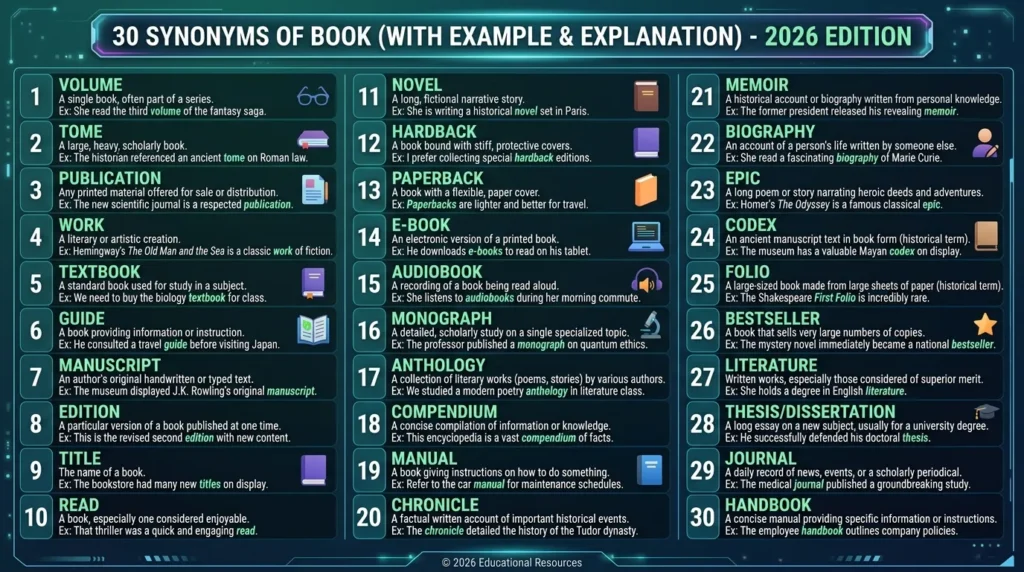
30 Synonyms of Book
1. Volume (Noun)
US: /ˈvɑːljuːm/ | UK: /ˈvɒljuːm/
Meaning: A single book, especially one in a series.
Examples:
- I bought the final volume of the series.
- The library contains thousands of volumes.
2. Publication (Noun)
US: /ˌpʌblɪˈkeɪʃən/ | UK: /ˌpʌblɪˈkeɪʃən/
Meaning: A printed or digital work released to the public.
Examples:
- The publication received excellent reviews.
- Her latest publication became a bestseller.
3. Text (Noun)
US: /tekst/ | UK: /tekst/
Meaning: Written material used for reading or study.
Examples:
- Students analyzed the text carefully.
- The text explains the topic clearly.
4. Textbook (Noun)
US: /ˈtekstbʊk/ | UK: /ˈtekstbʊk/
Meaning: A book used for educational purposes.
Examples:
- This textbook covers biology.
- She forgot her textbook at home.
5. Manual (Noun)
US: /ˈmænjuəl/ | UK: /ˈmænjuəl/
Meaning: A book containing instructions.
Examples:
- Read the manual before using the machine.
- The manual explains every step.
6. Guide (Noun)
US: /ɡaɪd/ | UK: /ɡaɪd/
Meaning: A book that provides information or advice.
Examples:
- We bought a travel guide.
- The guide helped us explore the city.
7. Handbook (Noun)
US: /ˈhændbʊk/ | UK: /ˈhændbʊk/
Meaning: A compact reference book.
Examples:
- Employees received a handbook.
- The handbook answers common questions.
8. Reference (Noun)
US: /ˈrefrəns/ | UK: /ˈrefrəns/
Meaning: A source of information for consultation.
Examples:
- This dictionary is a useful reference.
- The reference contains detailed facts.
9. Dictionary (Noun)
US: /ˈdɪkʃəneri/ | UK: /ˈdɪkʃənəri/
Meaning: A book explaining word meanings.
Examples:
- Use a dictionary to check spelling.
- The dictionary contains new words.
10. Encyclopedia (Noun)
US: /ɪnˌsaɪkləˈpiːdiə/ | UK: /ɪnˌsaɪkləˈpiːdiə/
Meaning: A reference book containing information on many subjects.
Examples:
- The encyclopedia covers world history.
- Children enjoy exploring the encyclopedia.
11. Novel (Noun)
US: /ˈnɑːvəl/ | UK: /ˈnɒvəl/
Meaning: A long fictional story.
Examples:
- She wrote a mystery novel.
- The novel became famous worldwide.
12. Storybook (Noun)
US: /ˈstɔːribʊk/ | UK: /ˈstɔːribʊk/
Meaning: A book containing stories.
Examples:
- The child loves storybooks.
- We read a storybook together.
13. Workbook (Noun)
US: /ˈwɜːrkbʊk/ | UK: /ˈwɜːkbʊk/
Meaning: A book containing exercises.
Examples:
- Complete page ten in the workbook.
- The workbook improves practice skills.
14. Journal (Noun)
US: /ˈdʒɜːrnəl/ | UK: /ˈdʒɜːnəl/
Meaning: A record of thoughts or events.
Examples:
- She writes in her journal daily.
- The journal contains personal reflections.
15. Diary (Noun)
US: /ˈdaɪəri/ | UK: /ˈdaɪəri/
Meaning: A personal record of daily experiences.
Examples:
- He keeps a diary.
- The diary describes her travels.
16. Record (Noun)
US: /ˈrekərd/ | UK: /ˈrekɔːd/
Meaning: Written information kept for future use.
Examples:
- The record shows all transactions.
- Keep a record of your expenses.
17. Chronicle (Noun)
US: /ˈkrɑːnɪkəl/ | UK: /ˈkrɒnɪkəl/
Meaning: A detailed historical account.
Examples:
- The book is a chronicle of events.
- Historians value the chronicle.
18. Treatise (Noun)
US: /ˈtriːtɪs/ | UK: /ˈtriːtɪs/
Meaning: A formal written work on a subject.
Examples:
- He published a treatise on law.
- The treatise explains the theory.
19. Thesis (Noun)
US: /ˈθiːsɪs/ | UK: /ˈθiːsɪs/
Meaning: A long academic research document.
Examples:
- She submitted her thesis.
- The thesis required years of study.
20. Dissertation (Noun)
US: /ˌdɪsərˈteɪʃən/ | UK: /ˌdɪsəˈteɪʃən/
Meaning: A detailed academic research paper.
Examples:
- His dissertation won an award.
- The dissertation presents original research.
21. Monograph (Noun)
US: /ˈmɑːnəɡræf/ | UK: /ˈmɒnəɡrɑːf/
Meaning: A detailed study of one subject.
Examples:
- The scholar wrote a monograph.
- The monograph examines the topic deeply.
22. Pamphlet (Noun)
US: /ˈpæmflət/ | UK: /ˈpæmflət/
Meaning: A small informational booklet.
Examples:
- The museum gave visitors a pamphlet.
- Read the pamphlet for details.
23. Booklet (Noun)
US: /ˈbʊklət/ | UK: /ˈbʊklət/
Meaning: A small book.
Examples:
- The booklet contains instructions.
- We received a booklet at the event.
24. Script (Noun)
US: /skrɪpt/ | UK: /skrɪpt/
Meaning: Written text for a performance.
Examples:
- The actor studied the script.
- The script was revised several times.
25. Catalogue (Noun)
US: /ˈkætəlɔːɡ/ | UK: /ˈkætəlɒɡ/
Meaning: A list of items in book form.
Examples:
- The catalogue shows new products.
- Customers received a catalogue.
26. Compendium (Noun)
US: /kəmˈpendiəm/ | UK: /kəmˈpendiəm/
Meaning: A collection of information.
Examples:
- The compendium summarizes key facts.
- Students used the compendium.
27. Anthology (Noun)
US: /ænˈθɑːlədʒi/ | UK: /ænˈθɒlədʒi/
Meaning: A collection of literary works.
Examples:
- The anthology contains poems.
- She edited a famous anthology.
28. Reader (Noun)
US: /ˈriːdər/ | UK: /ˈriːdə/
Meaning: A book of selected readings.
Examples:
- Students used the English reader.
- The reader includes short stories.
29. Ledger (Noun)
US: /ˈledʒər/ | UK: /ˈledʒə/
Meaning: A book used for financial records.
Examples:
- The accountant updated the ledger.
- The ledger tracks expenses.
30. Codex (Noun)
US: /ˈkoʊdeks/ | UK: /ˈkəʊdeks/
Meaning: An ancient manuscript book.
Examples:
- The museum displayed a codex.
- Researchers studied the codex carefully.
Prototype Meaning
The most typical meaning of book is a collection of written or printed pages bound together. When people hear the word, they usually imagine a physical object with a cover, pages, and text that can be read for information, education, or entertainment using Synonyms of Book.
Prototype Categorization
- Educational Books: textbook, workbook, reader, manual, handbook
- Reference Works: dictionary, encyclopedia, reference, catalogue, compendium
- Literary Works: novel, anthology, storybook
- Academic Works: thesis, dissertation, monograph, treatise
- Records and Documents: journal, diary, ledger, record, chronicle
- Small Publications: pamphlet, booklet
- General Terms: volume, publication, text, guide, codex
Antonyms of Book
- Blank Page (Noun) – an empty page without written content
- Silence (Noun) – absence of written or spoken communication
- Illiteracy (Noun) – inability to read or write
- Ignorance (Noun) – lack of knowledge
- Unwritten (Adjective) – not recorded in writing
- Erase (Verb) – remove written information
Short Questions and Answers
- What does book mean?
A book is a written or printed work made of pages bound together. - When should book be used?
Use it when referring to written material for reading, learning, entertainment, or reference. - Is book positive or negative?
It is generally neutral, but it often has a positive association with learning and knowledge. - How is it different from similar words?
Book is a broad term. Words like novel, textbook, and dictionary refer to specific types of books.
Conclusion
Learning the Synonyms of Book and Synonyms of Book can greatly improve your English vocabulary. Knowing different alternatives allows you to express ideas more clearly and accurately. It also makes your writing and speaking more interesting by reducing repetition. Whether you are a student, writer, teacher, or English learner, understanding these related words can help you communicate with greater confidence. As you practice using these synonyms in daily conversations, reading, and writing, you will develop stronger language skills. Make vocabulary learning a daily habit, and over time you will notice significant improvement in your English fluency and expression.

I’m Zahid Abbas, an educator, researcher, and digital publishing strategist with a passion for linguistics, grammar, and clear communication. As a content creator and SEO specialist, I craft research-driven, reader-focused content that empowers learners and makes knowledge accessible worldwide.