The word thus is a common English word that means in this way, as a result, or therefore. Imagine a student studies hard for an exam and gets excellent grades. You might say, “She studied every day; thus, she passed with high marks.” In this sentence, thus shows the result of an action.
People use thus in writing, speeches, academic papers, and everyday communication because it helps connect ideas clearly. Learning synonyms of thus is important for English learners, students, writers, and content creators because it helps avoid repetition and makes communication more interesting.
In this article, you will learn the meaning of thus, its pronunciation, history, grammar, connotations, and 30 useful synonyms. You will also discover examples, categories, antonyms, and practical usage tips to strengthen your English vocabulary using Synonyms of Thus.
Meaning of Thus
Definition
Thus (Adverb):
A word used to show a result, consequence, manner, or way in which something happens.
Examples
- The road was closed; thus, we took another route.
- He practiced daily and thus became a skilled musician.
Connotative Meaning
- Positive tone: Can suggest logical success or achievement.
- Negative tone: Can introduce an unfortunate result.
- Neutral tone: Most commonly used to show a simple cause-and-effect relationship.
Etymology
- Origin: Old English
- Original Form: þus
- Original Meaning: “In this manner” or “so”
Short History of the Keyword
- Old English (450–1100): Used as þus, meaning “in this way.”
- Middle English (1100–1500): Spelling gradually changed to thus.
- Modern English (1500–Present): Widely used to indicate manner, result, or conclusion.
Pronunciation (US & UK – IPA)
US: /ðʌs/
UK: /ðʌs/
Syllables
thus
Affixation Pattern of Thus
Root: thus
Prefix: None
Suffix: None
Word Formation of the Keyword
- Thus (Adverb)
- Thusly (Adverb)
- Thusness (Noun, rare)
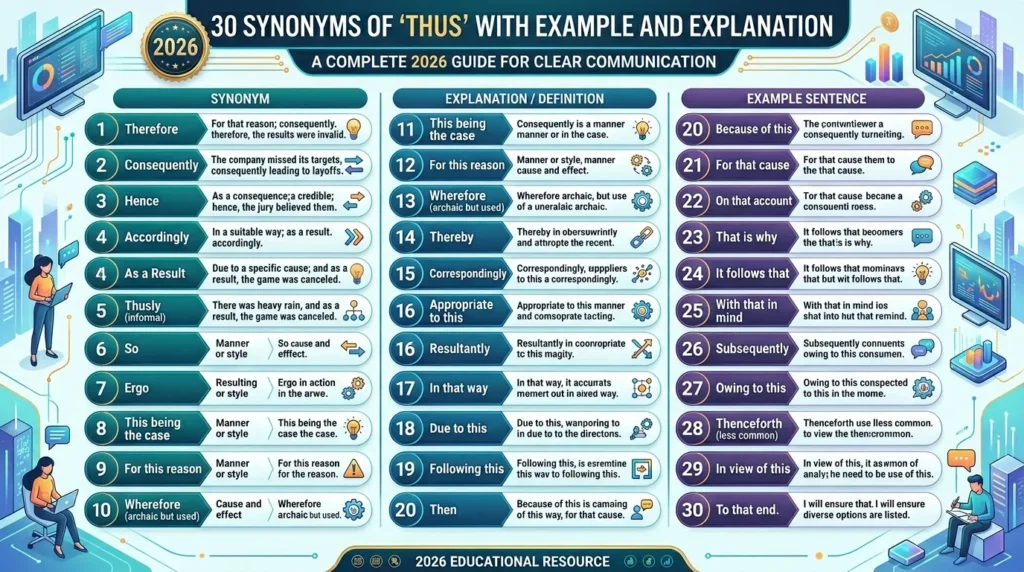
30 Synonyms of Thus
1. Therefore (Adverb)
US: /ˈðer.fɔːr/ | UK: /ˈðeə.fɔː/
Meaning: For that reason; as a result.
Examples:
- The weather was bad; therefore, the match was canceled.
- She worked hard; therefore, she succeeded.
2. Consequently (Adverb)
US: /ˈkɑːn.sə.kwənt.li/ | UK: /ˈkɒn.sɪ.kwənt.li/
Meaning: As a result of something.
Examples:
- He missed the train; consequently, he arrived late.
- Prices increased; consequently, sales declined.
3. Hence (Adverb)
US: /hens/ | UK: /hens/
Meaning: For this reason.
Examples:
- The evidence was weak; hence, the case failed.
- She was ill; hence, her absence.
4. Accordingly (Adverb)
US: /əˈkɔːr.dɪŋ.li/ | UK: /əˈkɔː.dɪŋ.li/
Meaning: In a way that matches the situation.
Examples:
- The plans changed; accordingly, we adjusted our schedule.
- Please act accordingly.
5. As a Result (Phrase)
US: /æz ə rɪˈzʌlt/ | UK: /æz ə rɪˈzʌlt/
Meaning: Because something happened.
Examples:
- It rained heavily; as a result, the event was delayed.
- He trained hard; as a result, he improved.
6. Therefore Then (Adverb)
US: /ˈðer.fɔːr ðen/ | UK: /ˈðeə.fɔː ðen/
Meaning: Consequently.
Examples:
- The rule applies; therefore then, we must follow it.
- The evidence is clear; therefore then, the decision stands.
7. Ergo (Adverb)
US: /ˈɜːr.ɡoʊ/ | UK: /ˈɜː.ɡəʊ/
Meaning: Therefore; consequently.
Examples:
- He is qualified; ergo, he got the job.
- The system failed; ergo, repairs were needed.
8. Wherefore (Adverb)
US: /ˈwer.fɔːr/ | UK: /ˈweə.fɔː/
Meaning: For which reason.
Examples:
- Nobody knew wherefore the change occurred.
- The cause was unclear, wherefore confusion spread.
9. Thereupon (Adverb)
US: /ˌðer.əˈpɑːn/ | UK: /ˌðeər.əˈpɒn/
Meaning: Immediately after that.
Examples:
- He signed the form and thereupon left.
- The meeting ended; thereupon everyone departed.
10. So (Adverb)
US: /soʊ/ | UK: /səʊ/
Meaning: As a result.
Examples:
- I was tired, so I went home.
- It was cold, so we stayed inside.
11. Then (Adverb)
US: /ðen/ | UK: /ðen/
Meaning: As a consequence.
Examples:
- If that is true, then we should proceed.
- The work is complete; then we can relax.
12. Thereby (Adverb)
US: /ˌðerˈbaɪ/ | UK: /ˌðeəˈbaɪ/
Meaning: By that means.
Examples:
- She improved efficiency, thereby saving money.
- He explained clearly, thereby reducing confusion.
13. Subsequently (Adverb)
US: /ˈsʌb.sə.kwənt.li/ | UK: /ˈsʌb.sɪ.kwənt.li/
Meaning: Afterward as a result.
Examples:
- The contract was signed and subsequently approved.
- He moved abroad and subsequently found work.
14. In Consequence (Phrase)
US: /ɪn ˈkɑːn.sə.kwəns/ | UK: /ɪn ˈkɒn.sɪ.kwəns/
Meaning: As a result.
Examples:
- The policy changed in consequence of the report.
- Costs rose in consequence of shortages.
15. For That Reason (Phrase)
US: /fɔːr ðæt ˈriː.zən/ | UK: /fɔː ðæt ˈriː.zən/
Meaning: Because of that.
Examples:
- She was experienced; for that reason, she was hired.
- The road was unsafe; for that reason, it was closed.
16. Accordingly Then (Adverb)
US: /əˈkɔːr.dɪŋ.li ðen/ | UK: /əˈkɔː.dɪŋ.li ðen/
Meaning: Therefore.
Examples:
- We prepared accordingly then continued.
- The rules changed accordingly then.
17. In This Way (Phrase)
US: /ɪn ðɪs weɪ/ | UK: /ɪn ðɪs weɪ/
Meaning: By this method.
Examples:
- In this way, mistakes can be avoided.
- The machine works in this way.
18. By This Means (Phrase)
US: /baɪ ðɪs miːnz/ | UK: /baɪ ðɪs miːnz/
Meaning: Through this method.
Examples:
- By this means, they solved the issue.
- Knowledge spreads by this means.
19. Henceforth (Adverb)
US: /ˌhensˈfɔːrθ/ | UK: /ˌhensˈfɔːθ/
Meaning: From this time onward.
Examples:
- Henceforth, the rule will apply.
- She promised to be punctual henceforth.
20. As Such (Phrase)
US: /æz sʌtʃ/ | UK: /æz sʌtʃ/
Meaning: In that capacity.
Examples:
- He is the manager and, as such, makes decisions.
- The document is official and, as such, important.
21. Thereafter (Adverb)
US: /ˌðerˈæf.tər/ | UK: /ˌðeərˈɑːf.tə/
Meaning: After that time.
Examples:
- They met once and thereafter remained friends.
- The law changed and thereafter improved conditions.
22. Consequently Thus (Adverb)
US: /ˈkɑːn.sə.kwənt.li ðʌs/ | UK: /ˈkɒn.sɪ.kwənt.li ðʌs/
Meaning: Therefore.
Examples:
- The evidence supported the claim; consequently thus, it was accepted.
- The risk increased; consequently thus, precautions were taken.
23. Accordingly So (Adverb)
US: /əˈkɔːr.dɪŋ.li soʊ/ | UK: /əˈkɔː.dɪŋ.li səʊ/
Meaning: Therefore.
Examples:
- The team adjusted accordingly so progress continued.
- We responded accordingly so delays were reduced.
24. Therefrom (Adverb)
US: /ˌðerˈfrʌm/ | UK: /ˌðeəˈfrɒm/
Meaning: From that source.
Examples:
- Benefits arose therefrom.
- Lessons were learned therefrom.
25. Resultantly (Adverb)
US: /rɪˈzʌl.tənt.li/ | UK: /rɪˈzʌl.tənt.li/
Meaning: As a result.
Examples:
- Demand increased; resultantly, production rose.
- Costs fell; resultantly, profits improved.
26. Therefore Accordingly (Adverb)
US: /ˈðer.fɔːr əˈkɔːr.dɪŋ.li/ | UK: /ˈðeə.fɔː əˈkɔː.dɪŋ.li/
Meaning: Consequently.
Examples:
- The facts were clear; therefore accordingly, action was taken.
- The need was urgent; therefore accordingly, help arrived.
27. For This Cause (Phrase)
US: /fɔːr ðɪs kɔːz/ | UK: /fɔː ðɪs kɔːz/
Meaning: Because of this reason.
Examples:
- For this cause, they postponed the meeting.
- For this cause, changes were necessary.
28. In Such a Way (Phrase)
US: /ɪn sʌtʃ ə weɪ/ | UK: /ɪn sʌtʃ ə weɪ/
Meaning: In that manner.
Examples:
- He explained it in such a way that everyone understood.
- The task was completed in such a way that errors were avoided.
29. Correspondingly (Adverb)
US: /ˌkɔːr.əˈspɑːn.dɪŋ.li/ | UK: /ˌkɒr.ɪˈspɒn.dɪŋ.li/
Meaning: In a matching way.
Examples:
- Expenses rose and income increased correspondingly.
- Demand changed correspondingly.
30. On That Account (Phrase)
US: /ɑːn ðæt əˈkaʊnt/ | UK: /ɒn ðæt əˈkaʊnt/
Meaning: For that reason.
Examples:
- He was absent; on that account, the meeting was delayed.
- The road was blocked; on that account, traffic increased.
Prototype Meaning
The most common meaning of thus is “as a result” or “therefore.” When people hear the word, they usually think of a logical connection between one event and another. It often introduces a conclusion, outcome, or consequence in Synonyms of Thus.
Prototype Categorization
- Result and consequence: therefore, consequently, hence, resultantly, for that reason.
- Method or manner: in this way, by this means, in such a way, thereby.
- Formal writing: ergo, wherefore, thereupon, therefrom.
- Everyday English: so, then, as a result.
- Time-related continuation: thereafter, subsequently, henceforth.
Antonyms of Thus
- Nevertheless (Adverb) — despite that.
- However (Adverb) — in contrast to what was expected.
- Yet (Adverb) — even so.
- Conversely (Adverb) — in an opposite way.
- Otherwise (Adverb) — if not.
- Regardless (Adverb) — without considering the circumstances.
- Nonetheless (Adverb) — despite what was said.
Short Questions and Answers
- What does thus mean?
It means therefore, as a result, or in this way. - When should thus be used?
Use it when showing a result, conclusion, or method. - Is thus positive or negative?
It is usually neutral. The tone depends on the surrounding context. - How is it different from similar words?
Thus is more formal than so and often appears in academic or professional writing.
Conclusion
Learning the Synonyms of Thus and its synonyms can greatly improve your English vocabulary. This useful word helps connect ideas, explain results, and make writing more logical. By understanding alternatives such as therefore, consequently, hence, and accordingly, you can avoid repeating the same word again and again. Strong vocabulary also makes speaking and writing more natural, professional, and engaging. Whether you are an English learner, student, blogger, or content writer, mastering thus and its related words will increase your confidence and communication skills. Practice using a new synonym every day, and over time your English will become richer, clearer, and more effective using Synonyms of Thus.

I’m Zahid Abbas, an educator, researcher, and digital publishing strategist with a passion for linguistics, grammar, and clear communication. As a content creator and SEO specialist, I craft research-driven, reader-focused content that empowers learners and makes knowledge accessible worldwide.