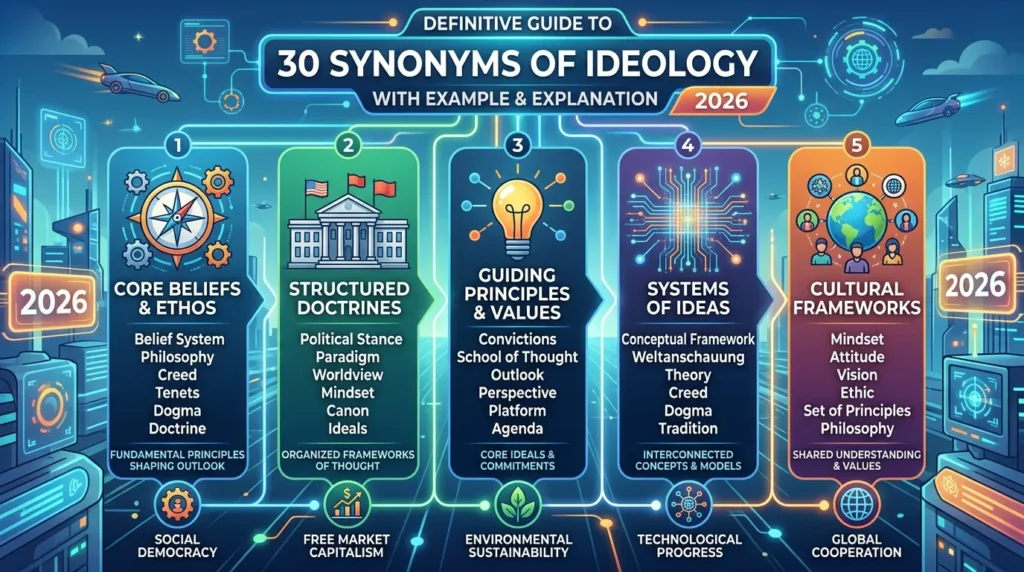
The word ideology means a system of ideas, beliefs, or values that guides how people think and act. Imagine a group of people working together because they share the same beliefs about society, education, or politics. Their shared ideology influences their decisions and goals.
People often use this word in politics, education, religion, philosophy, and social discussions. It is common because beliefs shape human behavior and opinions. However, using the same word many times can make writing repetitive and less engaging.
Learning synonyms of ideology helps English learners improve vocabulary and express ideas more clearly. It also helps writers choose the best word for formal, academic, or everyday communication. In this article, you will learn the meaning of ideology, its pronunciation, history, grammar, and 30 useful synonyms with examples.
You will also explore semantic categories, antonyms, and simple questions to strengthen your English skills.
Meaning of Ideology
Definition
Ideology (noun): a system of beliefs, ideas, or values that influences a person or group.
Examples
- The party follows a strong political ideology.
- Her ideology focuses on equality and freedom.
Connotative Meaning
(Connotation means the feeling or emotion a word suggests beyond its basic meaning.)
- Positive tone: principles, vision, guidance
- Negative tone: extremism, bias, rigid thinking
- Neutral tone: a set of beliefs or ideas
Etymology
- From French idéologie meaning “science of ideas”
- Derived from Greek idea meaning “form” or “concept” and logos meaning “study”
Short History:
- Old English (450–1100): no direct form of ideology existed
- Middle English (1100–1500): philosophical discussions about beliefs increased
- Modern English (1500–Present): “ideology” became widely used in politics and philosophy during the 18th century
Pronunciation (US & UK – IPA)
- US: /ˌaɪdiˈɑːlədʒi/
- UK: /ˌaɪdiˈɒlədʒi/
Syllables
- i-de-ol-o-gy
Affixation Pattern of Ideology
- Root: idea
- Prefix: none
- Suffix: -logy
Word Formation:
- idea (noun)
- ideological (adjective)
- ideologist (noun)
- ideologically (adverb)
- ideology (noun)
Synonyms of Ideology
1. Belief System (noun)
US: /bəˈliːf ˈsɪstəm/ | UK: /bɪˈliːf ˈsɪstəm/
Meaning: a group of connected beliefs
Examples:
- Every culture has a unique belief system.
- His belief system values honesty.
2. Philosophy (noun)
US: /fəˈlɑːsəfi/ | UK: /fɪˈlɒsəfi/
Meaning: a way of thinking about life and ideas
Examples:
- Her teaching philosophy is simple.
- The company follows a modern philosophy.
3. Doctrine (noun)
US: /ˈdɑːktrɪn/ | UK: /ˈdɒktrɪn/
Meaning: an official set of beliefs
Examples:
- The church teaches its doctrine carefully.
- Political doctrine shaped the movement.
4. Creed (noun)
US: /kriːd/ | UK: /kriːd/
Meaning: a guiding belief or principle
Examples:
- Honesty became his personal creed.
- The group followed a strict creed.
5. Worldview (noun)
US: /ˈwɜːrldvjuː/ | UK: /ˈwɜːldvjuː/
Meaning: a person’s way of seeing the world
Examples:
- Travel changed her worldview.
- Religion shaped his worldview.
6. Mindset (noun)
US: /ˈmaɪndset/ | UK: /ˈmaɪndset/
Meaning: a fixed way of thinking
Examples:
- Success requires a positive mindset.
- Her mindset helped her grow.
7. Principles (noun)
US: /ˈprɪnsəpəlz/ | UK: /ˈprɪnsəpəlz/
Meaning: moral rules or beliefs
Examples:
- He lives by strong principles.
- Their principles support fairness.
8. Values (noun)
US: /ˈvæljuːz/ | UK: /ˈvæljuːz/
Meaning: beliefs about what is important
Examples:
- Family values matter to her.
- The school teaches good values.
9. Theory (noun)
US: /ˈθiːəri/ | UK: /ˈθɪəri/
Meaning: a system of ideas explaining something
Examples:
- Scientists tested the theory.
- The political theory gained support.
10. Dogma (noun)
US: /ˈdɔːɡmə/ | UK: /ˈdɒɡmə/
Meaning: beliefs accepted without question
Examples:
- The leader rejected old dogma.
- Religious dogma influenced society.
11. Conviction (noun)
US: /kənˈvɪkʃən/ | UK: /kənˈvɪkʃən/
Meaning: a strong personal belief
Examples:
- She spoke with deep conviction.
- His conviction inspired others.
12. Faith (noun)
US: /feɪθ/ | UK: /feɪθ/
Meaning: strong belief or trust
Examples:
- Her faith gave her hope.
- The community shared the same faith.
13. Outlook (noun)
US: /ˈaʊtlʊk/ | UK: /ˈaʊtlʊk/
Meaning: a general attitude toward life
Examples:
- She has a positive outlook.
- His political outlook changed.
14. Perspective (noun)
US: /pərˈspɛktɪv/ | UK: /pəˈspektɪv/
Meaning: a particular way of thinking
Examples:
- Education changes your perspective.
- Her perspective was unique.
15. Ethics (noun)
US: /ˈɛθɪks/ | UK: /ˈeθɪks/
Meaning: moral principles about right and wrong
Examples:
- Business ethics are important.
- Doctors follow medical ethics.
16. Morality (noun)
US: /məˈræləti/ | UK: /məˈrælɪti/
Meaning: beliefs about correct behavior
Examples:
- Society debates morality often.
- His morality guided him.
17. Political Theory (noun)
US: /pəˈlɪtɪkəl ˈθiːəri/ | UK: /pəˈlɪtɪkəl ˈθɪəri/
Meaning: ideas about government and society
Examples:
- She studied political theory.
- The book explains modern political theory.
18. Platform (noun)
US: /ˈplætfɔːrm/ | UK: /ˈplætfɔːm/
Meaning: official beliefs or policies
Examples:
- The party announced its platform.
- Their platform supports education.
19. School of Thought (noun)
US: /skuːl əv θɔːt/ | UK: /skuːl əv θɔːt/
Meaning: a shared way of thinking
Examples:
- One school of thought supports change.
- Another school of thought disagrees.
20. Teaching (noun)
US: /ˈtiːtʃɪŋ/ | UK: /ˈtiːtʃɪŋ/
Meaning: ideas taught to others
Examples:
- Religious teachings influenced him.
- The teacher shared moral teachings.
21. Manifesto (noun)
US: /ˌmænəˈfestoʊ/ | UK: /ˌmænɪˈfestəʊ/
Meaning: a public statement of beliefs
Examples:
- The group released a manifesto.
- The political manifesto gained attention.
22. Code (noun)
US: /koʊd/ | UK: /kəʊd/
Meaning: a system of rules or beliefs
Examples:
- The team followed a moral code.
- Warriors lived by a strict code.
23. Viewpoint (noun)
US: /ˈvjuːpɔɪnt/ | UK: /ˈvjuːpɔɪnt/
Meaning: a personal opinion or way of seeing things
Examples:
- Everyone has a different viewpoint.
- Her viewpoint was respected.
24. Principle (noun)
US: /ˈprɪnsəpəl/ | UK: /ˈprɪnsəpəl/
Meaning: a basic truth or belief
Examples:
- Freedom is an important principle.
- He followed his moral principle.
25. Agenda (noun)
US: /əˈdʒendə/ | UK: /əˈdʒendə/
Meaning: a set of goals or ideas
Examples:
- The organization has a social agenda.
- Critics questioned their political agenda.
26. Rationalism (noun)
US: /ˈræʃənəˌlɪzəm/ | UK: /ˈræʃənəlɪzəm/
Meaning: belief in logic and reason
Examples:
- Rationalism values clear thinking.
- Philosophers studied rationalism.
27. Humanism (noun)
US: /ˈhjuːmənɪzəm/ | UK: /ˈhjuːmənɪzəm/
Meaning: belief in human values and dignity
Examples:
- Humanism supports human rights.
- The writer believed in humanism.
28. Nationalism (noun)
US: /ˈnæʃənəˌlɪzəm/ | UK: /ˈnæʃənəlɪzəm/
Meaning: strong support for one’s nation
Examples:
- Nationalism influenced politics.
- The speech encouraged nationalism.
29. Liberalism (noun)
US: /ˈlɪbərəlɪzəm/ | UK: /ˈlɪbərəlɪzəm/
Meaning: belief in freedom and equality
Examples:
- Liberalism supports individual rights.
- Many students studied liberalism.
30. Conservatism (noun)
US: /kənˈsɜːrvəˌtɪzəm/ | UK: /kənˈsɜːvətɪzəm/
Meaning: belief in traditional values
Examples:
- Conservatism values stability.
- His views reflected conservatism.
Prototype Meaning
The most common meaning of ideology is a system of beliefs that guides how people think, behave, and make decisions. People usually imagine political groups, religious beliefs, or personal values influencing actions and opinions.
Prototype Categorization
- Political beliefs: liberalism, conservatism, nationalism
- Personal thinking: mindset, worldview, outlook
- Moral systems: ethics, morality, principles
- Academic ideas: philosophy, theory, rationalism
Categorization helps writers choose the best synonym depending on context, emotion, and purpose.
Antonyms of Ideology
Antonyms
- Reality (noun): actual facts or truth
- Pragmatism (noun): practical thinking instead of theory
- Flexibility (noun): willingness to change ideas
- Neutrality (noun): absence of strong beliefs
- Objectivity (noun): unbiased thinking based on facts
Short Questions and Answers
What does ideology mean?
- It means a system of beliefs or ideas that guides people.
When should ideology be used?
- Use it when discussing beliefs, politics, philosophy, or values.
Is ideology positive or negative?
- It can be positive or negative depending on the situation and beliefs involved.
How is it different from similar words?
- “Ideology” usually refers to a complete system of beliefs, while “opinion” is only one personal idea.
Conclusion
Learning synonyms of ideology and synonyms of ideology improves vocabulary and communication skills. It helps English learners discuss beliefs, values, politics, and philosophy more clearly. Using different synonyms also avoids repetition and makes writing richer and more professional.These words are useful in essays, discussions, academic writing, and daily communication. They help people explain ideas, systems of thought, and personal beliefs with greater accuracy. Practice using new vocabulary every day. Small learning habits can greatly improve English fluency, confidence, and expression over time.

I’m Zahid Abbas, an educator, researcher, and digital publishing strategist with a passion for linguistics, grammar, and clear communication. As a content creator and SEO specialist, I craft research-driven, reader-focused content that empowers learners and makes knowledge accessible worldwide.