The word worth means value, importance, or usefulness. Imagine buying a book. You ask yourself, “Is this book worth the price?” You are thinking about its value.
People use this word often in daily life, business, school, and personal decisions. It helps us judge importance, price, and usefulness. However, using the same word again and again can make writing simple and repetitive.
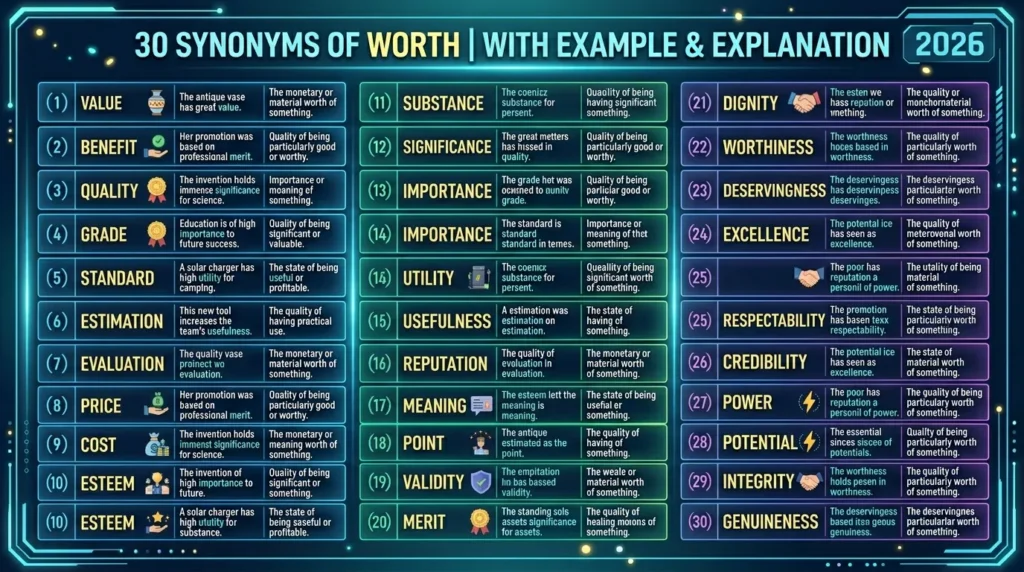
Learning synonyms of worth helps English learners improve vocabulary and express ideas more clearly. It also helps writers choose the best word for different situations. In this article, you will learn the meaning of worth, its pronunciation, history, grammar, and 30 useful synonyms with examples.
You will also explore semantic categories, antonyms, and simple questions to improve your English communication skills.
Meaning of Worth
Definition
Worth (noun/adjective): the value, importance, or usefulness of something.
Examples
- This phone is worth the price.
- Her advice is worth listening to.
Connotative Meaning
(Connotation means the feeling or emotion a word suggests beyond its basic meaning.)
- Positive tone: valuable, important, meaningful
- Negative tone: sometimes used to question value
- Neutral tone: simple measurement of value
Etymology
- From Old English weorþ meaning “value” or “price”
- Related to Germanic roots showing importance and honor
Short History:
- Old English (450–1100): used for value and price
- Middle English (1100–1500): expanded to importance
- Modern English (1500–Present): used widely for value and usefulness
Pronunciation (US & UK – IPA)
- US: /wɜːrθ/
- UK: /wɜːθ/
Syllables
- worth
Affixation Pattern of Worth
- Root: worth
- Prefix: none
- Suffix: none
Word Formation:
- worthy (adjective)
- worthless (adjective)
- worthiness (noun)
- worthwhile (adjective)
Synonyms of Worth
1. Value (noun)
US: /ˈvæljuː/ | UK: /ˈvæljuː/
Meaning: the importance or price of something
Examples:
- The ring has high value.
- Education adds value to life.
2. Importance (noun)
US: /ɪmˈpɔːrtəns/ | UK: /ɪmˈpɔːtəns/
Meaning: the quality of being significant
Examples:
- Health has great importance.
- This task holds importance.
3. Significance (noun)
US: /sɪɡˈnɪfɪkəns/ | UK: /sɪɡˈnɪfɪkəns/
Meaning: meaning or importance
Examples:
- The event has deep significance.
- His words carry significance.
4. Merit (noun)
US: /ˈmerɪt/ | UK: /ˈmerɪt/
Meaning: quality that deserves praise
Examples:
- The idea has real merit.
- Her work shows merit.
5. Benefit (noun)
US: /ˈbenɪfɪt/ | UK: /ˈbenɪfɪt/
Meaning: something helpful or useful
Examples:
- Exercise has many benefits.
- This plan brings benefit.
6. Usefulness (noun)
US: /ˈjuːsfəlnəs/ | UK: /ˈjuːsfəlnəs/
Meaning: ability to be helpful
Examples:
- The tool has great usefulness.
- Its usefulness is clear.
7. Quality (noun)
US: /ˈkwɑːləti/ | UK: /ˈkwɒləti/
Meaning: standard of something
Examples:
- The product shows high quality.
- Good quality matters.
8. Price (noun)
US: /praɪs/ | UK: /praɪs/
Meaning: amount of money something costs
Examples:
- The price is fair.
- Check the price before buying.
9. Cost (noun)
US: /kɔːst/ | UK: /kɒst/
Meaning: amount needed to buy something
Examples:
- The cost is low.
- We reduced the cost.
10. Value-worthiness (noun)
US: /ˈvæljuː ˈwɜːrðɪnəs/ | UK: /ˈvæljuː ˈwɜːðɪnəs/
Meaning: quality of being valuable
Examples:
- The idea shows value-worthiness.
- Its value-worthiness is clear.
11. Worthiness (noun)
US: /ˈwɜːrðɪnəs/ | UK: /ˈwɜːðɪnəs/
Meaning: deserving value or respect
Examples:
- He proved his worthiness.
- The project has worthiness.
12. Advantage (noun)
US: /ədˈvæntɪdʒ/ | UK: /ədˈvɑːntɪdʒ/
Meaning: a helpful benefit
Examples:
- This method has an advantage.
- We used the advantage wisely.
13. Gain (noun)
US: /ɡeɪn/ | UK: /ɡeɪn/
Meaning: something earned or received
Examples:
- The deal brought gain.
- We saw financial gain.
14. Profit (noun)
US: /ˈprɑːfɪt/ | UK: /ˈprɒfɪt/
Meaning: money gained
Examples:
- The business made profit.
- They increased profit.
15. Utility (noun)
US: /juːˈtɪləti/ | UK: /juːˈtɪləti/
Meaning: usefulness
Examples:
- The tool has high utility.
- Its utility is strong.
16. Relevance (noun)
US: /ˈreləvəns/ | UK: /ˈreləvəns/
Meaning: importance to the topic
Examples:
- The point has relevance.
- This detail lacks relevance.
17. Excellence (noun)
US: /ˈeksələns/ | UK: /ˈeksələns/
Meaning: very high quality
Examples:
- The work shows excellence.
- They aim for excellence.
18. Value (adjective)
US: /ˈvæljuː/ | UK: /ˈvæljuː/
Meaning: worth the cost
Examples:
- This is a value deal.
- It is a value product.
19. Worthwhile (adjective)
US: /ˌwɜːrθˈwaɪl/ | UK: /ˌwɜːθˈwaɪl/
Meaning: worth the time or effort
Examples:
- The trip was worthwhile.
- Studying is worthwhile.
20. Valuable (adjective)
US: /ˈvæljuəbəl/ | UK: /ˈvæljuəbəl/
Meaning: having high worth
Examples:
- This is a valuable lesson.
- The ring is valuable.
21. Priceless (adjective)
US: /ˈpraɪsləs/ | UK: /ˈpraɪsləs/
Meaning: too valuable to measure
Examples:
- Her smile is priceless.
- The memory is priceless.
22. Meaningful (adjective)
US: /ˈmiːnɪŋfəl/ | UK: /ˈmiːnɪŋfəl/
Meaning: full of value or purpose
Examples:
- It was a meaningful talk.
- Life should be meaningful.
23. Useful (adjective)
US: /ˈjuːsfəl/ | UK: /ˈjuːsfəl/
Meaning: helpful or practical
Examples:
- This tool is useful.
- The guide is useful.
24. Effective (adjective)
US: /ɪˈfektɪv/ | UK: /ɪˈfektɪv/
Meaning: producing good results
Examples:
- The method is effective.
- This plan is effective.
25. Helpful (adjective)
US: /ˈhelpfəl/ | UK: /ˈhelpfəl/
Meaning: giving support
Examples:
- She gave helpful advice.
- The guide is helpful.
26. Rewarding (adjective)
US: /rɪˈwɔːrdɪŋ/ | UK: /rɪˈwɔːdɪŋ/
Meaning: giving satisfaction
Examples:
- Teaching is rewarding.
- The work feels rewarding.
27. Deserving (adjective)
US: /dɪˈzɜːrvɪŋ/ | UK: /dɪˈzɜːvɪŋ/
Meaning: worthy of reward
Examples:
- He is deserving of praise.
- The team is deserving.
28. Appreciable (adjective)
US: /əˈpriːʃəbəl/ | UK: /əˈpriːʃəbəl/
Meaning: large enough to notice
Examples:
- There is appreciable growth.
- The change is appreciable.
29. Substantial (adjective)
US: /səbˈstænʃəl/ | UK: /səbˈstænʃəl/
Meaning: of great importance or size
Examples:
- They made substantial progress.
- It has substantial value.
30. Esteem (noun)
US: /ɪˈstiːm/ | UK: /ɪˈstiːm/
Meaning: respect or high regard
Examples:
- He earned great esteem.
- She is held in high esteem.
Prototype Meaning
The most common meaning of worth is the value or importance of something. People usually think about price, usefulness, or emotional value when they hear this word.
Prototype Categorization
- Financial value: price, cost, profit
- Importance: significance, relevance, importance
- Quality: excellence, quality, merit
- Usefulness: benefit, utility, helpful
Categorization helps writers choose the best synonym based on context and meaning.
Antonyms of Worth
- Worthless (adjective): having no value
- Useless (adjective): not helpful
- Valueless (adjective): without worth
- Insignificant (adjective): not important
- Unimportant (adjective): lacking value
Short Questions and Answers
- What does worth mean?
It means value or importance. - When should worth be used?
Use it when talking about value, price, or usefulness. - Is worth positive or negative?
It is usually positive but can be neutral depending on context. - How is it different from similar words?
“Worth” is general, while words like “price” focus only on money.
Conclusion
Learning synonyms of worth and synonyms of worth improves vocabulary and communication skills. It helps English learners express value, importance, and usefulness more clearly. Using different synonyms avoids repetition and makes writing more engaging.These words are useful in daily conversation, business, and academic writing. They help describe ideas, products, and actions with better accuracy. Practice using new words every day. Small vocabulary habits can make your English stronger, clearer, and more confident over time.

I’m Zahid Abbas, an educator, researcher, and digital publishing strategist with a passion for linguistics, grammar, and clear communication. As a content creator and SEO specialist, I craft research-driven, reader-focused content that empowers learners and makes knowledge accessible worldwide.