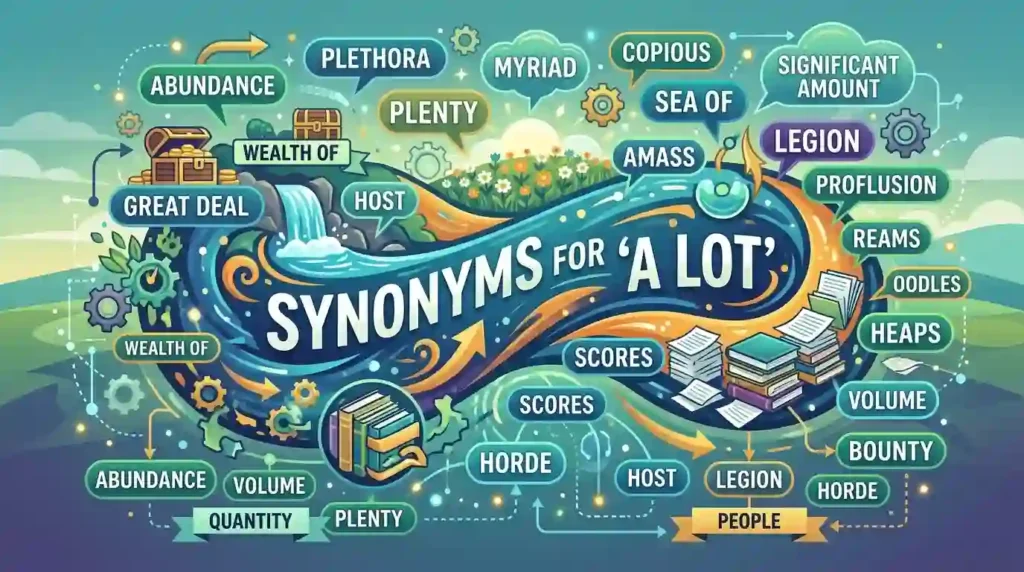

A synonym for “a lot” is many, much, plenty, a great deal, or numerous, depending on the sentence. Use many for countable things, much for uncountable things, and a great deal for a large amount. In formal writing, words such as numerous, substantial, and considerable can make your sentences clearer and more precise.
Key Takeaways
- Many and numerous work well when describing countable things, such as people, books, or ideas.
- Much, a great deal, and a large amount describe quantities that are not usually counted individually.
- Substantial and considerable are useful in professional and academic writing.
- Frequently and often can replace “a lot” when it describes how regularly something happens.
- Choose a synonym based on the meaning and tone of your sentence, not just because it sounds more advanced.
What Does “A Lot” Mean?
“A lot” is a common English expression that means a large amount, a large number, or to a great degree. It can also mean that something happens frequently.
For example:
- Quantity: I have a lot of books.
- Degree: I enjoyed the movie a lot.
- Frequency: She visits her grandparents a lot.
Because the expression has several meanings, one synonym will not fit every sentence. You might replace “a lot of books” with “many books,” but “I enjoyed the movie a lot” could become “I enjoyed the movie very much.”
Understanding the intended meaning helps you choose a natural replacement.
25 Synonyms for “A Lot”
Here are 25 useful alternatives, grouped by meaning and writing style.
Words for a Large Amount or Number
| Synonym | Best use | Example |
|---|---|---|
| Many | Countable things | Many students attended. |
| Much | Uncountable things | We don’t have much time. |
| Plenty | An adequate or generous supply | We have plenty of food. |
| A great deal | A large amount | She learned a great deal. |
| Numerous | A large number | Numerous options are available. |
| A large amount | An uncountable quantity | It requires a large amount of water. |
| A large number | Countable items or people | A large number of voters participated. |
| Abundance | A plentiful supply | The garden has an abundance of flowers. |
| Tons | A very large amount, informally | We have tons of homework. |
| Loads | A large amount, informally | He has loads of experience. |
Formal Alternatives for “A Lot”
These alternatives can help make essays, reports, applications, and workplace documents more precise.
| Synonym | Meaning or nuance | Example |
|---|---|---|
| Considerable | Large or important in amount | The project required considerable effort. |
| Substantial | Significant in size or amount | The company made substantial progress. |
| Numerous | Many individual items | The report identifies numerous concerns. |
| Extensive | Broad in range or coverage | The team conducted extensive research. |
| Ample | Enough or more than enough | We have ample time to prepare. |
| Significant | Important or large enough to matter | The changes produced significant results. |
| Appreciable | Large enough to notice | The treatment made an appreciable difference. |
| Copious | Abundant, often referring to amounts of something | The researcher collected copious notes. |
These words are not exact substitutes in every situation. For example, extensive research emphasizes the scope of the research, while substantial progress emphasizes the amount or importance of progress.
Informal Alternatives for “A Lot”
Use these expressions in everyday conversation, friendly messages, and casual writing.
| Alternative | Example |
|---|---|
| Lots of | We have lots of ideas. |
| A bunch of | I bought a bunch of snacks. |
| Heaps of | She has heaps of work to finish. |
| A ton of | They gave us a ton of information. |
| Loads of | We had loads of fun. |
These expressions sound natural in casual American English. However, formal reports and academic essays usually benefit from more precise wording.
Alternatives Meaning “Very Much” or “Often”
Sometimes, “a lot” describes the degree of an action or how often it happens rather than a quantity.
| Synonym | Meaning | Example |
|---|---|---|
| Very much | To a great degree | I appreciate your help very much. |
| Greatly | To a significant degree | Your support greatly helped us. |
| Considerably | By a noticeable amount | Costs have increased considerably. |
| Significantly | To an important or meaningful degree | Performance improved significantly. |
| Frequently | Happening often | We frequently discuss new ideas. |
| Often | Happening many times | He often walks to work. |
| Regularly | Happening at consistent intervals | She regularly practices English. |
Notice the difference between frequently and greatly. If someone travels a lot, they may travel frequently. If someone enjoys traveling a lot, they enjoy it very much.
How to Choose the Right Synonym
The best replacement depends on the noun, verb, meaning, and tone of your sentence.
Many vs. Much
Use many with countable plural nouns. Use much with uncountable nouns.
- Correct: She owns many books.
- Correct: She doesn’t have much free time.
- Incorrect: She owns much books.
- Incorrect: She doesn’t have many free time.
You can also use a lot of with both types of nouns: “a lot of books” and “a lot of free time.”
A Lot vs. A Great Deal
Both expressions can describe a large quantity or degree, but their grammar differs slightly.
- A lot of: I have a lot of work today.
- A great deal of: I have a great deal of work today.
- A lot: I learned a lot from the course.
- A great deal: I learned a great deal from the course.
The phrase a great deal of normally comes before a noun, while a great deal can stand alone when the quantity or degree is understood.
Formal vs. Informal Word Choice
Consider the audience before replacing “a lot.”
| Situation | Natural choice |
|---|---|
| Texting a friend | Lots of |
| School essay | Numerous or many |
| Business report | Substantial or considerable |
| Scientific writing | Significant, when justified |
| Everyday conversation | A bunch of or plenty |
| Describing repeated actions | Frequently or regularly |
Do not assume that a longer word is always better. “Many people attended the meeting” is clear and professional. Replacing many with a plethora of may sound unnecessarily complicated.
Examples of “A Lot” in Sentences
The following examples show how to replace the expression without changing the original meaning.
| Original sentence | Improved sentence |
|---|---|
| I have a lot of things to do. | I have many tasks to complete. |
| She drinks a lot of water. | She drinks plenty of water. |
| We learned a lot during the course. | We learned a great deal during the course. |
| He talks a lot in class. | He frequently speaks in class. |
| The project needs a lot of money. | The project requires a substantial amount of money. |
| There are a lot of problems. | There are numerous problems. |
| I like this book a lot. | I like this book very much. |
| The company has a lot of experience. | The company has extensive experience. |
The improved sentence should preserve the original meaning. For example, plenty of water suggests a sufficient supply, while a large amount of water focuses more directly on quantity. These expressions are related, but their emphasis differs.
Common Mistakes to Avoid
A few simple grammar and word-choice mistakes can make a sentence sound unnatural.
1. Using “alot” instead of “a lot”
The standard spelling is a lot, written as two words. “Alot” is a common spelling error. Allot is a different word meaning to assign or distribute something.
Grammarly
- Correct: I have a lot of work.
- Incorrect: I have alot of work.
- Different meaning: We will allot ten minutes to each speaker.
2. Using “numerous” with an uncountable noun
“Numerous” generally describes countable plural nouns.
- Correct: Numerous students joined the program.
- Better: A substantial amount of time was required.
3. Replacing every use of “a lot” with a formal word
The goal is clear communication, not complicated vocabulary. “I enjoyed the party a lot” is natural in conversation. “I enjoyed the party very much” is another natural option. The best choice depends on the context.
Frequently Asked Questions
What is the best synonym for “a lot”?
The best general alternatives are many, much, plenty, and a great deal. Use many for countable items, much for uncountable quantities, and a great deal when describing a large amount or degree. The correct choice depends on the sentence.
What is a more formal way to say “a lot”?
In formal writing, consider numerous, considerable, substantial, extensive, or a significant amount. For example, replace “The team did a lot of research” with “The team conducted extensive research.” Choose a word that accurately describes the amount, importance, or scope involved.
What is another word for “a lot” in an essay?
Useful essay alternatives include many, numerous, considerable, substantial, significantly, and a great deal. For example, “A lot of people support this idea” could become “Many people support this idea.” Avoid replacing a simple expression with a more complicated one unless it improves clarity or precision.
What is the difference between “many” and “much”?
“Many” describes things you can count individually, such as books, students, or questions. “Much” describes quantities that are not normally counted individually, such as time, water, or money. For example, say “many questions” but “much time.” Both can be used in negative sentences and questions.
Is “a lot” one word or two?
“A lot” is always written as two words when it means a large amount, degree, or frequency. “Alot” is a nonstandard spelling. “Allot” is a separate verb that means to assign or distribute something for a purpose.
Grammarly
+1
What is a synonym for “a lot” when describing frequency?
Use often, frequently, or regularly when “a lot” describes how often an action happens. For example, “She exercises a lot” could become “She exercises frequently.” Use regularly when the action occurs on a consistent schedule, rather than simply many times.
Conclusion
The best answer to “What is a synonym for a lot?” depends on what you want to express. Use many for countable items, much for uncountable quantities, a great deal for large amounts, and frequently for repeated actions. For formal writing, considerable, substantial, and numerous can be useful alternatives.
Choose words that fit your meaning and audience. Clear, natural writing is more effective than using complicated synonyms simply to sound professional.