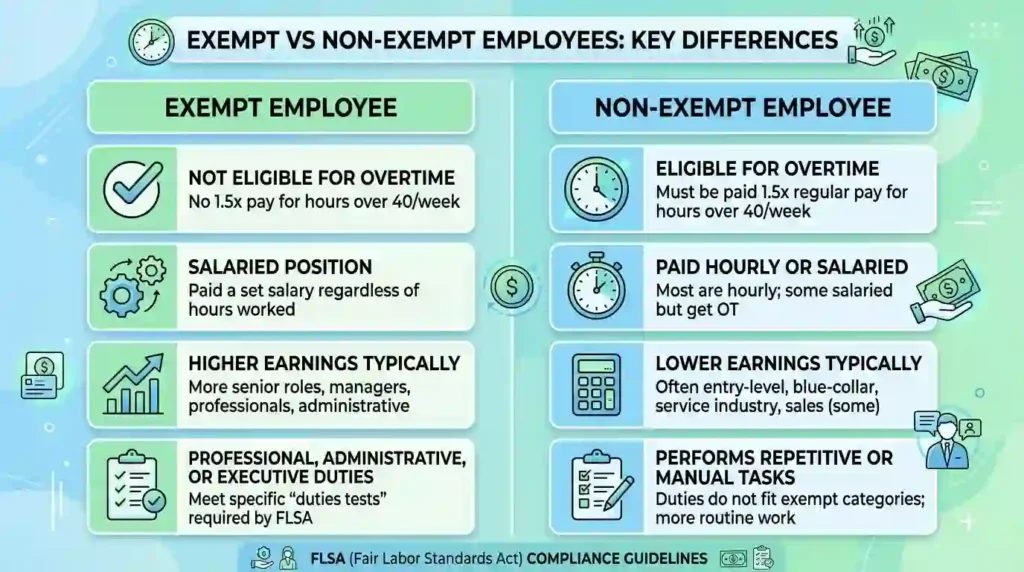

Exempt vs nonexempt refers to whether an employee is excluded from certain federal wage and overtime protections under the Fair Labor Standards Act (FLSA). Exempt employees who meet the applicable requirements generally do not receive FLSA overtime, while nonexempt employees are generally entitled to overtime at 1.5 times their regular rate for hours worked over 40 in a workweek.
Key Takeaways
- Exempt employees generally do not receive federal FLSA overtime when they meet all requirements for an applicable exemption.
- Nonexempt employees generally receive overtime for hours worked over 40 in a workweek.
- Being paid a salary does not automatically make an employee exempt.
- Many white-collar exemptions require a salary basis test, salary level test, and duties test.
- Job titles alone do not determine whether an employee is exempt.
- State laws can provide greater overtime protections than federal law.
What Does Exempt vs Non exempt Mean?
The terms exempt and nonexempt describe an employee’s status under wage-and-hour laws, particularly the FLSA.
An exempt employee falls within a valid FLSA exemption from certain minimum wage and overtime requirements. Common white-collar exemptions cover qualifying executive, administrative, professional, outside sales, and certain computer employees.
A nonexempt employee remains covered by the FLSA’s overtime and minimum wage protections. In general, a covered nonexempt employee must receive at least the applicable minimum wage and overtime pay at 1.5 times the regular rate for hours worked over 40 in a workweek.
The important point is that exempt does not simply mean salaried, and nonexempt does not simply mean hourly.
Exempt vs Non exempt: Key Differences
| Factor | Exempt | Nonexempt |
|---|---|---|
| Federal FLSA overtime | Generally not eligible | Generally eligible |
| Overtime after 40 hours | Generally not required under FLSA | Generally required |
| Pay method | Often salary | Often hourly, but can be salary |
| Timekeeping | May have different requirements | Hours generally must be tracked |
| Job duties | Must meet an applicable exemption | Usually does not meet an exemption |
| Salary requirement | Often applies to white-collar exemptions | No exemption salary test |
| Job title | Does not determine status | Does not determine status |
The classification depends on the employee’s actual circumstances, including applicable duties and compensation requirements. The Department of Labor specifically states that job titles and salary alone do not determine exemption status.
Overtime Pay
This is usually the biggest practical difference.
A covered nonexempt employee generally receives overtime at no less than one and one-half times the employee’s regular rate for hours worked above 40 in a workweek.
An exempt employee who properly qualifies for an FLSA exemption generally does not receive federal overtime simply because the employee works more than 40 hours.
For example, if a nonexempt employee works 45 hours in one workweek, the five hours above 40 generally qualify for overtime. If a properly exempt employee works 45 hours, the FLSA generally does not require an overtime premium for those additional five hours.
State law can change the analysis by providing greater protections.
How Employees Are Paid
Many exempt employees receive a salary. However, this does not mean every salaried employee is exempt.
A company could pay an employee a salary while still classifying that employee as nonexempt. In that situation, the employee can remain eligible for overtime when applicable.
This is one of the most important points to understand when comparing exempt vs nonexempt employees.
Timekeeping
Employers generally need accurate records for nonexempt employees because overtime calculations depend on the hours worked.
Exempt employees can have different recordkeeping requirements under federal law. However, an employer may still track an exempt employee’s schedule or hours for operational reasons.
Tracking hours does not automatically make an employee nonexempt.
How Does an Employee Qualify as Exempt?
For many white-collar FLSA exemptions, an employee generally must satisfy three basic requirements: the salary basis test, salary level test, and duties test.
1. Salary Basis Test
The salary basis test generally requires the employee to receive a predetermined amount for each pay period that is not reduced because of variations in the quality or quantity of the employee’s work.
There are specific rules and exceptions governing deductions from an exempt employee’s salary. Certain occupations, including outside sales employees, teachers, and employees practicing law or medicine, are not subject to the same salary requirements.
2. Salary Level Test
For most employees covered by the standard white-collar exemption rules, federal regulations currently use a minimum salary level of $684 per week, or $35,568 annually.
The U.S. Department of Labor says it is currently applying this threshold after a federal court vacated the 2024 overtime rule. The highly compensated employee threshold is currently $107,432 annually, including at least $684 per week paid on a salary or fee basis.
This is an important current-law distinction. The 2024 rule had scheduled higher thresholds, but those increases were vacated by the Eastern District of Texas in November 2024.
3. Duties Test
An employee also has to perform duties that satisfy the applicable exemption.
For example, executive, administrative, and professional exemptions have different duties requirements. The employee’s primary duty matters, rather than simply the job title printed on an employment contract.
The Department of Labor explains that determining an employee’s primary duty requires looking at the job as a whole and considering factors such as the importance of the exempt work, time spent performing it, freedom from direct supervision, and the relationship between salary and other work performed.
What Is a Nonexempt Employee?
A nonexempt employee is generally covered by the FLSA’s overtime and minimum wage protections.
Nonexempt workers can be paid hourly or on another basis. What matters is whether the employee is covered by the FLSA and does not qualify for an applicable exemption.
For example, an office employee who receives a weekly salary may still be nonexempt if the employee does not satisfy the requirements for an exemption. That employee may therefore remain entitled to overtime when applicable.
Can a Salaried Employee Be Nonexempt?
Yes. A salaried employee can be nonexempt.
This is a common source of confusion. Salary describes how someone is paid. Exempt status describes whether the employee qualifies for a legal exemption from certain FLSA protections.
For example, imagine an employee receives a fixed weekly salary but performs routine duties that do not satisfy an applicable exemption. The employee may still be nonexempt and entitled to overtime for qualifying hours over 40.
Therefore, salary does not automatically equal exempt.
Exempt vs Non exempt Examples
Consider these simplified examples:
Example 1: Properly exempt manager
A manager receives the required salary and primarily performs qualifying executive duties, including managing the enterprise or a recognized department and exercising the required authority. The employee may qualify for the executive exemption if all applicable requirements are met.
Example 2: Salaried nonexempt employee
An employee receives a fixed weekly salary but does not meet the applicable duties requirements for an exemption. The employee can remain nonexempt and may qualify for overtime.
Example 3: Nonexempt hourly employee
A retail worker receives an hourly wage and works 46 hours during a workweek. Assuming the FLSA applies and no exemption covers the employee, the six hours above 40 generally qualify for overtime.
These examples are simplified. Actual classification requires reviewing the employee’s duties, compensation, applicable exemption, and federal and state requirements.
Is It Better to Be Exempt or Nonexempt?
Neither status is automatically better. It depends on the employee’s job, pay structure, schedule, and priorities.
A nonexempt employee may benefit from overtime protection when working long hours. An exempt employee may receive a consistent salary and have greater flexibility in how work is organized, depending on the employer and position.
The key question is not which classification sounds better. It is whether the employer has classified the employee correctly under the applicable law.
Common Exempt vs Nonexempt Mistakes
Several mistakes can create confusion:
- Assuming every salaried employee is exempt. Salary alone is not enough.
- Relying on job titles. A title such as “manager” does not automatically create an exemption.
- Ignoring actual job duties. Classification depends heavily on what the employee actually does.
- Using only federal law. State wage-and-hour laws may provide stronger protections.
- Assuming overtime starts only because an employee is busy. Under the FLSA, the standard federal overtime rule generally focuses on hours worked over 40 in a workweek for covered nonexempt employees.
- Failing to maintain accurate records. Employers need appropriate records for employees covered by FLSA recordkeeping requirements.
The Department of Labor emphasizes that employers must look at the applicable exemption requirements rather than relying only on an employee’s title or salary.
Federal vs State Rules
Federal FLSA rules establish a nationwide baseline, but states can provide stronger wage-and-hour protections.
The Department of Labor notes that the FLSA does not prevent states from establishing more protective standards. If state law provides greater protection, the employer may need to comply with the more protective requirement.
This means an employee’s location can matter when determining overtime eligibility.
If you are an employee or employer trying to classify a specific position, check both federal requirements and the law in the applicable state.
Frequently Asked Questions
Does exempt mean no overtime?
Generally, a properly classified exempt employee is not entitled to federal FLSA overtime. However, the employee must actually qualify for the applicable exemption, and state law may provide additional protections.
Can a salaried employee be nonexempt?
Yes. Salary and exempt status are not the same thing. A salaried employee who does not satisfy an applicable exemption can remain nonexempt and may be entitled to overtime under the FLSA.
Are managers automatically exempt?
No. Calling someone a “manager” does not automatically make that employee exempt. The employee’s actual duties and compensation must satisfy the requirements of an applicable exemption.
Do exempt employees have to track hours?
Not necessarily in the same way as nonexempt employees. Federal recordkeeping rules differ, and employers may still track exempt employees’ schedules or hours for business purposes.
What happens if an employee is misclassified?
Misclassification can result in unpaid overtime and other wage-and-hour issues. Employers may also face additional legal consequences depending on the circumstances and applicable federal or state law.
If you believe your classification may be incorrect, review your actual duties, pay structure, time records, and applicable federal and state requirements. For a specific legal dispute, professional legal advice may be appropriate.
Conclusion
The main difference between exempt vs nonexempt employees is whether the worker qualifies for an exemption from certain FLSA wage and overtime protections.
Exempt employees generally do not receive federal overtime when they properly satisfy an applicable exemption. Nonexempt employees generally remain protected by federal overtime rules and receive at least 1.5 times their regular rate for qualifying hours worked over 40 in a workweek.
Most importantly, being salaried does not automatically make someone exempt. Employers must consider the applicable salary and duties requirements, while employees should look beyond their job title when determining their classification. Federal law is only part of the picture because state laws may provide stronger protections.