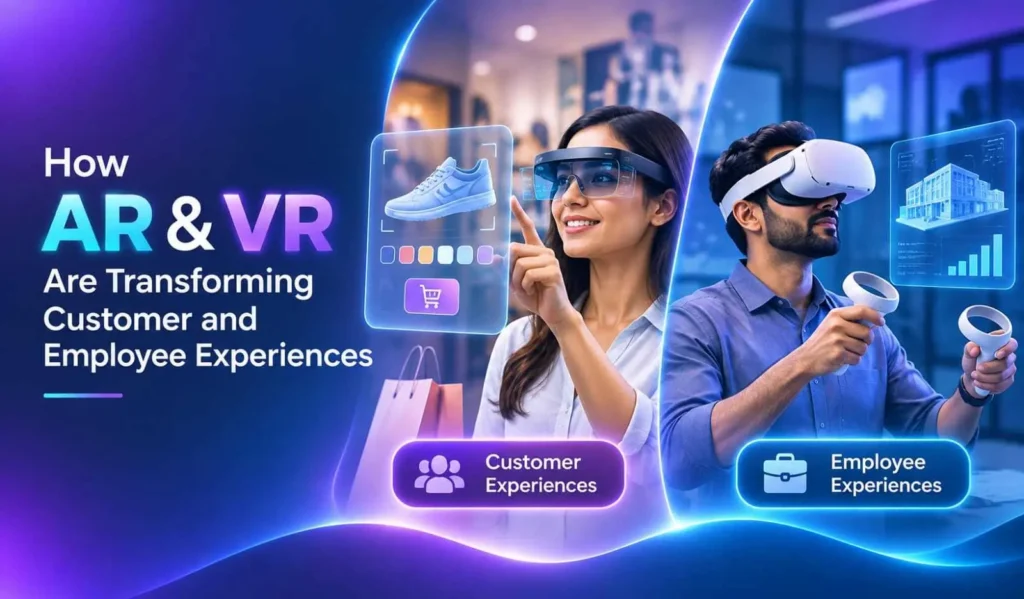

Technology is changing how businesses interact with customers and support their employees. Traditional websites, mobile apps, and workplace tools remain important, but people increasingly expect more interactive, personalized digital experiences. This shift is encouraging businesses to explore Augmented Reality (AR) and Virtual Reality (VR) as practical ways to improve engagement, communication, training, and collaboration.
AR and VR make digital experiences more immersive by letting people interact with virtual objects and environments. Customers can visualize products before purchasing them, explore virtual showrooms, and receive interactive support. Employees can participate in realistic training simulations, practice workplace procedures, and collaborate with colleagues in virtual environments.
These technologies are no longer limited to gaming and entertainment. Businesses across retail, healthcare, manufacturing, education, real estate, and other industries are exploring their potential. When implemented with clear objectives, AR and VR can help organizations improve customer satisfaction, simplify employee training, and create more engaging digital experiences.
Understanding AR and VR Technologies
Augmented Reality and Virtual Reality are immersive technologies that change how users interact with digital information. Although they are often discussed together, they offer different experiences and serve different business purposes.
Augmented Reality (AR) adds digital elements to the real-world environment. Users can access these elements through smartphones, tablets, or compatible wearable devices. For example, customers can use an AR application to see how furniture would look inside their homes before purchasing it.
Virtual Reality (VR) creates a completely computer-generated environment. Users typically access these environments through VR headsets, allowing them to explore virtual spaces and interact with digital objects. Businesses can use VR for employee training, product demonstrations, virtual events, and remote collaboration.
The choice between AR and VR depends on the intended experience. AR works well when users need digital information alongside their physical surroundings, while VR is useful when a fully simulated environment offers greater value.
You may also like: An Ultimate Guide to VR Game Development in 2026
Why Businesses are Adopting AR and VR
Customer expectations and workplace requirements are evolving. Customers want convenient ways to explore products, understand services, and communicate with brands. Employees need better learning opportunities, practical training tools, and flexible collaboration options.
Traditional digital platforms can handle many business activities, but they may not always provide the best experience for tasks involving physical spaces, complex products, or practical demonstrations. For example, a product photograph may show what an item looks like, but an interactive 3D model can help customers understand its dimensions and features.
AR and VR help bridge this gap by making digital interactions more visual and interactive. Businesses can create experiences that allow customers to explore products independently while giving employees opportunities to practice tasks in controlled environments.
How AR and VR are Transforming Customer Experiences
Customer experience plays an important role in building brand loyalty and encouraging repeat business. Businesses are using AR and VR to make product discovery, shopping, and customer support more interactive.
Instead of depending entirely on product descriptions, photographs, and videos, customers can explore digital models, try virtual products, and interact with simulated environments. These experiences can help people understand what a business offers before buying.
● Interactive Product Visualization and Virtual Try-Ons
One of AR’s most popular applications is interactive product visualization. It allows customers to preview digital representations of products in real-world settings.
For example, furniture retailers can let customers place virtual sofas, tables, and chairs inside their homes using smartphone cameras. Customers can compare different designs, colors, and sizes before deciding which product suits their space.
Fashion and beauty brands can also use virtual try-on features. Customers may preview eyewear, makeup, clothing, or accessories through compatible devices. This makes online shopping more interactive and gives customers additional information when evaluating products.
● Virtual Showrooms and Immersive Shopping
Virtual showrooms allow businesses to present products through interactive digital environments. Customers can explore collections, inspect 3D models, and learn about product features without visiting a physical store.
For example, a furniture company can create a virtual showroom featuring different room designs. Customers can move between spaces, examine individual products, and explore combinations that match their preferences.
Similarly, automotive brands can create virtual environments where potential buyers explore vehicle models and experience selected features. Retailers can also organize virtual product launches and branded shopping experiences.
● Personalized Customer Support and Engagement
AR can make customer support more visual and convenient. Businesses can provide interactive instructions, product guides, and visual assistance to help customers understand how to use or maintain products.
For example, a customer assembling furniture could use an AR guide that displays instructions alongside the actual components. A technician could receive visual guidance while inspecting equipment or performing maintenance.
VR can support customer engagement through virtual events, product demonstrations, and branded experiences. These environments give businesses more opportunities for customers to interact with products and services.
How AR and VR Are Improving Employee Experiences
Employee experience depends on the tools, training, and resources available in the workplace. AR and VR can make employee learning more practical and improve collaboration through interactive digital experiences.
Traditional training methods include presentations, manuals, and videos. While useful, they may not provide enough hands-on practice. AR and VR allow employees to learn through realistic simulations and interactive environments.
● Immersive Employee Training and Skill Development
VR allows employees to practice workplace tasks in virtual environments. They can learn procedures, operate simulated equipment, and handle different situations without real-world risks.
For example, manufacturing employees can practice machinery operations, while retail staff can improve customer service skills through virtual interactions.
AR can display step-by-step instructions and equipment information in the employee’s physical environment. This makes workplace learning more interactive and easier to follow.
● Remote Collaboration and Virtual Workspaces
VR creates shared virtual spaces where remote employees can meet, review 3D models, and discuss projects. This can make collaboration more interactive for teams working from different locations.
AR also supports remote assistance by allowing experts to guide on-site employees through visual instructions. These solutions are especially useful for engineering, manufacturing, and technical support teams.
● Workplace Safety and Operational Training
VR simulations allow employees to practice responding to workplace emergencies in controlled environments. For example, workers can learn how to respond to equipment failures without facing actual hazards.
AR can display maintenance instructions and highlight important equipment components. This helps employees follow procedures more easily.
Businesses should ensure that virtual training reflects real workplace safety standards. Immersive technology should support qualified instruction and practical safety assessments.
Industry Applications of AR and VR
AR and VR have applications across industries where visualization, interaction, and practical learning can improve business activities.
- Retail and e-commerce: Retailers can introduce virtual try-ons, AR product previews, and interactive shopping experiences. These features help customers explore products and see how they look before purchasing.
- Real estate: Property businesses can offer virtual tours that allow potential buyers and tenants to explore rooms, layouts, and interiors remotely. AR can help users visualize furniture and design changes within physical spaces.
- Healthcare: Healthcare organizations can explore immersive technologies for medical education, training simulations, and patient information. Applications must follow appropriate privacy and professional requirements.
- Manufacturing: Manufacturers can use VR for equipment training and AR for maintenance guidance. Interactive 3D models can also help teams review product designs.
- Education: Educational institutions can develop virtual laboratories, interactive lessons, and 3D learning environments that help students explore complex subjects.
The most effective applications depend on each industry’s needs. Businesses should identify specific challenges before selecting the technology and features required to address them.
Key Business Benefits of AR and VR Adoption
AR and VR offer several benefits when businesses use them to solve specific challenges. These technologies can improve customer experiences, support employee training, and make business operations more interactive.
1. Improved Product Visualization
AR allows customers to preview digital products in real-world environments. For example, they can see how furniture looks in their homes before purchasing.
VR takes this experience further by offering immersive product demonstrations. This helps customers understand product features and make confident buying decisions.
2. More Effective Employee Training
VR simulations allow employees to practice tasks in a safe, virtual environment. They can repeat activities and learn from mistakes without affecting real operations.
AR can also provide step-by-step instructions during workplace tasks. This makes training more practical and easier to follow.
3. Better Communication and Collaboration
AR makes complex information easier to understand through visual instructions and digital demonstrations. Employees can use these features to complete tasks more accurately.
VR creates shared virtual spaces where remote teams can meet, discuss projects, and review digital models together.
4. Stronger Customer Engagement
AR and VR create interactive experiences that encourage customers to explore products and services. Virtual demonstrations and immersive brand experiences can make businesses more memorable.
These experiences also help customers understand product benefits more engagingly.
5. Support for Product Development
Businesses can use AR and VR to visualize product designs before creating physical prototypes. This helps teams review concepts and identify potential design issues.
Virtual models also make it easier for designers, engineers, and other team members to share ideas and collaborate.
6. Improved Operational Efficiency
AR-based instructions can help employees complete tasks more accurately. Workers can follow digital guidance when assembling products, inspecting equipment, or handling technical procedures.
VR training can also prepare employees for complex tasks before they perform them in real workplace conditions.
Challenges of Implementing AR and VR Solutions
Despite their potential, implementing AR and VR solutions comes with several challenges. Businesses should consider technical requirements, development costs, user accessibility, and data security before investing in these technologies. Understanding these challenges helps organizations plan better and avoid unnecessary complications.
1. High Development Costs
Developing AR and VR applications can require significant investment, especially when projects involve custom 3D models, advanced features, interactive environments, and specialized hardware. Businesses must also consider ongoing expenses such as maintenance, updates, testing, and technical support.
You may also like: Metaverse Cost Breakdown: Budget Your Virtual Reality Dive
2. Hardware and Device Compatibility
Hardware requirements can affect how easily users access AR and VR applications. Some VR experiences require dedicated headsets, while AR applications may work through smartphones and tablets. Businesses should ensure their solutions support the devices their target audience uses most often.
3. User Comfort and Accessibility
Not every user feels comfortable using immersive technologies. Extended VR sessions may cause discomfort or motion sickness, while some users may find certain interfaces difficult to navigate. Businesses should focus on simple navigation, accessible controls, clear instructions, and alternative access options.
4. Security and Data Privacy
AR and VR applications may collect or process sensitive information, including account details, camera access, voice interactions, and user activity data. Businesses must implement appropriate security measures, protect user information, and clearly explain how data is collected, stored, and used.
5. Performance and Technical Limitations
Immersive applications require reliable infrastructure and responsive interactions to deliver a smooth experience. Slow loading, connectivity issues, or poor graphics performance can affect usability. Organizations should test applications across supported devices and different network conditions before launching them.
Addressing these challenges during the planning and development stages can help businesses create reliable, accessible, and effective AR and VR experiences.
How to Successfully Integrate AR and VR Into Business Operations
Successful implementation begins with a clear understanding of the business problem. Companies should identify whether they want to improve customer engagement, simplify employee training, support remote collaboration, or make products easier to understand.
Next, understand the intended users. A customer-facing AR application may need to work on commonly used smartphones, while an internal VR training platform may be designed around specific headsets.
Businesses should then select the right technology and plan the experience around user requirements. A practical development process generally includes:
- Define business goals: Identify the challenge and the results the application should deliver.
- Understand user needs: Research audience expectations, devices, and accessibility requirements.
- Choose suitable technology: Decide whether AR, VR, or a combination is appropriate.
- Design the experience: Plan navigation, interactions, visual content, and essential features.
- Develop and test: Build the application and evaluate usability, performance, and security.
- Launch and improve: Collect user feedback and refine the solution over time.
Starting with a focused pilot can help businesses evaluate an idea before investing in a larger platform. For example, a retailer might introduce AR visualization for one product category before expanding it across the entire store.
Organizations should also establish measurable performance indicators. Customer-facing projects may track engagement and satisfaction, while employee applications may evaluate training completion and task performance.
How Moon Technolabs Can Help With AR and VR Development
Moon Technolabs can help businesses explore AR and VR solutions designed around their customer engagement and employee experience goals. From interactive product visualization and virtual showrooms to immersive training and collaboration environments, the right development approach can turn business ideas into practical digital applications.
By focusing on usability, performance, integration, and scalability, businesses can develop immersive solutions that address real operational requirements. The objective should be to create useful experiences that deliver value beyond the technology’s novelty.
Conclusion
AR and VR are transforming how businesses connect with customers and support employees. AR adds digital information to real-world environments, while VR creates simulated spaces where users can explore, learn, and interact. Together, they offer new opportunities for product visualization, virtual shopping, employee training, workplace safety, and remote collaboration.
Industries such as retail, real estate, healthcare, manufacturing, and education are exploring these technologies to improve specific business activities. However, successful adoption requires careful planning, suitable technology, attention to privacy, and a clear understanding of user needs.
Businesses should focus on solving real challenges rather than adopting immersive features simply because they are trending. With the right strategy, AR and VR can make digital experiences more interactive, improve how employees develop skills, and help customers make more informed decisions.
Also Read
- Synonyms for Via 30 Powerful Words to Explore 2026
- Synonyms of Complacent,30 Best word for 2026
- What Is a Synonym for Also? 15 Useful Alternatives