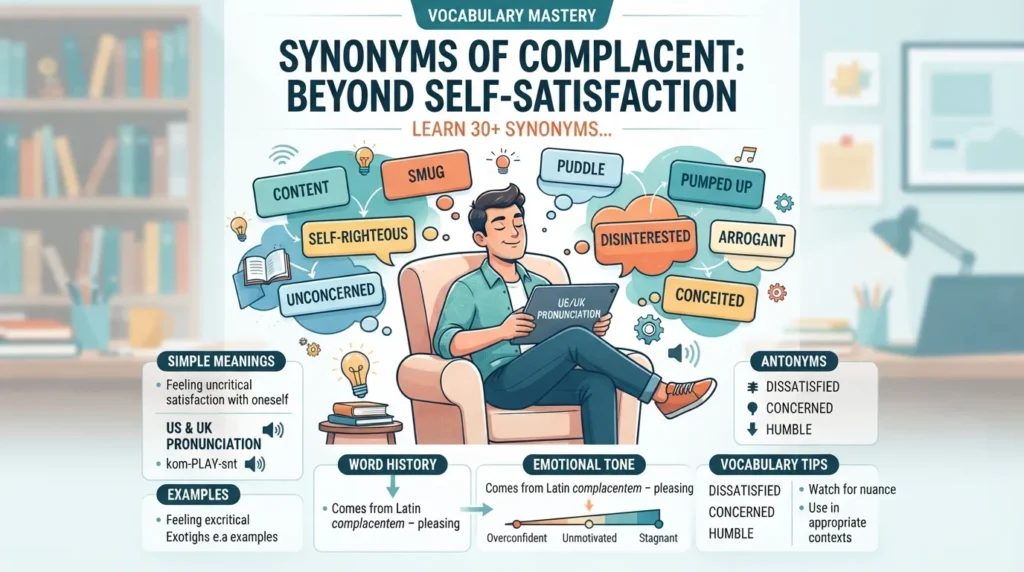
Complacent means feeling too pleased with yourself or your success, so you stop trying to improve. Imagine a student who gets high marks on one test. The student feels happy and stops studying. Soon, the next test becomes much harder. The student has become complacent.
The word complacent is often used when people feel safe, successful, or satisfied and fail to notice problems. It can describe a student, worker, leader, or team. Learning synonyms of complacent helps English learners express ideas in more precise ways. It also helps writers avoid using the same word again and again.
Some synonyms show too much pride. Others describe a lack of care, effort, or concern. In this guide, you will learn the meaning of complacent, its pronunciation, history, grammar, and 30 related words. Each word includes a simple meaning and two examples to help you use it with confidence.
Meaning of Complacent
Complacent (adjective): Too pleased with yourself or your situation, so you do not see problems or try hard enough to improve.
Examples
- The team became complacent after winning three games.
- Do not become complacent when things are going well.
Connotative Meaning
- Positive tone: Complacent rarely has a positive tone. In some settings, it may be confused with feeling calm or content.
- Negative tone: It often suggests carelessness, overconfidence, or a lack of effort.
- Neutral tone: It can describe someone’s attitude without directly blaming them, especially in a factual report.
Example: The manager warned the team not to become complacent after its early success.
Etymology of Complacent
- Source language: Latin, through French.
- Latin root: Complacēre, meaning “to please greatly” or “to be pleasing.”
- Core idea: The word developed a sense of being pleased with oneself or one’s situation, sometimes too pleased to notice problems.
A Short History
- Old English (450–1100): Complacent was not an established English word in this period. English used other words to express pleasure and satisfaction.
- Middle English (1100–1500): The word’s Latin and French roots helped shape later English vocabulary, though complacent was not a common everyday term.
- Modern English (1500–present): Complacent entered English through French and Latin influences. It developed the familiar meaning of being too satisfied or unconcerned about possible problems.
Pronunciation of Complacent
- US: /kəmˈpleɪsənt/
- UK: /kəmˈpleɪsənt/
The main stress falls on the second syllable.
Syllables
com-pla-cent — 3 syllables
Affixation Pattern of Complacent
- Root: plac — related to pleasing.
- Prefix: com- — from a Latin element meaning “with” or “together.”
- Suffix: -ent — forms adjectives.
- Word formation: Complacent is an adjective formed from Latin elements. Related words include complacency (noun) and complacently (adverb). The opposite form is noncomplacent, though it is far less common than phrases such as “not complacent.”
Related forms:
- Complacency (noun): A state of being complacent.
- Complacently (adverb): In a complacent way.
- Complacent (adjective): Too satisfied to notice problems or make an effort.
Synonyms of Complacent, 30 Powerful Words
1. Self-satisfied (Adjective) — US /ˌself ˈsætɪsfaɪd/ | UK /ˌself ˈsætɪsfaɪd/
Meaning: Too pleased with yourself and your achievements.
Examples:
- He looked self-satisfied after winning the award.
- Do not become self-satisfied after one success.
2. Smug (Adjective) — US /smʌɡ/ | UK /smʌɡ/
Meaning: Showing too much pride in your success or knowledge.
Examples:
- She gave a smug smile after winning the game.
- His smug attitude annoyed his classmates.
3. Overconfident (Adjective) — US /ˌoʊvərˈkɑːnfɪdənt/ | UK /ˌəʊvəˈkɒnfɪdənt/
Meaning: Too sure that you will succeed or that you are right.
Examples:
- The player became overconfident before the final.
- Do not be overconfident before an important exam.
4. Unconcerned (Adjective) — US /ˌʌnkənˈsɜːrnd/ | UK /ˌʌnkənˈsɜːnd/
Meaning: Not worried about something that may need attention.
Examples:
- He seemed unconcerned about the falling sales.
- She remained unconcerned about the warning.
5. Indifferent (Adjective) — US /ɪnˈdɪfərənt/ | UK /ɪnˈdɪfərənt/
Meaning: Not caring much about something.
Examples:
- He seemed indifferent to the team’s problems.
- The student was indifferent to the results.
6. Apathetic (Adjective) — US /ˌæpəˈθetɪk/ | UK /ˌæpəˈθetɪk/
Meaning: Showing little interest, care, or emotion.
Examples:
- The apathetic worker made little effort.
- Voters became apathetic about the local election.
7. Careless (Adjective) — US /ˈkerləs/ | UK /ˈkeələs/
Meaning: Not giving enough attention to what you do.
Examples:
- A careless mistake cost the team a point.
- Do not become careless after a good result.
8. Heedless (Adjective) — US /ˈhiːdləs/ | UK /ˈhiːdləs/
Meaning: Failing to pay attention to a warning or risk.
Examples:
- He was heedless of the safety warning.
- Her heedless actions caused trouble.
9. Lax (Adjective) — US /læks/ | UK /læks/
Meaning: Not strict or careful enough.
Examples:
- The school became lax about attendance.
- Lax security allowed strangers to enter.
10. Negligent (Adjective) — US /ˈneɡlɪdʒənt/ | UK /ˈneɡlɪdʒənt/
Meaning: Failing to take proper care or do what is required.
Examples:
- The negligent worker ignored the safety rules.
- Negligent care can put people at risk.
11. Nonchalant (Adjective) — US /ˌnɑːnʃəˈlɑːnt/ | UK /ˌnɒnʃələnt/
Meaning: Appearing calm and unconcerned.
Examples:
- He gave a nonchalant reply to the warning.
- She acted nonchalant before the interview.
12. Blasé (Adjective) — US /blɑːˈzeɪ/ | UK /ˈblɑːzeɪ/
Meaning: No longer excited or interested because something feels too familiar.
Examples:
- He became blasé about his daily success.
- The frequent traveler seemed blasé about delays.
13. Uncritical (Adjective) — US /ˌʌnˈkrɪtɪkəl/ | UK /ˌʌnˈkrɪtɪkəl/
Meaning: Accepting something without examining it carefully.
Examples:
- An uncritical reader may believe false claims.
- The team took an uncritical view of its success.
14. Inattentive (Adjective) — US /ˌɪnəˈtentɪv/ | UK /ˌɪnəˈtentɪv/
Meaning: Not paying enough attention.
Examples:
- The inattentive student missed an important point.
- An inattentive driver may miss a warning sign.
15. Slack (Adjective) — US /slæk/ | UK /slæk/
Meaning: Not working or acting with enough care or effort.
Examples:
- The team became slack after its early success.
- Slack supervision led to repeated mistakes.
16. Idle (Adjective) — US /ˈaɪdəl/ | UK /ˈaɪdəl/
Meaning: Not active or working.
Examples:
- The machine stood idle for several days.
- He remained idle instead of looking for work.
17. Passive (Adjective) — US /ˈpæsɪv/ | UK /ˈpæsɪv/
Meaning: Not taking action or making an effort to change things.
Examples:
- The passive team did not respond to the challenge.
- She took a passive role in the project.
Also read more about: https://synonymhubb.com/synonyms-for-confusion/
18. Unambitious (Adjective) — US /ˌʌnæmˈbɪʃəs/ | UK /ˌʌnæmˈbɪʃəs/
Meaning: Not wanting to achieve more or reach higher goals.
Examples:
- He seemed unambitious after getting his first job.
- An unambitious plan may limit future growth.
19. Content (Adjective) — US /kənˈtent/ | UK /kənˈtent/
Meaning: Happy and satisfied with what you have.
Examples:
- She was content with her simple life.
- He felt content with his progress.
Note: Being content is not always negative. It becomes close to complacent when satisfaction stops someone from improving.
20. Satisfied (Adjective) — US /ˈsætɪsfaɪd/ | UK /ˈsætɪsfaɪd/
Meaning: Pleased because something meets your needs or expectations.
Examples:
- The manager was satisfied with the team’s work.
- Do not become satisfied too early if more work is needed.
21. Presumptuous (Adjective) — US /prɪˈzʌmptʃuəs/ | UK /prɪˈzʌmptʃuəs/
Meaning: Acting as if you have more rights or importance than you do.
Examples:
- His presumptuous attitude upset the group.
- It was presumptuous to assume he would win.
22. Arrogant (Adjective) — US /ˈærəɡənt/ | UK /ˈærəɡənt/
Meaning: Believing you are better or more important than others.
Examples:
- The arrogant player refused to accept advice.
- His arrogant words hurt his coworkers.
23. Conceited (Adjective) — US /kənˈsiːtɪd/ | UK /kənˈsiːtɪd/
Meaning: Having too much pride in your own abilities or appearance.
Examples:
- The conceited actor talked only about himself.
- She sounded conceited when she praised her work.
24. Secure (Adjective) — US /sɪˈkjʊr/ | UK /sɪˈkjʊə/
Meaning: Feeling safe or confident about your position.
Examples:
- He felt secure in his job.
- The team felt secure after several wins.
Note: Feeling secure can be healthy. It resembles complacency only when it leads to carelessness.
25. Unworried (Adjective) — US /ʌnˈwɜːrid/ | UK /ʌnˈwʌrid/
Meaning: Not feeling worried about something.
Examples:
- She seemed unworried about the coming test.
- He remained unworried despite the delay.
26. Untroubled (Adjective) — US /ʌnˈtrʌbəld/ | UK /ʌnˈtrʌbəld/
Meaning: Free from worry or distress.
Examples:
- He appeared untroubled by the criticism.
- She remained untroubled during the meeting.
27. Easygoing (Adjective) — US /ˌiːziˈɡoʊɪŋ/ | UK /ˌiːziˈɡəʊɪŋ/
Meaning: Relaxed and not easily upset.
Examples:
- His easygoing nature made him popular.
- The easygoing manager stayed calm under pressure.
Note: Easygoing is usually positive and does not automatically mean complacent.
28. Incurious (Adjective) — US /ɪnˈkjʊriəs/ | UK /ɪnˈkjʊəriəs/
Meaning: Showing little interest in learning or finding out more.
Examples:
- The incurious student asked no questions.
- An incurious leader may overlook new ideas.
29. Unwary (Adjective) — US /ʌnˈweri/ | UK /ʌnˈweəri/
Meaning: Not alert to possible danger or trouble.
Examples:
- Unwary buyers may fall for false offers.
- The unwary hiker ignored the storm warning.
30. Dormant (Adjective) — US /ˈdɔːrmənt/ | UK /ˈdɔːmənt/
Meaning: Not active at the moment but able to become active again.
Examples:
- The project remained dormant for months.
- A dormant problem can return if ignored.
Prototype Meaning of Complacent
The most typical meaning of complacent is being so pleased with your current situation that you stop noticing risks or trying to improve. People often imagine someone who has achieved success and now believes there is nothing more to worry about.
For example, a business may become complacent after earning high profits. Its leaders may stop checking customer needs or watching competitors. Over time, the business may lose its advantage.
The central idea is not simple happiness. It is satisfaction that leads to less care, effort, or awareness.
Prototype Categorization: Choosing the Right Synonym
- Too much pride: smug, self-satisfied, arrogant, conceited, presumptuous. Use these when someone thinks too highly of themselves.
- Too little care or effort: careless, heedless, lax, negligent, slack, inattentive. Use these when someone fails to give enough attention to a task or risk.
- Little interest or concern: indifferent, apathetic, unconcerned, incurious, nonchalant, untroubled, unworried. Use these when someone does not seem to care or worry.
- Low effort or activity: idle, passive, dormant, unambitious. Use these when the focus is on inactivity or a lack of drive.
- Satisfaction or confidence: content, satisfied, secure, overconfident, uncritical, blasé. These words may overlap with complacent in some contexts, but their meanings differ.
- Relaxed behavior: easygoing. Use this for a calm, relaxed person. It is not usually negative.
Antonyms of Complacent
Antonyms are words with opposite or contrasting meanings.
- Alert: Quick to notice danger or change.
- Vigilant: Watching carefully for possible problems.
- Diligent: Working with care and steady effort.
- Conscientious: Taking duties and responsibilities seriously.
- Careful: Giving attention to avoid mistakes.
- Motivated: Eager to act or reach a goal.
- Ambitious: Wanting to achieve something important.
- Critical: Examining ideas or results carefully.
- Concerned: Showing that something matters to you.
- Proactive: Acting early to prevent problems or make progress.
Short Questions and Answers
– What does complacent mean? It means being too pleased with your situation and failing to notice risks or the need to improve.
– When should complacent be used? Use it when someone’s satisfaction leads to carelessness, overconfidence, or a lack of effort.
– Is complacent positive or negative? It is usually negative because it suggests that someone is too comfortable to notice problems.
– How is complacent different from content? Content means happy with what you have. Complacent often suggests that this satisfaction has made you less careful or less willing to improve.
– What is the closest synonym for complacent? Self-satisfied is often a close choice, especially when someone is too pleased with their own success.
– What is the opposite of complacent? Words such as vigilant, alert, and diligent can express the opposite idea, depending on the sentence.
– Can complacent describe a team or business? Yes. A team or business can become complacent when past success makes it stop working hard or noticing new risks.
Conclusion
Learning complacent and its synonyms can help you speak and write with greater skill. The word describes a person or group that feels too satisfied and stops paying enough attention to problems or improvement. It is useful when writing about work, school, business, sports, and daily life.
The 30 related words in this guide express different ideas. Smug and self-satisfied focus on pride. Careless and negligent focus on a lack of care. Indifferent and apathetic show little interest. Words such as content and easygoing can be positive, so they should not always replace complacent.
Using the right synonym helps you avoid repetition and express your meaning clearly. It can also improve your vocabulary, writing, and speaking confidence.
Try learning two new words each day. Write a sentence for each one and use it in a real conversation. With regular practice, you will find it easier to choose the right word for every situation.

I’m Zahid Abbas, an educator, researcher, and digital publishing strategist with a passion for linguistics, grammar, and clear communication. As a content creator and SEO specialist, I craft research-driven, reader-focused content that empowers learners and makes knowledge accessible worldwide.