Act (verb) means to do something or take action. Picture a man standing by a burning building. He does not wait or think twice he runs in and helps a child escape. That is an act of courage. People use synonyms for act often because life is full of moments that need action, not just words. For English learners and content writers, learning synonyms of common words is very useful. Synonyms for act helps you avoid using the same word too often. It also makes your writing sound more natural and interesting. This article explains the word’s meaning, synonyms, examples, grammar, history, pronunciation, and word groups. Everything is written in simple sentences to help you learn faster and write with confidence.
Meaning of Act
Definition
Act (verb): to do something, or to behave in a certain way.
Examples
- She decided to act quickly during the emergency.
- He always acts kindly toward strangers.
Connotative Meaning
- Positive tone: brave, responsible, helpful action
- Negative tone: rash, fake, or dishonest behavior (as in “acting” falsely)
- Neutral tone: simply doing something, with no strong feeling attached
Etymology
- The word comes from the Latin actus, meaning “a doing” or “a driving.”
- Actus comes from the Latin verb agere, meaning “to do” or “to drive.”
- Old English (450–1100): The word did not exist yet. Old English speakers used native words like don (do) or wyrcan (work) instead.
- Middle English (1100–1500):
- The word act came into English through Old French and Latin. It mainly meant “a deed” or “something done.”
- Modern English (1500–Present):
- The meaning grew to include everyday actions, stage performances, and behavior. Today, act is a very common word in English.
Pronunciation (US & UK — IPA)
- US: /ækt/
- UK: /ækt/
Syllables
act (1 syllable)
Affixation Pattern of Act
- Root: act- (from Latin agere, “to do”)
- Prefix: none in the base word (though forms like re-act, en-act use prefixes)
- Suffix: none in the base word (though forms like act-ion, act-ive use suffixes)
- Word formation: This root formed many words across grammar categories — act (verb/noun), action (noun), active (adjective), actively (adverb), actor (noun), activate (verb), reaction (noun), and enact (verb).
Explore related topics https://synonymhubb.com/synonyms-for-representation/
Synonyms for Act
1. Do (verb) — US /duː/ | UK /duː/
Meaning: to perform or carry out something.
Examples:
- She did her best during the test.
- He does his chores every morning.
2. Perform (verb) — US /pɚˈfɔːrm/ | UK /pəˈfɔːm/
Meaning: to carry out a task or action, often skillfully.
Examples:
- The surgeon performed the operation with care.
- She performs her duties well.
3. Behave (verb) — US /bɪˈheɪv/ | UK /bɪˈheɪv/
Meaning: to act in a certain way toward others.
Examples:
- The children behaved well at the party.
- He behaves differently around his boss.
4. Operate (verb) — US /ˈɑː.pɚ.eɪt/ | UK /ˈɒp.ə.reɪt/
Meaning: to work or function in a certain way.
Examples:
- The machine operates smoothly.
- She operates under strict rules.
5. Function (verb) — US /ˈfʌŋk.ʃən/ | UK /ˈfʌŋk.ʃən/
Meaning: to work or act in a particular role.
Examples:
- The team functions well under pressure.
- This device functions as a backup.
6. Conduct (verb) — US /kənˈdʌkt/ | UK /kənˈdʌkt/
Meaning: to carry out or manage an action.
Examples:
- The police conducted a thorough search.
- She conducts herself with confidence.
7. Execute (verb) — US /ˈek.sə.kjuːt/ | UK /ˈek.sɪ.kjuːt/
Meaning: to carry out a plan or task fully.
Examples:
- He executed the plan perfectly.
- The team executed their strategy well.
8. Carry out (phrasal verb) — US /ˈker.i aʊt/ | UK /ˈkær.i aʊt/
Meaning: to complete or perform a task.
Examples:
- They carried out the experiment successfully.
- She carried out her promise.
9. Take action (phrase) — US /teɪk ˈæk.ʃən/ | UK /teɪk ˈæk.ʃən/
Meaning: to start doing something to solve a problem.
Examples:
- The mayor took action after the flood.
- We must take action now.
10. React (verb) — US /riˈækt/ | UK /riˈækt/
Meaning: to respond to something that happens.
Examples:
- She reacted quickly to the noise.
- He reacted calmly to the bad news.
11. Respond (verb) — US /rɪˈspɑːnd/ | UK /rɪˈspɒnd/
Meaning: to answer or act in reply to something.
Examples:
- He responded to the alarm right away.
- She responded with a kind gesture.
12. Work (verb) — US /wɝːk/ | UK /wɜːk/
Meaning: to do a job or perform effort toward a goal.
Examples:
- They worked hard to finish the project.
- The plan worked well in the end.
13. Proceed (verb) — US /prəˈsiːd/ | UK /prəˈsiːd/
Meaning: to go ahead and do something.
Examples:
- The team proceeded with the plan.
- She proceeded carefully with the surgery.
14. Move (verb) — US /muːv/ | UK /muːv/
Meaning: to take action or make progress on something.
Examples:
- The company moved quickly to fix the issue.
- He moved to help his neighbor.
15. Play a part (phrase) — US /pleɪ ə pɑːrt/ | UK /pleɪ ə pɑːt/
Meaning: to take a role in doing something.
Examples:
- She played a part in the rescue.
- Everyone played a part in the success.
16. Deed (noun) — US /diːd/ | UK /diːd/
Meaning: something that is done, often a notable action.
Examples:
- His brave deed saved many lives.
- Good deeds are always remembered.
17. Deal with (phrasal verb) — US /diːl wɪð/ | UK /diːl wɪð/
Meaning: to take action to handle a situation.
Examples:
- She dealt with the problem calmly.
- He deals with customers all day.
18. Intervene (verb) — US /ˌɪn.tɚˈviːn/ | UK /ˌɪn.təˈviːn/
Meaning: to step in and take action in a situation.
Examples:
- The teacher intervened during the fight.
- Doctors intervened to save the patient.
19. Handle (verb) — US /ˈhæn.dəl/ | UK /ˈhæn.dəl/
Meaning: to deal with or manage a task or problem.
Examples:
- She handled the crisis very well.
- He handles difficult clients with patience.
20. Undertake (verb) — US /ˌʌn.dɚˈteɪk/ | UK /ˌʌn.dəˈteɪk/
Meaning: to start and commit to a task.
Examples:
- They undertook a huge project.
- She undertook the risky mission.
21. Enact (verb) — US /ɪˈnækt/ | UK /ɪˈnækt/
Meaning: to put a law or plan into action.
Examples:
- The government enacted a new policy.
- They enacted the safety plan quickly.
22. Practice (verb) — US /ˈpræk.tɪs/ | UK /ˈpræk.tɪs/
Meaning: to do something regularly or as a habit.
Examples:
- He practices kindness every day.
- She practices what she preaches.
23. Pursue (verb) — US /pɚˈsuː/ | UK /pəˈsjuː/
Meaning: to actively work toward a goal.
Examples:
- She pursued her dream job.
- They pursued a new business plan.
24. Engage (verb) — US /ɪnˈɡeɪdʒ/ | UK /ɪnˈɡeɪdʒ/
Meaning: to take part in an action or activity.
Examples:
- He engaged in the discussion.
- Students engaged with the project fully.
25. Step in (phrasal verb) — US /step ɪn/ | UK /step ɪn/
Meaning: to take action to help or stop something.
Examples:
- She stepped in to help her friend.
- The manager stepped in during the argument.
26. Implement (verb) — US /ˈɪm.plə.ment/ | UK /ˈɪm.plɪ.ment/
Meaning: to put a plan or decision into effect.
Examples:
- The school implemented a new rule.
- They implemented the changes fast.
27. Effectuate (verb) — US /ɪˈfek.tʃu.eɪt/ | UK /ɪˈfek.tʃu.eɪt/
Meaning: to make something happen through action.
Examples:
- The law was designed to effectuate change.
- Leaders must effectuate real solutions.
28. Maneuver (verb) — US /məˈnuː.vɚ/ | UK /məˈnuː.və/
Meaning: to act skillfully to achieve a result.
Examples:
- He maneuvered the deal with care.
- She maneuvered through a tough situation.
29. Transact (verb) — US /trænˈsækt/ | UK /trænˈsækt/
Meaning: to carry out business or dealings.
Examples:
- They transacted the sale quickly.
- The company transacts with many partners.
30. Enforce (verb) — US /ɪnˈfɔːrs/ | UK /ɪnˈfɔːs/
Meaning: to make sure an action or rule is carried out.
Examples:
- Police enforce traffic laws.
- The school enforced the new dress code.
Prototype Meaning
When most people hear the word “act,” they picture someone doing something clear and direct stepping forward, making a choice, or taking a real step instead of just talking or thinking. This is the typical image the word brings to mind: action over words, doing rather than planning.
Prototype Categorization
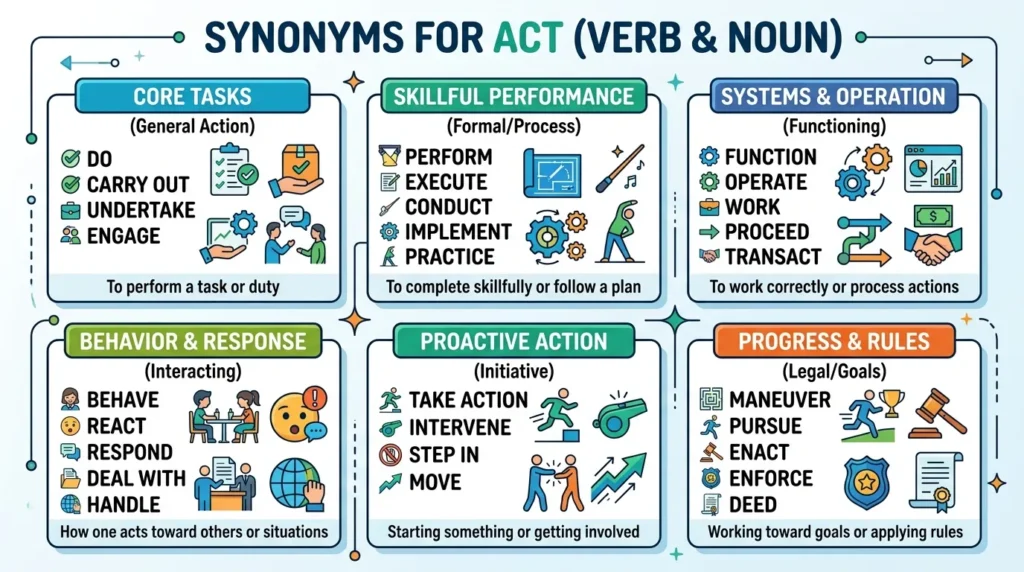
- General action words: do, perform, work, move
- Response words: react, respond, step in, intervene
- Behavior words: behave, practice
- Management words: handle, deal with, conduct, operate, function
- Formal or legal words: enact, enforce, implement, effectuate, transact
- Goal-driven words: pursue, undertake, engage, execute, proceed
- Descriptive phrases: carry out, take action, play a part
Antonyms of Act:
- Wait
- Delay
- Ignore
- Neglect
- Hesitate
Short Questions and Answers
- What does act mean?
- It means to do something or behave in a certain way.
- When should act be used?
- Use it when talking about doing something, taking action, or behaving a certain way.
- Is act positive or negative? Tone:
- “Act” is usually neutral. It can sound positive when it means a brave action. It can sound negative when it means fake behavior.
- How is it different from similar words?
- “Act” is a general and simple word. “Execute” means to carry out a plan. “React” means to respond to something that has already happened.
Conclusion
Synonyms for act can improve your English. It can help you write and speak more clearly. It also helps you avoid using the same word again and again. Words like “respond,” “handle,” “undertake,” and “enforce” have different meanings. Learning these synonyms for act helps you choose the right word. Practice a little each day. Read new synonyms for act, use them in sentences, and notice how good writers choose different words. Small daily habits lead to big improvement over time.

I’m Zahid Abbas, an educator, researcher, and digital publishing strategist with a passion for linguistics, grammar, and clear communication. As a content creator and SEO specialist, I craft research-driven, reader-focused content that empowers learners and makes knowledge accessible worldwide.