Science (noun) means the organized study of the natural world through observation, testing, and proof. Picture a curious child asking “why is the sky blue?” and a teacher explaining light and air — that moment is science in action. People use synonyms for science every day in school, news, and daily life. It relates to facts, discovery, and learning. Learning synonyms for science words helps English learners and writers. It helps you avoid using the same word many times. It can also make your writing more clear and interesting. This article explains the word’s meaning, synonyms, examples, grammar, history, pronunciation, and word groups. Everything is written in simple language to make learning easier.
Meaning of Science
Definition
Science (noun):
The careful study of the natural world using facts, tests, and proof to understand how things work.
Examples
- She studies science at the local university.
- Science helps us understand how the human body works.
Connotative Meaning
- Positive tone: trust, discovery, progress, truth
- Negative tone: coldness, over-complication, or distance from emotion (in some contexts)
- Neutral tone: a simple field of study or subject in school
Etymology
- The word comes from the Old French science, which came from the Latin scientia, meaning “knowledge.”
- Scientia comes from the Latin verb scire, meaning “to know.”
- Old English (450–1100): The word did not exist yet. English speakers used native words like wit or cræft for knowledge and skill.
- Middle English (1100–1500): The word science came into English through French. It meant “knowledge” or “learning.”
- Modern English (1500–Present): The meaning became more specific. It came to mean learning through study, observation, and experiments.
Pronunciation (US & UK — IPA)
- US: /ˈsaɪ.əns/
- UK: /ˈsaɪ.əns/
Syllables
sci-ence (2 syllables)
Affixation Pattern of Science
- Root: sci- (from Latin scire, “to know”)
- Prefix: none
- Suffix: -ence (forms an abstract noun)
- Word Formation: English formed several related words from this root. These include science (noun), scientist (noun), scientific (adjective), and scientifically (adverb). Scientism means a strong belief in the power of science.
Explore related topics https://synonymhubb.com/synonyms-for-expected/
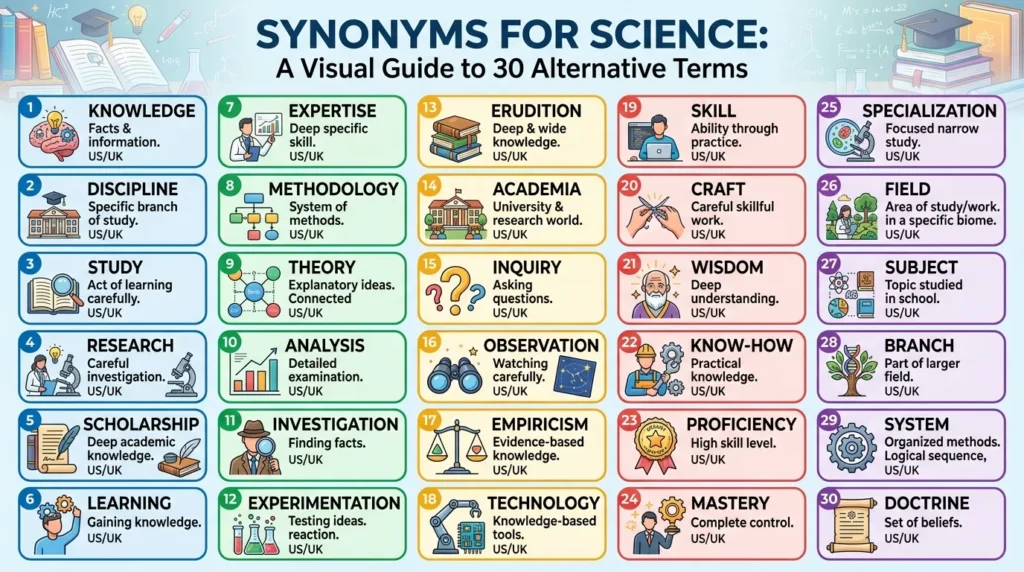
Synonyms for Science
1. Knowledge (noun) — US /ˈnɑː.lɪdʒ/ | UK /ˈnɒl.ɪdʒ/
Meaning: facts and information a person knows.
Examples:
- His knowledge of chemistry impressed the teacher.
- Reading builds your knowledge over time.
2. Discipline (noun) — US /ˈdɪs.ə.plɪn/ | UK /ˈdɪs.ɪ.plɪn/
Meaning: a specific area or branch of study.
Examples:
- Physics is a challenging discipline.
- She teaches a discipline related to biology.
3. Study (noun) — US /ˈstʌd.i/ | UK /ˈstʌd.i/
Meaning: the act of learning about a subject carefully.
Examples:
- His study of insects led to a new discovery.
- Years of study made her an expert.
4. Research (noun) — US /ˈriː.sɝːtʃ/ | UK /rɪˈsɜːtʃ/
Meaning: careful investigation to find new facts.
Examples:
- The team published their research on climate change.
- Good research takes time and patience.
5. Scholarship (noun) — US /ˈskɑː.lɚ.ʃɪp/ | UK /ˈskɒl.ə.ʃɪp/
Meaning: deep academic knowledge and study.
Examples:
- His scholarship in history is well respected.
- The book reflects years of careful scholarship.
6. Learning (noun) — US /ˈlɝː.nɪŋ/ | UK /ˈlɜː.nɪŋ/
Meaning: the process of gaining knowledge or skills.
Examples:
- Learning never really stops.
- Her love of learning started in childhood.
7. Expertise (noun) — US /ˌek.spɚˈtiːz/ | UK /ˌek.spɜːˈtiːz/
Meaning: special skill or deep knowledge in one area.
Examples:
- His expertise in medicine saved many lives.
- The company hired her for her technical expertise.
8. Methodology (noun) — US /ˌmeθ.əˈdɑː.lə.dʒi/ | UK /ˌmeθ.əˈdɒl.ə.dʒi/
Meaning: a system of methods used in a study or field.
Examples:
- The report explains the research methodology clearly.
- Scientists follow a strict methodology to test ideas.
9. Theory (noun) — US /ˈθiː.ɚ.i/ | UK /ˈθɪə.ri/
Meaning: an idea or set of ideas that explain something.
Examples:
- Einstein’s theory changed how we see time.
- This theory is supported by strong evidence.
10. Analysis (noun) — US /əˈnæl.ə.sɪs/ | UK /əˈnæl.ə.sɪs/
Meaning: careful examination of something in detail.
Examples:
- The analysis showed surprising results.
- Data analysis is a key part of research.
11. Investigation (noun) — US /ɪnˌves.təˈɡeɪ.ʃən/ | UK /ɪnˌves.tɪˈɡeɪ.ʃən/
Meaning: the process of studying something to find facts.
Examples:
- The investigation revealed how the disease spreads.
- Scientists began an investigation into the water quality.
12. Experimentation (noun) — US /ɪkˌsper.ə.mənˈteɪ.ʃən/ | UK /ɪkˌsper.ɪ.menˈteɪ.ʃən/
Meaning: the act of testing ideas through experiments.
Examples:
- Years of experimentation led to the new vaccine.
- Experimentation is central to the scientific method.
13. Erudition (noun) — US /ˌer.əˈdɪʃ.ən/ | UK /ˌer.ʊˈdɪʃ.ən/
Meaning: deep and wide knowledge gained through study.
Examples:
- His erudition impressed every professor.
- The lecture showed great erudition on ancient history.
14. Academia (noun) — US /ˌæk.əˈdiː.mi.ə/ | UK /ˌæk.əˈdiː.mi.ə/
Meaning: the world of universities, teaching, and research.
Examples:
- She spent her whole career in academia.
- Academia values careful, proven research.
15. Inquiry (noun) — US /ɪnˈkwaɪ.ri/ | UK /ɪnˈkwaɪ.ə.ri/
Meaning: the act of asking questions to learn the truth.
Examples:
- Scientific inquiry starts with a simple question.
- The inquiry led to an important discovery.
16. Observation (noun) — US /ˌɑːb.zɚˈveɪ.ʃən/ | UK /ˌɒb.zəˈveɪ.ʃən/
Meaning: the act of watching something carefully to learn from it.
Examples:
- Careful observation is the first step in science.
- Her observation of the stars led to a new finding.
17. Empiricism (noun) — US /ɪmˈpɪr.ə.sɪ.zəm/ | UK /ɪmˈpɪr.ɪ.sɪ.zəm/
Meaning: the belief that knowledge comes from experience and evidence.
Examples:
- Modern science is built on empiricism.
- Empiricism relies on tests, not just ideas.
18. Technology (noun) — US /tekˈnɑː.lə.dʒi/ | UK /tekˈnɒl.ə.dʒi/
Meaning: tools and methods made using scientific knowledge.
Examples:
- New technology helps doctors treat patients better.
- Technology grows quickly every year.
19. Skill (noun) — US /skɪl/ | UK /skɪl/
Meaning: the ability to do something well through practice.
Examples:
- Coding is a valuable skill today.
- Her research skill grew over the years.
20. Craft (noun) — US /kræft/ | UK /krɑːft/
Meaning: a skill used to make or do something with care.
Examples:
- Writing is both an art and a craft.
- He learned his craft through years of practice.
21. Wisdom (noun) — US /ˈwɪz.dəm/ | UK /ˈwɪz.dəm/
Meaning: deep understanding gained from knowledge and experience.
Examples:
- Her wisdom guided the whole research team.
- True wisdom comes from both study and life.
22. Know-how (noun) — US /ˈnoʊ.haʊ/ | UK /ˈnəʊ.haʊ/
Meaning: practical knowledge or skill to do something.
Examples:
- Engineers need real know-how, not just theory.
- Her technical know-how solved the problem fast.
23. Proficiency (noun) — US /prəˈfɪʃ.ən.si/ | UK /prəˈfɪʃ.ən.si/
Meaning: a high level of skill or ability.
Examples:
- He showed great proficiency in lab work.
- Language proficiency takes years to build.
24. Mastery (noun) — US /ˈmæs.tɚ.i/ | UK /ˈmɑː.stər.i/
Meaning: complete control or skill in a subject.
Examples:
- Her mastery of physics amazed her students.
- Mastery comes from years of steady practice.
25. Specialization (noun) — US /ˌspeʃ.əl.əˈzeɪ.ʃən/ | UK /ˌspeʃ.əl.aɪˈzeɪ.ʃən/
Meaning: focused study or skill in one narrow area.
Examples:
- His specialization is marine biology.
- Modern research often needs deep specialization.
26. Field (noun) — US /fiːld/ | UK /fiːld/
Meaning: a specific area of study or wor
Examples:
- Medicine is a demanding field.
- She chose a new field after college.
27. Subject (noun) — US /ˈsʌb.dʒɪkt/ | UK /ˈsʌb.dʒɪkt/
Meaning: a topic studied in school or research
. Examples:
- Chemistry was her favorite subject.
- The subject requires strong math skills.
28. Branch (noun) — US /bræntʃ/ | UK /brɑːntʃ/
Meaning: a smaller part of a larger field of study.
Examples:
- Genetics is a branch of biology.
- Each branch of science has its own methods.
29. System (noun) — US /ˈsɪs.təm/ | UK /ˈsɪs.təm/
Meaning: an organized set of ideas or methods.
Examples:
- The scientific system relies on testing and proof.
- Their filing system made research easier.
30. Doctrine (noun) — US /ˈdɑːk.trɪn/ | UK /ˈdɒk.trɪn/
Meaning: a set of beliefs or principles taught and followed.
Examples:
- The doctrine shaped how early scientists worked.
- This doctrine is still taught in some schools.
Prototype Meaning
When people hear the word “science,” they often think of a lab, a white coat, and test tubes. They think about careful tests and facts, not guesses. Science is commonly seen as the careful study of the world around us. It uses facts, tests, and observations to learn how things work.
Prototype Categorization
- Knowledge-based words: knowledge, wisdom, erudition, scholarship
- Study and research words: study, research, investigation, inquiry, analysis
- Skill-based words: skill, craft, expertise, proficiency, mastery, know-how
- Method and system words: methodology, system, doctrine, empiricism
- Academic and field words: academia, discipline, field, subject, branch, specialization
- Belief or idea words: theory
- Applied words: technology, experimentation, observation
Antonyms of Science:
- Ignorance
- Superstition
- Guesswork
- Myth
- Folklore
Short Questions and Answers
- What does science mean? It means the organized study of the natural world through observation and testing.
- When should science be used? Use it when talking about facts, research, experiments, or organized knowledge.
- Is science positive or negative? It is mostly positive, linked to discovery and truth, though it can feel formal or cold in casual writing.
- How is it different from similar words? “Science” focuses on proven, tested knowledge, while words like “theory” suggest an idea still being tested, and “technology” means the tools built from scientific knowledge.
Conclusion
Synonyms for science can improve your English. It can help you write and speak more clearly. It also helps you avoid using the same word again and again. Words like “research,” “knowledge,” and “expertise” have different meanings. Learning these synonyms for science helps you choose the right word. Practice a little each day. Read new synonyms for science, use them in sentences, and notice how writers use different words. Small daily practice adds up to big improvement over time.

I’m Zahid Abbas, an educator, researcher, and digital publishing strategist with a passion for linguistics, grammar, and clear communication. As a content creator and SEO specialist, I craft research-driven, reader-focused content that empowers learners and makes knowledge accessible worldwide.