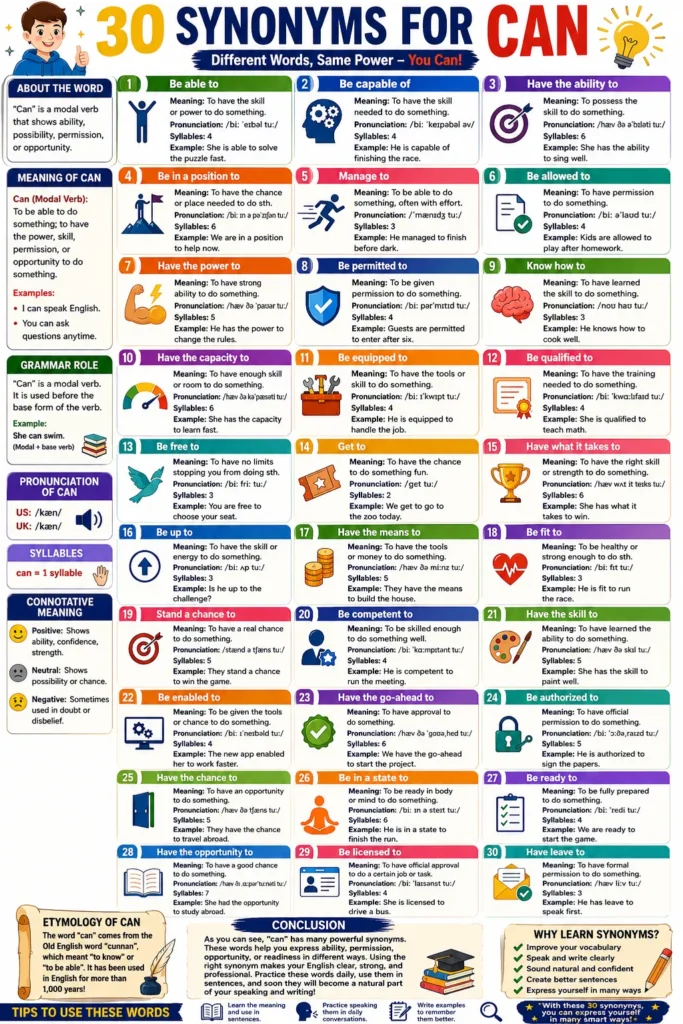
Can means to be able to do something. Think about a young girl learning to swim. After many lessons, she jumps in the pool and says, “I can swim now!” That word “can” shows she has the skill to do it. People use synonyms for can a lot every day. It helps show what someone is able to do. Learning new synonyms for can helps English learners and writers. Synonyms for can helps you say the same idea in fresh ways. It also makes your writing sound more clear. This article will teach you the meaning of can. You will learn its history, how to say it, and 30 synonyms for can and phrases that mean the same thing.
Meaning of Can
Definition
Can (Modal Verb): To be able to do something, or to have permission to do something.
Examples
- She can ride a bike very well.
- Can I go outside and play?
Connotative Meaning
- Positive tone: This word often feels helpful and hopeful, like showing someone has a skill or a chance.
- Negative tone: This word rarely feels bad. It only feels less positive in its negative form, “cannot” or “can’t.”
- Neutral tone: In plain talk, this word is used simply to show ability or permission, with no strong feeling attached.
Etymology
- This word comes from Old English “cunnan.”
- “Cunnan” meant “to know” or “to know how to do something.”
- Over time, the meaning changed from “knowing how” to “being able to.”
Short History
- Old English (450–1100): The word “cunnan” meant “to know” or “to have knowledge of how to do something.”
- Middle English (1100–1500): The word became “connen” or “cunnen.” Its meaning slowly shifted from knowledge to ability.
- Modern English (1500–Present): The word became “can,” and it is now used every day to show ability or permission, like “I can help” or “You can go.”
Pronunciation (US & UK – IPA)
- US: /kæn/
- UK: /kæn/
Syllables
can (1 syllable)
Affixation Pattern of Can
- Root: can
- Prefix: none
- Suffix: none
Word Formation:
- Can (present form)
- Could (past form)
- Cannot / can’t (negative form)
Discover more about https://synonymhubb.com/synonyms-for-accomplishment/
Prototype Meaning
When people hear the word can, they think of having the power or permission to do something. It shows a clear yes, that something is possible. This word often appears when someone is showing a skill, asking for permission, or offering help.
Prototype Categorization
- Showing skill or ability: be able to, be capable of, have the ability to, know how to, have the skill to
- Showing permission: be allowed to, be permitted to, be authorized to, be licensed to, have leave to
- Showing a chance or opportunity: get to, have the chance to, have the opportunity to, stand a chance to
- Showing readiness or fitness: be ready to, be fit to, be in a state to, be up to
- Showing training or power: be qualified to, be competent to, have the power to, have the means to, have what it takes to
- Showing approval: have the go-ahead to, be enabled to, be equipped to, be in a position to, manage to
Antonyms of Can
- Cannot
- Unable
- Incapable
- Forbidden
- Unqualified
Short Questions and Answers
- What does can mean?
- It means to be able to do something, or to have permission to do something.
- When should can be used?
- Use synonyms for can when talking about a skill, a chance, or permission to do something.
- Is can positive or negative?
- It is usually positive. It shows ability, hope, or permission.
- How is it different from similar words?
- “May” often shows polite permission. “Can” is more common and shows both ability and permission in everyday talk.
Conclusion
Synonyms for can helps you grow your word bank. It makes your writing and talking more clear and useful. It helps you use different words instead of the same one again and again. Synonyms for can also helps you feel more sure when you speak English. Try to learn one new synonyms for can from this list each day. Small steps like this help you grow a lot over time. English learners and content writers can improve their vocabulary, writing, and speaking skills by learning synonyms for can.

I’m Zahid Abbas, an educator, researcher, and digital publishing strategist with a passion for linguistics, grammar, and clear communication. As a content creator and SEO specialist, I craft research-driven, reader-focused content that empowers learners and makes knowledge accessible worldwide.