Accomplishment means something you have done successfully, often after hard work or effort. Picture a student who studies for months and finally passes a hard exam. That success, that proud moment of finishing something difficult, is an accomplishment. People use this word often because it captures pride, effort, and success in one simple term. For English learners and content writers, learning synonyms for accomplishments is important. Synonyms for accomplishment helps you avoid repeating the same word again and again. Synonyms for accomplishment makes your writing sound more natural, and keeps readers interested. This article explains the meaning of accomplishment, its synonyms, examples, grammar, history, pronunciation, and word categories.
Meaning of Accomplishment
Definition
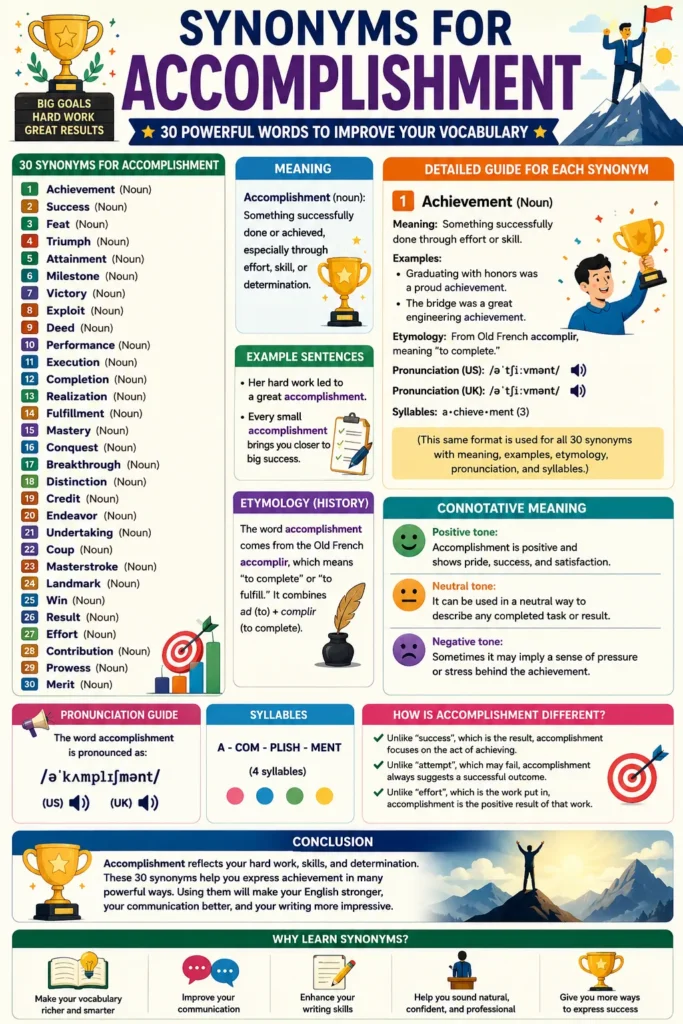
Accomplishment (Noun): Something done successfully, especially through hard work, skill, or effort.
Examples
- Winning the award was a great accomplishment for the young writer.
- Her biggest accomplishment was finishing the marathon.
Connotative Meaning
- Positive tone: Accomplishment almost always sounds positive. It suggests pride, success, and hard work paying off.
- Negative tone: This word rarely carries a negative tone, though it can sound boastful if someone lists their accomplishments too often.
- Neutral tone: In formal writing, such as resumes or reports, accomplishment is used in a plain, factual way to describe completed tasks.
Etymology
- The word accomplishment comes from Old French.
- It traces back to the French word “accomplir,” meaning “to complete” or “to fulfill.”
- This word came from the Latin “complere,” meaning “to fill up” or “to finish.”
Short History
- Old English (450–1100): The word did not exist yet. English speakers used native words like “deed” or “work” for finished tasks.
- Middle English (1100–1500): French words entered English after the Norman Conquest. “Accomplish” appeared, borrowed from French “accomplir.”
- Modern English (1500–Present): The noun “accomplishment” developed from the verb “accomplish,” and its meaning widened to include any successful achievement, in school, work, sports, and daily life.
Pronunciation (US & UK – IPA)
- US: /əˈkɑːmplɪʃmənt/
- UK: /əˈkʌmplɪʃmənt/
Syllables
ac-com-plish-ment (4 syllables)
Affixation Pattern of Accomplishment
- Root: complish (from Latin “complere,” meaning “to complete”)
- Prefix: ac- (a form of “ad-,” meaning “to” or “toward”)
- Suffix: -ment (turns a verb into a noun)
Word Formation:
- Accomplish (verb)
- Accomplished (adjective)
- Accomplishment (noun)
- Accomplisher (noun, rare)
Continue learning about https://synonymhubb.com/synonyms-for-learn/
Synonyms for Accomplishment
1. Achievement (Noun) — US: /əˈtʃiːvmənt/ | UK: /əˈtʃiːvmənt/
Meaning: Something successfully done through effort or skill. Examples:
- Graduating with honors was a proud achievement.
- The bridge was a great engineering achievement.
2. Success (Noun) — US: /səkˈsɛs/ | UK: /səkˈsɛs/
Meaning: The favorable outcome of an attempt or effort. Examples:
- The event was a huge success.
- Her success came after years of practice.
3. Feat (Noun) — US: /fiːt/ | UK: /fiːt/
Meaning: An impressive act that shows skill or bravery. Examples:
- Climbing the mountain alone was a remarkable feat.
- Building the tower in one day was quite a feat.
4. Triumph (Noun) — US: /ˈtraɪəmf/ | UK: /ˈtraɪʌmf/
Meaning: A great success or victory, often after a struggle. Examples:
- Winning the championship was a personal triumph.
- The project’s success felt like a true triumph.
5. Attainment (Noun) — US: /əˈteɪnmənt/ | UK: /əˈteɪnmənt/
Meaning: Something reached or achieved through effort. Examples:
- Her attainment of the goal took two years.
- The award recognized his academic attainment.
6. Milestone (Noun) — US: /ˈmaɪlstoʊn/ | UK: /ˈmaɪlstəʊn/
Meaning: An important event or stage in progress. Examples:
- Turning thirty felt like a big milestone.
- The launch was a milestone for the company.
7. Victory (Noun) — US: /ˈvɪktəri/ | UK: /ˈvɪktəri/
Meaning: Success in a struggle, contest, or effort. Examples:
- The team celebrated their hard-earned victory.
- Finishing the project on time felt like a victory.
8. Exploit (Noun) — US: /ˈɛksplɔɪt/ | UK: /ˈɛksplɔɪt/
Meaning: A bold and notable act or achievement. Examples:
- The soldier’s exploits were praised by everyone.
- Her exploits in business are well known.
9. Deed (Noun) — US: /diːd/ | UK: /diːd/
Meaning: Something done, especially a notable action. Examples:
- His brave deed saved the child’s life.
- She is known for her many good deeds.
10. Performance (Noun) — US: /pərˈfɔːrməns/ | UK: /pəˈfɔːməns/
Meaning: How well someone completes a task or activity. Examples:
- His performance at work earned him a promotion.
- The team’s performance improved this year.
11. Execution (Noun) — US: /ˌɛksɪˈkjuːʃən/ | UK: /ˌɛksɪˈkjuːʃən/
Meaning: The successful completion of a plan or task. Examples:
- The execution of the plan was flawless.
- Good execution turned the idea into reality.
12. Completion (Noun) — US: /kəmˈpliːʃən/ | UK: /kəmˈpliːʃən/
Meaning: The act of finishing something fully. Examples:
- The completion of the bridge took three years.
- She felt proud after the completion of her thesis.
13. Realization (Noun) — US: /ˌriːələˈzeɪʃən/ | UK: /ˌrɪəlaɪˈzeɪʃən/
Meaning: The successful achievement of a goal or plan. Examples:
- The realization of her dream took hard work.
- The project’s realization pleased the whole team.
14. Fulfillment (Noun) — US: /fʊlˈfɪlmənt/ | UK: /fʊlˈfɪlmənt/
Meaning: The satisfying completion of a task or goal. Examples:
- Teaching gave her a deep sense of fulfillment.
- The fulfillment of the contract took six months.
15. Mastery (Noun) — US: /ˈmæstəri/ | UK: /ˈmɑːstəri/
Meaning: Complete skill or control over something. Examples:
- His mastery of the piano amazed the audience.
- Years of practice led to true mastery.
16. Conquest (Noun) — US: /ˈkɑːŋkwɛst/ | UK: /ˈkɒŋkwɛst/
Meaning: The act of overcoming or winning something difficult. Examples:
- Her conquest of the difficult exam surprised everyone.
- The conquest of the market took years of effort.
17. Breakthrough (Noun) — US: /ˈbreɪkˌθruː/ | UK: /ˈbreɪkθruː/
Meaning: An important discovery or sudden success after effort. Examples:
- The scientists made a major breakthrough in medicine.
- Her breakthrough came after years of research.
18. Distinction (Noun) — US: /dɪˈstɪŋkʃən/ | UK: /dɪˈstɪŋkʃən/
Meaning: A special achievement or honor for excellence. Examples:
- She graduated with distinction.
- His work in science earned him great distinction.
19. Credit (Noun) — US: /ˈkrɛdɪt/ | UK: /ˈkrɛdɪt/
Meaning: Recognition given for a successful action. Examples:
- She deserves credit for the project’s success.
- His hard work brought him much credit.
20. Endeavor (Noun) — US: /ɪnˈdɛvər/ | UK: /ɪnˈdɛvə/
Meaning: A serious attempt that leads to a successful result. Examples:
- The new business was a bold endeavor.
- Their endeavor to help others paid off.
21. Undertaking (Noun) — US: /ˈʌndərˌteɪkɪŋ/ | UK: /ˈʌndəˌteɪkɪŋ/
Meaning: A task successfully carried out, often a large one. Examples:
- Building the school was a huge undertaking.
- The project was a difficult but rewarding undertaking.
22. Coup (Noun) — US: /kuː/ | UK: /kuː/
Meaning: A sudden, successful, and clever act. Examples:
- Signing the star player was a real coup for the team.
- Winning the contract was a business coup.
23. Masterstroke (Noun) — US: /ˈmæstərˌstroʊk/ | UK: /ˈmɑːstəˌstrəʊk/
Meaning: A brilliantly clever and successful action. Examples:
- Her decision was a masterstroke that saved the company.
- The coach’s move was a tactical masterstroke.
24. Landmark (Noun) — US: /ˈlændˌmɑːrk/ | UK: /ˈlændˌmɑːk/
Meaning: An important achievement that marks progress. Examples:
- The discovery was a landmark in medical history.
- Her book became a landmark in literature.
25. Win (Noun) — US: /wɪn/ | UK: /wɪn/
Meaning: A success or victory in an effort or contest. Examples:
- Getting the new client was a big win for the team.
- Every small win builds confidence.
26. Result (Noun) — US: /rɪˈzʌlt/ | UK: /rɪˈzʌlt/
Meaning: A successful outcome from effort or work. Examples:
- Her hard work produced great results.
- The result of the experiment pleased the scientists.
27. Effort (Noun) — US: /ˈɛfərt/ | UK: /ˈɛfət/
Meaning: Successful hard work recognized as a notable act. Examples:
- Her effort in training led to the winning performance.
- The team’s combined effort brought success.
28. Contribution (Noun) — US: /ˌkɑːntrɪˈbjuːʃən/ | UK: /ˌkɒntrɪˈbjuːʃən/
Meaning: A valuable and successful addition to a shared goal. Examples:
- His contribution to the project was outstanding.
- Her contribution helped the team succeed.
29. Prowess (Noun) — US: /ˈpraʊəs/ | UK: /ˈpraʊɪs/
Meaning: Great skill or ability shown through success. Examples:
- Her prowess in math earned her a scholarship.
- The athlete’s prowess impressed the coaches.
30. Merit (Noun) — US: /ˈmɛrɪt/ | UK: /ˈmɛrɪt/
Meaning: Something deserving praise because of its quality or success. Examples:
- Her project had real merit and won an award.
- The idea’s merit was recognized by the whole team.
Prototype Meaning
When people hear the word accomplishment, they imagine a moment of success after hard work. Like finishing a project, winning an award, or reaching a personal goal. This typical image connects accomplishment with pride, effort, and a sense of “I did it.” It often brings feelings of satisfaction and confidence.
Prototype Categorization
- Personal success: achievement, success, fulfillment, satisfaction-related words like realization
- Bold or skillful acts: feat, exploit, coup, masterstroke, prowess
- Formal or academic recognition: distinction, credit, merit, attainment
- Progress markers: milestone, breakthrough, landmark
- Completed work: completion, execution, performance, result
- Effort-based success: endeavor, undertaking, effort, contribution
Antonyms of Accomplishment
- Failure
- Defeat
- Shortcoming
- Disappointment
- Incompletion
Short Questions and Answers
- What does accomplishment mean? Accomplishment means something successfully done, often after effort or hard work.
- When should accomplishment be used? Use accomplishment when describing a completed goal, or success worth being proud of.
- Is accomplishment positive or negative? Accomplishment is almost always positive. It reflects pride, success, and hard work.
- How is it different from similar words? Unlike “effort,” which focuses on the work itself, accomplishment focuses on the successful result. Unlike “feat,” which suggests something impressive or rare, accomplishment can describe both small and large successes.
Conclusion
Synonyms for accomplishment helps you build a stronger, more colorful vocabulary. It improves your writing and speaking by giving you more ways to describe success and effort. Synonyms for accomplishment also helps you avoid repeating the same words, which keeps your writing interesting. Most importantly, learning new words like this builds your confidence in English. Try using one new synonym from this list every day. Small daily practice adds up to big improvement over time.

I’m Zahid Abbas, an educator, researcher, and digital publishing strategist with a passion for linguistics, grammar, and clear communication. As a content creator and SEO specialist, I craft research-driven, reader-focused content that empowers learners and makes knowledge accessible worldwide.