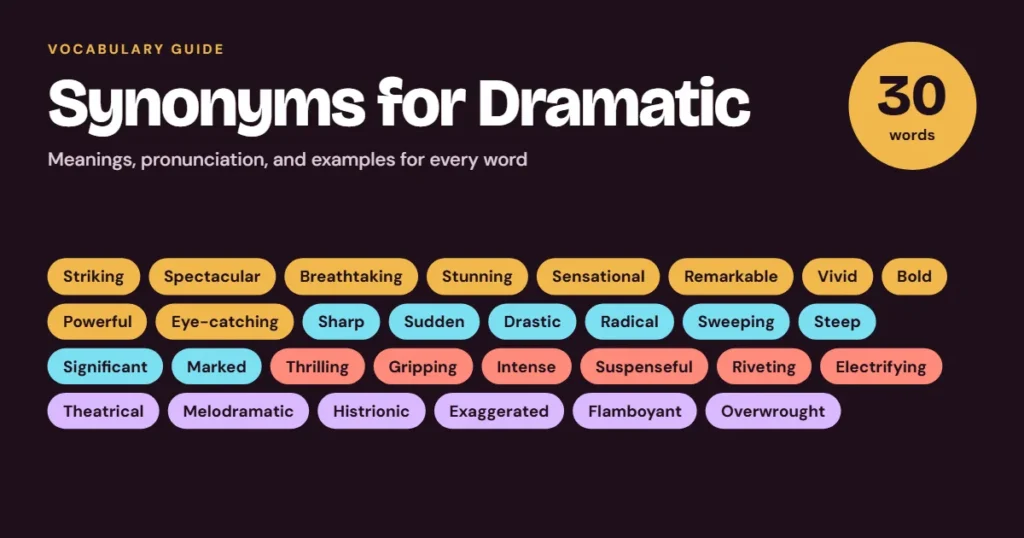
Dramatic means very sudden, exciting, or striking. Picture Lina watching a soccer final. The score is tied. In the last second, her team scores. “What a dramatic ending!” she shouts. The word fits because the moment felt big and full of feeling. People use synonyms for dramatic every day. They say it about films, weather, news, and even a friend who loves a scene. But using one word again and again makes writing dull. That is why synonyms matter. English learners get more synonyms for dramatic to choose from. Content writers sound fresh and exact. In this article, you will learn the meaning of dramatic and its tone. You will see its history and how to say it. You will study how it is built. Then you will meet 30 synonyms for dramatic with examples, grouped by meaning.
Meaning of Dramatic
Definition
Dramatic (adjective): Very sudden, exciting, or striking. It can also mean showy, as if someone is acting on a stage.
Examples
- The city saw a dramatic rise in prices.
- He made a dramatic entrance and everyone turned to look.
Connotative Meaning
- Positive tone: Exciting and impressive. “The mountain has a dramatic view at sunrise.”
- Negative tone: Over the top or attention-seeking. “Stop being so dramatic about a small problem.”
- Neutral tone: A plain fact about a big change, or about the stage. “Sales showed a dramatic drop.” “She studies dramatic arts.”
Etymology
- Source language: Late Latin dramaticus, from Greek dramatikos, from drama.
- Original meaning: Drama meant “action” or “deed,” and later “a play.” So dramatic first meant “related to a play.”
- How it changed: Over time, people used it for any moment as vivid and powerful as a scene on stage. Later it came to mean a sudden, big change.
Short History of the Word
- Old English (450–1100): The word dramatic did not exist yet. People talked about plays and games with words like plega.
- Middle English (1100–1500): English still had no common word for it. Stage shows were known as miracle plays and interludes.
- Modern English (1500–present): Around the late 1500s, dramatic entered English with the meaning “of a play.” Later it grew to mean striking, sudden, and showy.
Pronunciation (US & UK – IPA)
- US: /drəˈmæt̬.ɪk/
- UK: /drəˈmæt.ɪk/
Syllables
dra-mat-ic
Affixation Pattern of Dramatic
- Root: drama (stem: dramat-)
- Prefix: none
- Suffix: -ic (means “related to” and makes adjectives)
Word formatio
At least seven words grow from this root.
- drama (noun)
- dramatic (adjective)
- dramatics (noun)
- dramatically (adverb)
- dramatist (noun)
- dramatize (verb)
- dramatization (noun)
Learn more about it https://synonymhubb.com/synonyms-for-cheating/
Synonyms for Dramatic
1. Striking (adjective) — US /ˈstraɪ.kɪŋ/ | UK /ˈstraɪ.kɪŋ/
Meaning: So unusual or strong that it catches your eye.
Examples:
- She wore a striking red dress.
- The lake has a striking view at sunrise.
2. Spectacular (adjective) — US /spekˈtæk.jə.lɚ/ | UK /spekˈtæk.jə.lə/
Meaning: Very impressive to look at.
Examples:
- The fireworks were spectacular.
- We saw a spectacular sunset from the beach.
3. Breathtaking (adjective) — US /ˈbreθˌteɪ.kɪŋ/ | UK /ˈbreθˌteɪ.kɪŋ/
Meaning: So beautiful or amazing that it takes your breath away.
Examples:
- The view from the top was breathtaking.
- She gave a breathtaking performance.
4. Stunning (adjective) — US /ˈstʌn.ɪŋ/ | UK /ˈstʌn.ɪŋ/
Meaning: Very beautiful or surprising in a good way.
Examples:
- The bride looked stunning.
- The team’s stunning win shocked everyone.
5. Sensational (adjective) — US /senˈseɪ.ʃən.əl/ | UK /senˈseɪ.ʃən.əl/
Meaning: Causing great excitement or interest.
Examples:
- The singer gave a sensational show.
- The news was sensational and spread fast.
6. Remarkable (adjective) — US /rɪˈmɑːr.kə.bəl/ | UK /rɪˈmɑː.kə.bəl/
Meaning: Worth noticing because it is unusual or great.
Examples:
- She made a remarkable recovery.
- It was a remarkable story of courage.
7. Vivid (adjective) — US /ˈvɪv.ɪd/ | UK /ˈvɪv.ɪd/
Meaning: Very clear, bright, and full of life.
Examples:
- He gave a vivid description of the storm.
- The painting has vivid colors.
8. Bold (adjective) — US /boʊld/ | UK /bəʊld/
Meaning: Strong, clear, and not afraid to stand out.
Examples:
- The artist made a bold choice with red and gold.
- She took a bold step and changed careers.
9. Powerful (adjective) — US /ˈpaʊ.ɚ.fəl/ | UK /ˈpaʊ.ə.fəl/
Meaning: Having a strong effect on feelings or thoughts.
Examples:
- The speech was powerful and moving.
- It was a powerful film about hope.
10. Eye-catching (adjective) — US /ˈaɪˌkætʃ.ɪŋ/ | UK /ˈaɪˌkætʃ.ɪŋ/
Meaning: Bright or unusual enough to get your attention.
Examples:
- The shop has an eye-catching sign.
- He wore an eye-catching hat.
11. Sharp (adjective) — US /ʃɑːrp/ | UK /ʃɑːp/
Meaning: Sudden and large, when talking about a change.
Examples:
- We saw a sharp drop in sales.
- There was a sharp rise in prices.
12. Sudden (adjective) — US /ˈsʌd.ən/ | UK /ˈsʌd.ən/
Meaning: Happening quickly and without warning.
Examples:
- A sudden storm ended the picnic.
- There was a sudden change in plans.
13. Drastic (adjective) — US /ˈdræs.tɪk/ | UK /ˈdræs.tɪk/
Meaning: Very strong and extreme, and often hard to undo.
Examples:
- The company made drastic cuts.
- She took drastic action to save money.
14. Radical (adjective) — US /ˈræd.ɪ.kəl/ | UK /ˈræd.ɪ.kəl/
Meaning: Very big and deep, changing the basics of something.
Examples:
- The school made radical changes to the schedule.
- It was a radical new idea.
15. Sweeping (adjective) — US /ˈswiː.pɪŋ/ | UK /ˈswiː.pɪŋ/
Meaning: Wide and covering many things.
Examples:
- The mayor announced sweeping changes.
- The law brought sweeping reforms.
16. Steep (adjective) — US /stiːp/ | UK /stiːp/
Meaning: Rising or falling very fast.
Examples:
- The shop saw a steep drop in visitors.
- Prices showed a steep rise this year.
17. Significant (adjective) — US /sɪɡˈnɪf.ɪ.kənt/ | UK /sɪɡˈnɪf.ɪ.kənt/
Meaning: Large enough to matter.
Examples:
- She made significant progress this week.
- There was a significant change in the weather.
18. Marked (adjective) — US /mɑːrkt/ | UK /mɑːkt/
Meaning: Easy to see and clear.
Examples:
- There was a marked improvement in his grades.
- The two cities show a marked difference.
19. Thrilling (adjective) — US /ˈθrɪl.ɪŋ/ | UK /ˈθrɪl.ɪŋ/
Meaning: Very exciting.
Examples:
- It was a thrilling ride.
- The final was a thrilling match.
20. Gripping (adjective) — US /ˈɡrɪp.ɪŋ/ | UK /ˈɡrɪp.ɪŋ/
Meaning: So exciting that you cannot stop watching or reading.
Examples:
- The book was gripping from page one.
- It was a gripping trial.
21. Intense (adjective) — US /ɪnˈtens/ | UK /ɪnˈtens/
Meaning: Very strong and deep, as a feeling or moment.
Examples:
- The final minutes were intense.
- She felt intense joy.
22. Suspenseful (adjective) — US /səˈspens.fəl/ | UK /səˈspens.fəl/
Meaning: Full of tension, making you wait to see what happens.
Examples:
- The movie was suspenseful from start to end.
- He wrote a suspenseful story.
23. Riveting (adjective) — US /ˈrɪv.ɪ.t̬ɪŋ/ | UK /ˈrɪv.ɪ.tɪŋ/
Meaning: So interesting that it holds your full attention.
Examples:
- Her talk was riveting.
- It was a riveting documentary.
24. Electrifying (adjective) — US /ɪˈlek.trɪ.faɪ.ɪŋ/ | UK /ɪˈlek.trɪ.faɪ.ɪŋ/
Meaning: Causing sudden, strong excitement.
Examples:
- The crowd loved the electrifying finish.
- She gave an electrifying speech.
25. Theatrical (adjective) — US /θiˈæt̬.ɪ.kəl/ | UK /θiˈæt.ɪ.kəl/
Meaning: Like a stage show, or done to be noticed.
Examples:
- He made a theatrical bow.
- Her theatrical sigh made us laugh.
26. Melodramatic (adjective) — US /ˌmel.ə.drəˈmæt̬.ɪk/ | UK /ˌmel.ə.drəˈmæt.ɪk/
Meaning: Showing too much feeling, in an over-the-top way.
Examples:
- Don’t be so melodramatic about a small mistake.
- The movie was too melodramatic for me.
27. Histrionic (adjective) — US /ˌhɪs.triˈɑː.nɪk/ | UK /ˌhɪs.triˈɒn.ɪk/
Meaning: Acting in a way that is too emotional and stagey.
Examples:
- Her histrionic cry surprised the guests.
- He gave a histrionic speech about the late bus.
28. Exaggerated (adjective) — US /ɪɡˈzædʒ.ə.reɪ.t̬ɪd/ | UK /ɪɡˈzædʒ.ə.reɪ.tɪd/
Meaning: Made bigger or stronger than it really is.
Examples:
- He told an exaggerated story of the fight.
- She waved with exaggerated joy.
29. Flamboyant (adjective) — US /flæmˈbɔɪ.ənt/ | UK /flæmˈbɔɪ.ənt/
Meaning: Bold, showy, and full of style.
Examples:
- The singer wore a flamboyant coat.
- He has a flamboyant way of speaking.
30. Overwrought (adjective) — US /ˌoʊ.vɚˈrɑːt/ | UK /ˌəʊ.vəˈrɔːt/
Meaning: Too upset or too full of emotion.
Examples:
- She was overwrought and could not speak.
- The poem felt overwrought.
Prototype Meaning
When people hear dramatic, most picture a big, sudden change or a tense, exciting moment. Think of a last-second goal or a storm rolling in. The most typical meaning is something that grabs your attention because it is strong and striking. It can describe events, views, changes, and even people.
Prototype Categorization
- Striking looks: striking, spectacular, breathtaking, stunning, sensational, remarkable, vivid, bold, powerful, eye-catching
- Sudden or big change: sharp, sudden, drastic, radical, sweeping, steep, significant, marked
- Tense and exciting: thrilling, gripping, intense, suspenseful, riveting, electrifying
- Over the top: theatrical, melodramatic, histrionic, exaggerated, flamboyant, overwrought
Antonyms of dramatic
- calm
- subtle
- gradual
- ordinary
- plain
- mild
- understated
- modest
- dull
- boring
Short Questions and Answers
- What does dramatic mean?
- It means very sudden, exciting, or striking. It can also mean showy or over the top.
- When should dramatic be used?
- Use it for big changes, tense moments, strong views, or acting-style behavior. It works in news, stories, and daily talk.
- Is dramatic positive or negative?
- It depends on context. “A dramatic view” is positive. “Stop being dramatic” is negative. “A dramatic drop in sales” is neutral.
- How is it different from similar words?
- Dramatic is broad. Drastic is about strong, often harsh change. Spectacular is about something impressive to see. Theatrical is about stage-like behavior. Melodramatic is over the top and usually negative.
Conclusion
Synonyms for dramatic makes your vocabulary bigger and stronger. You now know that one word can have many shades. Spectacular fits a view. Drastic fits a change. Gripping fits a story. Melodramatic fits a person who overreacts. With the right word, your writing becomes clear and sharp. Your speaking sounds more natural too. You also avoid repeating the same word again and again, which keeps readers interested. Every new synonyms for dramatic you learn builds your English confidence. So don’t stop here. Pick three synonyms for dramatic from this list today. Use synonyms for dramatic in a message, a short story, or a blog post. Say them out loud to practice the sounds. Review them tomorrow and again next week. A little daily practice turns new words into words you own.

I’m Zahid Abbas, an educator, researcher, and digital publishing strategist with a passion for linguistics, grammar, and clear communication. As a content creator and SEO specialist, I craft research-driven, reader-focused content that empowers learners and makes knowledge accessible worldwide.