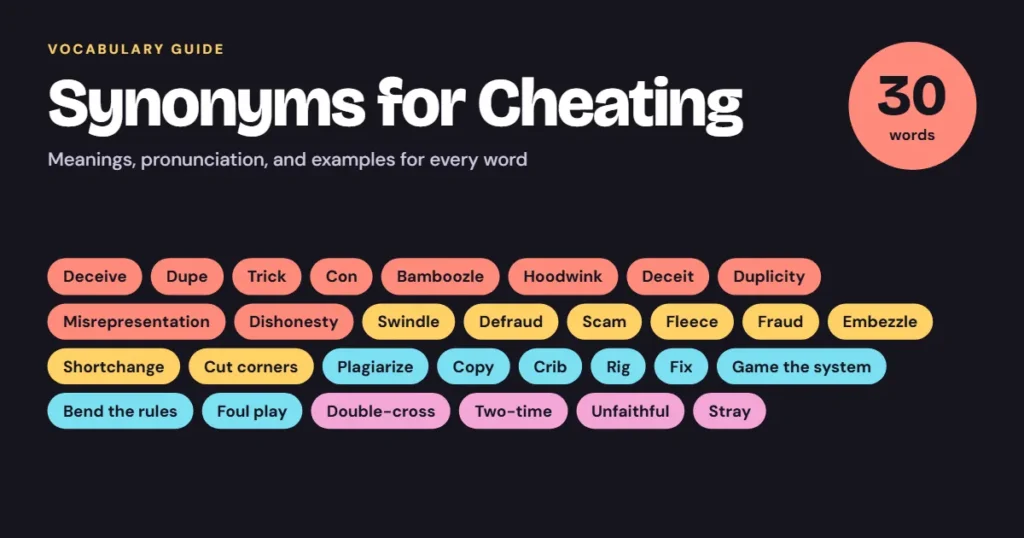
Cheating means acting in a dishonest way to win or gain something. Imagine Sam, a student. He copies his friend’s answers during a test. His teacher says, “That is cheating.” The word fits well here because it is short and clear. People use synonyms for cheating every day. They say it about school, sports, money, and love. But one word cannot fit every case. That is why learning synonyms for cheating matters. English learners gain more words to choose from. Content writers avoid repeated words and sound sharper. In this article, you will study the meaning of cheating and its tone. You will see where the word comes from and how to say it. You will learn how it is built. Then you will meet 30 synonyms for cheating with examples, and we will group them by meaning so you can pick the right one every time.
Meaning of Cheating
Definition
Cheating (noun, verb form, adjective): Acting in a dishonest way to win, gain, or get ahead. It means breaking the rules in secret or fooling people.
Examples
- The teacher caught him cheating on the test.
- Cheating in a game is never fair.
Connotative Meaning
- Positive tone: Rare. It shows up in playful phrases like “cheat day” (a day you break your diet for fun) or “cheating death.”
- Negative tone: The most common. It suggests lying, betrayal, and unfair play. Cheating in a marriage breaks trust.
- Neutral tone: Used in rules and news. “The school has a policy on cheating.” A “cheat code” in a video game is also neutral.
Etymology
- Source language: Old French eschete, from Latin excadere, which means “to fall out.”
- Original meaning: Property that “falls back” to a lord when the owner dies with no heir. The legal word is escheat.
- How it changed: Many word historians believe that the officers who took this property got a bad name for unfair dealing. So the word slowly came to mean fooling someone.
Short History of the Word
- Old English (450–1100): The word cheat did not exist yet. People used words like swic and facen for deceit.
- Middle English (1100–1500): After 1066, Norman French brought eschete into English as a law word. By the 1300s it was shortened to chete.
- Modern English (1500–present): By the 1500s, cheat meant to trick or defraud. Later it grew to cover games, exams, and love.
Pronunciation (US & UK – IPA)
- US: /ˈtʃiː.t̬ɪŋ/
- UK: /ˈtʃiː.tɪŋ/
Syllables
cheat-ing
Affixation Pattern of Cheating
- Root: cheat
- Prefix: none
- Suffix: -ing (turns the verb into a noun, adjective, or action form)
Word formation
At least six forms grow from this root.
- cheat (verb, noun)
- cheats (verb, noun plural)
- cheated (verb, past form)
- cheating (noun, adjective, verb form)
- cheater (noun)
- cheat sheet (compound noun)
You may also like https://synonymhubb.com/synonyms-for-pervasive/
Synonyms for Cheating
1. Deceive (verb) — US /dɪˈsiːv/ | UK /dɪˈsiːv/
Meaning: To make someone believe something that is not true.
Examples:
- The seller tried to deceive his customers about the price.
- She felt bad for deceiving her friends.
2. Swindle (verb) — US /ˈswɪn.dəl/ | UK /ˈswɪn.dəl/
Meaning: To take money from someone by lying.
Examples:
- The man swindled old people out of their savings.
- They were caught swindling tourists at the market.
3. Defraud (verb) — US /dɪˈfrɑːd/ | UK /dɪˈfrɔːd/
Meaning: To take money or things from someone with a lie or a false plan.
Examples:
- The company was accused of defrauding its investors.
- He went to court for defrauding the bank.
4. Dupe (verb) — US /duːp/ | UK /djuːp/
Meaning: To fool someone so they believe a lie.
Examples:
- The fake email duped many people into sharing their passwords.
- I felt silly after I was duped by the ad.
5. Scam (verb) — US /skæm/ | UK /skæm/
Meaning: To use a trick, often online, to steal money.
Examples:
- Criminals were scamming shoppers with fake websites.
- Don’t get scammed by offers that sound too good.
6. Con (verb) — US /kɑːn/ | UK /kɒn/
Meaning: To trick someone after you gain their trust.
Examples:
- He conned his neighbors with a fake charity.
- She knew she had been conned out of her money.
7. Trick (verb) — US /trɪk/ | UK /trɪk/
Meaning: To fool someone with a clever plan.
Examples:
- The player tricked the referee by pretending to be hurt.
- Don’t trick me into doing your homework.
8. Fleece (verb) — US /fliːs/ | UK /fliːs/
Meaning: To take too much money from someone in an unfair way.
Examples:
- The shop fleeced tourists with huge prices.
- He felt fleeced after paying for a broken phone.
9. Bamboozle (verb) — US /bæmˈbuː.zəl/ | UK /bæmˈbuː.zəl/
Meaning: To fool or confuse someone to get what you want.
Examples:
- The salesman bamboozled buyers with fancy words.
- They bamboozled the guard and slipped inside.
10. Hoodwink (verb) — US /ˈhʊd.wɪŋk/ | UK /ˈhʊd.wɪŋk/
Meaning: To fool someone with a clever lie.
Examples:
- The group hoodwinked voters with false promises.
- I won’t be hoodwinked by a fake smile.
11. Plagiarize (verb) — US /ˈpleɪ.dʒə.raɪz/ | UK /ˈpleɪ.dʒə.raɪz/
Meaning: To use someone else’s words or ideas and say they are yours.
Examples:
- The student was caught plagiarizing an online essay.
- Plagiarizing is a serious problem in school.
12. Copy (verb) — US /ˈkɑː.pi/ | UK /ˈkɒp.i/
Meaning: To take answers or work from someone else.
Examples:
- He got in trouble for copying his friend’s test.
- Copying homework does not help you learn.
13. Crib (verb) — US /krɪb/ | UK /krɪb/
Meaning: To secretly use notes or another person’s work in an exam.
Examples:
- She cribbed from a hidden note during the quiz.
- The teacher spotted him cribbing answers.
14. Rig (verb) — US /rɪɡ/ | UK /rɪɡ/
Meaning: To set up a contest or vote so a certain person wins.
Examples:
- They rigged the contest to help their friend.
- The club accused him of rigging the election.
15. Fix (verb) — US /fɪks/ | UK /fɪks/
Meaning: To secretly arrange the result of a game or race.
Examples:
- Officials found the team was fixing matches.
- Match fixing can end a player’s career.
16. Game the system (phrase) — US /ɡeɪm ðə ˈsɪs.təm/ | UK /ɡeɪm ðə ˈsɪs.təm/
Meaning: To use the rules in an unfair way to get ahead.
Examples:
- Some writers game the system with fake reviews.
- He gamed the system to get free shipping every time.
17. Bend the rules (phrase) — US /bend ðə ruːlz/ | UK /bend ðə ruːlz/
Meaning: To break a rule a little to gain an advantage.
Examples:
- She bent the rules by starting the test early.
- Bending the rules can get you in big trouble.
18. Foul play (noun) — US /ˌfaʊl ˈpleɪ/ | UK /ˌfaʊl ˈpleɪ/
Meaning: Unfair or dishonest acts, often in sports or crime.
Examples:
- The judges suspected foul play in the race.
- The team lost its title because of foul play.
19. Fraud (noun) — US /frɑːd/ | UK /frɔːd/
Meaning: The crime of lying to get money or gain.
Examples:
- The owner was arrested for fraud.
- Online fraud grows every year.
20. Deceit (noun) — US /dɪˈsiːt/ | UK /dɪˈsiːt/
Meaning: Lying or hiding the truth on purpose.
Examples:
- His deceit hurt everyone who trusted him.
- She spoke with deceit in her voice.
21. Duplicity (noun) — US /duːˈplɪs.ə.t̬i/ | UK /djuːˈplɪs.ə.ti/
Meaning: Acting one way while secretly acting another way.
Examples:
- His duplicity ruined the friendship.
- The leader’s duplicity was soon exposed.
22. Misrepresentation (noun) — US /ˌmɪs.rep.rɪ.zenˈteɪ.ʃən/ | UK /ˌmɪs.rep.rɪ.zenˈteɪ.ʃən/
Meaning: Giving false details to mislead someone.
Examples:
- The ad was a clear misrepresentation of the product.
- Misrepresentation on a job form can cost you the job.
23. Embezzle (verb) — US /ɪmˈbez.əl/ | UK /ɪmˈbez.əl/
Meaning: To steal money you were trusted to look after.
Examples:
- The clerk embezzled funds from the school.
- He went to jail for embezzling company money.
24. Double-cross (verb) — US /ˌdʌb.əlˈkrɔːs/ | UK /ˌdʌb.əlˈkrɒs/
Meaning: To betray someone who trusted you.
Examples:
- She double-crossed her partners in secret.
- He double-crossed his team to win the prize.
25. Two-time (verb) — US /ˌtuːˈtaɪm/ | UK /ˌtuːˈtaɪm/
Meaning: To secretly date another person while in a relationship.
Examples:
- He was two-timing her with a coworker.
- No one likes a partner who two-times.
26. Unfaithful (adjective) — US /ʌnˈfeɪθ.fəl/ | UK /ʌnˈfeɪθ.fəl/
Meaning: Breaking a promise to stay loyal in a relationship.
Examples:
- He was accused of being unfaithful to his wife.
- Being unfaithful can break trust fast.
27. Stray (verb) — US /streɪ/ | UK /streɪ/
Meaning: To move away from loyalty to a partner, often in secret.
Examples:
- Rumors said that he was straying from his marriage.
- She never thought her husband would stray.
28. Cut corners (phrase) — US /kʌt ˈkɔːr.nɚz/ | UK /kʌt ˈkɔː.nəz/
Meaning: To do a job the cheap or easy way, with lower quality.
Examples:
- The builder cut corners to save money.
- Cutting corners on safety is never okay.
29. Shortchange (verb) — US /ˌʃɔːrtˈtʃeɪndʒ/ | UK /ˌʃɔːtˈtʃeɪndʒ/
Meaning: To give someone less than they paid for or deserve.
Examples:
- The cashier shortchanged customers on purpose.
- You shortchange your readers with weak articles.
30. Dishonesty (noun) — US /dɪˈsɑː.nə.sti/ | UK /dɪˈsɒn.ə.sti/
Meaning: Not being truthful or fair.
Examples:
- Dishonesty can cost you a good name.
- The coach would not accept dishonesty on the team.
Prototype Meaning
When people hear cheating, most picture a student sneaking a look at a classmate’s test. Others picture a player who breaks the rules to win. The most typical meaning is breaking rules in secret to gain an unfair edge. It is a short, everyday word. It sounds less formal than fraud and less harsh than embezzle.
Prototype Categorization
- Fooling people: deceive, dupe, trick, hoodwink, bamboozle, con, deceit, duplicity, misrepresentation
- Money and fraud: swindle, defraud, scam, fleece, embezzle, fraud, shortchange
- School and exams: plagiarize, copy, crib
- Games and contests: rig, fix, foul play, game the system, bend the rules
- Love and trust: two-time, unfaithful, stray, double-cross
- Character and quality: dishonesty, cut corners
Antonyms of cheating
- honesty
- fairness
- loyalty
- integrity
- truthfulness
- sincerity
- playing fair
- following the rules
Short Questions and Answers
- What does cheating mean? It means acting dishonestly to win or gain something.
- When should cheating be used? Use it for everyday talk about breaking rules. It works for school, games, money, and love.
- Is cheating positive or negative? Mostly negative. It is neutral in a phrase like “cheat code” and playful in “cheat day.”
- How is it different from similar words? Cheating is broad and casual. Fraud is a crime about money. Plagiarize is only about copying words or ideas. Two-time is only about love.
Conclusion
Synonyms for cheating makes your vocabulary bigger and stronger. You now know that one word can have many shades. Plagiarize fits an essay. Rig fits a contest. Swindle fits money. Two-time fits love. With the right word, your writing becomes clear and sharp. Your speaking sounds more natural too. You also avoid repeating the same word again and again, which keeps readers interested. Every new synonyms for cheating you learn builds your English confidence. So don’t stop here. Pick three synonyms for cheating from this list today. Use them in a message, a short story, or a blog post. Say them out loud to practice the sounds. Review them tomorrow and again next week. A little daily practice turns new words into words you own.

I’m Zahid Abbas, an educator, researcher, and digital publishing strategist with a passion for linguistics, grammar, and clear communication. As a content creator and SEO specialist, I craft research-driven, reader-focused content that empowers learners and makes knowledge accessible worldwide.