The phrase due to means because of something or caused by a reason. Imagine a young girl named Lily who misses her morning school bus. Her mom looks out the window at the heavy dark clouds and tells her that the bus is late due to the sudden rainstorm. The phrase fits naturally whenever you want to explain why an event happened.
People use synonyms for due to every day in weather news, school notes, business letters, and casual talks. Because explaining cause and effect happens all the time, learning new ways to say synonyms for due are vital for English learners and content writers. Repeating the same phrase makes sentences sound dull and plain.
This guide explores the full meaning of due to alongside 30 simple synonyms. You will discover clear sentence examples, simple grammar notes, interesting history, correct pronunciation guides, and easy semantic categories written in smooth, natural sentences.
Meaning of Due to
Definition
due to (Prepositional Phrase / Adjective Phrase): Caused by something, or as a result of a specific reason.
Examples
- The picnic was canceled due to the cold weather.
- Her great test score was due to daily practice.
Connotative Meaning
- Positive tone: Shows success, good results, hard work, and happy moments.
- Negative tone: Points to delays, sudden accidents, bad weather, or sad problems.
- Neutral tone: Used in formal reports, science papers, and plain facts.
Etymology
- Source language: Came from Old French deu (meaning owed) and Latin debere (meaning to owe).
- Old English (450–1100): Early speakers used simple words like for or þurh (through) to explain reasons.
- Middle English (1100–1500): Borrowed due from French to describe something owed or expected.
- Modern English (1500–Present): Combined with to to mean “caused by” in formal writing and news stories.
Pronunciation
- US: /ˈduː tuː/
- UK: /ˈdjuː tuː/
Syllables
due-to (2 parts)
Affixation Pattern of Due to
- Root: Due
- Prefix: None
- Suffix: None
- Word Formation:
- Noun: Dues
- Adjective: Due
- Adverb: Duly
Also read more about https://synonymhubb.com/synonyms-of-advice/
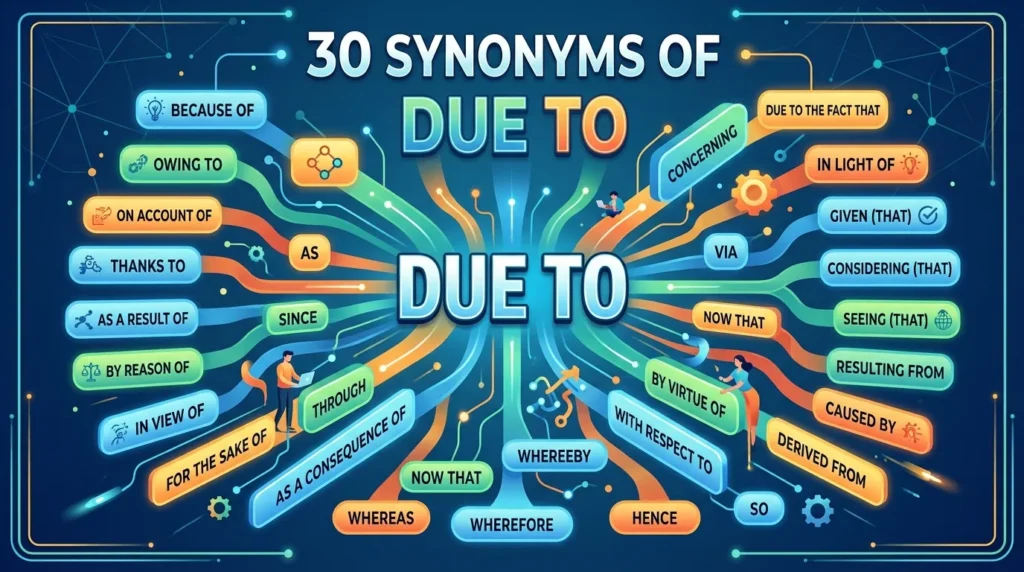
Synonyms of Due to
1. Because of (Preposition) — US: /bɪˈkɔːz ʌv/ | UK: /bɪˈkɒz ɒv/
Meaning: As a result of a person, thing, or event.
Examples:
We stayed inside because of the heavy rain.
She smiled because of her friend’s nice joke.
2. Owning to (Preposition) — US: /ˈoʊɪŋ tuː/ | UK: /ˈəʊɪŋ tuː/
Meaning: Because of a particular reason or cause.
Examples:
The game ended early owing to the dark sky.
Owing to his hard work, he passed the test.
3. Caused by (Adjective Phrase) — US: /kɔːzd baɪ/ | UK: /kɔːzd baɪ/
Meaning: Brought about or created by something.
Examples:
The noise was caused by a falling box.
Her dry skin was caused by the cold wind.
4. Thanks to (Prepositional Phrase) — US: /θæŋks tuː/ | UK: /θæŋks tuː/
Meaning: As a happy or helpful result of someone or something.
Examples:
We won the match thanks to our great coach.
Thanks to the map, we found the hidden park.
5. As a result of (Prepositional Phrase) — US: /æz ə rɪˈzʌlt ʌv/ | UK: /æz ə rɪˈzʌlt ɒv/
Meaning: Happening directly after and because of an event.
Examples:
The street was wet as a result of the storm.
He gained strength as a result of daily runs.
6. On account of (Prepositional Phrase) — US: /ɑːn əˈkaʊnt ʌv/ | UK: /ɒn əˈkaʊnt ɒv/
Meaning: For the reason of something happening.
Examples:
School closed on account of the heavy snow.
He missed the trip on account of his bad cough.
7. By reason of (Prepositional Phrase) — US: /baɪ ˈriːzən ʌv/ | UK: /baɪ ˈriːzn ɒv/
Meaning: Due to a specific fact or rule.
Examples:
He stayed home by reason of his illness.
She got the job by reason of her long skill.
8. In view of (Prepositional Phrase) — US: /ɪn vjuː ʌv/ | UK: /ɪn vjuː ɒv/
Meaning: Thinking about a clear fact or event.
Examples:
In view of the late hour, we went to sleep.
We left early in view of the busy traffic.
9. Produced by (Adjective Phrase) — US: /prəˈduːst baɪ/ | UK: /prəˈdjuːst baɪ/
Meaning: Made or created by a force or event.
Examples:
The heat was produced by the bright sun.
The sweet sound was produced by a wooden flute.
10. Stemming from (Prepositional Phrase) — US: /ˈstɛmɪŋ frʌm/ | UK: /ˈstemɪŋ frɒm/
Meaning: Growing out of or starting from a root reason.
Examples:
His joy was stemming from his good news.
Her fear was stemming from an old bad dream.
11. Arising from (Prepositional Phrase) — US: /əˈraɪzɪŋ frʌm/ | UK: /əˈraɪzɪŋ frɒm/
Meaning: Coming up or starting as a new result.
Examples:
Problems arising from late payments were solved.
The joy arising from the party was great.
12. Brought about by (Adjective Phrase) — US: /brɔːt əˈbaʊt baɪ/ | UK: /brɔːt əˈbaʊt baɪ/
Meaning: Caused to happen by an action or thing.
Examples:
The big change was brought about by teamwork.
The delay was brought about by a flat tire.
13. Resulting from (Prepositional Phrase) — US: /rɪˈzʌltɪŋ frʌm/ | UK: /rɪˈzʌltɪŋ frɒm/
Meaning: Coming directly out of a clear cause.
Examples:
The wet floor was resulting from a pipe leak.
Her bright smile was resulting from her prize.
14. Led by (Adjective Phrase) — US: /lɛd baɪ/ | UK: /led baɪ/
Meaning: Guided or brought forward by something.
Examples:
The success was led by a wise captain.
The move was led by strong public demand.
15. Sparked by (Adjective Phrase) — US: /spɑːrkt baɪ/ | UK: /spɑːkt baɪ/
Meaning: Started suddenly by an event or idea.
Examples:
The fun cheer was sparked by the final goal.
The debate was sparked by a news story.
16. Triggered by (Adjective Phrase) — US: /ˈtrɪɡərd baɪ/ | UK: /ˈtrɪɡəd baɪ/
Meaning: Set off quickly by a cause or event.
Examples:
His sneeze was triggered by small dust bits.
The alarm was triggered by thick smoke.
17. Driven by (Adjective Phrase) — US: /ˈdrɪvən baɪ/ | UK: /ˈdrɪvn baɪ/
Meaning: Pushed forward by a strong need or desire.
Examples:
She was driven by her love for painting.
The car growth was driven by new tech ideas.
18. Prompted by (Adjective Phrase) — US: /ˈprɑːmptɪd baɪ/ | UK: /ˈprɒmptɪd baɪ/
Meaning: Moved to action by a reason or gift.
Examples:
He wrote a letter prompted by her kind note.
Our move was prompted by a job offer.
19. Born of (Adjective Phrase) — US: /bɔːrn ʌv/ | UK: /bɔːn ɒv/
Meaning: Coming straight out of a feeling or state.
Examples:
Her success was born of hard daily effort.
His grand act was born of true courage.
20. Originating from (Prepositional Phrase) — US: /əˈrɪdʒəˌneɪtɪŋ frʌm/ | UK: /əˈrɪdʒɪneɪtɪŋ frɒm/
Meaning: Starting or coming first from a place or cause.
Examples:
The river was originating from a mountain spring.
The news was originating from a local office.
21. Grounded in (Adjective Phrase) — US: /ˈɡraʊndɪd ɪn/ | UK: /ˈɡraʊndɪd ɪn/
Meaning: Based firmly on facts or reasons.
Examples:
His trust was grounded in her honest words.
The story was grounded in real city history.
22. In consequence of (Prepositional Phrase) — US: /ɪn ˈkɑːnsəkwəns ʌv/ | UK: /ɪn ˈkɒnsɪkwəns ɒv/
Meaning: As a natural outcome of an action.
Examples:
He stayed late in consequence of extra work.
The shop closed in consequence of low sales.
23. Out of (Preposition) — US: /aʊt ʌv/ | UK: /aʊt ɒv/
Meaning: Motivated or caused by an inner feeling.
Examples:
She helped the cat out of pure kindness.
He asked a question out of curiosity.
24. Through (Preposition) — US: /θruː/ | UK: /θruː/
Meaning: By means of or because of something.
Examples:
They succeeded through hard daily practice.
The plant grew through good sunlight.
25. Derived from (Adjective Phrase) — US: /dɪˈraɪvd frʌm/ | UK: /dɪˈraɪvd frɒm/
Meaning: Taken or formed from an original source.
Examples:
The sweet syrup is derived from maple trees.
Her great idea was derived from a book.
26. Based on (Adjective Phrase) — US: /beɪst ɑːn/ | UK: /beɪst ɒn/
Meaning: Using facts or ideas as a foundation.
Examples:
The movie is based on a true life story.
Our guess was based on early test numbers.
27. On the grounds of (Prepositional Phrase) — US: /ɑːn ðə ɡraʊndz ʌv/ | UK: /ɒn ðə ɡraʊndz ɒv/
Meaning: Using a specific rule or reason as proof.
Examples:
He left early on the grounds of poor health.
The rule changed on the grounds of safety.
28. In light of (Prepositional Phrase) — US: /ɪn laɪt ʌv/ | UK: /ɪn laɪt ɒv/
Meaning: Taking new information into thought.
Examples:
In light of the news, we changed our plans.
She smiled in light of his nice words.
29. Yielded by (Adjective Phrase) — US: /ˈjiːldɪd baɪ/ | UK: /ˈjiːldɪd baɪ/
Meaning: Given or produced as a direct result.
Examples:
The high profits were yielded by good sales.
The sweet fruit was yielded by young trees.
30. Generated by (Adjective Phrase) — US: /ˈdʒɛnəˌreɪtɪd baɪ/ | UK: /ˈdʒenəreɪtɪd baɪ/
Meaning: Created or produced by a machine or action.
Examples:
Power was generated by the big wind fan.
Heat was generated by the camp fire.
Prototype Meaning
When people hear due to, they usually picture a clear link between a cause and an effect. It is the mental bridge that connects why something happened to the event itself. Like rain causing a wet street or hard work leading to a good grade.
Prototype Categorization
- Direct Cause & Result: Because of, Caused by, Produced by, Resulting from, Generated by, Yielded by.
- Origins & Roots: Stemming from, Arising from, Born of, Originating from, Derived from, Grounded in.
- Triggers & Action Starters: Sparked by, Triggered by, Driven by, Prompted by, Led by, Brought about by.
- Reasons & Explanations: Thanks to, Owing to, On account of, As a result of, By reason of, In view of, In light of, Based on, On the grounds of, In consequence of, Out of, Through.
Antonyms of Due to
- Irrespective of
- Regardless of
- Despite
- In spite of
- Unrelated to
- Independent of
Short Questions and Answers
- What does due to mean?
- It means caused by something or as a result of a clear reason.
- When should due to be used?
- Use it when linking an effect back to its cause in school essays, news reports, or talks.
- Is due to positive or negative?
- It is neutral on its own, but it fits happy events (success due to effort) and sad events (delays due to rain).
- How is it different from similar words?
- Due to modifies nouns as an adjective phrase, while because of works as an adverb phrase to modify verbs.
Conclusion
Synonyms for due to improves your overall vocabulary quickly. Using the same basic transition again and again can make your writing feel plain. Swapping in phrases like thanks to for happy moments, sparked by for fast actions, or in light of for smart choices adds variety to your sentences. Synonyms for due to strengthens your writing and speaking skills, prevents dull repetition, and builds total English confidence. Try using two or three of these new synonyms for due to in your daily reading, writing, and practice.

I’m Zahid Abbas, an educator, researcher, and digital publishing strategist with a passion for linguistics, grammar, and clear communication. As a content creator and SEO specialist, I craft research-driven, reader-focused content that empowers learners and makes knowledge accessible worldwide.