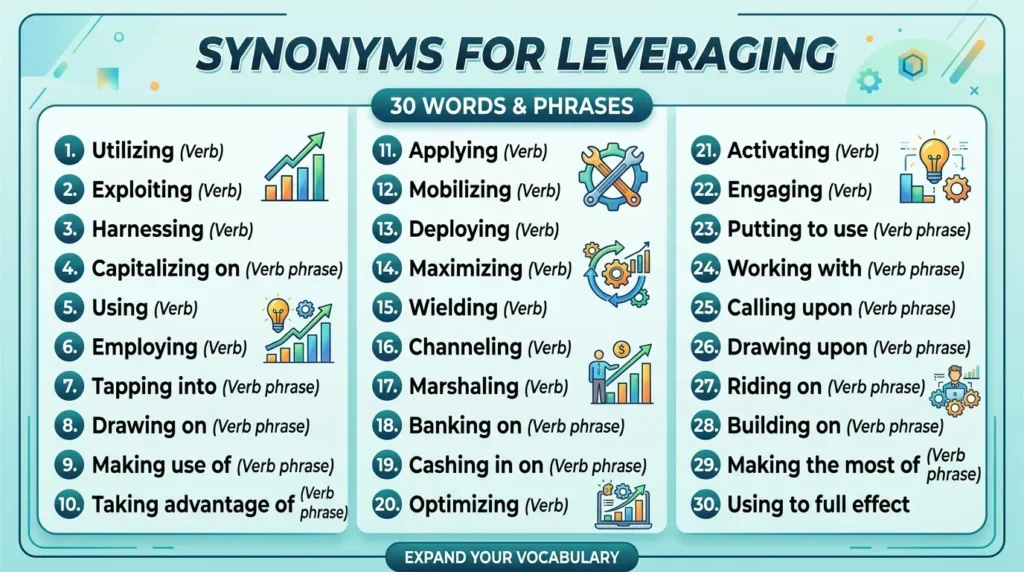
Leveraging means using something, such as a resource, skill, or tool, to maximum advantage in order to achieve a goal. Think about a small business owner who uses her large social media following to promote a new product without spending money on ads. She is leveraging her online presence to grow her business quickly. Synonyms for leveraging describes smart, efficient use of resources that a person or company already has. People use synonyms for leveraging a lot in business, technology, and everyday planning. Learning new synonyms for leveraging helps English learners speak and write with more variety. It also helps writers avoid using the same word again and again. This article explains the meaning of leveraging, its history, and how to say it. It also shares 30 words that mean almost the same thing.
Meaning of Leveraging
Definition
Leveraging (Verb, from “leverage”):
Using something, such as a resource or skill, to maximum advantage to achieve a goal.
Examples
- The company is leveraging new technology to speed up production.
- She leveraged her strong network to find a new job quickly.
Connotative Meaning
- Positive tone:
- This word often feels smart and strategic, showing clever use of available resources.
- Negative tone:
- This word can feel calculated when it suggests using people or situations unfairly.
- Neutral tone:
- In business and finance writing, it is often used in a plain, factual way to describe smart resource use.
Etymology
- This word comes from “leverage,” based on “lever,” from Old French “levier,” meaning “to raise.”
- That word came from Latin “levare,” meaning “to lift,” related to “levis,” meaning “light.”
- The word “leverage” first described the mechanical advantage of a lever, later growing to mean smart use of any resource.
Short History
- Old English (450–1100):
- This word did not exist yet. People used other native words to describe lifting or gaining advantage.
- Middle English (1100–1500): The word lever came into English from Old French. It referred to a simple tool used to lift heavy things.
- Modern English (1500–Present): Leverage
- later came to mean using an advantage to get a better result. Today, it is also widely used for making smart use of resources, or tools, especially in business.
Pronunciation (US & UK – IPA)
- US: /ˈlɛvərɪdʒɪŋ/
- UK: /ˈliːvərɪdʒɪŋ/
Syllables
lev-er-ag-ing (4 syllables)
Affixation Pattern of Leveraging
- Root: lev (from Latin “levare,” meaning “to lift”)
- Prefix: none
- Suffix: -age (forms the noun “leverage”) + -ing (forms the verb “leveraging”)
Explore related words https://synonymhubb.com/synonyms-for-antagonize/
Word Formation:
Lever (noun), leverage (noun/verb), leveraging (verb form), and leveraged (adjective/past tense) all come from this root.
Synonyms for Leveraging
1. Utilizing (Verb) — US: /ˈjuːtəˌlaɪzɪŋ/ | UK: /ˈjuːtɪlaɪzɪŋ/
Meaning: Making practical use of something.
Examples:
- The team is utilizing new software to save time.
- She utilized her language skills during the trip.
2. Exploiting (Verb) — US: /ɪkˈsplɔɪtɪŋ/ | UK: /ɪkˈsplɔɪtɪŋ/
Meaning: Using something fully, often for personal gain.
Examples:
- The company is exploiting a gap in the market.
- He exploited his connections to find new clients.
3. Harnessing (Verb) — US: /ˈhɑːrnəsɪŋ/ | UK: /ˈhɑːnəsɪŋ/
Meaning: Controlling and using something’s power effectively.
Examples:
- They are harnessing solar power for the new building.
- She harnessed her creativity to design the campaign.
4. Capitalizing on (Verb phrase) — US: /ˈkæpɪtəˌlaɪzɪŋ ɒn/ | UK: /ˈkæpɪtəlaɪzɪŋ ɒn/
Meaning: Taking advantage of a situation for benefit.
Examples:
- The store is capitalizing on the holiday rush.
- She capitalized on her early success to grow further.
5. Using (Verb) — US: /ˈjuːzɪŋ/ | UK: /ˈjuːzɪŋ/
Meaning: Employing something for a specific purpose.
Examples:
- He is using his savings to start a business.
- She used her free time to learn a new skill.
6. Employing (Verb) — US: /ɪmˈplɔɪɪŋ/ | UK: /ɪmˈplɔɪɪŋ/
Meaning: Using a method or tool for a purpose.
Examples:
- The team is employing new strategies this year.
- She employed careful planning to finish on time.
7. Tapping into (Verb phrase) — US: /ˈtæpɪŋ ˈɪntuː/ | UK: /ˈtæpɪŋ ˈɪntə/
Meaning: Making use of an available source of value.
Examples:
- The company is tapping into a growing market.
- She tapped into her past experience to solve the issue.
8. Drawing on (Verb phrase) — US: /ˈdrɔːɪŋ ɒn/ | UK: /ˈdrɔːɪŋ ɒn/
Meaning: Using something as a resource or support.
Examples:
- He drew on years of experience to give advice.
- She drew on her savings to fund the trip.
9. Making use of (Verb phrase) — US: /ˈmeɪkɪŋ juːs əv/ | UK: /ˈmeɪkɪŋ juːs əv/
Meaning: Using something available for a benefit.
Examples:
- They are making use of the extra space in the office.
- She made use of every free hour to study.
10. Taking advantage of (Verb phrase) — US: /ˈteɪkɪŋ ædˈvæntɪdʒ əv/ | UK: /ˈteɪkɪŋ ədˈvɑːntɪdʒ əv/
Meaning: Using an opportunity to gain benefit. Examples:
- She took advantage of the sale to buy new shoes.
- He took advantage of the quiet office to focus.
11. Applying (Verb) — US: /əˈplaɪɪŋ/ | UK: /əˈplaɪɪŋ/
Meaning: Putting a skill or method into practical use.
Examples:
- She is applying new methods to improve results.
- He applied his training to solve the problem.
12. Mobilizing (Verb) — US: /ˈmoʊbəˌlaɪzɪŋ/ | UK: /ˈməʊbəlaɪzɪŋ/
Meaning: Organizing and using resources or people for action.
Examples:
- The charity is mobilizing volunteers for the event.
- She mobilized her team to meet the deadline.
13. Deploying (Verb) — US: /dɪˈplɔɪɪŋ/ | UK: /dɪˈplɔɪɪŋ/
Meaning: Putting resources into action for a purpose.
Examples:
- The company is deploying new tools company-wide.
- They deployed extra staff during the busy season.
14. Maximizing (Verb) — US: /ˈmæksɪˌmaɪzɪŋ/ | UK: /ˈmæksɪmaɪzɪŋ/
Meaning: Making the most possible use of something.
Examples:
- She is maximizing her time by planning ahead.
- The team maximized their budget carefully.
15. Wielding (Verb) — US: /ˈwiːldɪŋ/ | UK: /ˈwiːldɪŋ/
Meaning: Using power or influence effectively.
Examples:
- He wields great influence in the industry.
- She wielded her skills to lead the project.
16. Channeling (Verb) — US: /ˈtʃænəlɪŋ/ | UK: /ˈtʃænəlɪŋ/
Meaning: Directing resources or energy toward a specific goal.
Examples:
- She channeled her energy into the new project.
- The company is channeling funds into research.
17. Marshaling (Verb) — US: /ˈmɑːrʃəlɪŋ/ | UK: /ˈmɑːʃəlɪŋ/
Meaning: Organizing resources carefully for a purpose.
Examples:
- He marshaled his arguments before the debate.
- The team marshaled its resources for the launch.
18. Banking on (Verb phrase) — US: /ˈbæŋkɪŋ ɒn/ | UK: /ˈbæŋkɪŋ ɒn/
Meaning: Relying confidently on something to succeed. Examples:
- The company is banking on the new product’s success.
- She banked on her hard work to earn the promotion.
19. Cashing in on (Verb phrase) — US: /ˈkæʃɪŋ ɪn ɒn/ | UK: /ˈkæʃɪŋ ɪn ɒn/
Meaning: Using a situation to gain quick benefit.
Examples:
- The brand is cashing in on the trend.
- He cashed in on his early investment.
20. Optimizing (Verb) — US: /ˈɑːptɪˌmaɪzɪŋ/ | UK: /ˈɒptɪmaɪzɪŋ/
Meaning: Making the best possible use of something.
Examples:
- They are optimizing the website for faster loading.
- She optimized her schedule to save time.
21. Activating (Verb) — US: /ˈæktɪˌveɪtɪŋ/ | UK: /ˈæktɪveɪtɪŋ/
Meaning: Putting something into active use.
Examples:
- The company is activating a new marketing plan.
- She activated her network to spread the news.
22. Engaging (Verb) — US: /ɪnˈɡeɪdʒɪŋ/ | UK: /ɪnˈɡeɪdʒɪŋ/
Meaning: Using or involving something actively.
Examples:
- The team is engaging new partners for the project.
- She engaged her skills to solve the tricky issue.
23. Putting to use (Verb phrase) — US: /ˈpʊtɪŋ tuː juːs/ | UK: /ˈpʊtɪŋ tuː juːs/
Meaning: Actively using something available.
Examples:
- He is putting his training to use at the new job.
- She put her free time to use by volunteering.
24. Working with (Verb phrase) — US: /ˈwɜːrkɪŋ wɪð/ | UK: /ˈwɜːkɪŋ wɪð/
Meaning: Using something as a helpful part of a plan.
Examples:
- The team is working with limited resources.
- She worked with her strengths to build the plan.
25. Calling upon (Verb phrase) — US: /ˈkɔːlɪŋ əˈpɒn/ | UK: /ˈkɔːlɪŋ əˈpɒn/
Meaning: Making use of a resource or skill when needed.
Examples:
- She called upon her experience to guide the team.
- He called upon old friends for support.
26. Drawing upon (Verb phrase) — US: /ˈdrɔːɪŋ əˈpɒn/ | UK: /ˈdrɔːɪŋ əˈpɒn/
Meaning: Using knowledge or resources as support.
Examples:
- She drew upon years of study for the exam.
- He drew upon community support to fund the project.
27. Riding on (Verb phrase) — US: /ˈraɪdɪŋ ɒn/ | UK: /ˈraɪdɪŋ ɒn/
Meaning: Relying on something’s momentum or success.
Examples:
- The brand is riding on its recent popularity.
- She rode on her early success to attract investors.
28. Building on (Verb phrase) — US: /ˈbɪldɪŋ ɒn/ | UK: /ˈbɪldɪŋ ɒn/
Meaning: Using existing progress as a foundation for more.
Examples:
- The team is building on last year’s success.
- She built on her basic skills to master the craft.
29. Making the most of (Verb phrase) — US: /ˈmeɪkɪŋ ðə moʊst əv/ | UK: /ˈmeɪkɪŋ ðə məʊst əv/
Meaning: Using an opportunity as fully as possible.
Examples:
- She made the most of her short vacation.
- He made the most of the extra funding.
30. Using to full effect (Verb phrase) — US: /ˈjuːzɪŋ tuː fʊl ɪˈfɛkt/ | UK: /ˈjuːzɪŋ tuː fʊl ɪˈfɛkt/
Meaning: Using something in the most effective way possible.
Examples:
- She used her training to full effect during the crisis.
- The team used their small budget to full effect.
Prototype Meaning
When people hear the word leveraging, they picture someone cleverly using what they already have. Whether it is money, skill, or connections, to reach a bigger goal with less effort. It brings to mind smart planning and getting the most value from limited resources.
Prototype Categorization
- Business and finance use:
- Capitalizing on, cashing in on, banking on, optimizing, maximizing
- Using skills or knowledge:
- Applying, drawing on, drawing upon, calling upon, working with
- Organizing resources:
- Mobilizing, deploying, marshaling, channeling
- General smart use:
- Utilizing, using, employing, putting to use, making use of
- Taking advantage of opportunities:
- Taking advantage of, tapping into, riding on, building on, making the most of
- Using power or influence:
- Wielding, exploiting, harnessing, activating, engaging, using to full effect
Antonyms of Leveraging:
- Wasting
- Neglecting
- Ignoring
- Underusing
- Squandering
Short Questions and Answers
- What does leveraging mean? It means using something, such as a resource or skill, to maximum advantage to achieve a goal.
- When should leveraging be used? Use it when describing smart, efficient use of resources, skills, or opportunities.
- Is leveraging positive or negative? It is usually positive, showing smart strategy, though it can feel negative when it suggests using people unfairly.
- How is it different from similar words? “Using” is a simple, general word for putting something to work. “Leveraging” suggests a smarter, more strategic use aimed at gaining maximum advantage.
Conclusion
Synonyms for leveraging helps you build a stronger, more strategic vocabulary. It strengthens your writing and speaking by giving you many ways to describe smart planning and resource use. It also helps you avoid repeating the same word again and again. Synonyms for leveraging keeps your writing clearer and more professional. Most importantly, learning new synonyms for leveraging builds your confidence as an English speaker and writer. Try learning one synonyms for leveraging each day, and watch your vocabulary grow steadily over time.

I’m Zahid Abbas, an educator, researcher, and digital publishing strategist with a passion for linguistics, grammar, and clear communication. As a content creator and SEO specialist, I craft research-driven, reader-focused content that empowers learners and makes knowledge accessible worldwide.