Event means something that happens, often planned and special. Think about a girl who gets an invite to her cousin’s birthday party. She tells her mom, “It’s going to be a fun event!” She means the party, the people, and the whole happy day. People use synonyms for event a lot. We use it for parties, sports, news, and even small daily happenings. New synonyms for event help you talk better. Synonyms for event help you write better too. You will not repeat the same word. Your writing will be more fun to read. This article will teach you the word “event.” You will learn 30 other words like it. You will see easy examples. We will learn how to say each word. You will learn some history too.
Meaning of Event
Definition
Event (noun): something that happens, often planned or important.
Examples
- The wedding was a beautiful event.
- The school held a sports event last week.
Connotative Meaning
- Positive tone: fun, exciting, and worth remembering
- Negative tone: can feel heavy if linked to sad or hard news
- Neutral tone: just a plain word for something that happens
Etymology
- This word comes from the Latin word eventus. It means “an outcome” or “a result.”
- Eventus comes from the Latin verb evenire. It means “to come out” or “to happen.”
- The word moved into English through French in the 1500s.
- Old English (450–1100): This word did not exist yet. People used words like gelimp, which meant “a happening” or “chance.”
- Middle English (1100–1500): The word was not common yet. English still used older native words for happenings.
- Modern English (1500–Present): “Event” came into English in the 1500s. It first meant “an outcome.” Later, it grew to mean any happening, planned or not.
Pronunciation (US & UK — IPA)
- US: /ɪˈvent/
- UK: /ɪˈvent/
Syllables
e-vent (2 parts)
Affixation Pattern of Event
- Root: vent- (from Latin venire, meaning “to come”)
- Prefix: e- (from Latin ex-, meaning “out”)
- Suffix: none in the base word (though forms like event-ful use one)
- Word formation: This root makes many words. We get event (noun), eventful (adjective), eventually (adverb), eventual (adjective), and nonevent (noun). That is five related words.
You may also like https://synonymhubb.com/synonyms-for-marriage/
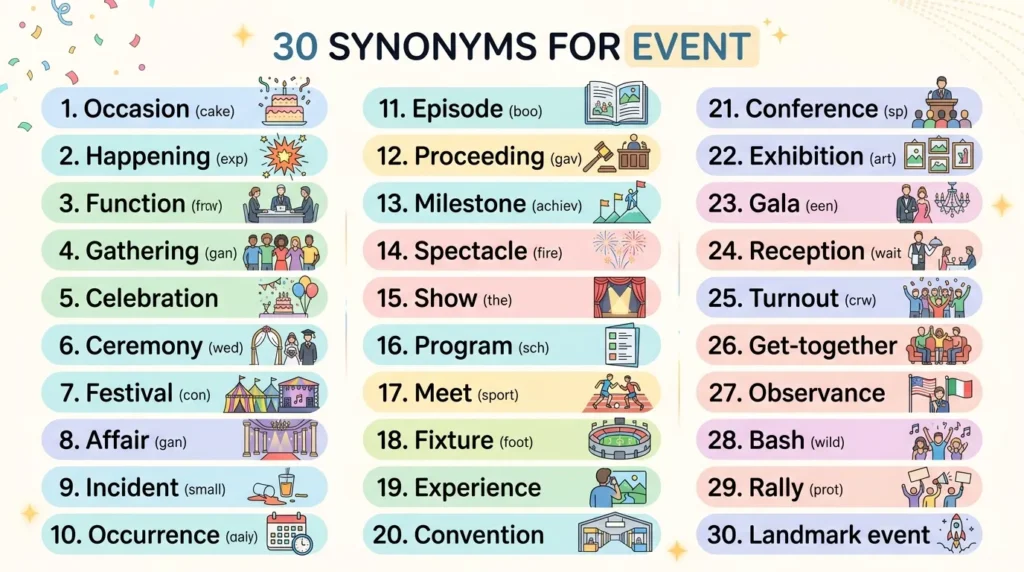
Synonyms for Event
1. Occasion (noun) — US /əˈkeɪ.ʒən/ | UK /əˈkeɪ.ʒən/
Meaning: a special time when something happens. Examples:
- The dinner was a special occasion.
- We dressed up for the occasion.
2. Happening (noun) — US /ˈhæp.ən.ɪŋ/ | UK /ˈhæp.ən.ɪŋ/
Meaning: something that takes place.
Examples:
- The fair was a fun happening in town.
- Strange happenings occurred that night.
3. Function (noun) — US /ˈfʌŋk.ʃən/ | UK /ˈfʌŋk.ʃən/
Meaning: a formal gathering or event.
Examples:
- They attended a work function.
- The hotel hosted a large function.
4. Gathering (noun) — US /ˈɡæð.ɚ.ɪŋ/ | UK /ˈɡæð.ər.ɪŋ/
Meaning: a group of people meeting for a reason.
Examples:
- The family held a small gathering.
- It was a fun gathering of old friends.
5. Celebration (noun) — US /ˌsel.əˈbreɪ.ʃən/ | UK /ˌsel.ɪˈbreɪ.ʃən/
Meaning: an event held to mark something happy.
Examples:
- Her birthday celebration was huge.
- The team held a celebration after the win.
6. Ceremony (noun) — US /ˈser.ə.moʊ.ni/ | UK /ˈser.ɪ.mə.ni/
Meaning: a formal event, often with set actions and words.
Examples:
- The wedding ceremony was short and sweet.
- They held a graduation ceremony outside.
7. Festival (noun) — US /ˈfes.tə.vəl/ | UK /ˈfes.tɪ.vəl/
Meaning: a day or time of public joy and events.
Examples:
- The music festival drew a huge crowd.
- We enjoy the food festival every year.
8. Affair (noun) — US /əˈfer/ | UK /əˈfeə/
Meaning: an event, often formal or planned.
Examples:
- The charity affair raised a lot of money.
- It was a grand affair with many guests.
9. Incident (noun) — US /ˈɪn.sə.dənt/ | UK /ˈɪn.sɪ.dənt/
Meaning: something that happens, often small or unplanned.
Examples:
- A small incident delayed the bus.
- The news reported the strange incident.
10. Occurrence (noun) — US /əˈkɝː.əns/ | UK /əˈkʌr.əns/
Meaning: something that takes place or happens.
Examples:
- The power cut was a rare occurrence.
- Such occurrences are common in winter.
11. Episode (noun) — US /ˈep.ə.soʊd/ | UK /ˈep.ɪ.səʊd/
Meaning: one event, often part of a bigger story.
Examples:
- That was a strange episode in her life.
- The show had an exciting new episode.
12. Proceeding (noun) — US /prəˈsiː.dɪŋ/ | UK /prəˈsiː.dɪŋ/
Meaning: an event or action that is formally carried out.
Examples:
- The court proceeding lasted all day.
- They watched the proceedings closely.
13. Milestone (noun) — US /ˈmaɪl.stoʊn/ | UK /ˈmaɪl.stəʊn/
Meaning: an important event that marks progress.
Examples:
- Her graduation was a big milestone.
- The company reached a new milestone this year.
14. Spectacle (noun) — US /ˈspek.tə.kəl/ | UK /ˈspek.tə.kəl/
Meaning: a grand or impressive event to watch.
Examples:
- The fireworks were a stunning spectacle.
- The parade was a true spectacle.
15. Show (noun) — US /ʃoʊ/ | UK /ʃəʊ/
Meaning: a public event meant to entertain.
Examples:
- The magic show amazed the kids.
- We watched a great show downtown.
16. Program (noun) — US /ˈproʊ.ɡræm/ | UK /ˈprəʊ.ɡræm/
Meaning: a planned event or series of activities.
Examples:
- The school held a music program.
- The charity program ran for three days.
17. Meet (noun) — US /miːt/ | UK /miːt/
Meaning: a sports event where people compete.
Examples:
- She won first place at the track meet.
- The swim meet starts at noon.
18. Fixture (noun) — US /ˈfɪks.tʃɚ/ | UK /ˈfɪks.tʃə/
Meaning: a planned sports event or match.
Examples:
- The football fixture was moved to Sunday.
- Fans waited for the big fixture.
19. Experience (noun) — US /ɪkˈspɪr.i.əns/ | UK /ɪkˈspɪə.ri.əns/
Meaning: something that happens to a person and is felt or lived through.
Examples:
- The trip was a wonderful experience.
- It was a scary experience for him.
20. Convention (noun) — US /kənˈven.ʃən/ | UK /kənˈven.ʃən/
Meaning: a large planned meeting, often for a group or topic.
Examples:
- They attended a comic book convention.
- The convention brought experts from many fields.
21. Conference (noun) — US /ˈkɑːn.fɚ.əns/ | UK /ˈkɒn.fər.əns/
Meaning: a formal meeting to talk about a topic.
Examples:
- She spoke at the science conference.
- The conference lasted three days.
22. Exhibition (noun) — US /ˌek.səˈbɪʃ.ən/ | UK /ˌek.sɪˈbɪʃ.ən/
Meaning: a public event where things are shown.
Examples:
- The art exhibition opened last night.
- We saw a car exhibition downtown.
23. Gala (noun) — US /ˈɡeɪ.lə/ | UK /ˈɡɑː.lə/
Meaning: a grand, festive event, often for a special cause.
Examples:
- The charity gala raised much needed funds.
- She wore a long dress to the gala.
24. Reception (noun) — US /rɪˈsep.ʃən/ | UK /rɪˈsep.ʃən/
Meaning: a formal event to welcome guests.
Examples:
- The wedding reception had great food.
- They held a reception for the new staff.
25. Turnout (noun) — US /ˈtɝːn.aʊt/ | UK /ˈtɜːn.aʊt/
Meaning: an event measured by how many people came.
Examples:
- The fair had a huge turnout this year.
- A small turnout attended the meeting.
26. Get-together (noun) — US /ˈɡet.təˌɡeð.ɚ/ | UK /ˈɡet.təˌɡeð.ə/
Meaning: a casual event where people meet and talk.
Examples:
- We had a small get-together on Friday.
- The family get-together was full of laughs.
27. Observance (noun) — US /əbˈzɝː.vəns/ | UK /əbˈzɜː.vəns/
Meaning: an event held to honor a day or tradition.
Examples:
- The town held an observance for the holiday.
- The observance included songs and speeches.
28. Bash (noun) — US /bæʃ/ | UK /bæʃ/
Meaning: a lively, fun party or event.
Examples:
- They threw a big birthday bash.
- The office bash lasted until midnight.
29. Rally (noun) — US /ˈræl.i/ | UK /ˈræl.i/
Meaning: a large public event to support a cause.
Examples:
- Thousands joined the climate rally.
- The team held a rally before the game.
30. Landmark event (phrase) — US /ˈlænd.mɑːrk ɪˈvent/ | UK /ˈlænd.mɑːk ɪˈvent/
Meaning: an event seen as very important in history.
Examples:
- The moon landing was a landmark event.
- Her speech became a landmark event in history.
Prototype Meaning
People hear “event.” They think of something special happening, like a party, a game, or a big meeting. They picture a planned time with people gathered together. This is the main picture the word gives us.
Prototype Categorization
- Celebration words: celebration, gala, bash, get-together, reception
- Formal meeting words: conference, convention, function, proceeding
- Sports words: meet, fixture
- Show and display words: show, spectacle, exhibition, program
- Happening words: happening, occurrence, incident, episode
- Important-moment words: milestone, landmark event, experience
- Public-cause words: rally, observance
- Simple group words: gathering, affair, occasion, turnout
Antonyms of Event
- Nonevent
- Routine
- Ordinary day
- Stillness
Short Questions and Answers
- What does event mean?
- It means something that happens, often planned or important.
- When should event be used?
- Use it when you talk about a party, meeting, sports game, or any happening.
- Is event positive or negative?
- It is mostly neutral or positive. It can feel negative if used for sad or hard news.
- How is it different from similar words?
- “Event” is a general word. “Incident” often means something small or sudden. “Ceremony” is formal and structured. “Bash” is casual and fun.
Conclusion
Synonyms for event helps you build a stronger vocabulary. It improves both your writing and speaking, helps you avoid repeating the same word again and again, and builds real confidence in English. Synonyms for event like “occasion,” “gathering,” “ceremony,” and “gala” each carry a slightly different shade of meaning, and knowing when to use each one makes your language clearer and more skilled. Keep practicing a little every day read new words, try them in sentences, and notice how strong writers vary their word choice. Small daily habits lead to big improvement over time.

I’m Zahid Abbas, an educator, researcher, and digital publishing strategist with a passion for linguistics, grammar, and clear communication. As a content creator and SEO specialist, I craft research-driven, reader-focused content that empowers learners and makes knowledge accessible worldwide.