The word method refers to a particular way, procedure, or system of doing something in a and organized manner. Imagine following a step-by-step recipe to bake a delicious cake or following clear rules to solve a math puzzle. That structured way of doing things is a method.
We use synonyms for method when explaining how to complete tasks, solve problems, or organize our work efficiently. Learning new ways to say method helps make their story writing expressive.
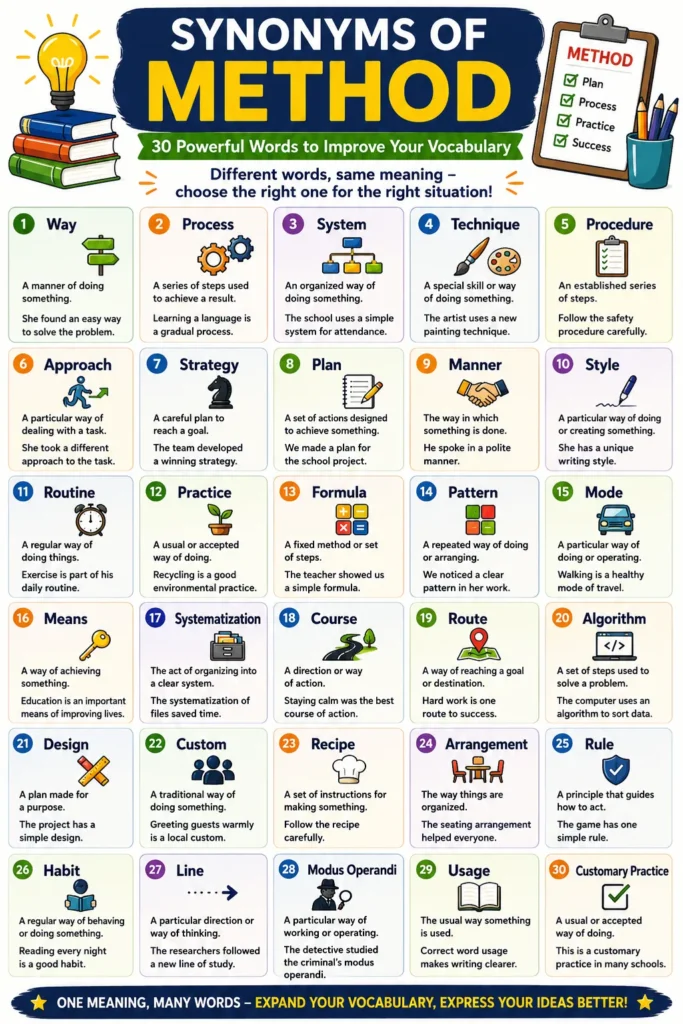
This guide gives you 30 simple synonyms for method. Along with easy sentences, word origins, pronunciation guides, and clear categories.
Meaning of Method
Definition
Method (Noun): A systematic, logical, or orderly way of doing something; a plan or technique used to achieve a goal.
Examples
- She has a great method for organizing her art supplies.
- Science class helps us learn the scientific method for experiments.
Connotative Meaning
- Positive tone: Represents organization, efficiency, order, success, and smart planning.
- Negative tone: Can imply rigid routine or lack of spontaneous creativity when followed too strictly.
- Neutral tone: Simply describes a procedure, technique, or series of steps.
Etymology
- Source language: Came from Greek (methodos), meaning “pursuit of knowledge” or “way of inquiry.”
- Old French: Passed through Old French as methode.
- Modern English: Refers to a clear, step-by-step plan for doing work.
Pronunciation
- US: /ˈmɛθəd/
- UK: /ˈmeθəd/
Syllables
meth-od (2 parts)
Affixation Pattern of Method
- Root: Method (noun)
- Suffix: -ical (adjective), -ology (study of)
- Word Formation:
- Noun: Method / Methodology / Methodism
- Verb: Methodize
- Adjective: Methodical
- Adverb: Methodically
Discover more about https://synonymhubb.com/synonyms-for-proprietary/
Synonyms of Method
1. Way (Noun) — US: /weɪ/ | UK: /weɪ/
Meaning: A manner, style, or route of doing something.
Examples:
She found an easy way to solve the puzzle.
This is the fastest way to tie your shoes.
2. Process (Noun) — US: /ˈprɑːsɛs/ | UK: /ˈprəʊses/
Meaning: A series of actions or steps taken to achieve a result.
Examples:
Planting a seed is the first step in the growing process.
Building a toy house takes a careful step-by-step process.
3. System (Noun) — US: /ˈsɪstəm/ | UK: /ˈsɪstəm/
Meaning: An organized set of rules or methods for doing work.
Examples:
Our library uses a simple system to organize books.
He created a daily system for completing his homework.
4. Technique (Noun) — US: /tɛkˈniːk/ | UK: /tekˈniːk/
Meaning: A special skill or practical method used in an activity.
Examples:
The artist uses a unique painting technique.
She improved her swimming technique during summer camp.
5. Procedure (Noun) — US: /prəˈsiːdʒər/ | UK: /prəˈsiːdʒə/
Meaning: An official or established way of doing an activity step by step.
Examples:
Students follow a safety procedure during fire drills.
Mixing the ingredients is an important baking procedure.
6. Manner (Noun) — US: /ˈmænər/ | UK: /ˈmænə/
Meaning: The way in which something is done or happens.
Examples:
He spoke to the teacher in a polite manner.
She arranged the flowers in an artistic manner.
7. Plan (Noun) — US: /plæn/ | UK: /plæn/
Meaning: A detailed set of decisions about how to do something.
Examples:
We made a clever plan for our weekend project.
Following the daily lesson plan keeps us on track.
8. Strategy (Noun) — US: /ˈstrætədʒi/ | UK: /ˈstrætədʒi/
Meaning: A careful plan or method chosen to reach a specific goal.
Examples:
Our chess team practiced a winning strategy.
Saving pocket money is a good financial strategy.
9. Approach (Noun) — US: /əˈproʊtʃ/ | UK: /əˈprəʊtʃ/
Meaning: A specific way of thinking about or dealing with a task.
Examples:
She took a fresh approach to solving the riddle.
A friendly approach helps in making new friends.
10. Routine (Noun) — US: /ruːˈtiːn/ | UK: /ruːˈtiːn/
Meaning: A regular, fixed pattern of habits and actions.
Examples:
Brushing teeth is part of my morning routine.
The class followed its daily reading routine.
11. Mode (Noun) — US: /moʊd/ | UK: /məʊd/
Meaning: A particular way or style of operating or living.
Examples:
Traveling by train is a fast mode of transport.
He switched his phone to silent mode.
12. Formula (Noun) — US: /ˈfɔːrmjələ/ | UK: /ˈfɔːmjələ/
Meaning: A fixed rule or set of steps for doing or making something.
Examples:
The baker shared his secret formula for cookies.
She used a simple math formula to find the area.
13. Style (Noun) — US: /staɪl/ | UK: /staɪl/
Meaning: A particular way of doing, writing, or creating something.
Examples:
The author writes in a fun and humorous style.
Everyone has a unique drawing style.
14. Practice (Noun) — US: /ˈpræktɪs/ | UK: /ˈpræktɪs/
Meaning: An accepted or habitual way of doing something.
Examples:
Recycling paper is a helpful green practice.
Washing hands before meals is a healthy practice.
15. Scheme (Noun) — US: /skiːm/ | UK: /skiːm/
Meaning: A structured plan for doing or organizing something.
Examples:
The color scheme in the classroom looks bright.
They came up with a clever scheme to tidy up fast.
16. Rule (Noun) — US: /ruːl/ | UK: /ruːl/
Meaning: An accepted guide or instruction for conduct or action.
Examples:
Follow the safety rule while riding a bicycle.
The game has a simple rule for scoring points.
17. Habit (Noun) — US: /ˈhæbɪt/ | UK: /ˈhæbɪt/
Meaning: A regular way of behaving that has become fixed over time.
Examples:
Reading before bed is a wonderful habit.
Keeping your desk clean is a good work habit.
18. Line (Noun) — US: /laɪn/ | UK: /laɪn/
Meaning: A course or direction of action or thought.
Examples:
He followed a logical line of reasoning in his speech.
She took a creative line when designing the poster.
19. Means (Noun) — US: /miːnz/ | UK: /miːnz/
Meaning: An action, object, or system by which a result is achieved.
Examples:
Letters were once the main means of communication.
Hard work is a proven means to success.
20. Pattern (Noun) — US: /ˈpætərn/ | UK: /ˈpætn/
Meaning: A regular, repeated arrangement or way of doing things.
Examples:
She noticed a clear pattern in the math puzzle.
The weather followed a warm seasonal pattern.
21. Route (Noun) — US: /raʊt/ or /ruːt/ | UK: /ruːt/
Meaning: A way or path taken to get from a starting point to a destination.
Examples:
Taking notes is a good route to getting top marks.
We walked along the scenic forest route.
22. Algorithm (Noun) — US: /ˈælɡərɪðəm/ | UK: /ˈælɡərɪðəm/
Meaning: A set of step-by-step rules to be followed in calculations.
Examples:
Computers use an algorithm to solve math problems.
The teacher explained the addition algorithm clearly.
23. Design (Noun) — US: /dɪˈzaɪn/ | UK: /dɪˈzaɪn/
Meaning: A plan or arrangement created for a specific purpose.
Examples:
The garden had a neat and beautiful design.
The teacher praised the design of her science project.
24. Modus operandi (Noun) — US: /ˌmoʊdəs ˌɑːpəˈrændi/ | UK: /ˌməʊdəs ˌɒpəˈrændi/
Meaning: A particular way or habit of working or operating.
Examples:
Working in quiet spaces is her favorite modus operandi.
The detective studied the thief’s unique modus operandi.
25. Custom (Noun) — US: /ˈkʌstəm/ | UK: /ˈkʌstəm/
Meaning: A traditional way of behaving or doing something in a group.
Examples:
Decorating trees is a joyful holiday custom.
Greeting elders with respect is an ancient custom.
26. Recipe (Noun) — US: /ˈrɛsəpi/ | UK: /ˈresəpi/
Meaning: A set of instructions for preparing something, especially food.
Examples:
Follow the cookie recipe step by step.
Kindness is a great recipe for making true friends.
27. Course (Noun) — US: /kɔːrs/ | UK: /kɔːs/
Meaning: A direction, path, or series of actions taken over time.
Examples:
Staying calm was the best course of action.
The river takes a winding course through the valley.
28. Systematization (Noun) — US: /ˌsɪstəmətəˈzeɪʃn/ | UK: /ˌsɪstəmətaɪˈzeɪʃn/
Meaning: The act of arranging things according to an organized plan.
Examples:
The systematization of library files saved time.
Good systematization makes studying much easier.
29. Usage (Noun) — US: /ˈjuːsɪdʒ/ | UK: /ˈjuːsɪdʒ/
Meaning: The standard or habitual way in which something is used.
Examples:
Proper word usage helps make writing clear.
The manual explains the correct usage of tools.
30. Arrangement (Noun) — US: /əˈreɪndʒmənt/ | UK: /əˈreɪndʒmənt/
Meaning: The way in which things are organized or set in order.
Examples:
The seating arrangement helped students focus.
They made a special arrangement for project work.
Prototype Meaning
When someone hears method, they picture following steps to build a LEGO model. Using a formula to solve a math problem, or using a smart daily system to keep their school bag organized.
Prototype Categorization
- General Ways & Actions: Way, Manner, Mode, Style, Line, Route, Course.
- Structured Steps & Processes: Process, Procedure, Technique, Formula, Algorithm, Recipe, Usage.
- Organized Plans & Systems: System, Plan, Strategy, Approach, Scheme, Design, Systematization, Arrangement.
- Regular Habits & Practices: Routine, Practice, Rule, Habit, Means, Pattern, Modus operandi, Custom.
Antonyms of Method
- Chaos
- Disorder
- Confusion
- Randomness
- Disorganization
- Haphazardness
Short Questions and Answers
- What does method mean?
- It means an organized, step-by-step way of completing a task or solving a problem.
- When should I use method?
- Use it when writing about organized plans, science experiments, baking steps, or study habits.
- Is method a noun or a verb?
- It is a noun (following a method). Its adjective form is methodical!
- What is the difference between method and chaos?
- A method follows clear order and planning, while chaos is messy, confused, and unplanned!
Conclusion
Synonyms for method can help you express ideas in a clearer and more natural way. The right alternative depends on the context, as some words describe a general way of doing something while others suggest a planned process or technique. Understanding synonyms for method helps you avoid repetition and choose the most suitable word. Regular practice of synonyms for method can strengthen your vocabulary. And also improve both your writing and everyday communication.

I’m Zahid Abbas, an educator, researcher, and digital publishing strategist with a passion for linguistics, grammar, and clear communication. As a content creator and SEO specialist, I craft research-driven, reader-focused content that empowers learners and makes knowledge accessible worldwide.