The word shenanigans refers to secret, playful, mischievous, or tricky behavior. Imagine a funny dog unraveling paper around the house or kids playing silly pranks at recess. Those playful actions are shenanigans!
We use synonyms for shenanigans to describe silly fun, secret tricks, or sneaky plans in a story. Learning new ways to say shenanigans and synonyms for shenanigans helps young writers make their story writing precise.
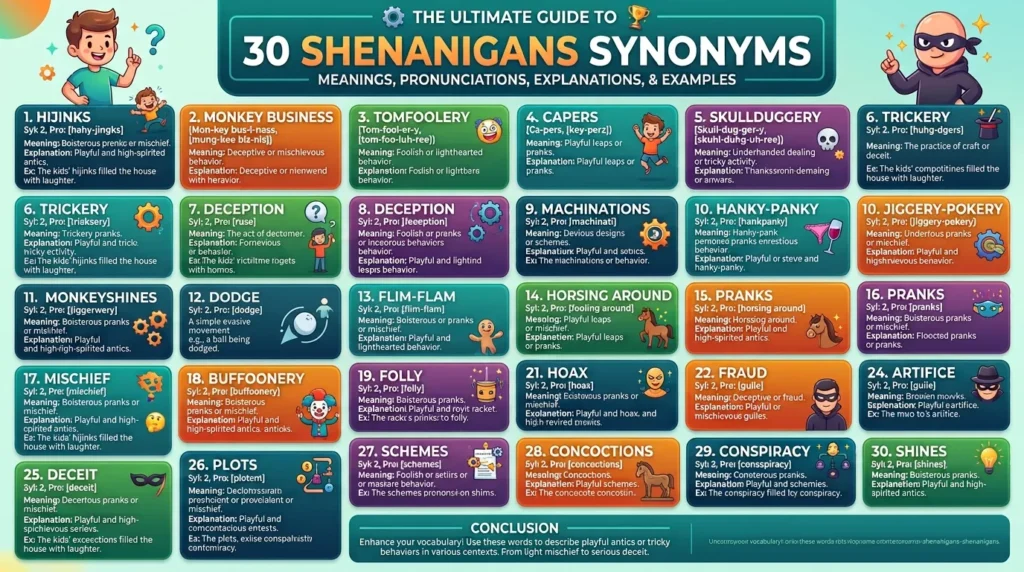
This guide gives you 30 simple synonyms for shenanigans. Along with super easy sentences, word origins, pronunciation guides, and clear categories.
Meaning of Shenanigans
Definition
Shenanigans (Noun, plural): Secret or silly activity, playful fun, or sneaky tricks.
Examples
- The teacher stopped the classroom shenanigans so we could start reading.
- Our puppy gets into all kinds of shenanigans when left alone.
Connotative Meaning
- Positive tone: Means harmless fun, silly jokes, and playful mischief.
- Negative tone: Can mean sneaky behavior or dishonest tricks.
- Neutral tone: Simply describes unusual or surprising actions.
Etymology
- Source language: Came from 19th-century American English, likely from the Irish word sionnachuighim, which means “to play tricks.”
- History: People first started saying it around 1850 for fun pranks and clever tricks.
- Modern English: Refers to silly fun, playful pranks, or sneaky tricks!
Pronunciation
- US: /ʃəˈnænɪɡənz/
- UK: /ʃəˈnænɪɡənz/
Syllables
she-nan-i-gans (4 parts)
Affixation Pattern of Shenanigans
- Root: Shenanigan (noun)
- Suffix: -s (plural form)
- Word Formation:
- Noun: Shenanigan / Shenanigans
- Adjective: Shenanigan-like
Explore our guide to https://synonymhubb.com/synonyms-for-confusion/
Synonyms for Shenanigans
1. Mischief (Noun) — US: /ˈmɪstʃɪf/ | UK: /ˈmɪstʃɪf/
Meaning: Playful behavior that causes minor trouble.
Examples:
The little cat got into mischief with the yarn.
The kids were full of mischief today.
2. Antics (Noun) — US: /ˈæntɪks/ | UK: /ˈæntɪks/
Meaning: Funny or silly actions that make people laugh.
Examples:
The monkey’s silly antics made us smile.
We laughed at the clown’s funny antics.
3. Pranks (Noun) — US: /præŋks/ | UK: /præŋks/
Meaning: Playful tricks or funny practical jokes.
Examples:
They played harmless pranks on April Fool’s Day.
His fun pranks always make the class laugh.
4. Tricks (Noun) — US: /trɪks/ | UK: /trɪks/
Meaning: Clever actions meant to fool or entertain someone.
Examples:
The magician showed us neat card tricks.
Watch out for sneaky tricks in the game.
5. Tomfoolery (Noun) — US: /ˌtɑːmˈfuːləri/ | UK: /ˌtɒmˈfuːləri/
Meaning: Silly or foolish behavior.
Examples:
Stop the tomfoolery and look at the book.
Recess was full of fun tomfoolery.
6. High jinks (Noun) — US: /haɪ dʒɪŋks/ | UK: /haɪ dʒɪŋks/
Meaning: Loud, wild, and playful fun.
Examples:
Camp night was full of playful high jinks.
Their holiday was packed with fun high jinks.
7. Monkey business (Noun) — US: /ˈmʌŋki ˈbɪznəs/ | UK: /ˈmʌŋki ˈbɪznəs/
Meaning: Silly or sneaky behavior.
Examples:
No monkey business during the test, please!
I think some monkey business is going on here.
8. Horsing around (Noun/Verb) — US: /ˈhɔːrsɪŋ əˈraʊnd/ | UK: /ˈhɔːsɪŋ əˈraʊnd/
Meaning: Playing in a rough or noisy way.
Examples:
Stop horsing around near the table.
Their horsing around knocked over a chair.
9. Foolery (Noun) — US: /ˈfuːləri/ | UK: /ˈfuːləri/
Meaning: Silly actions or nonsense.
Examples:
The comic book was full of funny foolery.
His loud foolery woke up the dog.
10. Skylarking (Noun) — US: /ˈskaɪlɑːrkɪŋ/ | UK: /ˈskaɪlɑːkɪŋ/
Meaning: Running around and playing in a happy way.
Examples:
The boys were skylarking in the yard.
Sunny days are great for skylarking.
11. Deceit (Noun) — US: /dɪˈsiːt/ | UK: /dɪˈsiːt/
Meaning: Hiding the truth to trick someone.
Examples:
The bad guy used deceit to trick the king.
Always choose honesty over deceit.
12. Dishonesty (Noun) — US: /dɪsˈɑːnəsti/ | UK: /dɪsˈɒnəsti/
Meaning: Not being honest or truthful.
Examples:
Cheating in a game shows dishonesty.
Our school rules do not allow dishonesty.
13. Subterfuge (Noun) — US: /ˈsʌbtərfjuːdʒ/ | UK: /ˈsʌbtəfjuːdʒ/
Meaning: A secret trick used to win or get something.
Examples:
The spy used sneaky subterfuge to hide.
They won the game with a clever subterfuge.
14. Guile (Noun) — US: /ɡaɪl/ | UK: /ɡaɪl/
Meaning: Cleverness used to trick or outsmart others.
Examples:
The clever fox used guile to find food.
She solved the maze with skill and guile.
15. Knavery (Noun) — US: /ˈneɪvəri/ | UK: /ˈneɪvəri/
Meaning: Sneaky or dishonest behavior.
Examples:
The story told of the robber’s sneaky knavery.
He got in trouble for his knavery.
16. Chicanery (Noun) — US: /ʃɪˈkeɪnəri/ | UK: /ʃɪˈkeɪnəri/
Meaning: Using smart tricks to cheat someone.
Examples:
The dishonest trade was full of chicanery.
They caught him trying some legal chicanery.
17. Nonsense (Noun) — US: /ˈnɑːnsɛns/ | UK: /ˈnɒnsns/
Meaning: Silly words or behavior that makes no sense.
Examples:
Please stop that nonsense and clean up!
The nursery rhyme was full of funny nonsense.
18. Frolics (Noun) — US: /ˈfrɑːlɪks/ | UK: /ˈfrɒlɪks/
Meaning: Happy and energetic games or play.
Examples:
The puppies had fun with their morning frolics.
Warm spring days bring outdoor frolics.
19. Capers (Noun) — US: /ˈkeɪpərz/ | UK: /ˈkeɪpəz/
Meaning: Silly, playful, or exciting adventures.
Examples:
We read a fun book about pirate capers.
Their weekend capers made great stories.
20. Escalades (Noun) — US: /ˌɛskəˈleɪdz/ | UK: /ˌeskəˈleɪdz/
Meaning: Daring tricks or bold adventures.
Examples:
Superhero stories are full of wild escalades.
Their park escalades were super fun.
21. Escapades (Noun) — US: /ˈɛskəpeɪdz/ | UK: /ˈeskəpeɪdz/
Meaning: Exciting and adventurous acts.
Examples:
The camping trip was a fun summer escapade.
Read about the knight’s brave escapades.
22. Humbug (Noun) — US: /ˈhʌmbʌɡ/ | UK: /ˈhʌmbʌɡ/
Meaning: Foolish talk, fake behavior, or silly tricks.
Examples:
He said the scary story was just total humbug.
Don’t listen to that silly humbug.
23. Stratagem (Noun) — US: /ˈstrætədʒəm/ | UK: /ˈstrætədʒəm/
Meaning: A smart trick or plan to win a game.
Examples:
She used a smart stratagem to win at chess.
The team planned a sneaky stratagem.
24. Scheme (Noun) — US: /skiːm/ | UK: /skiːm/
Meaning: A secret or clever plan.
Examples:
The kids made a secret scheme for the party.
The fox had a clever scheme to get the cheese.
25. Ruse (Noun) — US: /ruːz/ | UK: /ruːz/
Meaning: A trick meant to fool someone.
Examples:
His fake yawn was a ruse to go to bed.
The disguise was a smart ruse to stay hidden.
26. Hoax (Noun) — US: /hoʊks/ | UK: /həʊks/
Meaning: A fake story or trick meant to fool people.
Examples:
The monster photo turned out to be a hoax.
They made a funny hoax for April Fools.
27. Plot (Noun) — US: /plɑːt/ | UK: /plɒt/
Meaning: A secret plan made by a group.
Examples:
The mice hatched a secret plot to get the cheese.
They made a sneaky plot to surprise their friend.
28. Playfulness (Noun) — US: /ˈpleɪfəlnəs/ | UK: /ˈpleɪfəlnəs/
Meaning: Being happy, funny, and full of play.
Examples:
The kitten showed lots of happy playfulness.
Her bright smile showed her sweet playfulness.
29. Mischievousness (Noun) — US: /ˈmɪstʃɪvəsnəs/ | UK: /ˈmɪstʃɪvəsnəs/
Meaning: Being playful and causing minor trouble.
Examples:
There was a look of mischievousness in his eyes.
Her mischievousness made everyone giggle.
30. Badinage (Noun) — US: /ˌbædɪˈnɑːʒ/ | UK: /ˌbædɪˈnɑːʒ/
Meaning: Fun, playful, and teasing talk.
Examples:
The two friends shared playful badinage.
Their friendly badinage made the bus ride fun.
Prototype Meaning
When you hear shenanigans, picture puppies playing with stolen socks. Friends giggling over a funny joke, or cartoon animals playing harmless pranks.
Prototype Categorization
- Playful Mischief & Silliness: Mischief, Antics, Pranks, Tomfoolery, High jinks, Horsing around, Foolery, Skylarking, Nonsense, Frolics, Playfulness, Mischievousness, Badinage.
- Adventures & Fun Capers: Capers, Escalades, Escapades.
- Tricks, Deceit & Sneaky Schemes: Tricks, Monkey business, Deceit, Dishonesty, Subterfuge, Guile, Knavery, Chicanery, Humbug, Stratagem, Scheme, Ruse, Hoax, Plot.
Antonyms of Shenanigans
- Honesty
- Truthfulness
- Seriousness
- Order
- Fairness
Short Questions and Answers
- What does shenanigans mean?
- It means playful mischief, silly fun, or secret tricks.
- When should I use shenanigans?
- Use it when writing about pet tricks, fun pranks, exciting adventures, or sneaky plans in stories.
- Is shenanigans a singular or plural word?
- It is almost always used as a plural noun (these shenanigans).
- What is the difference between shenanigans and dishonesty?
- Shenanigans is usually silly and playful fun, while dishonesty means real lying or cheating!
Conclusion
Synonyms for shenanigans can help you describe playful, silly, or troublesome behavior in a more interesting way. The best synonym depends on the situation and the tone you want to use. Understanding synonyms for shenanigans can help you avoid repetition . And also make your writing more colorful and natural. Regular practice can also improve your vocabulary and communication skills.

I’m Zahid Abbas, an educator, researcher, and digital publishing strategist with a passion for linguistics, grammar, and clear communication. As a content creator and SEO specialist, I craft research-driven, reader-focused content that empowers learners and makes knowledge accessible worldwide.