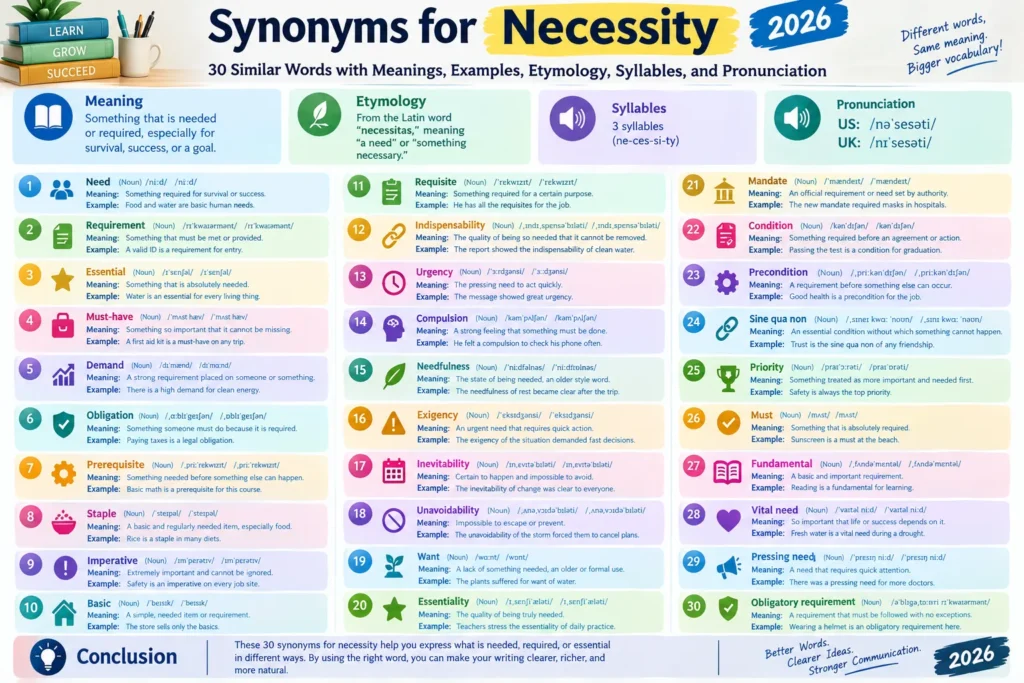
Necessity means something that is needed, or the state of being required and unavoidable. Think about a family preparing for a long camping trip. They pack food, water, and a flashlight, saying, “These are pure necessities. We can’t leave without them.” This word describes the things or actions that cannot be skipped because they are truly important. People use synonyms for necessity a lot when talking about survival, planning, and daily life. Learning new synonyms for necessity are helpful for English learners and writers. Who want to describe needs and requirements in many different ways. Synonyms for necessity also makes writing feel clearer and more thoughtful. This article explains the meaning of necessity. Its history, how to say it, and 30 words that share a similar meaning.
Meaning of Necessity
Definition
Necessity (Noun): Something that is needed, or the state of being required and unavoidable.
Examples
- Clean water is a basic necessity for everyone.
- Out of necessity, they moved to a smaller home.
Connotative Meaning
- Positive tone: This word can sound helpful and clear. It shows what is important and should come first.
- Negative tone: This word can feel heavy or stressful when it points to a hard situation with no other choice.
- Neutral tone: In business, and daily writing, this word is used in a plain, factual way to describe basic needs.
Etymology
- This word comes from the Latin word “necessitas,” meaning “unavoidable need.”
- That word came from “necesse,” meaning “necessary” or “unavoidable.”
- The word entered English in the 13th and 14th centuries through Old French, borrowed from Latin.
Short History
- Old English (450–1100):
- This word did not exist yet. People used simpler native words to describe things that were needed.
- Middle English (1100–1500):
- The word “necessite” entered English from Old French, which took it from Latin. It described something required or unable to be avoided.
- Modern English (1500–Present):
- The word became common in everyday speech, science, and business. It is used for basic needs, such as food and shelter, and for things that cannot be avoided.
Pronunciation (US & UK – IPA)
- US: /nəˈsɛsəti/
- UK: /nɪˈsɛsəti/
Syllables
ne-ces-si-ty (4 syllables)
More Words to Explore https://synonymhubb.com/synonyms-for-required/
Affixation Pattern of Necessity
- Root: cess (from Latin “cedere,” meaning “to yield” or “to go”)
- Prefix: ne- (meaning “not”)
- Suffix: -ity (turns the word into a noun)
Word Formation:
- Necessary (adjective)
- Necessitate (verb)
- Necessarily (adverb)
- Necessity (noun)
Synonyms for Necessity
1. Need (Noun) — US: /niːd/ | UK: /niːd/
Meaning: Something required for survival or success.
Examples:
- Food and water are basic human needs.
- She has a strong need for quiet time each day.
2. Requirement (Noun) — US: /rɪˈkwaɪərmənt/ | UK: /rɪˈkwaɪəmənt/
Meaning: Something that must be met or provided.
Examples:
- A valid ID is a requirement for entry.
- The job has strict education requirements.
3. Essential (Noun) — US: /ɪˈsɛnʃəl/ | UK: /ɪˈsɛnʃəl/
Meaning: Something that is absolutely needed.
Examples:
- Water is an essential for every living thing.
- Sleep is an essential for good health.
4. Must-have (Noun) — US: /ˈmʌst hæv/ | UK: /ˈmʌst hæv/
Meaning: Something so important that it cannot be missing.
Examples:
- A first aid kit is a must-have on any trip.
- Good shoes are a must-have for hikers.
5. Demand (Noun) — US: /dɪˈmænd/ | UK: /dɪˈmɑːnd/
Meaning: A strong requirement placed on someone or something.
Examples:
- The job places heavy demands on her time.
- There is a high demand for clean energy.
6. Obligation (Noun) — US: /ˌɑːblɪˈɡeɪʃən/ | UK: /ˌɒblɪˈɡeɪʃən/
Meaning: Something someone must do because it is required.
Examples:
- Paying taxes is a legal obligation.
- He felt an obligation to help his neighbors.
7. Prerequisite (Noun) — US: /ˌpriːˈrɛkwɪzɪt/ | UK: /ˌpriːˈrɛkwɪzɪt/
Meaning: Something needed before something else can happen.
Examples:
- Basic math is a prerequisite for this course.
- A license is a prerequisite for driving.
8. Staple (Noun) — US: /ˈsteɪpəl/ | UK: /ˈsteɪpəl/
Meaning: A basic and regularly needed item, especially food.
Examples:
- Rice is a staple in many diets.
- Bread and milk are staples in her kitchen.
9. Imperative (Noun) — US: /ɪmˈpɛrətɪv/ | UK: /ɪmˈpɛrətɪv/
Meaning: Something that is extremely important and cannot be ignored.
Examples:
- Safety is an imperative on every job site.
- Clean water is an imperative for good health.
10. Basic (Noun) — US: /ˈbeɪsɪk/ | UK: /ˈbeɪsɪk/
Meaning: A simple, needed item or requirement.
Examples:
- The store sells only the basics.
- She packed the basics for the trip.
11. Requisite (Noun) — US: /ˈrɛkwɪzɪt/ | UK: /ˈrɛkwɪzɪt/
Meaning: Something required for a certain purpose.
Examples:
- He has all the requisites for the job.
- The form asks for several requisites before approval.
12. Indispensability (Noun) — US: /ˌɪndɪˌspɛnsəˈbɪləti/ | UK: /ˌɪndɪˌspɛnsəˈbɪləti/
Meaning: The quality of being so needed that it cannot be removed.
Examples:
- The report showed the indispensability of clean water.
- Her indispensability to the team was clear to everyone.
13. Urgency (Noun) — US: /ˈɜːrdʒənsi/ | UK: /ˈɜːdʒənsi/
Meaning: The pressing need to act quickly.
Examples:
- The message showed great urgency.
- She acted with urgency during the flood.
14. Compulsion (Noun) — US: /kəmˈpʌlʃən/ | UK: /kəmˈpʌlʃən/
Meaning: A strong feeling that something must be done.
Examples:
- He felt a compulsion to check his phone often.
- There was no compulsion to attend the meeting.
15. Needfulness (Noun) — US: /ˈniːdfəlnəs/ | UK: /ˈniːdfʊlnəs/
Meaning: The state of being needed, an older style word.
Examples:
- The needfulness of rest became clear after the long trip.
- She understood the needfulness of clean water in the village.
16. Exigency (Noun) — US: /ˈɛksɪdʒənsi/ | UK: /ˈɛksɪdʒənsi/
Meaning: An urgent need that requires quick action.
Examples:
- The exigency of the situation demanded fast decisions.
- They responded quickly to the medical exigency.
17. Inevitability (Noun) — US: /ɪnˌɛvɪtəˈbɪləti/ | UK: /ɪnˌɛvɪtəˈbɪləti/
Meaning: The state of being certain to happen and impossible to avoid.
Examples:
- The inevitability of change was clear to everyone.
- They accepted the inevitability of the delay.
18. Unavoidability (Noun) — US: /ˌʌnəˌvɔɪdəˈbɪləti/ | UK: /ˌʌnəˌvɔɪdəˈbɪləti/
Meaning: The quality of being impossible to escape or prevent.
Examples:
- The unavoidability of the storm forced them to cancel plans.
- She accepted the unavoidability of the long wait.
19. Want (Noun) — US: /wɑːnt/ | UK: /wɒnt/
Meaning: A lack of something needed, an older or formal use.
Examples:
- The plants suffered for want of water.
- The report cited a want of proper planning.
20. Essentiality (Noun) — US: /ɪˌsɛnʃiˈæləti/ | UK: /ɪˌsɛnʃiˈæləti/
Meaning: The quality of being truly needed.
Examples:
- The doctor explained the essentiality of clean air.
- Teachers stress the essentiality of daily practice.
21. Mandate (Noun) — US: /ˈmændeɪt/ | UK: /ˈmændeɪt/
Meaning: An official requirement or need set by authority.
Examples:
- The new mandate required masks in hospitals.
- The city issued a mandate for water conservation.
22. Condition (Noun) — US: /kənˈdɪʃən/ | UK: /kənˈdɪʃən/
Meaning: Something required before an agreement or action can happen.
Examples:
- Passing the test is a condition for graduation.
- One condition of the loan was steady income.
23. Precondition (Noun) — US: /ˌpriːkənˈdɪʃən/ | UK: /ˌpriːkənˈdɪʃən/
Meaning: A requirement that must be met before something else can occur.
Examples:
- A stable internet connection is a precondition for the online class.
- Good health is often a precondition for the job.
24. Sine qua non (Noun) — US: /ˌsɪneɪ kwɑː ˈnoʊn/ | UK: /ˌsɪnɪ kwɑː ˈnəʊn/
Meaning: An essential condition without which something cannot happen.
Examples:
- Trust is the sine qua non of any friendship.
- Clean water is the sine qua non of good health.
25. Priority (Noun) — US: /praɪˈɔːrəti/ | UK: /praɪˈɒrəti/
Meaning: Something treated as more important and needed first.
Examples:
- Safety is always the top priority.
- Her health became her main priority.
26. Must (Noun) — US: /mʌst/ | UK: /mʌst/
Meaning: Something that is absolutely required.
Examples:
- Sunscreen is a must at the beach.
- Good manners are a must in this house.
27. Fundamental (Noun) — US: /ˌfʌndəˈmɛntəl/ | UK: /ˌfʌndəˈmɛntəl/
Meaning: A basic and important requirement.
Examples:
- Reading is a fundamental for learning.
- Trust is a fundamental in every relationship.
28. Vital need (Noun) — US: /ˈvaɪtəl niːd/ | UK: /ˈvaɪtəl niːd/
Meaning: A need so important that life or success depends on it.
Examples:
- Fresh water is a vital need during a drought.
- Sleep is a vital need for growing children.
29. Pressing need (Noun) — US: /ˈprɛsɪŋ niːd/ | UK: /ˈprɛsɪŋ niːd/
Meaning: A need that requires quick attention.
Examples:
- There was a pressing need for more doctors.
- The pressing need for shelter grew after the storm.
30. Obligatory requirement (Noun) — US: /əˈblɪɡəˌtɔːri rɪˈkwaɪərmənt/ | UK: /əˈblɪɡətəri rɪˈkwaɪəmənt/
Meaning: A requirement that must be followed with no exceptions.
Examples:
- Wearing a helmet is an obligatory requirement here.
- Passing the exam is an obligatory requirement for the course.
Prototype Meaning
When people hear the word necessity, they often think of something very important. That is needed to live or complete a plan, such as food, water, or an important rule. The word shows that something is needed and cannot be left out.
Everyday Example: Water is a necessity because we need it every day.
Prototype Categorization
- Basic life needs: need, essential, staple, must, vital need
- Formal or official requirements: requirement, mandate, condition, precondition, obligatory requirement
- Strong or urgent needs: urgency, exigency, pressing need, compulsion
- Unavoidable situations: inevitability, unavoidability, want
- Priority and importance: priority, imperative, fundamental, essentiality, indispensability
- Steps before something else: prerequisite, requisite, sine qua non, demand, must-have, basic, needfulness
Antonyms of Necessity
- Luxury
- Option
- Extra
- Nonessential
- Choice
Short Questions and Answers
- What does necessity mean?
- It means something that is needed, or the state of being required and unavoidable.
- When should necessity be used?
- Use it when describing something that is truly needed or a situation that cannot be avoided.
- Is necessity positive or negative?
- It is neutral, though it can feel stressful when linked to a hard, unavoidable situation.
- How is it different from similar words?
- “Want” often describes a wish or desire that is not required. “Necessity” points to something truly needed, without which a plan or life cannot continue smoothly.
Conclusion
Synonyms for necessity helps you build a stronger, more precise vocabulary. It strengthens your writing and speaking by giving you many ways to describe needs, requirements, and important priorities. It also helps you avoid repeating the same word again and again. Synonyms for necessity keeps your writing clearer and more thoughtful. Most importantly, learning new synonyms for necessity builds your confidence as an English speaker and writer. Try learning one new word from this list each day, and watch your vocabulary grow steadily over time.

I’m Zahid Abbas, an educator, researcher, and digital publishing strategist with a passion for linguistics, grammar, and clear communication. As a content creator and SEO specialist, I craft research-driven, reader-focused content that empowers learners and makes knowledge accessible worldwide.