Conclude means to bring something to an end, or to decide something after thinking about the facts. Think about a detective in a mystery story who gathers clues one by one. After looking at everything carefully, she concludes that the missing painting was hidden in the old library the whole time. This word describes both the act of finishing something. Like a speech or a story, and the act of forming a clear decision after careful thought. People use synonyms for conclude a lot in essays, speeches, and everyday conversations. Learning new synonyms for conclude are helpful for English learners and writers. Who want to describe endings and decisions in many different ways. Synonyms for conclude also makes writing feel more clear and organized. This article explains the meaning of conclude. Its history, how to say it, and 30 words that share a similar meaning.
Meaning of Conclude
Definition
Conclude (Verb):
To bring something to an end, or to decide something after carefully thinking about the facts.
Examples
- The teacher concluded the lesson with a short quiz.
- After reading all the clues, she concluded that he was innocent.
Connotative Meaning
- Positive tone: This word often sounds smart and organized. It shows careful thinking or a clear ending.
- Negative tone: It is rarely negative, but it can sound final or a little sad when something enjoyable ends.
- Neutral tone: In reports, essays, and formal speech, it is often used in a simple, factual way to show a final decision or ending.
Etymology
- This word comes from the Latin word “concludere,” meaning “to shut up” or “to finish.”
- The Latin word joined “com-” (meaning “together”) and “claudere” (meaning “to close”).
- The word entered English in the 14th century through Old French and Latin.
Short History
- Old English (450–1100): This word did not exist yet. People used other native words to describe finishing something or reaching a decision.
- Middle English (1100–1500): The word “concluden” came into English from Old French and Latin. It meant “to finish” or “to settle a matter.”
- Modern English (1500–Present): The word came to mean both finishing something, such as a speech, and reaching a decision after carefully thinking about the facts.
Pronunciation (US & UK – IPA)
- US: /kənˈkluːd/
- UK: /kənˈkluːd/
More Words to Explore https://synonymhubb.com/synonyms-for-burning/
Syllables
con-clude (2 syllables)
Affixation Pattern of Conclude
- Root: clude (from Latin “claudere,” meaning “to close”)
- Prefix: con- (meaning “together”)
- Suffix: none
Word Formation:
- Conclude (verb)
- Conclusion (noun)
- Conclusive (adjective)
- Conclusively (adverb)
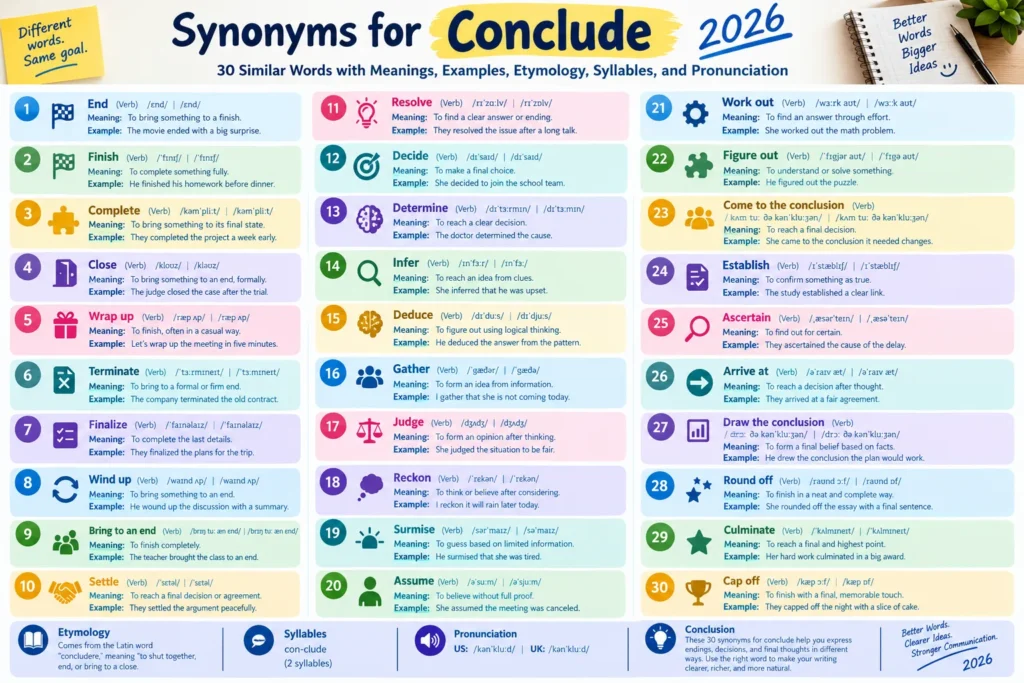
Synonyms for Conclude
1. End (Verb) — US: /ɛnd/ | UK: /ɛnd/
Meaning: To bring something to a finish. Examples:
- The movie ended with a big surprise.
- She ended the meeting a few minutes early.
2. Finish (Verb) — US: /ˈfɪnɪʃ/ | UK: /ˈfɪnɪʃ/
Meaning: To complete something fully. Examples:
- He finished his homework before dinner.
- She finished the race in record time.
3. Complete (Verb) — US: /kəmˈpliːt/ | UK: /kəmˈpliːt/
Meaning: To bring something to its final, whole state. Examples:
- They completed the project a week early.
- She completed her training last month.
4. Close (Verb) — US: /kloʊz/ | UK: /kləʊz/
Meaning: To bring something to an end, often formally. Examples:
- The judge closed the case after the trial.
- She closed her speech with a thank-you note.
5. Wrap up (Verb) — US: /ræp ʌp/ | UK: /ræp ʌp/
Meaning: To finish something, often in a casual way. Examples:
- Let’s wrap up the meeting in five minutes.
- She wrapped up the story with a happy ending.
6. Terminate (Verb) — US: /ˈtɜːrmɪˌneɪt/ | UK: /ˈtɜːmɪneɪt/
Meaning: To bring something to a formal or firm end. Examples:
- The company terminated the old contract.
- The meeting was terminated early due to the storm.
7. Finalize (Verb) — US: /ˈfaɪnəˌlaɪz/ | UK: /ˈfaɪnəlaɪz/
Meaning: To complete the last details of something. Examples:
- They finalized the plans for the trip.
- She finalized her decision after the interview.
8. Wind up (Verb) — US: /waɪnd ʌp/ | UK: /waɪnd ʌp/
Meaning: To bring something to an end. Examples:
- He wound up the discussion with a summary.
- The show wound up right on time.
9. Bring to an end (Verb) — US: /brɪŋ tuː æn ɛnd/ | UK: /brɪŋ tuː æn ɛnd/
Meaning: To finish something completely. Examples:
- The teacher brought the class to an end.
- They brought the long meeting to an end quickly.
10. Settle (Verb) — US: /ˈsɛtəl/ | UK: /ˈsɛtəl/
Meaning: To reach a final decision or agreement. Examples:
- They settled the argument peacefully.
- She settled her doubts after reading more.
11. Resolve (Verb) — US: /rɪˈzɑːlv/ | UK: /rɪˈzɒlv/
Meaning: To find a clear answer or ending to a problem. Examples:
- They resolved the issue after a long talk.
- She resolved to work harder next year.
12. Decide (Verb) — US: /dɪˈsaɪd/ | UK: /dɪˈsaɪd/
Meaning: To make a final choice after thinking about something. Examples:
- She decided to join the school team.
- He decided the plan was too risky.
13. Determine (Verb) — US: /dɪˈtɜːrmɪn/ | UK: /dɪˈtɜːmɪn/
Meaning: To reach a clear decision through careful thought. Examples:
- The doctor determined the cause of the illness.
- They determined the best route for the trip.
14. Infer (Verb) — US: /ɪnˈfɜːr/ | UK: /ɪnˈfɜː/
Meaning: To reach an idea based on facts or clues, without being told directly. Examples:
- She inferred that he was upset from his silence.
- We can infer the answer from the given clues.
15. Deduce (Verb) — US: /dɪˈduːs/ | UK: /dɪˈdjuːs/
Meaning: To figure something out using logical thinking. Examples:
- He deduced the answer from the pattern.
- The detective deduced who the thief was.
16. Gather (Verb) — US: /ˈɡæðər/ | UK: /ˈɡæðə/
Meaning: To form an idea based on information collected. Examples:
- I gather that she is not coming today.
- From his tone, we gathered the news was bad.
17. Judge (Verb) — US: /dʒʌdʒ/ | UK: /dʒʌdʒ/
Meaning: To form an opinion after thinking about facts. Examples:
- She judged the situation to be fair.
- He judged the plan to be a good idea.
18. Reckon (Verb) — US: /ˈrɛkən/ | UK: /ˈrɛkən/
Meaning: To think or believe something after considering it. Examples:
- I reckon it will rain later today.
- She reckoned the trip would take three hours.
19. Surmise (Verb) — US: /sərˈmaɪz/ | UK: /səˈmaɪz/
Meaning: To guess something based on limited information. Examples:
- He surmised that she was tired from her quiet mood.
- They surmised the cause of the delay.
20. Assume (Verb) — US: /əˈsuːm/ | UK: /əˈsjuːm/
Meaning: To believe something is true without full proof. Examples:
- She assumed the meeting was canceled.
- He assumed his friend would arrive on time.
21. Work out (Verb) — US: /wɜːrk aʊt/ | UK: /wɜːk aʊt/
Meaning: To find an answer or solution through effort. Examples:
- She worked out the math problem carefully.
- They worked out a fair solution together.
22. Figure out (Verb) — US: /ˈfɪɡjər aʊt/ | UK: /ˈfɪɡə aʊt/
Meaning: To understand or solve something after thinking about it. Examples:
- He figured out the puzzle in a few minutes.
- She figured out why the machine stopped working.
23. Come to the conclusion (Verb) — US: /kʌm tuː ðə kənˈkluːʒən/ | UK: /kʌm tuː ðə kənˈkluːʒən/
Meaning: To reach a final decision after thinking carefully. Examples:
- She came to the conclusion that the plan needed changes.
- They came to the conclusion that more time was needed.
24. Establish (Verb) — US: /ɪˈstæblɪʃ/ | UK: /ɪˈstæblɪʃ/
Meaning: To clearly determine or confirm something as true. Examples:
- The study established a clear link between sleep and health.
- They established the facts before making a decision.
25. Ascertain (Verb) — US: /ˌæsərˈteɪn/ | UK: /ˌæsəˈteɪn/
Meaning: To find out something for certain. Examples:
- They ascertained the cause of the delay.
- She ascertained that the report was accurate.
26. Arrive at (Verb) — US: /əˈraɪv æt/ | UK: /əˈraɪv æt/
Meaning: To reach a decision or answer after thought. Examples:
- They arrived at a fair agreement.
- She arrived at her decision after much thought.
27. Draw the conclusion (Verb) — US: /drɔː ðə kənˈkluːʒən/ | UK: /drɔː ðə kənˈkluːʒən/
Meaning: To form a final belief or idea based on facts. Examples:
- He drew the conclusion that the plan would work.
- We drew the conclusion from the test results.
28. Round off (Verb) — US: /raʊnd ɔːf/ | UK: /raʊnd ɒf/
Meaning: To finish something in a neat and complete way. Examples:
- She rounded off the essay with a strong final sentence.
- They rounded off the trip with a nice dinner.
29. Culminate (Verb) — US: /ˈkʌlmɪˌneɪt/ | UK: /ˈkʌlmɪneɪt/
Meaning: To reach a final and highest point after a series of events. Examples:
- Her hard work culminated in a big award.
- The festival culminated in a bright fireworks show.
30. Cap off (Verb) — US: /kæp ɔːf/ | UK: /kæp ɒf/
Meaning: To finish something with a final, memorable touch. Examples:
- They capped off the night with a slice of cake.
- She capped off her speech with a warm thankyou.
Prototype Meaning
When people hear the word conclude, they often think of a clear, final ending. Whether it is the end of a story, a meeting, or a chain of careful thinking that leads to a decision. This word brings to mind a feeling of closure and clarity after everything has been considered.
Prototype Categorization
- Simple endings: end, finish, complete, close, wrap up
- Formal endings: terminate, finalize, wind up, bring to an end, round off
- Reaching a decision: decide, determine, resolve, settle, establish
- Reasoning and thinking: infer, deduce, gather, reckon, surmise, assume
- Working toward an answer: work out, figure out, ascertain, arrive at
- Final and complete outcomes: come to the conclusion, draw the conclusion, culminate, cap off, judge
Antonyms of Conclude
- Begin
- Start
- Commence
- Continue
- Initiate
Short Questions and Answers
- What does conclude mean?
- It means to bring something to an end, or to decide something after thinking about the facts.
- When should conclude be used?
- Use it when finishing a speech, story, or task, or when forming a decision based on careful thought.
- Is conclude positive or negative?
- It is usually neutral, though it can feel positive when showing clear thinking, or slightly sad when ending something enjoyable.
- How is it different from similar words?
- “End” is a simple, general word for finishing something. “Conclude” often shows a more thoughtful or formal ending, especially when reasoning leads to a decision.
Conclusion
Synonyms for conclude helps you build a stronger, more organized vocabulary. It strengthens your writing by giving you ways to describe careful decision-making. Synonyms for conclude also helps you avoid repeating the same word again and again. Its keeps your writing clearer and more polished. Most importantly, learning new synonyms for conclude builds your confidence as an English speaker and writer. Try learning one new word from this list each day, and watch your vocabulary grow steadily over time.

I’m Zahid Abbas, an educator, researcher, and digital publishing strategist with a passion for linguistics, grammar, and clear communication. As a content creator and SEO specialist, I craft research-driven, reader-focused content that empowers learners and makes knowledge accessible worldwide.