OK means fine, good enough, or all right. Think about a boy who falls off his bike. His mom runs over and asks, “Are you hurt?” He stands up and says, “I’m OK.” He is not hurt. He is fine. People use this word all day long. We use it to agree. We use synonyms for ok to say we feel fine. Learner use it to say something is good enough. New words help you talk better. Synonyms for ok help you write better too. You will not repeat the same word. Your writing will be more fun to read. This article will teach you the word “OK.” You will learn 30 other words like it. You will see easy examples. We will learn how to say each word. You will learn some history too.
Meaning of OK
Definition
OK (adjective): fine, all right, or good enough.
Examples
- The food was OK, but not great.
- Is it OK if I sit here?
Connotative Meaning
- Positive tone: kind and easy, like saying yes or giving a thumbs up
- Negative tone: dull or weak, like saying a movie was only “OK”
- Neutral tone: just saying something is fine or allowed
Etymology
- This word started in the United States in 1839. It came from a joke spelling, “oll korrect,” which meant “all correct.”
- The short form “OK” spread fast in newspapers and speech.
- It then moved into many languages around the world.
- Old English (450–1100): This word did not exist yet. People used words like wel (well) and gōd (good).
- Middle English (1100–1500): The word did not exist yet. People still said “well” and “good.”
- Modern English (1500–Present): “OK” appeared in the 1800s in America. Today, it is one of the most used words in the world.
Pronunciation (US & UK — IPA)
- US: /oʊˈkeɪ/
- UK: /əʊˈkeɪ/
Syllables
o-kay (2 parts)
Affixation Pattern of OK
- Root: OK (from the short form of “oll korrect”)
- Prefix: none
- Suffix: none
- Word formation:
- This word makes a few other forms. We get OK (adjective/adverb), okay (adjective/adverb, a longer spelling), OK (verb, as in “the boss OK’d it”), OK’d (verb, past form), and OK (noun, as in “she gave the OK”). That is five forms.
You May Also Like https://synonymhubb.com/synonyms-for-trusting/
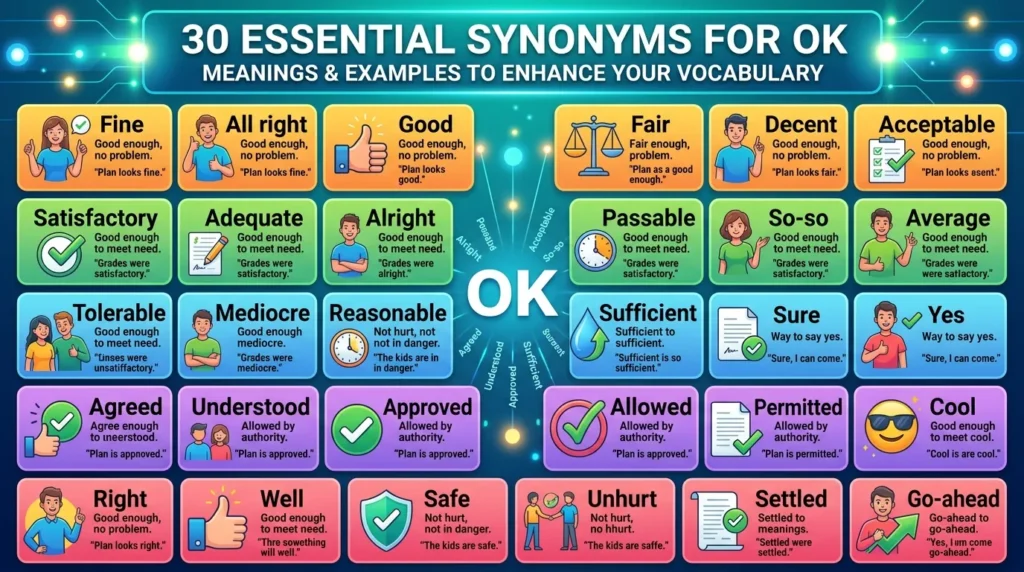
Synonyms for OK
1. Fine (adjective) — US /faɪn/ | UK /faɪn/
Meaning: good enough and with no problem.
Examples:
- The plan looks fine to me.
- I feel fine today.
2. All right (adjective) — US /ɔːl raɪt/ | UK /ɔːl raɪt/
Meaning: good enough or safe.
Examples:
- Is the food all right?
- She is all right after the fall.
3. Good (adjective) — US /ɡʊd/ | UK /ɡʊd/
Meaning: of a nice level or quality.
Examples:
- The idea is good.
- He did a good job.
4. Fair (adjective) — US /fer/ | UK /feə/
Meaning: not great, but not bad.
Examples:
- The test score was fair.
- She gave a fair answer.
5. Decent (adjective) — US /ˈdiː.sənt/ | UK /ˈdiː.sənt/
Meaning: good enough and of fair quality.
Examples:
- It was a decent meal.
- He earns a decent pay.
6. Acceptable (adjective) — US /əkˈsep.tə.bəl/ | UK /əkˈsep.tə.bəl/
Meaning: good enough to be allowed.
Examples:
- The work is acceptable.
- Is this dress acceptable for school?
7. Satisfactory (adjective) — US /ˌsæt.ɪsˈfæk.tɚ.i/ | UK /ˌsæt.ɪsˈfæk.tər.i/
Meaning: good enough to meet the need.
Examples:
- Her grades were satisfactory.
- The room was clean and satisfactory.
8. Adequate (adjective) — US /ˈæd.ɪ.kwət/ | UK /ˈæd.ɪ.kwət/
Meaning: enough for what is needed.
Examples:
- We have adequate food for the trip.
- The light in the room is adequate.
9. Alright (adjective) — US /ɔːlˈraɪt/ | UK /ɔːlˈraɪt/
Meaning: fine or safe, in a casual way.
Examples:
- Everything is alright now.
- I hope you are alright.
10. Passable (adjective) — US /ˈpæs.ə.bəl/ | UK /ˈpɑː.sə.bəl/
Meaning: just good enough, and no more.
Examples:
- The meal was passable.
- He speaks passable French.
11. So-so (adjective) — US /ˈsoʊ.soʊ/ | UK /ˈsəʊ.səʊ/
Meaning: not good and not bad.
Examples:
- The movie was so-so.
- I feel so-so today.
12. Average (adjective) — US /ˈæv.rɪdʒ/ | UK /ˈæv.rɪdʒ/
Meaning: in the middle, not special.
Examples:
- He is an average runner.
- The test was average.
13. Tolerable (adjective) — US /ˈtɑː.lɚ.ə.bəl/ | UK /ˈtɒl.ər.ə.bəl/
Meaning: bearable, but not great.
Examples:
- The heat was tolerable.
- The noise was tolerable.
14. Mediocre (adjective) — US /ˌmiː.diˈoʊ.kɚ/ | UK /ˌmiː.diˈəʊ.kə/
Meaning: not very good, just middle level.
Examples:
- The food was mediocre.
- He gave a mediocre speech.
15. Reasonable (adjective) — US /ˈriː.zən.ə.bəl/ | UK /ˈriː.zən.ə.bəl/
Meaning: fair and sensible.
Examples:
- The price is reasonable.
- That is a reasonable plan.
16. Sufficient (adjective) — US /səˈfɪʃ.ənt/ | UK /səˈfɪʃ.ənt/
Meaning: enough for the need.
Examples:
- One hour is sufficient.
- We have sufficient time.
17. Sure (interjection) — US /ʃʊr/ | UK /ʃɔː/
Meaning: a way to say yes.
Examples:
- “Can you help me?” “Sure!”
- Sure, I can come.
18. Yes (interjection) — US /jes/ | UK /jes/
Meaning: a word used to agree.
Examples:
- Yes, I will help you.
- She said yes right away.
19. Agreed (adjective) — US /əˈɡriːd/ | UK /əˈɡriːd/
Meaning: said to show you think the same.
Examples:
- Agreed, let’s start now.
- We all agreed on the plan.
20. Understood (adjective) — US /ˌʌn.dɚˈstʊd/ | UK /ˌʌn.dəˈstʊd/
Meaning: said to show you know what was said.
Examples:
- “Be here at nine.” “Understood.”
- She said understood and left.
21. Approved (adjective) — US /əˈpruːvd/ | UK /əˈpruːvd/
Meaning: allowed by someone in charge.
Examples:
- The plan is approved.
- He got an approved note from the boss.
22. Allowed (adjective) — US /əˈlaʊd/ | UK /əˈlaʊd/
Meaning: free to do without trouble.
Examples:
- Phones are allowed in class.
- Are we allowed to eat here?
23. Permitted (adjective) — US /pɚˈmɪt.ɪd/ | UK /pəˈmɪt.ɪd/
Meaning: allowed by a rule.
Examples:
- Parking is permitted here.
- Pets are not permitted inside.
24. Cool (adjective) — US /kuːl/ | UK /kuːl/
Meaning: fine and with no problem, in a casual way.
Examples:
- “Meet at six?” “Cool.”
- Are we cool?
25. Right (adjective) — US /raɪt/ | UK /raɪt/
Meaning: correct and as it should be.
Examples:
- Your answer is right.
- Everything looks right.
26. Well (adverb) — US /wel/ | UK /wel/
Meaning: in a good and fine way.
Examples:
- She is doing well.
- The plan worked well.
27. Safe (adjective) — US /seɪf/ | UK /seɪf/
Meaning: not hurt and not in danger.
Examples:
- The kids are safe.
- Is it safe to swim here?
28. Unhurt (adjective) — US /ʌnˈhɝːt/ | UK /ʌnˈhɜːt/
Meaning: not harmed.
Examples:
- He fell but was unhurt.
- She walked away unhurt.
29. Settled (adjective) — US /ˈset.əld/ | UK /ˈset.əld/
Meaning: agreed and no longer a problem.
Examples:
- The matter is settled.
- Is everything settled now?
30. Go-ahead (noun) — US /ˈɡoʊ.ə.hed/ | UK /ˈɡəʊ.ə.hed/
Meaning: permission to start.
Examples:
- She gave us the go-ahead.
- We waited for the boss’s go-ahead.
Prototype Meaning
People hear “OK.” They think of a thumbs up. They think of a quick yes. Learners also think of something that is fine, but not amazing. This is the main picture the word gives us.
Prototype Categorization
- Fine words: fine, all right, alright, good, cool, right, well
- Middle words: fair, average, so-so, passable, tolerable, mediocre
- Enough words: decent, adequate, sufficient, satisfactory, acceptable, reasonable
- Yes words: sure, yes, agreed, understood
- Permission words: approved, allowed, permitted, go-ahead
- Safe words: safe, unhurt
- Done words: settled
Antonyms of OK:
- bad
- poor
- wrong
- terrible
- unacceptable
Short Questions and Answers
- What does OK mean?
- It means fine, all right, or good enough.
- When should OK be used?
- Use it to agree, to say you feel fine, or to give permission.
- Is OK positive or negative?
- It can be either. “I’m OK” is good. “The food was just OK” can sound a little bad.
- How is it different from similar words?
- “OK” is casual and used every day. “Satisfactory” is more formal. “Mediocre” sounds negative. “Fine” is close to OK but can sound warmer.
Conclusion
Synonyms for OK can help you a lot. It helps you speak better. Synonyms for ok helps you write better too. You will not repeat the same word. Your English will sound clear. Your English will sound strong too. Synonyms for ok like “fine,” “decent,” and “adequate” each mean a small bit different. Knowing each word makes you a strong writer. Try to learn one new word each day. Use it in a sentence. Read it in a book. Small steps build big skills over time.

I’m Zahid Abbas, an educator, researcher, and digital publishing strategist with a passion for linguistics, grammar, and clear communication. As a content creator and SEO specialist, I craft research-driven, reader-focused content that empowers learners and makes knowledge accessible worldwide.