Insignificant means too small or unimportant to matter. Think about a boy who drops one crumb on the floor. His mom looks at it and says, “That is an insignificant mess. Do not worry.” The crumb does not matter. It is very small. People use synonyms for insignificant a lot. We use synonyms for insignificant for small amounts, small problems, and small changes. New words help you talk better. Synonyms for insignificant help you write better too. You will not repeat the same word. Your writing will be more fun to read. This article will teach you the word “insignificant.” You will learn 30 other words like it. We will learn how to say each word. You will learn some history too.
Meaning of Insignificant
Definition
Insignificant (adjective): too small or too unimportant to matter.
Examples
- The mistake was insignificant, so nobody cared.
- He earned an insignificant amount of money.
Connotative Meaning
- Positive tone: good news, like a problem that is too small to worry about
- Negative tone: rude or hurtful, like calling a person or their work unimportant
- Neutral tone: just saying something is small or has little effect
Etymology
- This word comes from Latin. The root is significare. It means “to show” or “to make a sign.”
- The Latin word insignificans meant “not showing” or “having no meaning.”
- The word moved into English through French and Latin long ago.
- Old English (450–1100): This word did not exist yet. People used simple words like lȳtel (little) for small things.
- Middle English (1100–1500): The word “signify” came from French. The word “insignificant” was not common yet.
- Modern English (1500–Present): “Insignificant” showed up in the 1600s. It meant “having no meaning.” Later, it also meant “too small to matter.”
Pronunciation (US & UK — IPA)
- US: /ˌɪn.sɪɡˈnɪf.ɪ.kənt/
- UK: /ˌɪn.sɪɡˈnɪf.ɪ.kənt/
Syllables
in-sig-nif-i-cant (5 parts)
Affixation Pattern of Insignificant
- Root: sign- (from Latin signum, meaning “a mark or sign”)
- Prefix: in- (means “not”)
- Suffix: -ant (makes an adjective)
- Word formation:
- This root makes many words. We get sign (noun/verb), signify (verb), significant (adjective), significance (noun), insignificance (noun), insignificantly (adverb), and significantly (adverb). That is seven related words.
You May Also Like https://synonymhubb.com/synonyms-for-prioritizing/
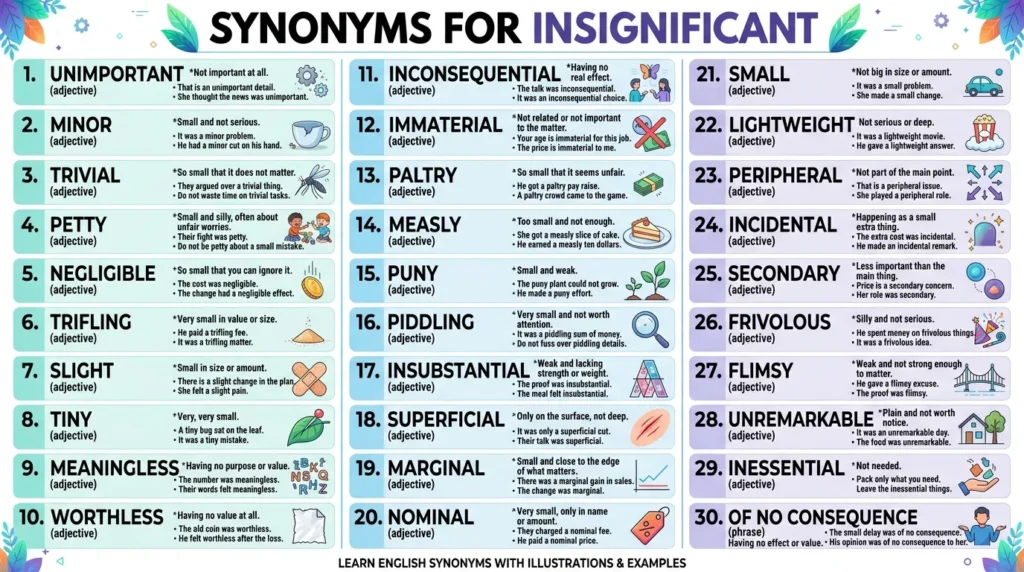
Synonyms for Insignificant
1. Unimportant (adjective) — US /ˌʌn.ɪmˈpɔːr.tənt/ | UK /ˌʌn.ɪmˈpɔː.tənt/
Meaning: not important at all.
Examples:
- That is an unimportant detail.
- She thought the news was unimportant.
2. Minor (adjective) — US /ˈmaɪ.nɚ/ | UK /ˈmaɪ.nə/
Meaning: small and not serious.
Examples:
- It was a minor problem.
- He had a minor cut on his hand.
3. Trivial (adjective) — US /ˈtrɪv.i.əl/ | UK /ˈtrɪv.i.əl/
Meaning: so small that it does not matter.
Examples:
- They argued over a trivial thing.
- Do not waste time on trivial tasks.
4. Petty (adjective) — US /ˈpet.i/ | UK /ˈpet.i/
Meaning: small and silly, often about unfair worries.
Examples:
- Their fight was petty.
- Do not be petty about a small mistake.
5. Negligible (adjective) — US /ˈneɡ.lɪ.dʒə.bəl/ | UK /ˈneɡ.lɪ.dʒə.bəl/
Meaning: so small that you can ignore it.
Examples:
- The cost was negligible.
- The change had a negligible effect.
6. Trifling (adjective) — US /ˈtraɪ.flɪŋ/ | UK /ˈtraɪ.flɪŋ/
Meaning: very small in value or size.
Examples:
- He paid a trifling fee.
- It was a trifling matter.
7. Slight (adjective) — US /slaɪt/ | UK /slaɪt/
Meaning: small in size or amount.
Examples:
- There is a slight change in the plan.
- She felt a slight pain.
8. Tiny (adjective) — US /ˈtaɪ.ni/ | UK /ˈtaɪ.ni/
Meaning: very, very small.
Examples:
- A tiny bug sat on the leaf.
- It was a tiny mistake.
9. Meaningless (adjective) — US /ˈmiː.nɪŋ.ləs/ | UK /ˈmiː.nɪŋ.ləs/
Meaning: having no purpose or value.
Examples:
- The number was meaningless.
- Their words felt meaningless.
10. Worthless (adjective) — US /ˈwɝːθ.ləs/ | UK /ˈwɜːθ.ləs/
Meaning: having no value at all.
Examples:
- The old coin was worthless.
- He felt worthless after the loss.
11. Inconsequential (adjective) — US /ɪnˌkɑːn.səˈkwen.ʃəl/ | UK /ɪnˌkɒn.sɪˈkwen.ʃəl/
Meaning: having no real effect.
Examples:
- The talk was inconsequential.
- It was an inconsequential choice.
12. Immaterial (adjective) — US /ˌɪm.əˈtɪr.i.əl/ | UK /ˌɪm.əˈtɪə.ri.əl/
Meaning: not related or not important to the matter.
Examples:
- Your age is immaterial for this job.
- The price is immaterial to me.
13. Paltry (adjective) — US /ˈpɑːl.tri/ | UK /ˈpɔːl.tri/
Meaning: so small that it seems unfair.
Examples:
- He got a paltry pay raise.
- A paltry crowd came to the game.
14. Measly (adjective) — US /ˈmiːz.li/ | UK /ˈmiːz.li/
Meaning: too small and not enough.
Examples:
- She got a measly slice of cake.
- He earned a measly ten dollars.
15. Puny (adjective) — US /ˈpjuː.ni/ | UK /ˈpjuː.ni/
Meaning: small and weak.
Examples:
- The puny plant could not grow.
- He made a puny effort.
16. Piddling (adjective) — US /ˈpɪd.lɪŋ/ | UK /ˈpɪd.lɪŋ/
Meaning: very small and not worth attention.
Examples:
- It was a piddling sum of money.
- Do not fuss over piddling details.
17. Insubstantial (adjective) — US /ˌɪn.səbˈstæn.ʃəl/ | UK /ˌɪn.səbˈstæn.ʃəl/
Meaning: weak and lacking strength or weight.
Examples:
- The proof was insubstantial.
- The meal felt insubstantial.
18. Superficial (adjective) — US /ˌsuː.pɚˈfɪʃ.əl/ | UK /ˌsuː.pəˈfɪʃ.əl/
Meaning: only on the surface, not deep.
Examples:
- It was only a superficial cut.
- Their talk was superficial.
19. Marginal (adjective) — US /ˈmɑːr.dʒɪ.nəl/ | UK /ˈmɑː.dʒɪ.nəl/
Meaning: small and close to the edge of what matters.
Examples:
- There was a marginal gain in sales.
- The change was marginal.
20. Nominal (adjective) — US /ˈnɑː.mɪ.nəl/ | UK /ˈnɒm.ɪ.nəl/
Meaning: very small, only in name or amount.
Examples:
- They charged a nominal fee.
- He paid a nominal price.
21. Small (adjective) — US /smɔːl/ | UK /smɔːl/
Meaning: not big in size or amount.
Examples:
- It was a small problem.
- She made a small change.
22. Lightweight (adjective) — US /ˈlaɪt.weɪt/ | UK /ˈlaɪt.weɪt/
Meaning: not serious or deep.
Examples:
- It was a lightweight movie.
- He gave a lightweight answer.
23. Peripheral (adjective) — US /pəˈrɪf.ɚ.əl/ | UK /pəˈrɪf.ər.əl/
Meaning: not part of the main point.
Examples:
- That is a peripheral issue.
- She played a peripheral role.
24. Incidental (adjective) — US /ˌɪn.səˈden.təl/ | UK /ˌɪn.sɪˈden.təl/
Meaning: happening as a small extra thing.
Examples:
- The extra cost was incidental.
- He made an incidental remark.
25. Secondary (adjective) — US /ˈsek.ən.der.i/ | UK /ˈsek.ən.dri/
Meaning: less important than the main thing.
Examples:
- Price is a secondary concern.
- Her role was secondary.
26. Frivolous (adjective) — US /ˈfrɪv.ə.ləs/ | UK /ˈfrɪv.ə.ləs/
Meaning: silly and not serious.
Examples:
- He spent money on frivolous things.
- It was a frivolous idea.
27. Flimsy (adjective) — US /ˈflɪm.zi/ | UK /ˈflɪm.zi/
Meaning: weak and not strong enough to matter.
Examples:
- He gave a flimsy excuse.
- The proof was flimsy.
28. Unremarkable (adjective) — US /ˌʌn.rɪˈmɑːr.kə.bəl/ | UK /ˌʌn.rɪˈmɑː.kə.bəl/
Meaning: plain and not worth notice.
Examples:
- It was an unremarkable day.
- The food was unremarkable.
29. Inessential (adjective) — US /ˌɪn.ɪˈsen.ʃəl/ | UK /ˌɪn.ɪˈsen.ʃəl/
Meaning: not needed.
Examples:
- Pack only what you need. Leave the inessential things.
- Those items are inessential.
30. Of no consequence (phrase) — US /ʌv noʊ ˈkɑːn.sə.kwens/ | UK /ɒv nəʊˈkɒn.sɪ.kwəns/
Meaning: having no effect or value.
Examples:
- The small delay was of no consequence.
- His opinion was of no consequence to her.
Prototype Meaning
People hear “insignificant.” They think of something very small. They think of something that does not matter. It could be a crumb, a tiny dot, or a small change. This is the main picture the word gives us.
Prototype Categorization
- Small-size words: tiny, small, slight, puny, minor
- No-effect words: negligible, inconsequential, immaterial, incidental
- Silly or trivial words: trivial, trifling, petty, frivolous, piddling
- Too-little words: paltry, measly, nominal, marginal
- Not-important words: unimportant, secondary, peripheral, inessential, of no consequence
- No-value words: worthless, meaningless
- Weak words: insubstantial, flimsy, lightweight, superficial
- Plain words: unremarkable
Antonyms of Insignificant:
- Important
- Significant
- Major
- Vital
- Essential
Short Questions and Answers
- What does insignificant mean?
- It means too small or too unimportant to matter.
- When should insignificant be used?
- Use it when something has little effect, size, or value.
- Is insignificant positive or negative?
- It can be either. It is good when a problem is small. It is hurtful when used about a person or their work.
- How is it different from similar words?
- “Insignificant” is a general word. “Negligible” is about amounts you can ignore. “Petty” is about small, silly things. “Trivial” is about small matters.
Conclusion
Synonyms for insignificant can help you a lot. It helps you speak better. It helps you write better too. You will not repeat the same word. Your English will sound clear. Your English will sound strong too. Synonyms for insignificant like “minor,” “trivial,” and “negligible” each mean a small bit different. Knowing each word makes you a strong writer. Try to learn one new word each day. Use it in a sentence. Read it in a book. Small steps build big skills over time.

I’m Zahid Abbas, an educator, researcher, and digital publishing strategist with a passion for linguistics, grammar, and clear communication. As a content creator and SEO specialist, I craft research-driven, reader-focused content that empowers learners and makes knowledge accessible worldwide.