Pervasive means spreading through every part of something, so it feels present everywhere. Think about the smell of fresh bread in a small bakery. It does not stay in one corner. It spreads through the whole shop, into the street, and even into nearby stores. The smell is pervasive. People use synonyms for pervasive a lot. We use synonyms for pervasive for smells, feelings, ideas, and even problems that spread widely. New words help you talk better. Synonyms for pervasive help you write better too. You will not repeat the same word. Your writing will be more fun to read. This article will teach you the word “pervasive.” You will learn 30 other words like it. You will see easy examples. We will learn how to say each word. You will learn some history too.
Meaning of Pervasive
Definition
Pervasive (adjective): spreading through every part of something, so it feels present everywhere.
Examples
- Fear of failure was pervasive in the office.
- The smell of smoke was pervasive in the room.
Connotative Meaning
- Positive tone: can feel strong, like a positive change spreading widely
- Negative tone: often feels heavy, like a problem that is hard to escape
- Neutral tone: just describes something present in every part of a space or group
Etymology
- This word comes from the Latin word pervadere. It means “to go through” or “to spread through.”
- Pervadere comes from per- (through) and vadere (to go or walk).
- The word moved into English in the 1600s through Latin roots.
- Old English (450–1100): This word did not exist yet. People used simple words like þurhfaran, meaning “to travel through.”
- Middle English (1100–1500): The word was not common yet. English still used older native words for spreading or filling.
- Modern English (1500–Present): “Pervasive” entered English in the 1600s. It grew to describe anything that spreads widely, from smells to ideas to social problems.
Pronunciation (US & UK — IPA)
- US: /pɚˈveɪ.sɪv/
- UK: /pəˈveɪ.sɪv/
Syllables
per-va-sive (3 parts)
Affixation Pattern of Pervasive
- Root: -vas- (from Latin vadere, meaning “to go”)
- Prefix: per- (means “through”)
- Suffix: -ive (turns the word into an adjective)
- Word formation: This root makes several words. We get pervade (verb), pervasive (adjective), pervasively (adverb), and pervasiveness (noun). That is four related words.
You may also like https://synonymhubb.com/synonyms-for-prioritizing/
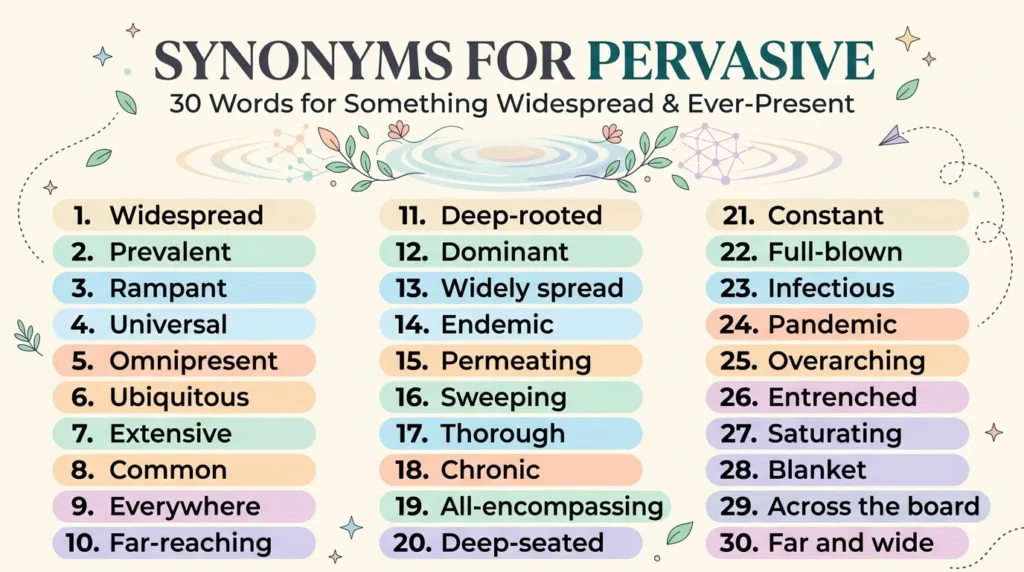
Synonyms for Pervasive
1. Widespread (adjective) — US /ˈwaɪd.spred/ | UK /ˈwaɪd.spred/
Meaning: found or happening in many places.
Examples:
- The illness became widespread across the city.
- Widespread support helped the new law pass.
2. Prevalent (adjective) — US /ˈprev.ə.lənt/ | UK /ˈprev.ə.lənt/
Meaning: common and found in many places or people.
Examples:
- This belief is prevalent in small towns.
- The disease is prevalent during winter months.
3. Rampant (adjective) — US /ˈræm.pənt/ | UK /ˈræm.pənt/
Meaning: spreading quickly and hard to control.
Examples:
- Crime was rampant in that neighborhood.
- Rumors became rampant after the news broke.
4. Universal (adjective) — US /ˌjuː.nəˈvɝː.səl/ | UK /ˌjuː.nɪˈvɜː.səl/
Meaning: true or present everywhere, for everyone.
Examples:
- Kindness is a universal value.
- The fear felt almost universal in the group.
5. Omnipresent (adjective) — US /ˌɑːm.nɪˈprez.ənt/ | UK /ˌɒm.nɪˈprez.ənt/
Meaning: present everywhere at the same time.
Examples:
- Technology feels omnipresent in daily life.
- The sound of traffic was omnipresent downtown.
6. Ubiquitous (adjective) — US /juːˈbɪk.wə.təs/ | UK /juːˈbɪk.wɪ.təs/
Meaning: seeming to be everywhere at once.
Examples:
- Phones are ubiquitous in modern life.
- Plastic waste has become ubiquitous worldwide.
7. Extensive (adjective) — US /ɪkˈsten.sɪv/ | UK /ɪkˈsten.sɪv/
Meaning: covering a large area or amount.
Examples:
- The damage from the storm was extensive.
- She has extensive experience in teaching.
8. Common (adjective) — US /ˈkɑː.mən/ | UK /ˈkɒm.ən/
Meaning: happening often or found in many places.
Examples:
- This mistake is common among new drivers.
- Rain is common in this season.
9. Everywhere (adverb) — US /ˈev.ri.wer/ | UK /ˈev.ri.weə/
Meaning: in every place, with no part left untouched.
Examples:
- Dust was everywhere in the old house.
- Smiles were everywhere at the parade.
10. Far-reaching (adjective) — US /fɑːrˈriː.tʃɪŋ/ | UK /fɑːˈriː.tʃɪŋ/
Meaning: having a wide and strong effect. Examples:
- The policy had far-reaching effects on jobs.
- Her words had a far-reaching impact.
11. Deep-rooted (adjective) — US /ˈdiːp.ruː.tɪd/ | UK /ˈdiːp.ruː.tɪd/
Meaning: firmly set and spread through something over time.
Examples:
- The tradition is deep-rooted in the culture.
- His fear was deep-rooted from childhood.
12. Dominant (adjective) — US /ˈdɑː.mə.nənt/ | UK /ˈdɒm.ɪ.nənt/
Meaning: having the strongest or most common presence.
Examples:
- English is the dominant language there.
- Fear was the dominant feeling in the room.
13. Widely spread (phrase) — US /ˈwaɪd.lispred/ | UK /ˈwaɪd.lispred/
Meaning: found or happening across a large area.
Examples:
- The news was widely spread within hours.
- This custom is widely spread across the region.
14. Endemic (adjective) — US /enˈdem.ɪk/ | UK /enˈdem.ɪk/
Meaning: common and regularly found within a certain group or area.
Examples:
- The problem became endemic in the system.
- Poverty was endemic in parts of the city.
15. Permeating (adjective) — US /ˈpɝː.mi.eɪ.tɪŋ/ | UK /ˈpɜː.mi.eɪ.tɪŋ/
Meaning: spreading slowly through every part of something.
Examples:
- A permeating smell filled the whole house.
- Fear was permeating through the crowd.
16. Sweeping (adjective) — US /ˈswiː.pɪŋ/ | UK /ˈswiː.pɪŋ/
Meaning: large and affecting many things at once.
Examples:
- The company made sweeping changes.
- Sweeping reforms changed the whole school system.
17. Thorough (adjective) — US /ˈθɝː.oʊ/ | UK /ˈθʌr.ə/
Meaning: complete and present in every part.
Examples:
- She gave a thorough report on the problem.
- His thorough influence changed the whole team.
18. Chronic (adjective) — US /ˈkrɑː.nɪk/ | UK /ˈkrɒn.ɪk/
Meaning: happening again and again over a long time.
Examples:
- The city faces chronic traffic problems.
- Chronic stress is common in big cities.
19. All-encompassing (adjective) — US /ɔːl.ɪnˈkʌm.pə.sɪŋ/ | UK /ɔːl.ɪnˈkʌm.pə.sɪŋ/
Meaning: covering everything, with nothing left out.
Examples:
- The fear felt all-encompassing that night.
- Her all-encompassing plan included every detail.
20. Deep-seated (adjective) — US /ˈdiːp.siː.tɪd/ | UK /ˈdiːp.siː.tɪd/
Meaning: firmly fixed and spread through one’s beliefs or habits.
Examples:
- His deep-seated doubts affected his work.
- The tradition holds deep-seated meaning for them.
21. Constant (adjective) — US /ˈkɑːn.stənt/ | UK /ˈkɒn.stənt/
Meaning: happening all the time, without stopping.
Examples:
- There was a constant noise in the hallway.
- Constant worry filled her thoughts.
22. Full-blown (adjective) — US /ˈfʊl.bloʊn/ | UK /ˈfʊl.bləʊn/
Meaning: fully developed and spread completely.
Examples:
- The issue became a full-blown crisis.
- It turned into a full-blown argument fast.
23. Infectious (adjective, figurative) — US /ɪnˈfek.ʃəs/ | UK /ɪnˈfek.ʃəs/
Meaning: spreading quickly, like it affects everyone around it.
Examples:
- Her laughter was infectious in the room.
- The excitement felt infectious at the game.
24. Pandemic (adjective, figurative) — US /pænˈdem.ɪk/ | UK /pænˈdem.ɪk/
Meaning: widespread, affecting a large group or area, often used for fear or panic.
Examples:
- Panic spread in pandemic proportions.
- The rumor reached pandemic levels online.
25. Overarching (adjective) — US /ˌoʊ.vɚˈɑːr.tʃɪŋ/ | UK /ˌəʊ.vərˈɑː.tʃɪŋ/
Meaning: covering or affecting everything in a general way.
Examples:
- The overarching theme of the book is loss.
- An overarching sense of hope filled the crowd.
26. Entrenched (adjective) — US /ɪnˈtrentʃt/ | UK /ɪnˈtrentʃt/
Meaning: firmly and widely set in place, hard to remove.
Examples:
- The habit is entrenched in the whole team.
- Entrenched beliefs are hard to change.
27. Saturating (adjective) — US /ˈsætʃ.ɚ.eɪ.tɪŋ/ | UK /ˈsætʃ.ə.reɪ.tɪŋ/
Meaning: filling completely through every part.
Examples:
- A saturating fog covered the whole town.
- Saturating ads filled every website.
28. Blanket (adjective, figurative) — US /ˈblæŋ.kɪt/ | UK /ˈblæŋ.kɪt/
Meaning: covering everything equally and completely.
Examples:
- They made a blanket rule for everyone.
- A blanket fear spread through the office.
29. Across the board (phrase) — US /əˈkrɔːs ðə bɔːrd/ | UK /əˈkrɒs ðə bɔːd/
Meaning: affecting everyone or everything equally.
Examples:
- The changes applied across the board.
- Prices rose across the board this year.
30. Far and wide (phrase) — US /fɑːr ænd waɪd/ | UK /fɑː ænd waɪd/
Meaning: spreading over a large area or distance.
Examples:
- The news spread far and wide.
- Her fame reached far and wide.
Prototype Meaning
People hear “pervasive.” They think of something slowly filling every corner, like smoke in a room or an idea spreading through a whole group. They picture no clear edge, just something present almost everywhere. This is the main picture the word gives us.
Prototype Categorization
These groups help you pick the best word:
- Spreading words: widespread, far-reaching, sweeping, permeating, saturating, far and wide
- Everywhere-present words: omnipresent, ubiquitous, everywhere, universal, blanket
- Common and frequent words: common, prevalent, endemic, constant, chronic
- Deep and fixed words: deep-rooted, deep-seated, entrenched, dominant
- Large-scale words: extensive, all-encompassing, overarching, full-blown, across the board
- Fast-spreading words: rampant, infectious, pandemic
Antonyms of Pervasive
- Rare
- Limited
- Scarce
- Isolated
- Contained
Short Questions and Answers
- What does pervasive mean? It means spreading through every part of something, so it feels present everywhere.
- When should pervasive be used? Use it when describing something that spreads widely, like a smell, feeling, idea, or problem.
- Is pervasive positive or negative? It is mostly neutral, but it often leans negative when describing problems like fear, crime, or illness. It can feel positive when describing something good, like kindness or hope.
- How is it different from similar words? “Pervasive” focuses on spreading through every part. “Widespread” focuses more on covering a large area. “Rampant” suggests something spreading fast and out of control. “Ubiquitous” means something feels present everywhere at once, often in daily life.
Conclusion
Synonyms for pervasive helps you build a stronger vocabulary. It improves both your writing and speaking, helps you avoid repeating the same word again and again, and builds real confidence in English. Synonyms for pervasive like “widespread,” “ubiquitous,” “rampant,” and “entrenched” each carry a slightly different shade of meaning, and knowing when to use each one makes your language clearer and more precise. Keep practicing a little every day read new synonyms for pervasive, try them in sentences, and notice how skilled writers vary their word choice. Small daily habits lead to big improvement over time.

I’m Zahid Abbas, an educator, researcher, and digital publishing strategist with a passion for linguistics, grammar, and clear communication. As a content creator and SEO specialist, I craft research-driven, reader-focused content that empowers learners and makes knowledge accessible worldwide.