Matter means something that is important, or the physical stuff that makes up everything around us. Think about a boy who spills juice on his new shirt. His mom says, “It does not matter, we can wash it.” She means it is not a big problem. People use synonyms for matter a lot. We use synonyms for matter for feelings, problems, ideas, and even science, like the matter that makes up rocks, water, and air. New synonyms for matter help you talk better. They help you write better too. You will not repeat the same word. Your writing will be more fun to read. This article will teach you the word “matter.” You will learn 30 other words like it. You will see easy examples. We will learn how to say each word. You will learn some history too.
Meaning of Matter
Definition
Matter (noun/verb): something that is important, or the physical substance that makes up all things.
Examples
- Her opinion matters a lot to me.
- Scientists study matter in different forms.
Connotative Meaning
- Positive tone: meaningful, important, and worth attention
- Negative tone: can feel heavy, like a serious problem or concern
- Neutral tone: just describes a topic, substance, or fact
Etymology
- This word comes from the Latin word materia. It means “wood” or “the stuff something is made of.”
- Materia later grew to mean “substance” or “material” in a broader sense.
- The word moved into English through French in the 1200s and 1300s.
- Old English (450–1100): This word did not exist yet. People used words like andweorc, meaning “material” or “stuff.”
- Middle English (1100–1500): The word “matter” entered English through French. It meant “substance” and also “a subject of concern.”
- Modern English (1500–Present): The word grew to cover science, like physical matter, and daily speech, like something that is important or worth caring about.
Pronunciation (US & UK — IPA)
- US: /ˈmæt.ɚ/
- UK: /ˈmæt.ə/
Syllables
mat-ter (2 parts)
Affixation Pattern of Matter
- Root: mater- (from Latin materia, meaning “substance”)
- Prefix: none
- Suffix: none in the base word (though forms like matter-less and material use suffixes)
- Word formation: This root makes several words. We get matter (noun/verb), material (noun/adjective), materialize (verb), materially (adverb), and immaterial (adjective). That is five related words.
Explore more about https://synonymhubb.com/synonyms-for-ok/
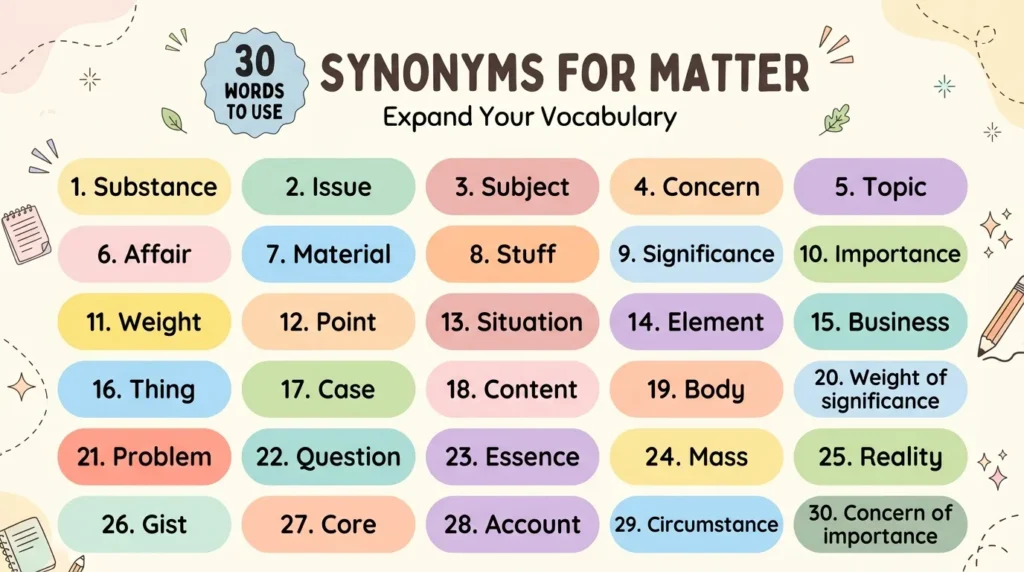
Synonyms for Matter
1. Substance (noun) — US /ˈsʌb.stəns/ | UK /ˈsʌb.stəns/
Meaning: the physical material that something is made of.
Examples:
- The sticky substance covered the table.
- Water is a common substance on Earth.
2. Issue (noun) — US /ˈɪʃ.uː/ | UK /ˈɪʃ.uː/
Meaning: a topic or problem that needs attention.
Examples:
- They discussed an important issue at the meeting.
- This is a serious issue for the team.
3. Subject (noun) — US /ˈsʌb.dʒɪkt/ | UK /ˈsʌb.dʒɪkt/
Meaning: a topic that people talk or write about.
Examples:
- Climate change is a common subject in the news.
- She avoided the subject during dinner.
4. Concern (noun) — US /kənˈsɝːn/ | UK /kənˈsɜːn/
Meaning: something that worries or interests someone.
Examples:
- Safety is a major concern for parents.
- This issue is of great concern to the city.
5. Topic (noun) — US /ˈtɑː.pɪk/ | UK /ˈtɒp.ɪk/
Meaning: a subject discussed or written about.
Examples:
- The topic of the speech was kindness.
- They argued over a sensitive topic.
6. Affair (noun) — US /əˈfer/ | UK /əˈfeə/
Meaning: a situation or matter that involves people.
Examples:
- The whole affair was very confusing.
- It became a family affair quickly.
7. Material (noun) — US /məˈtɪr.i.əl/ | UK /məˈtɪə.ri.əl/
Meaning: the physical substance something is made from.
Examples:
- The shirt is made of soft material.
- They studied the material under a microscope.
8. Stuff (noun, informal) — US /stʌf/ | UK /stʌf/
Meaning: a general word for material or things.
Examples:
- There is strange stuff on the table.
- He packed his stuff for the trip.
9. Significance (noun) — US /sɪɡˈnɪf.ə.kəns/ | UK /sɪɡˈnɪf.ɪ.kəns/
Meaning: the importance or meaning of something.
Examples:
- The event had great significance for the town.
- She explained the significance of the symbol.
10. Importance (noun) — US /ɪmˈpɔːr.təns/ | UK /ɪmˈpɔː.təns/
Meaning: the quality of being valuable or worth attention.
Examples:
- He stressed the importance of honesty.
- The importance of sleep is often ignored.
11. Weight (noun, figurative) — US /weɪt/ | UK /weɪt/
Meaning: the importance or value given to something.
Examples:
- Her words carried a lot of weight.
- The decision has real weight for the company.
12. Point (noun) — US /pɔɪnt/ | UK /pɔɪnt/
Meaning: the main idea or reason behind something.
Examples:
- What is the point of this meeting?
- She made a strong point during the debate.
13. Situation (noun) — US /ˌsɪtʃ.uˈeɪ.ʃən/ | UK /ˌsɪtʃ.uˈeɪ.ʃən/
Meaning: a set of facts or events that form a matter to deal with.
Examples:
- The situation needs quick action.
- They discussed the current situation calmly.
14. Element (noun) — US /ˈel.ə.mənt/ | UK /ˈel.ɪ.mənt/
Meaning: a basic part or substance that makes up something.
Examples:
- Fire is a classic element in old science.
- Trust is a key element in friendship.
15. Business (noun, figurative) — US /ˈbɪz.nəs/ | UK /ˈbɪz.nəs/
Meaning: a matter that concerns or involves someone.
Examples:
- It is none of your business.
- The whole business felt strange to her.
16. Thing (noun, informal) — US /θɪŋ/ | UK /θɪŋ/
Meaning: a general word for an object, topic, or matter.
Examples:
- There is one thing I must tell you.
- That thing on the table looks odd.
17. Case (noun) — US /keɪs/ | UK /keɪs/
Meaning: a particular situation or matter to be dealt with.
Examples:
- This is a strange case to study.
- The lawyer worked on a difficult case.
18. Content (noun) — US /ˈkɑːn.tent/ | UK /ˈkɒn.tent/
Meaning: the material or information that fills something.
Examples:
- The content of the speech was clear.
- She reviewed the content of the book.
19. Body (noun, physical) — US /ˈbɑː.di/ | UK /ˈbɒd.i/
Meaning: a physical mass or amount of material.
Examples:
- A large body of water covered the land.
- The body of the report was well written.
20. Weight of significance (phrase) — US /weɪt əv sɪɡˈnɪf.ə.kəns/ | UK /weɪt əv sɪɡˈnɪf.ɪ.kəns/
Meaning: the serious value or meaning something carries.
Examples:
- The news had a real weight of significance.
- Her words carried a weight of significance in the room.
21. Problem (noun) — US /ˈprɑː.bləm/ | UK /ˈprɒb.ləm/
Meaning: a matter that causes difficulty and needs a solution.
Examples:
- They solved the problem quickly.
- This is a serious problem for the school.
22. Question (noun) — US /ˈkwes.tʃən/ | UK /ˈkwes.tʃən/
Meaning: a matter that needs thought or discussion.
Examples:
- The question of fairness came up again.
- It raised an important question for everyone.
23. Essence (noun) — US /ˈes.əns/ | UK /ˈes.əns/
Meaning: the core or most important part of something.
Examples:
- The essence of her message was hope.
- He captured the essence of the story well.
24. Mass (noun) — US /mæs/ | UK /mæs/
Meaning: a large amount of physical material or substance.
Examples:
- A mass of clouds covered the sky.
- The mass of the rock was huge.
25. Reality (noun) — US /riˈæl.ə.ti/ | UK /riˈæl.ɪ.ti/
Meaning: the true facts or the real matter of a situation.
Examples:
- The reality of the problem was hard to accept.
- She faced the reality of the situation calmly.
26. Gist (noun) — US /dʒɪst/ | UK /dʒɪst/
Meaning: the main point or central matter of something.
Examples:
- The gist of the speech was clear.
- He explained the gist of the plan quickly.
27. Core (noun, figurative) — US /kɔːr/ | UK /kɔː/
Meaning: the central and most important part of a matter.
Examples:
- Trust is the core of their friendship.
- The core of the issue was money.
28. Account (noun, figurative) — US /əˈkaʊnt/ | UK /əˈkaʊnt/
Meaning: something taken into consideration as important.
Examples:
- His opinion was taken into account.
- The plan took her advice into account.
29. Circumstance (noun) — US /ˈsɝː.kəm.stæns/ | UK /ˈsɜː.kəm.stɑːns/
Meaning: a fact or condition connected to a situation or matter.
Examples:
- The circumstance made the decision harder.
- They explained the circumstance to the judge.
30. Concern of importance (phrase) — US /kənˈsɝːn əv ɪmˈpɔːr.təns/ | UK /kənˈsɜːn əv ɪmˈpɔː.təns/
Meaning: something treated as important and worth attention.
Examples:
- This became a concern of importance for the team.
- Her health was a concern of importance to the family.
Prototype Meaning
People hear “matter.” They think of two main pictures. One is something important that deserves attention, like a serious topic or feeling. The other is the physical stuff that makes up the world, like rocks, water, or air. This is the main picture the synonyms for matter gives us.
Prototype Categorization
These groups help you pick the best word:
- Importance words: significance, importance, weight, concern of importance, essence
- Topic and discussion words: topic, subject, issue, question, affair
- Physical substance words: substance, material, mass, body, element
- Problem-related words: problem, case, situation, circumstance
- General and informal words: stuff, thing, business, content
- Core-idea words: gist, core, point, reality, account
Antonyms of Matter
- Nothing
- Unimportance
- Triviality
- Insignificance
Short Questions and Answers
- What does matter mean? It means something important, or the physical substance that makes up all things.
- When should matter be used? Use it when talking about a topic, problem, feeling, or the physical material of something.
- Is matter positive or negative? It is mostly neutral. It can feel positive when showing something important, or negative when linked to a serious problem.
- How is it different from similar words? “Matter” is a general word for importance or substance. “Issue” often means a problem needing attention. “Substance” focuses only on physical material. “Significance” focuses only on importance, not physical stuff.
Conclusion
Synonyms for matter helps you build a stronger vocabulary. It improves both your writing and speaking, helps you avoid repeating the same word again and again, and builds real confidence in English. Synonyms for matter like “substance,” “issue,” “significance,” and “concern” each carry a slightly different shade of meaning, and knowing when to use each one makes your language clearer and more precise. Keep practicing a little every day read new synonyms for matter, try them in sentences. Also notice how skilled writers vary their word choice. Small daily habits lead to big improvement over time.

I’m Zahid Abbas, an educator, researcher, and digital publishing strategist with a passion for linguistics, grammar, and clear communication. As a content creator and SEO specialist, I craft research-driven, reader-focused content that empowers learners and makes knowledge accessible worldwide.