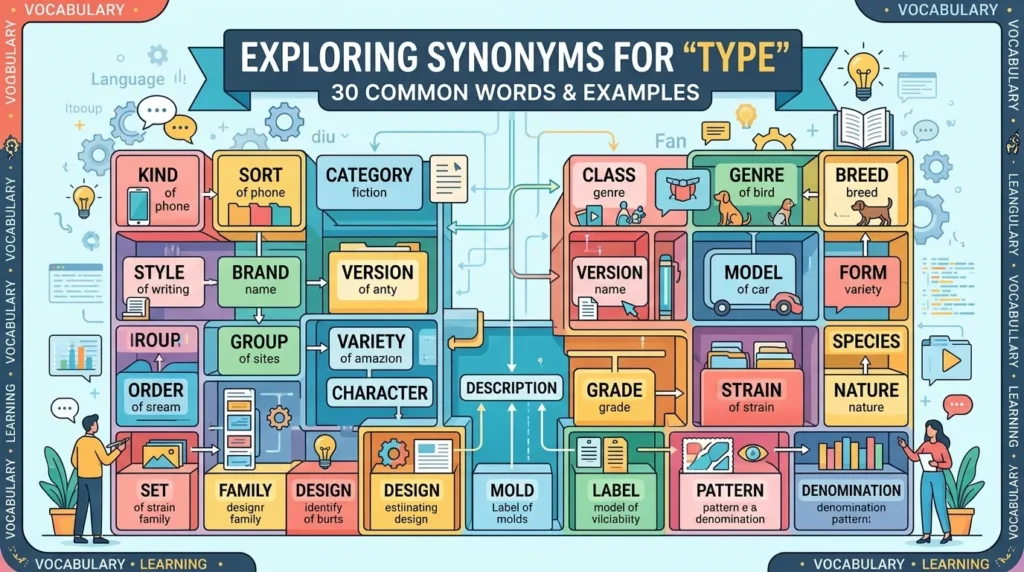
Type means a group of things that are alike. Think about a fruit shop. There are many kinds of apples. Some are red. A number of are green. Some are sweet. Some are sour. Each kind is a type of apple. People use this word a lot. We use synonyms for type to talk about food, people, jobs, and even feelings. Learning new words for “type” helps you speak and write better. Synonyms for type stops you from saying the same word again and again. Synonyms for type also makes your writing more fun to read. This article will teach you the meaning of “type.” You will also learn 30 other words that mean the same thing. We will look at examples, sounds, and history too.
Meaning of Type
Definition
Type (noun): a group of things or people that share the same features.
Examples
- This is a rare type of flower.
- She likes this type of music.
Connotative Meaning
- Positive tone: special, unique, well-known
- Negative tone: boxed in, labeled, or judged unfairly
- Neutral tone: just a plain way to sort things
Etymology
- This word comes from the Greek word typos. It means “a mark” or “a shape made by a blow.”
- Later, Latin used the word typus to mean “a figure” or “an image.”
- The word moved into English through French in the 1400s and 1500s.
- Old English (450–1100): This word did not exist yet. People used words like cynn, which meant “kind” or “family.”
- Middle English (1100–1500): The word type began to appear near the end of this time. It came from Latin and French and meant “a symbol” or “a model.”
- Modern English (1500–Present): The word grew to mean “a group” or “a kind” of person or thing. It later gained new uses, like “to type” on a keyboard.
Pronunciation (US & UK — IPA)
- US: /taɪp/
- UK: /taɪp/
Syllables
type (1 part)
Affixation Pattern of Type
- Root: typ- (comes from Greek typos, meaning “mark” or “shape”)
- Prefix: none in the base word (though forms like pro-to-type use one)
- Suffix: none in the base word (though forms like typ-ical use one)
- Word formation:
- This root gives us many words: type (noun/verb), typical (adjective), typically (adverb), typify (verb), typist (noun), and prototype (noun).
Explore related topics https://synonymhubb.com/synonyms-for-expected/
Synonyms for Type
1. Kind (noun) — US /kaɪnd/ | UK /kaɪnd/
Meaning: a group of things that are alike.
Examples:
- This is a new kind of phone.
- She likes this kind of book.
2. Sort (noun) — US /sɔːrt/ | UK /sɔːt/
Meaning: a group or class of similar things.
Examples:
- What sort of dog is that?
- I like this sort of music.
3. Category (noun) — US /ˈkæt.ə.ɡɔː.ri/ | UK /ˈkæt.ə.ɡər.i/
Meaning: a group used to sort things by type.
Examples:
- This book fits in the fiction category.
- Each item has its own category.
4. Class (noun) — US /klæs/ | UK /klɑːs/
Meaning: a group of things that share features.
Examples:
- This is a rare class of bird.
- The car belongs to a new class.
5. Variety (noun) — US /vəˈraɪ.ə.ti/ | UK /vəˈraɪ.ə.ti/
Meaning: one form among many different kinds.
Examples:
- This is a sweet variety of apple.
- The shop sells many varieties of tea.
6. Species (noun) — US /ˈspiː.ʃiːz/ | UK /ˈspiː.ʃiːz/
Meaning: a specific group of living things, often used in science.
Examples:
- This is a rare species of bird.
- Scientists found a new species of fish.
7. Breed (noun) — US /briːd/ | UK /briːd/
Meaning: a specific kind of animal, often bred by people.
Examples:
- This dog is a small breed.
- That is a strong breed of horse.
8. Genre (noun) — US /ˈʒɑːn.rə/ | UK /ˈʒɒn.rə/
Meaning: a category of art, music, or writing.
Examples:
- Horror is her favorite genre.
- This song fits the pop genre.
9. Brand (noun) — US /brænd/ | UK /brænd/
Meaning: a specific kind or style, often linked to a company.
Examples:
- She has her own brand of humor.
- This shoe brand is well known.
10. Style (noun) — US /staɪl/ | UK /staɪl/
Meaning: a particular way something looks or is done.
Examples:
- I like this style of writing.
- That is a bold style of art.
11. Model (noun) — US /ˈmɑː.dəl/ | UK /ˈmɒd.əl/
Meaning: a specific version or design of something.
Examples:
- This is the newest model of phone.
- He bought an old model of car.
12. Form (noun) — US /fɔːrm/ | UK /fɔːm/
Meaning: a specific shape or version of something.
Examples:
- Ice is a form of water.
- This is a strong form of steel.
13. Group (noun) — US /ɡruːp/ | UK /ɡruːp/
Meaning: a set of things placed together because they are alike.
Examples:
- This fruit fits in the citrus group.
- We sorted the toys into groups.
14. Order (noun) — US /ˈɔːr.dɚ/ | UK /ˈɔː.də/
Meaning: a large group used in science to sort living things.
Examples:
- Wolves belong to the dog order.
- Scientists study each order closely.
15. Classification (noun) — US /ˌklæs.ə.fəˈkeɪ.ʃən/ | UK /ˌklæs.ɪ.fɪˈkeɪ.ʃən/
Meaning: a system used to sort things into groups.
Examples:
- This plant has a special classification.
- The classification helps scientists study animals.
16. Nature (noun) — US /ˈneɪ.tʃɚ/ | UK /ˈneɪ.tʃə/
Meaning: the basic character or kind of something.
Examples:
- This problem is of a serious nature.
- The task is of a simple nature.
17. Character (noun) — US /ˈker.ək.tɚ/ | UK /ˈkær.ək.tə/
Meaning: the basic quality that shows what kind something is.
Examples:
- This wine has a strong character.
- The town has a quiet character.
18. Description (noun) — US /dɪˈskrɪp.ʃən/ | UK /dɪˈskrɪp.ʃən/
Meaning: a way to describe the kind of something.
Examples:
- What description of job do you want?
- This fits the description of a classic car.
19. Grade (noun) — US /ɡreɪd/ | UK /ɡreɪd/
Meaning: a level or kind based on quality.
Examples:
- This is a high grade of steel.
- She buys a good grade of coffee.
20. Version (noun) — US /ˈvɝː.ʒən/ | UK /ˈvɜː.ʒən/
Meaning: a specific kind or form of something.
Examples:
- This is the new version of the app.
- He likes the old version of the movie.
21. Strain (noun) — US /streɪn/ | UK /streɪn/
Meaning: a specific kind of plant, animal, or virus.
Examples:
- Scientists found a new strain of flu.
- This is a strong strain of wheat.
22. Set (noun) — US /set/ | UK /set/
Meaning: a group of things that belong together.
Examples:
- This is a set of tools for repair.
- She has a set of rare coins.
23. Family (noun) — US /ˈfæm.əl.i/ | UK /ˈfæm.ə.li/
Meaning: a group of things that are related in kind.
Examples:
- Cats belong to the same family as lions.
- This word belongs to a family of languages.
24. Design (noun) — US /dɪˈzaɪn/ | UK /dɪˈzaɪn/
Meaning: a specific style or pattern used for something.
Examples:
- This bag has a new design.
- The house has a modern design.
25. Mold (noun) — US /moʊld/ | UK /məʊld/
Meaning: a typical pattern or kind that others follow.
Examples:
- He does not fit the usual mold of a manager.
- She broke the mold with her new idea.
26. Label (noun) — US /ˈleɪ.bəl/ | UK /ˈleɪ.bəl/
Meaning: a name used to sort something into a type.
Examples:
- Don’t put a label on people so fast.
- This product has a new label.
27. Group type (phrase) — US /ɡruːp taɪp/ | UK /ɡruːp taɪp/
Meaning: a way to describe things placed in the same group.
Examples:
- Each group type has its own rules.
- This chart shows every group type.
28. Pattern (noun) — US /ˈpæt.ɚn/ | UK /ˈpæt.ən/
Meaning: a repeated form or kind that can be seen clearly.
Examples:
- This shows a common pattern of behavior.
- The fabric has a floral pattern.
29. Classing (verb) — US /ˈklæs.ɪŋ/ | UK /ˈklɑːs.ɪŋ/
Meaning: putting something into a kind or group.
Examples:
- They are classing the fruit by size.
- She is classing books by genre.
30. Denomination (noun) — US /dɪˌnɑː.mɪˈneɪ.ʃən/ | UK /dɪˌnɒm.ɪˈneɪ.ʃən/
Meaning: a specific kind or class, often used for money or groups.
Examples:
- This bill has a small denomination.
- Each denomination has its own value.
Prototype Meaning
When people hear the word “type,” they picture things sorted into neat groups. They think of labels, boxes, or clear categories that help make sense of the world. This is what the word brings to mind: order, sameness within a group, and a clear way to tell things apart.
Prototype Categorization
- Simple everyday words: kind, sort, class, style
- Science words: species, strain, order, classification
- Living-thing words: breed, family, nature
- Art and media words: genre, brand, design
- Product words: model, version, grade
- Group-based words: group, set, category, group type
- Pattern-based words: pattern, mold, form
- Naming words: label, description, denomination, character
Antonyms of Type:
- Mismatch
- Oddity
- Exception
- Anomaly
Short Questions and Answers
- What does type mean?
- It means a group of things that are alike in some way.
- When should type be used?
- Use it when you talk about a kind, group, or category of things.
- Is type positive or negative?
- It is mostly a neutral word. It can feel negative if it is used to label a person unfairly.
- How is it different from similar words?
- “Type” is a simple, everyday word. “Species” is used mostly in science. “Genre” is used for art, books, and music.
Conclusion
Synonyms for type helps you speak and write with more skill. It stops you from using the same word too much.Synonyms for type makes your English sound rich and clear. Words like “kind,” “genre,” “breed,” and “category” all mean something a bit different. Knowing when to use each one makes you a stronger writer. Try to learn one new word each day. Use it in a sentence. Read it in a book or article. Small steps like this build big skills over time

I’m Zahid Abbas, an educator, researcher, and digital publishing strategist with a passion for linguistics, grammar, and clear communication. As a content creator and SEO specialist, I craft research-driven, reader-focused content that empowers learners and makes knowledge accessible worldwide.