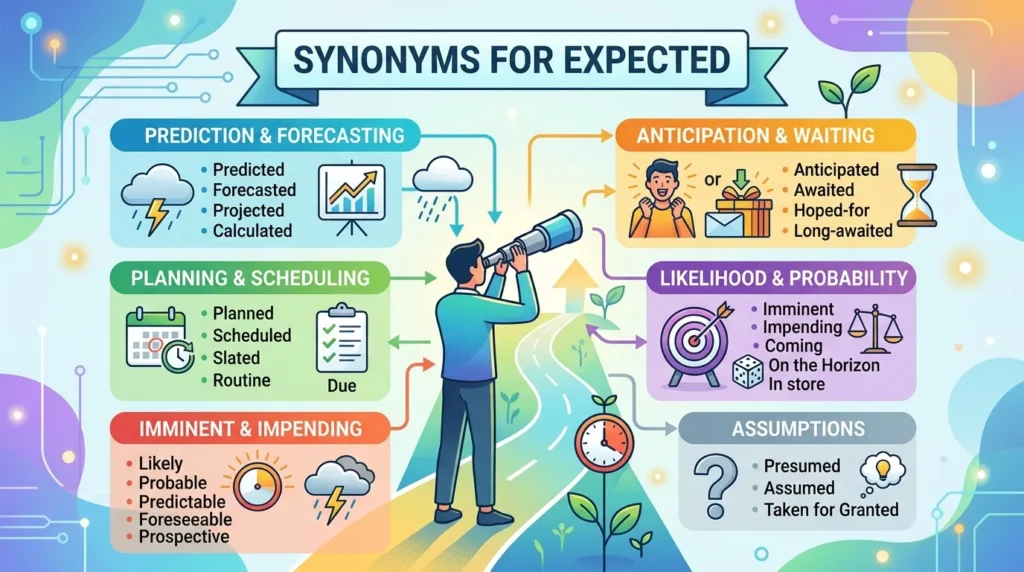
Expected means thought likely to happen, arrive, or be true, based on what is already known. Think about a family waiting at the airport for a flight. The screen shows the expected arrival time, so they know exactly when to be ready. This word helps people plan ahead and feel prepared, whether they are waiting for a package, a guest, or good news. People use synonyms for expected constantly in daily life, weather reports, and business plans. Learning new synonyms for expected helps English learners speak and write with more variety. Synonyms for expected also helps writers avoid using the same word again and again. This article explains the meaning of expected, its history, and how to say it. It also shares 30 words that mean almost the same thing.
Meaning of Expected
Definition
Expected (Adjective): Thought likely to happen, arrive, or be true, based on what is known.
Examples
- The expected rain never actually arrived.
- Her expected arrival time is around noon.
Connotative Meaning
- Positive tone:
- This word can feel hopeful, showing that something good is coming soon.
- Negative tone:
- This word can feel disappointing when something expected fails to happen or arrive.
- Neutral tone:
- In weather reports, schedules, and business plans, this word is often used in a plain, factual way.
Etymology
- This word comes from the verb “expect,” from Latin “exspectare,” meaning “to look out for” or “to await.”
- The Latin word joined “ex-” (meaning “out”) and “spectare” (meaning “to look” or “to watch”).
- The adjective “expected” formed by adding “-ed” to the verb “expect.”
Short History
- Old English (450–1100):
- This word did not exist yet. People used other native words to describe waiting or hoping for something.
- Middle English (1100–1500):
- The word “expect” had not yet fully entered English during this period.
- Modern English (1500–Present):
The word “expect” came into English from Latin in the 1500s. The word “expected” soon became common in schedules, forecasts, and everyday speech.
Pronunciation (US & UK – IPA)
- US: /ɪkˈspɛktɪd/
- UK: /ɪkˈspɛktɪd/
Syllables
ex-pect-ed (3 syllables)
Affixation Pattern of Expected
- Root: spect (from Latin “spectare,” meaning “to look” or “to watch”)
- Prefix: ex- (meaning “out”)
- Suffix: -ed (turns the word into an adjective)
Explore related topics https://synonymhubb.com/synonyms-for-required/
Word Formation:
Expect (verb), expectation (noun), expected (adjective), and unexpected (adjective, the opposite) all come from this root.
Synonyms for Expected
1. Anticipated (Adjective) — US: /ænˈtɪsɪˌpeɪtɪd/ | UK: /ænˈtɪsɪpeɪtɪd/
Meaning: Looked forward to as likely to happen.
Examples:
- The anticipated results arrived a day early.
- Her anticipated visit made everyone excited.
2. Predicted (Adjective) — US: /prɪˈdɪktɪd/ | UK: /prɪˈdɪktɪd/
Meaning: Said in advance to be likely to happen.
Examples:
- The predicted storm hit the coast overnight.
- Her predicted win came true in the end.
3. Foreseen (Adjective) — US: /fɔːrˈsiːn/ | UK: /fɔːˈsiːn/
Meaning: Known or guessed about before it happened.
Examples:
- The foreseen delay frustrated the passengers.
- Few problems were foreseen before the launch.
4. Forecasted (Adjective) — US: /ˈfɔːrˌkæstɪd/ | UK: /ˈfɔːkɑːstɪd/
Meaning: Predicted, especially about weather or future events.
Examples:
- The forecasted snow arrived right on time.
- Analysts shared the forecasted sales numbers.
5. Planned (Adjective) — US: /plænd/ | UK: /plænd/
Meaning: Arranged or expected to happen at a set time.
Examples:
- The planned meeting started a few minutes late.
- Their planned trip was canceled due to weather.
6. Scheduled (Adjective) — US: /ˈskɛdʒuːld/ | UK: /ˈʃɛdjuːld/
Meaning: Set to happen at a certain time.
Examples:
- The scheduled flight departed right on time.
- Her scheduled appointment moved to next week.
7. Likely (Adjective) — US: /ˈlaɪkli/ | UK: /ˈlaɪkli/
Meaning: Probably going to happen.
Examples:
- Rain is likely later this afternoon.
- Her promotion seemed likely after the review.
8. Probable (Adjective) — US: /ˈprɑːbəbəl/ | UK: /ˈprɒbəbəl/
Meaning: More likely than not to happen.
Examples:
- A delay is probable due to the storm.
- Her win felt probable after the strong start.
9. Projected (Adjective) — US: /prəˈdʒɛktɪd/ | UK: /prəˈdʒɛktɪd/
Meaning: Estimated to happen based on current information.
Examples:
- The projected costs stayed within budget.
- Their projected growth impressed the investors.
10. Awaited (Adjective) — US: /əˈweɪtɪd/ | UK: /əˈweɪtɪd/
Meaning: Looked forward to with attention.
Examples:
- The long-awaited results finally arrived.
- Her much-awaited return brought smiles to everyone.
11. Hoped-for (Adjective) — US: /hoʊpt fɔːr/ | UK: /həʊpt fɔː/
Meaning: Wished for, and thought likely to happen.
Examples:
- The hoped-for rain finally came.
- Their hoped-for success took years of hard work.
12. Predictable (Adjective) — US: /prɪˈdɪktəbəl/ | UK: /prɪˈdɪktəbəl/
Meaning: Able to be guessed correctly based on a pattern.
Examples:
- The movie’s ending felt quite predictable.
- His predictable schedule made planning easy.
13. Foreseeable (Adjective) — US: /fɔːrˈsiːəbəl/ | UK: /fɔːˈsiːəbəl/
Meaning: Able to be known or guessed in advance.
Examples:
- No major problems are foreseeable this year.
- The foreseeable risks were carefully studied.
14. Imminent (Adjective) — US: /ˈɪmɪnənt/ | UK: /ˈɪmɪnənt/
Meaning: About to happen very soon.
Examples:
- The storm’s arrival felt imminent.
- Her promotion seemed imminent after the meeting.
15. Impending (Adjective) — US: /ɪmˈpɛndɪŋ/ | UK: /ɪmˈpɛndɪŋ/
Meaning: Likely to happen soon, often something serious.
Examples:
- The impending deadline worried the whole team.
- They sensed the impending change in the office.
16. Due (Adjective) — US: /duː/ | UK: /djuː/
Meaning: Expected to happen or arrive at a set time.
Examples:
- The package is due to arrive today.
- Her baby is due next month.
17. On the horizon (Adjective phrase) — US: /ɒn ðə həˈraɪzən/ | UK: /ɒn ðə həˈraɪzən/
Meaning: Likely to happen in the near future.
Examples:
- Big changes are on the horizon for the company.
- A new opportunity seemed to be on the horizon.
18. In the cards (Adjective phrase) — US: /ɪn ðə kɑːrdz/ | UK: /ɪn ðə kɑːdz/
Meaning: Likely to happen based on current signs.
Examples:
- A promotion seemed to be in the cards for her.
- Rain looked like it was in the cards today.
19. Presumed (Adjective) — US: /prɪˈzuːmd/ | UK: /prɪˈzjuːmd/
Meaning: Believed to be true or likely without full proof.
Examples:
- The presumed cause of the delay was traffic.
- His presumed innocence was proven later.
20. Assumed (Adjective) — US: /əˈsuːmd/ | UK: /əˈsjuːmd/
Meaning: Taken as true or likely without checking.
Examples:
- The assumed answer turned out to be correct.
- Her assumed schedule left little room for delays.
21. Prospective (Adjective) — US: /prəˈspɛktɪv/ | UK: /prəˈspɛktɪv/
Meaning: Likely to happen or become true in the future.
Examples:
- The prospective buyer toured the house twice.
- Her prospective career plans excited her family.
22. Envisioned (Adjective) — US: /ɪnˈvɪʒənd/ | UK: /ɪnˈvɪʒənd/
Meaning: Imagined or expected as a likely future outcome.
Examples:
- The envisioned changes will take a full year.
- Her envisioned design finally became reality.
23. Forthcoming (Adjective) — US: /ˌfɔːrθˈkʌmɪŋ/ | UK: /ˌfɔːθˈkʌmɪŋ/
Meaning: About to happen or appear soon.
Examples:
- The forthcoming book excited many fans.
- Her forthcoming visit was planned for spring.
24. Slated (Adjective) — US: /ˈsleɪtɪd/ | UK: /ˈsleɪtɪd/
Meaning: Planned or scheduled to happen.
Examples:
- The event is slated for next Friday.
- Her promotion is slated to begin in June.
25. Calculated (Adjective) — US: /ˈkælkjəˌleɪtɪd/ | UK: /ˈkælkjʊleɪtɪd/
Meaning: Carefully estimated as a likely outcome.
Examples:
- The calculated risk paid off in the end.
- Their calculated growth matched the report closely.
26. Envisaged (Adjective) — US: /ɪnˈvɪzɪdʒd/ | UK: /ɪnˈvɪzɪdʒd/
Meaning: Expected or imagined as a likely future event.
Examples:
- The envisaged plan took shape slowly.
- Her envisaged outcome matched the final result.
27. Coming (Adjective) — US: /ˈkʌmɪŋ/ | UK: /ˈkʌmɪŋ/
Meaning: About to happen soon.
Examples:
- The coming winter looked especially cold.
- Her coming exams kept her busy studying.
28. In store (Adjective phrase) — US: /ɪn stɔːr/ | UK: /ɪn stɔː/
Meaning: Waiting to happen in the near future.
Examples:
- A big surprise was in store for her.
- No one knew what was in store for the team.
29. Taken for granted (Adjective phrase) — US: /ˈteɪkən fɔːr ˈɡræntɪd/ | UK: /ˈteɪkən fɔː ˈɡrɑːntɪd/
Meaning: So expected that it is assumed without question.
Examples:
- His support was often taken for granted.
- Her success was almost taken for granted by fans.
30. Routine (Adjective) — US: /ruːˈtiːn/ | UK: /ruːˈtiːn/
Meaning: Expected as a normal, regular part of something.
Examples:
- The routine checkup found nothing unusual.
- Her routine tasks kept the office running smoothly.
Prototype Meaning
When people hear the word expected, they picture something that is likely to happen based on clear signs, plans, or past patterns. It brings to mind schedules, forecasts, and a feeling of being prepared for what comes next.
Prototype Categorization
- Planned or scheduled: planned, scheduled, slated, due, routine
- Predicted through evidence: predicted, forecasted, projected, calculated, presumed, assumed
- Hoped for or looked forward to: anticipated, awaited, hoped-for, envisioned, envisaged
- Soon to happen: imminent, impending, coming, on the horizon, in the cards, in store
- Based on patterns: predictable, foreseeable, foreseen, likely, probable
- Future possibilities: prospective, taken for granted
Antonyms of Expected
- Unexpected
- Surprising
- Sudden
- Unforeseen
- Unpredictable
Short Questions and Answers
- What does expected mean? It means thought likely to happen, arrive, or be true, based on what is known.
- When should expected be used? Use it when describing something predicted, planned, or likely to happen soon.
- Is “expected” positive or negative?It is usually neutral. But it can feel hopeful when something good is expected or disappointing when the result is not what was expected.
- How is it different from similar words? “Predicted” often focuses on a guess based on evidence. “Expected” is broader and can include hopes, and everyday assumptions about what will happen.
Conclusion
Synonyms for expected helps you build a stronger, more precise vocabulary. It strengthens your writing and speaking by giving you many ways to describe plans, predictions, and future events. Synonyms for expected also helps you avoid repeating the same word again and again. Its keeps your writing clearer and more useful. Most importantly, learning new synonyms for expected builds your confidence as an English speaker and writer. Try learning one new synonyms for expected from this list each day, and watch your vocabulary grow steadily over time.

I’m Zahid Abbas, an educator, researcher, and digital publishing strategist with a passion for linguistics, grammar, and clear communication. As a content creator and SEO specialist, I craft research-driven, reader-focused content that empowers learners and makes knowledge accessible worldwide.