Welcome means to greet someone in a kind and friendly way. Picture Ana on her first day at a new school. She feels shy. A girl smiles and says, “Welcome! Sit with us.” Ana feels at home right away. People use synonyms for welcome every day because it shows kindness in one short word. They say it at doors, in emails, and on signs. But using one word again and again can feel flat. That is why synonyms matter. English learners get more words to choose from. Content writers sound fresh and exact.
In this article, you will learn the meaning of welcome and its tone. You will see where it comes from and how to say it. You will study how it is built. Then you will meet 30 synonyms with examples, grouped by meaning.
Meaning of Welcome
Definition
Welcome (verb, noun, adjective, interjection): To greet someone in a kind way. As a noun, it is a friendly greeting. As an adjective, it describes something that is gladly received.
Examples
- We welcome every guest with a smile.
- Your help is always welcome.
Connotative Meaning
- Positive tone: Warm, kind, and open. “A warm welcome made us feel at home.”
- Negative tone: Rare. It appears when someone is not wanted, or when people speak with sarcasm. “You are not welcome here.”
- Neutral tone: Plain use on signs and in speech. “Welcome to the museum.”
Etymology
- Source language: Old English wilcuma, made from wil- (desire, pleasure) and cuma (guest, one who comes).
- Original meaning: A guest whose coming brings joy.
- How it changed: Later, English speakers changed wil- to wel-, which means “well.” This was probably helped by Old French bienvenu and Old Norse velkominn. So the word came to mean “well come,” or “it is good that you came.”
Short History of the Word
- Old English (450–1100): The word was wilcuma for a guest, and wilcumian for the act of greeting.
- Middle English (1100–1500): The spelling shifted to welcome, with wel- meaning “well.”
- Modern English (1500–present): Welcome grew into a verb, a noun, an adjective, and a greeting. Later, “you’re welcome” became the polite reply to “thank you.”
Pronunciation (US & UK – IPA)
- US: /ˈwel.kəm/
- UK: /ˈwel.kəm/
Syllables
wel-come
Affixation Pattern of Welcome
- Root: come
- Prefix: none (wel- is a form of “well,” so this is a compound word)
- Suffix: none
Word formation
At least seven words grow from this root.
- welcome (verb, noun, adjective, interjection)
- welcomes (verb, noun plural)
- welcomed (verb, past form)
- welcoming (adjective, verb form)
- welcomer (noun)
- unwelcome (adjective)
- welcome mat (compound noun)
Explore related topics https://synonymhubb.com/synonyms-of-complacent/
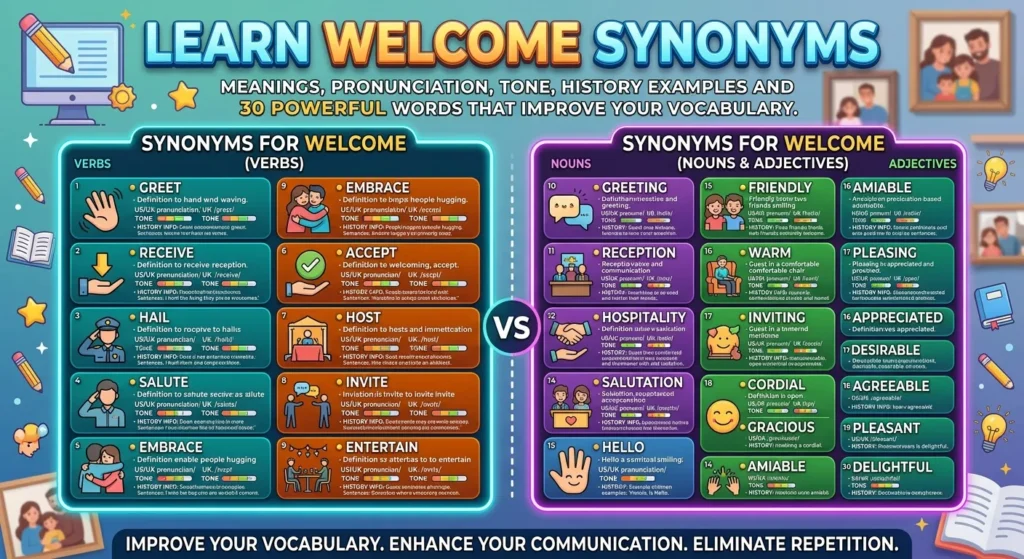
Synonyms for Welcome
1. Greet (verb) — US /ɡriːt/ | UK /ɡriːt/
Meaning: To say hello in a friendly way.
Examples:
- She greeted each guest at the door.
- He greeted us with a big smile.
2. Receive (verb) — US /rɪˈsiːv/ | UK /rɪˈsiːv/
Meaning: To take in a guest or visitor.
Examples:
- The mayor received the visitors in her office.
- We were received warmly by the family.
3. Hail (verb) — US /heɪl/ | UK /heɪl/
Meaning: To greet someone loudly or with praise.
Examples:
- The crowd hailed the winners.
- She hailed a friend across the street.
4. Salute (verb) — US /səˈluːt/ | UK /səˈluːt/
Meaning: To greet someone with a gesture or a few words.
Examples:
- The soldier saluted the captain.
- He saluted us with a wave.
5. Embrace (verb) — US /ɪmˈbreɪs/ | UK /ɪmˈbreɪs/
Meaning: To accept someone or something with joy.
Examples:
- The town embraced the new neighbors.
- She embraced her new role.
6. Accept (verb) — US /əkˈsept/ | UK /əkˈsept/
Meaning: To take someone in as part of a group.
Examples:
- The team accepted him at once.
- They accepted her into the club.
7. Host (verb) — US /hoʊst/ | UK /həʊst/
Meaning: To receive guests at your home or event.
Examples:
- We host friends every Sunday.
- The school will host the new students.
8. Invite (verb) — US /ɪnˈvaɪt/ | UK /ɪnˈvaɪt/
Meaning: To ask someone to come.
Examples:
- She invited us to her house.
- They invite everyone to the party.
9. Entertain (verb) — US /ˌɛn.t̬ɚˈteɪn/ | UK /ˌɛn.təˈteɪn/
Meaning: To welcome guests with food, talk, or fun.
Examples:
- They entertain guests with music.
- We love to entertain on weekends.
10. Greeting (noun) — US /ˈɡriː.t̬ɪŋ/ | UK /ˈɡriː.tɪŋ/
Meaning: A kind word or act when you meet someone.
Examples:
- He gave us a warm greeting.
- A wave was her greeting.
11. Reception (noun) — US /rɪˈsep.ʃən/ | UK /rɪˈsep.ʃən/
Meaning: The way people are received.
Examples:
- The singer got a warm reception.
- The new boss had a friendly reception.
12. Hospitality (noun) — US /ˌhɑː.spɪˈtæl.ə.t̬i/ | UK /ˌhɒs.pɪˈtæl.ə.ti/
Meaning: Kind and generous treatment of guests.
Examples:
- Thank you for your hospitality.
- The village is known for its hospitality.
13. Salutation (noun) — US /ˌsæl.jəˈteɪ.ʃən/ | UK /ˌsæl.jəˈteɪ.ʃən/
Meaning: A greeting in words or at the start of a letter.
Examples:
- The letter began with a polite salutation.
- He gave a cheerful salutation.
14. Acceptance (noun) — US /əkˈsep.təns/ | UK /əkˈsep.təns/
Meaning: Glad reception into a group.
Examples:
- She felt acceptance in her new school.
- The club offered him acceptance.
15. Hello (interjection) — US /həˈloʊ/ | UK /həˈləʊ/
Meaning: A word you say when you meet someone.
Examples:
- She said hello to every guest.
- A simple hello made him smile.
16. Welcoming (adjective) — US /ˈwel.kə.mɪŋ/ | UK /ˈwel.kə.mɪŋ/
Meaning: Friendly and kind to guests.
Examples:
- The staff were welcoming.
- It is a welcoming town.
17. Friendly (adjective) — US /ˈfrend.li/ | UK /ˈfrend.li/
Meaning: Kind and ready to be a friend.
Examples:
- Our neighbors are friendly.
- The shop has a friendly feel.
18. Warm (adjective) — US /wɔːrm/ | UK /wɔːm/
Meaning: Kind and full of care.
Examples:
- They gave us a warm smile.
- The café has a warm mood.
19. Hospitable (adjective) — US /hɑːˈspɪt̬.ə.bəl/ | UK /hɒˈspɪt.ə.bəl/
Meaning: Kind and generous to guests.
Examples:
- The family was hospitable.
- She is a hospitable host.
20. Inviting (adjective) — US /ɪnˈvaɪ.t̬ɪŋ/ | UK /ɪnˈvaɪ.tɪŋ/
Meaning: Pleasant in a way that makes you want to come in.
Examples:
- The room looked bright and inviting.
- The smell of bread was inviting.
21. Cordial (adjective) — US /ˈkɔːr.dʒəl/ | UK /ˈkɔː.di.əl/
Meaning: Polite and friendly.
Examples:
- He gave a cordial hello.
- They had a cordial talk.
22. Gracious (adjective) — US /ˈɡreɪ.ʃəs/ | UK /ˈɡreɪ.ʃəs/
Meaning: Kind and polite, especially to guests.
Examples:
- She was a gracious host.
- He gave a gracious reply.
23. Amiable (adjective) — US /ˈeɪ.mi.ə.bəl/ | UK /ˈeɪ.mi.ə.bəl/
Meaning: Friendly and easy to like.
Examples:
- The teacher is amiable.
- He gave an amiable nod.
24. Open (adjective) — US /ˈoʊ.pən/ | UK /ˈəʊ.pən/
Meaning: Ready to accept new people or ideas.
Examples:
- Our club is open to everyone.
- She has an open heart.
25. Pleasing (adjective) — US /ˈpliː.zɪŋ/ | UK /ˈpliː.zɪŋ/
Meaning: Giving joy or comfort.
Examples:
- It is pleasing to see you.
- The pleasing smell of tea filled the room.
26. Appreciated (adjective) — US /əˈpriː.ʃi.eɪ.t̬ɪd/ | UK /əˈpriː.ʃi.eɪ.tɪd/
Meaning: Gladly received and valued.
Examples:
- Your help is appreciated.
- Any gift is appreciated.
27. Desirable (adjective) — US /dɪˈzaɪr.ə.bəl/ | UK /dɪˈzaɪə.rə.bəl/
Meaning: Wanted by many people and worth having.
Examples:
- It is a desirable place to live.
- A quiet seat is desirable on a long trip.
28. Agreeable (adjective) — US /əˈɡriː.ə.bəl/ | UK /əˈɡriː.ə.bəl/
Meaning: Pleasant and easy to accept.
Examples:
- The offer was agreeable to all.
- We spent an agreeable evening.
29. Pleasant (adjective) — US /ˈplez.ənt/ | UK /ˈplez.ənt/
Meaning: Nice and enjoyable.
Examples:
- It was a pleasant surprise.
- She has a pleasant voice.
30. Delightful (adjective) — US /dɪˈlaɪt.fəl/ | UK /dɪˈlaɪt.fəl/
Meaning: Very pleasing and joyful.
Examples:
- It was a delightful visit.
- She is a delightful host.
Prototype Meaning
When people hear welcome, most picture an open door and a smiling host. Think of a “Welcome” mat or a sign at the entrance. The most typical meaning is to greet someone kindly and make them feel they belong. It is a warm, friendly word used at homes, schools, shops, and online.
Prototype Categorization
- Greeting actions: greet, receive, hail, salute, embrace, accept, host, invite, entertain
- Greeting words: greeting, salutation, hello, reception, hospitality, acceptance
- Friendly people and places: welcoming, friendly, warm, hospitable, inviting, cordial, gracious, amiable, open
- Gladly received things: pleasing, appreciated, desirable, agreeable, pleasant, delightful
Antonyms of welcome
- reject
- snub
- ignore
- dismiss
- unwelcome
- unfriendly
- cold
- hostile
Short Questions and Answers
- What does welcome mean?
- It means to greet someone in a kind way, or something that is gladly received.
- When should welcome be used?
- Use it when people arrive, join a group, or visit a place. It also fits when you accept help or news with joy.
- Is welcome positive or negative?
- It is mostly positive. It turns negative in a phrase like “You are not welcome here.”
- How is it different from similar words?
- Greet is only the first hello. Welcome also says you are glad they came. Host means to receive guests at your event. Embrace means to accept with joy. Hospitable describes a kind person or place.
Conclusion
Synonyms for welcome makes your vocabulary bigger and stronger. You now know that one word can have many shades. Greet fits a first hello. Host fits a party. Hospitable fits a kind family. Appreciated fits a gift. With the right synonyms for welcome, your writing becomes clear and sharp. Your speaking sounds more natural too. You also avoid repeating the same word again and again, which keeps readers interested. Every new synonyms for welcome you learn builds your English confidence. So don’t stop here. Pick three synonyms for welcome from this list today. Use them in an email, a short essay, or a blog post. Say them out loud to practice the sounds. Review them tomorrow and again next week. A little daily practice turns new words into words you own.

I’m Zahid Abbas, an educator, researcher, and digital publishing strategist with a passion for linguistics, grammar, and clear communication. As a content creator and SEO specialist, I craft research-driven, reader-focused content that empowers learners and makes knowledge accessible worldwide.