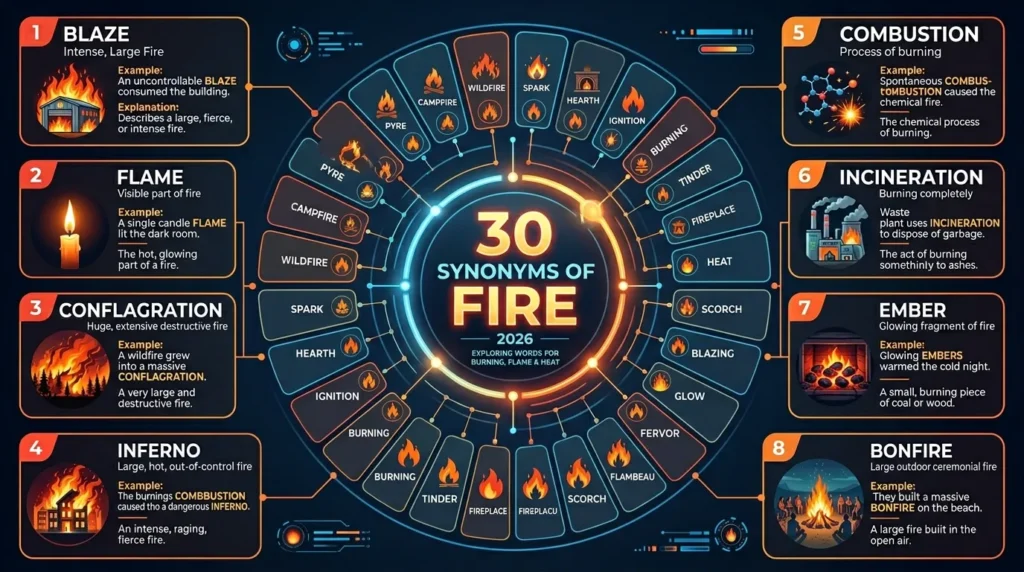
The word fire means flames, heat, or burning energy. Imagine sitting near a campfire on a cold evening. The warm fire lights the area and keeps everyone comfortable. Fire is also used in cooking, industry, stories, emotions, and daily conversations.
People use this word very often because it has many meanings. It can describe heat, danger, energy, passion, or even strong emotions. Learning synonyms of fire helps English learners improve vocabulary and avoid repeating the same word. It also helps writers make sentences more vivid and expressive.
In this article, you will learn the meaning of fire, its pronunciation, history, grammar, and 30 useful synonyms with examples. You will also explore semantic categories, antonyms, and short questions to strengthen your English speaking and writing skills.
Meaning of Fire
Definition
Fire (noun/verb): the heat, light, and flames produced by burning.
Examples
- The fire kept us warm at night.
- The workers tried to stop the fire quickly.
Connotative Meaning
(Connotation means the feeling or emotion a word suggests beyond its basic meaning.)
- Positive tone: warmth, passion, energy, power
- Negative tone: danger, destruction, anger
- Neutral tone: burning process or heat source
Etymology
- From Old English fȳr meaning “fire, flame, burning”
- Related to Germanic language roots connected to heat and burning
Short History:
- Old English (450–1100): used for flame and heat
- Middle English (1100–1500): gained symbolic meanings like passion and anger
- Modern English (1500–Present): widely used in science, emotions, and daily speech
Pronunciation (US & UK – IPA)
- US: /faɪər/
- UK: /faɪə/
Syllables
- fire
Affixation Pattern of Fire
- Root: fire
- Prefix: none
- Suffix: none
Word Formation:
- fire (noun/verb)
- fiery (adjective)
- firefighter (noun)
- firing (noun/verb)
- fireproof (adjective)
30 Synonyms of Fire
1. Flame (noun)
US: /fleɪm/ | UK: /fleɪm/
Meaning: the visible burning part of fire
Examples:
- The candle gave a bright flame.
- A small flame appeared suddenly.
2. Blaze (noun)
US: /bleɪz/ | UK: /bleɪz/
Meaning: a strong and bright fire
Examples:
- The forest blaze spread quickly.
- Firefighters stopped the blaze.
3. Inferno (noun)
US: /ɪnˈfɜːrnoʊ/ | UK: /ɪnˈfɜːnəʊ/
Meaning: a very large and dangerous fire
Examples:
- The building became an inferno.
- Smoke rose from the inferno.
4. Bonfire (noun)
US: /ˈbɑːnfaɪər/ | UK: /ˈbɒnfaɪə/
Meaning: a large outdoor fire
Examples:
- We sat around the bonfire.
- The children enjoyed the bonfire.
5. Campfire (noun)
US: /ˈkæmpfaɪər/ | UK: /ˈkæmpfaɪə/
Meaning: a fire used outdoors while camping
Examples:
- The campers built a campfire.
- We cooked near the campfire.
6. Wildfire (noun)
US: /ˈwaɪldfaɪər/ | UK: /ˈwaɪldfaɪə/
Meaning: a fire spreading quickly in nature
Examples:
- The wildfire destroyed trees.
- Smoke from the wildfire filled the air.
7. Ember (noun)
US: /ˈembər/ | UK: /ˈembə/
Meaning: a small glowing piece from a fire
Examples:
- The embers still glowed.
- She watched the red embers.
8. Spark (noun)
US: /spɑːrk/ | UK: /spɑːk/
Meaning: a tiny burning particle
Examples:
- A spark started the fire.
- Sparks flew into the air.
9. Heat (noun)
US: /hiːt/ | UK: /hiːt/
Meaning: high temperature from fire
Examples:
- The heat became intense.
- We moved away from the heat.
10. Burn (verb/noun)
US: /bɜːrn/ | UK: /bɜːn/
Meaning: to be damaged by fire
Examples:
- Dry wood can burn easily.
- The paper started to burn.
11. Combustion (noun)
US: /kəmˈbʌstʃən/ | UK: /kəmˈbʌstʃən/
Meaning: the process of burning
Examples:
- Engines use combustion.
- Scientists studied combustion carefully.
12. Ignition (noun)
US: /ɪɡˈnɪʃən/ | UK: /ɪɡˈnɪʃən/
Meaning: the act of starting a fire
Examples:
- The ignition happened suddenly.
- Faulty wires caused the ignition.
13. Furnace (noun)
US: /ˈfɜːrnɪs/ | UK: /ˈfɜːnɪs/
Meaning: a very hot heating device
Examples:
- The metal melted in the furnace.
- Workers repaired the furnace.
14. Explosion (noun)
US: /ɪkˈsploʊʒən/ | UK: /ɪkˈspləʊʒən/
Meaning: a sudden burst with fire and force
Examples:
- The explosion caused panic.
- Fire followed the explosion.
15. Torch (noun)
US: /tɔːrtʃ/ | UK: /tɔːtʃ/
Meaning: a portable burning light
Examples:
- He carried a torch at night.
- The torch lit the cave.
16. Glow (noun/verb)
US: /ɡloʊ/ | UK: /ɡləʊ/
Meaning: soft light from heat or fire
Examples:
- The fire gave a warm glow.
- The coals continued to glow.
17. Scorch (verb)
US: /skɔːrtʃ/ | UK: /skɔːtʃ/
Meaning: to burn slightly
Examples:
- The sun can scorch plants.
- Fire scorched the walls.
18. Kindle (verb)
US: /ˈkɪndl/ | UK: /ˈkɪndl/
Meaning: to start a fire
Examples:
- He used wood to kindle the fire.
- Dry leaves helped kindle it.
19. Ignite (verb)
US: /ɪɡˈnaɪt/ | UK: /ɪɡˈnaɪt/
Meaning: to set on fire
Examples:
- Heat can ignite fuel.
- Sparks may ignite paper.
20. Smoke (noun)
US: /smoʊk/ | UK: /sməʊk/
Meaning: gas produced by fire
Examples:
- Thick smoke filled the room.
- We saw black smoke outside.
21. Ash (noun)
US: /æʃ/ | UK: /æʃ/
Meaning: powder left after burning
Examples:
- The fire left gray ash.
- Wind blew the ash away.
22. Flame-up (noun)
US: /ˈfleɪm ʌp/ | UK: /ˈfleɪm ʌp/
Meaning: a sudden burst of fire
Examples:
- Oil caused a flame-up.
- The grill had a quick flame-up.
23. Pyre (noun)
US: /ˈpaɪər/ | UK: /ˈpaɪə/
Meaning: a pile burned in a ceremony
Examples:
- Wood formed the funeral pyre.
- The ancient pyre burned brightly.
24. Conflagration (noun)
US: /ˌkɑːnfləˈɡreɪʃən/ | UK: /ˌkɒnfləˈɡreɪʃən/
Meaning: a large destructive fire
Examples:
- The city faced a huge conflagration.
- The conflagration lasted hours.
25. Flare (noun/verb)
US: /fler/ | UK: /fleə/
Meaning: a sudden bright fire or light
Examples:
- A bright flare appeared.
- The fire began to flare again.
26. Incineration (noun)
US: /ɪnˌsɪnəˈreɪʃən/ | UK: /ɪnˌsɪnəˈreɪʃən/
Meaning: complete burning into ash
Examples:
- Waste goes through incineration.
- The machine handles incineration safely.
27. Flamelet (noun)
US: /ˈfleɪmlət/ | UK: /ˈfleɪmlət/
Meaning: a very small flame
Examples:
- A tiny flamelet appeared.
- The candle showed a weak flamelet.
28. Firelight (noun)
US: /ˈfaɪərlaɪt/ | UK: /ˈfaɪəlaɪt/
Meaning: light produced by fire
Examples:
- The room glowed with firelight.
- They talked by the firelight.
29. Backfire (noun/verb)
US: /ˈbækfaɪər/ | UK: /ˈbækfaɪə/
Meaning: an unwanted burst of fire or failure
Examples:
- The engine made a loud backfire.
- The plan may backfire.
30. Firestorm (noun)
US: /ˈfaɪərstɔːrm/ | UK: /ˈfaɪəstɔːm/
Meaning: a very intense spreading fire
Examples:
- The town faced a firestorm.
- Winds created a dangerous firestorm.
Prototype Meaning
The most common meaning of fire is burning flames that produce heat and light. People usually imagine a campfire, fireplace, or dangerous blaze when hearing this word.
Prototype Categorization
- Small burning elements: spark, ember, flamelet
- Large destructive fires: inferno, wildfire, conflagration
- Heat and light: glow, firelight, heat
- Actions of burning: ignite, kindle, scorch
Categorization helps writers choose the best synonym depending on size, emotion, and context.
Antonyms of Fire
Antonyms
- Water (noun): liquid used to stop fire
- Cold (noun/adjective): lack of heat
- Freeze (verb): become very cold
- Extinguish (verb): stop a fire
- Coolness (noun): low temperature
Short Questions and Answers
What does fire mean?
- It means flames, heat, and burning energy.
When should fire be used?
- Use it when talking about burning, heat, danger, or passion.
Is fire positive or negative?
- It can be positive for warmth and energy or negative for destruction.
How is it different from similar words?
- “Fire” is general, while “blaze” and “inferno” describe larger and stronger fires.
Conclusion
Learning synonyms of fire and synonyms of fire improves vocabulary and communication skills. These words help English learners describe heat, danger, emotions, and energy more clearly. Using different synonyms also avoids repetition and makes writing stronger.Understanding related vocabulary helps in storytelling, science, daily conversations, and creative writing. These words allow writers and speakers to express size, intensity, and emotion more accurately. Practice using new vocabulary every day. Small learning habits can greatly improve English fluency and confidence over time.

I’m Zahid Abbas, an educator, researcher, and digital publishing strategist with a passion for linguistics, grammar, and clear communication. As a content creator and SEO specialist, I craft research-driven, reader-focused content that empowers learners and makes knowledge accessible worldwide.