The word more means a greater amount, number, or degree of something. Imagine asking for another slice of pizza because you are still hungry. You may say, “I want more.” This simple word appears everywhere in daily English conversations, books, schools, offices, and online writing.
People use more very often because it helps compare things, express needs, and describe quantity. However, repeating the same word again and again can make writing sound plain. Learning synonyms of more helps English learners improve vocabulary and speak more naturally. It also helps writers avoid repetition and create stronger sentences.
In this article, you will learn the meaning of more, its pronunciation, grammar, history, and 30 useful synonyms with meanings and examples. You will also explore categories, antonyms, and short questions to improve your English skills.
Meaning of More
Definition
More (adjective, adverb, pronoun): a greater amount, number, or degree of something.
Examples
- I need more time to finish my homework.
- She wants more coffee.
Connotative Meaning
(Connotation means the feeling or emotion a word suggests beyond its basic meaning.)
- Positive tone: growth, improvement, abundance
- Negative tone: excess, greed, overload
- Neutral tone: greater quantity or degree
Etymology
- From Old English māra meaning “greater” or “larger”
- Related to Germanic language roots about increase and comparison
Short History:
- Old English (450–1100): used as māra for greater quantity
- Middle English (1100–1500): became “more” in common speech
- Modern English (1500–Present): widely used for comparison and quantity
Pronunciation (US & UK – IPA)
- US: /mɔːr/
- UK: /mɔː/
Syllables
- more
Affixation Pattern of More
- Root: more
- Prefix: none
- Suffix: none
Word Formation:
- more (adjective)
- moreover (adverb)
- most (adjective/adverb)
- increasingly (adverb)
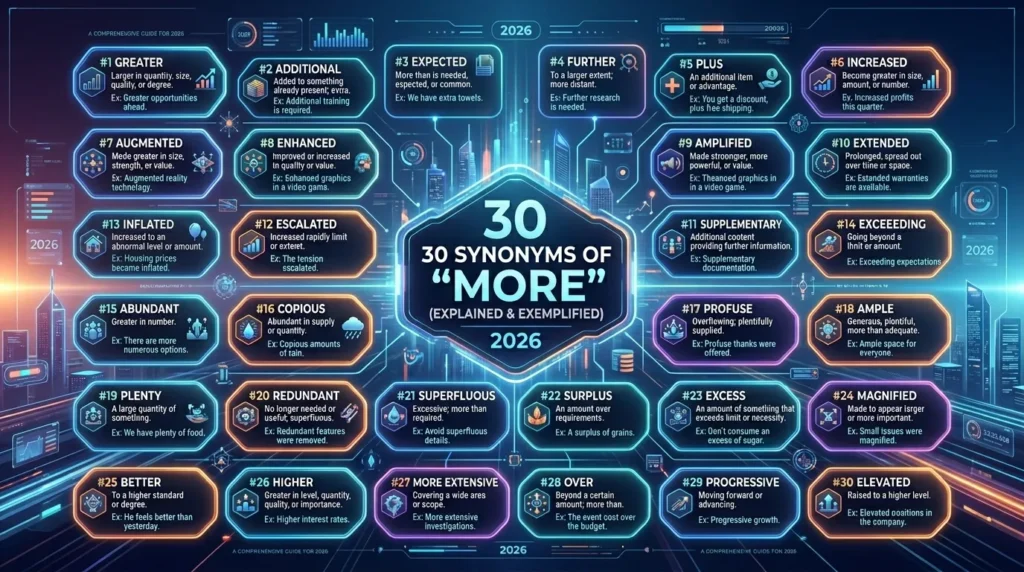
30 Synonyms of More
1. Additional (adjective)
US: /əˈdɪʃənəl/ | UK: /əˈdɪʃənəl/
Meaning: added or extra
Examples:
- We need additional chairs.
- She asked for additional details.
2. Extra (adjective)
US: /ˈekstrə/ | UK: /ˈekstrə/
Meaning: more than usual
Examples:
- I bought an extra ticket.
- He needs extra help.
3. Further (adjective/adverb)
US: /ˈfɜːrðər/ | UK: /ˈfɜːðə/
Meaning: additional or beyond
Examples:
- We need further discussion.
- No further questions were asked.
4. Added (adjective)
US: /ˈædɪd/ | UK: /ˈædɪd/
Meaning: included additionally
Examples:
- There are added benefits.
- She enjoyed the added support.
5. Increased (adjective)
US: /ɪnˈkriːst/ | UK: /ɪnˈkriːst/
Meaning: made greater in amount
Examples:
- The company saw increased sales.
- We need increased effort.
6. Greater (adjective)
US: /ˈɡreɪtər/ | UK: /ˈɡreɪtə/
Meaning: larger in amount or importance
Examples:
- She showed greater confidence.
- This needs greater care.
7. Excess (noun/adjective)
US: /ɪkˈses/ | UK: /ɪkˈses/
Meaning: too much of something
Examples:
- Avoid excess sugar.
- The store had excess stock.
8. Surplus (noun/adjective)
US: /ˈsɜːrpləs/ | UK: /ˈsɜːpləs/
Meaning: more than needed
Examples:
- The farm produced a surplus.
- They sold the surplus goods.
9. Spare (adjective)
US: /sper/ | UK: /speə/
Meaning: extra and available
Examples:
- Do you have a spare pen?
- We kept a spare key.
10. Supplementary (adjective)
US: /ˌsʌpləˈmentəri/ | UK: /ˌsʌplɪˈmentəri/
Meaning: added to complete something
Examples:
- She read supplementary materials.
- The teacher gave supplementary notes.
11. Expanded (adjective)
US: /ɪkˈspændɪd/ | UK: /ɪkˈspændɪd/
Meaning: made larger or broader
Examples:
- The store opened an expanded section.
- We need an expanded plan.
12. Broader (adjective)
US: /ˈbrɔːdər/ | UK: /ˈbrɔːdə/
Meaning: wider or more extensive
Examples:
- We need a broader view.
- The company reached a broader audience.
13. Bigger (adjective)
US: /ˈbɪɡər/ | UK: /ˈbɪɡə/
Meaning: larger in size or amount
Examples:
- They moved to a bigger house.
- She wants a bigger piece.
14. Larger (adjective)
US: /ˈlɑːrdʒər/ | UK: /ˈlɑːdʒə/
Meaning: greater in size
Examples:
- We need a larger table.
- The city has a larger population.
15. Amplified (adjective)
US: /ˈæmplɪfaɪd/ | UK: /ˈæmplɪfaɪd/
Meaning: increased in strength or effect
Examples:
- The message was amplified online.
- Noise became amplified indoors.
16. Enhanced (adjective)
US: /ɪnˈhænst/ | UK: /ɪnˈhɑːnst/
Meaning: improved or increased
Examples:
- The update provided enhanced security.
- She enjoyed enhanced features.
17. Elevated (adjective)
US: /ˈeləveɪtɪd/ | UK: /ˈelɪveɪtɪd/
Meaning: raised to a higher level
Examples:
- The company reached elevated profits.
- His mood became elevated.
18. Abundant (adjective)
US: /əˈbʌndənt/ | UK: /əˈbʌndənt/
Meaning: existing in large amounts
Examples:
- Food was abundant.
- The forest has abundant wildlife.
19. Numerous (adjective)
US: /ˈnuːmərəs/ | UK: /ˈnjuːmərəs/
Meaning: many in number
Examples:
- She received numerous emails.
- There were numerous visitors.
20. Plenty (noun/pronoun)
US: /ˈplenti/ | UK: /ˈplenti/
Meaning: a large amount
Examples:
- We have plenty of time.
- There is plenty of food.
21. Excessive (adjective)
US: /ɪkˈsesɪv/ | UK: /ɪkˈsesɪv/
Meaning: too much or too great
Examples:
- Avoid excessive spending.
- The noise became excessive.
22. Overflowing (adjective)
US: /ˌoʊvərˈfloʊɪŋ/ | UK: /ˌəʊvəˈfləʊɪŋ/
Meaning: filled beyond capacity
Examples:
- The cup was overflowing.
- The hall had an overflowing crowd.
23. Heavier (adjective)
US: /ˈhevɪər/ | UK: /ˈheviə/
Meaning: greater in weight or amount
Examples:
- Traffic became heavier.
- We carried a heavier load.
24. Richer (adjective)
US: /ˈrɪtʃər/ | UK: /ˈrɪtʃə/
Meaning: fuller or greater in quality
Examples:
- The story became richer.
- She enjoys a richer flavor.
25. Multipled (adjective)
US: /ˈmʌltəpəld/ | UK: /ˈmʌltɪpəld/
Meaning: increased many times
Examples:
- Profits multipled quickly.
- The number of users multipled.
26. Accumulated (adjective)
US: /əˈkjuːmjəˌleɪtɪd/ | UK: /əˈkjuːmjəleɪtɪd/
Meaning: gathered over time
Examples:
- Dust had accumulated.
- They used accumulated savings.
27. Countless (adjective)
US: /ˈkaʊntləs/ | UK: /ˈkaʊntləs/
Meaning: too many to count
Examples:
- She faced countless problems.
- There are countless stars.
28. Extended (adjective)
US: /ɪkˈstendɪd/ | UK: /ɪkˈstendɪd/
Meaning: made longer or larger
Examples:
- The meeting had an extended schedule.
- They enjoyed an extended holiday.
29. Enlarged (adjective)
US: /ɪnˈlɑːrdʒd/ | UK: /ɪnˈlɑːdʒd/
Meaning: made bigger
Examples:
- The photo was enlarged.
- They moved into an enlarged office.
30. Added-On (adjective)
US: /ˈædɪd ɑːn/ | UK: /ˈædɪd ɒn/
Meaning: included as an extra part
Examples:
- The app has added-on features.
- They offered added-on services.
Prototype Meaning
The most common meaning of more is a greater amount or number of something. People usually imagine wanting extra food, more time, more money, or a larger quantity of something useful or needed.
Prototype Categorization
- Extra quantity: additional, extra, surplus
- Growth and increase: expanded, increased, amplified
- Large amount: abundant, numerous, countless
- Improvement and extension: enhanced, extended, richer
Categorization helps writers choose the best synonym depending on amount, quality, or context.
Antonyms of More
Antonyms
- Less (adjective/adverb): a smaller amount
- Fewer (adjective): a smaller number
- Limited (adjective): restricted in amount
- Reduced (adjective): made smaller
- Scarce (adjective): not enough available
Short Questions and Answers
What does more mean?
- It means a greater amount, number, or degree of something.
When should more be used?
- Use it when comparing quantities or asking for additional things.
Is more positive or negative?
- It is usually neutral, but context can make it positive or negative.
How is it different from similar words?
- “More” is general, while words like “additional” or “surplus” have more specific meanings.
Conclusion
Learning synonyms of more and synonyms of more improves vocabulary and communication skills. It helps English learners describe quantity, comparison, and growth more clearly. Using different synonyms also avoids repetition and makes speaking and writing more natural.These words are useful in daily conversation, academic writing, business communication, and creative storytelling. They help writers explain ideas with greater accuracy and variety. Practice using new vocabulary every day. Small improvements in word choice can build strong English confidence over time.

I’m Zahid Abbas, an educator, researcher, and digital publishing strategist with a passion for linguistics, grammar, and clear communication. As a content creator and SEO specialist, I craft research-driven, reader-focused content that empowers learners and makes knowledge accessible worldwide.