The word furthermore means “in addition” or “also.” People use it to add more information to a sentence or idea. Imagine a student giving a class presentation. The student explains one point and then says, “Furthermore, regular practice improves memory.” The word helps connect ideas smoothly.
Furthermore is common in essays, articles, business writing, and formal speaking. It makes sentences clear and organized. However, using the same linking word again and again can sound repetitive.
Learning synonyms of furthermore helps English learners improve vocabulary and writing style. It also helps content writers create smooth and natural sentences. In this article, you will learn the meaning of furthermore, its pronunciation, history, grammar, and 30 useful synonyms with examples. You will also explore semantic categories, antonyms, and simple questions to strengthen your English communication skills.
Meaning of Furthermore
Definition
Furthermore (adverb): used to add more information or support to a statement.
Examples
- The course is affordable. Furthermore, it is easy to access online.
- She is hardworking. Furthermore, she is very creative.
Connotative Meaning
(Connotation means the feeling or emotion a word suggests beyond its basic meaning.)
- Positive tone: organized, intelligent, formal
- Negative tone: sometimes sounds overly formal in casual speech
- Neutral tone: simply adds information
Etymology
- From Middle English furthermore
- Made from “further” + “more” meaning “more in addition”
Short History:
- Old English (450–1100): similar linking words existed
- Middle English (1100–1500): “furthermore” appeared in written English
- Modern English (1500–Present): widely used in academic and formal writing
Pronunciation (US & UK – IPA)
- US: /ˌfɜːrðərˈmɔːr/
- UK: /ˌfɜːðəˈmɔː/
Syllables
- fur-ther-more
Affixation Pattern of Furthermore
- Root: further + more
- Prefix: none
- Suffix: none
Word Formation:
- further (adjective/adverb)
- more (adjective/adverb)
- furthermore (adverb)
- furthering (verb)
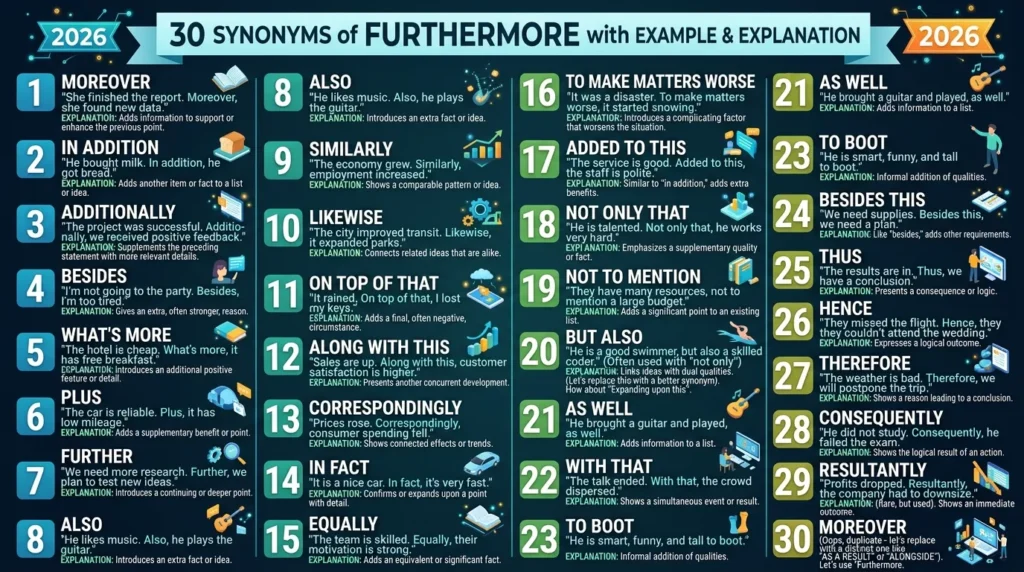
Synonyms of Furthermore
1. Moreover (adverb)
US: /mɔːrˈoʊvər/ | UK: /mɔːrˈəʊvə/
Meaning: in addition to what was said
Examples:
- The plan is simple. Moreover, it is effective.
- She is kind. Moreover, she is honest.
2. Additionally (adverb)
US: /əˈdɪʃənəli/ | UK: /əˈdɪʃənəli/
Meaning: as an extra point
Examples:
- The app is free. Additionally, it is easy to use.
- He studies hard. Additionally, he works part-time.
3. Also (adverb)
US: /ˈɔːlsoʊ/ | UK: /ˈɔːlsəʊ/
Meaning: too or in addition
Examples:
- She sings and also dances.
- I like tea and also coffee.
4. Besides (adverb)
US: /bɪˈsaɪdz/ | UK: /bɪˈsaɪdz/
Meaning: in addition to that
Examples:
- The hotel is cheap. Besides, it is clean.
- He was tired. Besides, it was late.
5. Too (adverb)
US: /tuː/ | UK: /tuː/
Meaning: as well
Examples:
- I enjoy reading too.
- She came too.
6. As Well (phrase)
US: /æz wɛl/ | UK: /æz wel/
Meaning: in addition
Examples:
- He speaks French as well.
- Bring your notebook as well.
7. In Addition (phrase)
US: /ɪn əˈdɪʃən/ | UK: /ɪn əˈdɪʃən/
Meaning: adding another point
Examples:
- The service is fast. In addition, it is affordable.
- She teaches math. In addition, she writes books.
8. Plus (conjunction/adverb)
US: /plʌs/ | UK: /plʌs/
Meaning: and also
Examples:
- The phone is cheap. Plus, it looks nice.
- We need chairs, plus a table.
9. Alongside (adverb)
US: /əˌlɔːŋˈsaɪd/ | UK: /əˌlɒŋˈsaɪd/
Meaning: together with something else
Examples:
- She worked alongside her team.
- Training came alongside experience.
10. Likewise (adverb)
US: /ˈlaɪkwaɪz/ | UK: /ˈlaɪkwaɪz/
Meaning: in the same way
Examples:
- He loves football. Likewise, his brother does too.
- The teacher smiled. The students likewise smiled.
11. Similarly (adverb)
US: /ˈsɪmələrli/ | UK: /ˈsɪmɪləli/
Meaning: in a similar way
Examples:
- Cats need care. Similarly, dogs do too.
- She reacted similarly.
12. What’s More (phrase)
US: /wʌts mɔːr/ | UK: /wɒts mɔː/
Meaning: an additional important point
Examples:
- The car is fast. What’s more, it is safe.
- He is smart. What’s more, he is humble.
13. Not Only That (phrase)
US: /nɑːt ˈoʊnli ðæt/ | UK: /nɒt ˈəʊnli ðæt/
Meaning: adding another strong point
Examples:
- She cooks well. Not only that, she bakes too.
- The class was useful. Not only that, it was fun.
14. Again (adverb)
US: /əˈɡen/ | UK: /əˈɡeɪn/
Meaning: introducing another point
Examples:
- Again, practice improves learning.
- Again, teamwork matters.
15. Further (adverb)
US: /ˈfɜːrðər/ | UK: /ˈfɜːðə/
Meaning: to a greater degree or addition
Examples:
- Further, more research is needed.
- He explained the issue further.
16. Coupled With (phrase)
US: /ˈkʌpəld wɪð/ | UK: /ˈkʌpəld wɪð/
Meaning: combined with
Examples:
- Skill, coupled with effort, brings success.
- Practice, coupled with patience, helps learning.
17. Together With (phrase)
US: /təˈɡeðər wɪð/ | UK: /təˈɡeðə wɪð/
Meaning: along with
Examples:
- Tea, together with snacks, was served.
- She arrived together with her sister.
18. Over and Above (phrase)
US: /ˈoʊvər ænd əˈbʌv/ | UK: /ˈəʊvə ænd əˈbʌv/
Meaning: more than expected
Examples:
- He worked over and above his duties.
- She helped over and above expectations.
19. By the Same Token (phrase)
US: /baɪ ðə seɪm ˈtoʊkən/ | UK: /baɪ ðə seɪm ˈtəʊkən/
Meaning: for the same reason
Examples:
- Exercise improves health. By the same token, it boosts mood.
- Learning English helps travel. By the same token, it helps business.
20. To Boot (phrase)
US: /tə buːt/ | UK: /tə buːt/
Meaning: in addition
Examples:
- The meal was delicious and cheap to boot.
- He is talented and friendly to boot.
21. On Top of That (phrase)
US: /ɑːn tɑːp əv ðæt/ | UK: /ɒn tɒp əv ðæt/
Meaning: adding another point
Examples:
- The room was small. On top of that, it was noisy.
- She was tired. On top of that, she was sick.
22. Into the Bargain (phrase)
US: /ˈɪntuː ðə ˈbɑːrɡən/ | UK: /ˈɪntuː ðə ˈbɑːɡɪn/
Meaning: as an extra advantage
Examples:
- The book is useful and cheap into the bargain.
- He is smart and kind into the bargain.
23. More Than That (phrase)
US: /mɔːr ðæn ðæt/ | UK: /mɔː ðæn ðæt/
Meaning: beyond what was mentioned
Examples:
- She is talented. More than that, she is hardworking.
- The project succeeded. More than that, it inspired others.
24. Then (adverb)
US: /ðen/ | UK: /ðen/
Meaning: next or in addition
Examples:
- Finish homework, then clean your room.
- He studied and then practiced speaking.
25. And All (phrase)
US: /ænd ɔːl/ | UK: /ænd ɔːl/
Meaning: including everything else
Examples:
- They brought food and all.
- She came with gifts and all.
26. Supplementarily (adverb)
US: /ˌsʌpləˈmentərəli/ | UK: /ˌsʌplɪˈmentrəli/
Meaning: in an additional way
Examples:
- The notes were provided supplementarily.
- He trained supplementarily online.
27. Correspondingly (adverb)
US: /ˌkɔːrəˈspɑːndɪŋli/ | UK: /ˌkɒrɪˈspɒndɪŋli/
Meaning: in a matching way
Examples:
- Costs increased. Correspondingly, prices rose.
- Skills improved correspondingly.
28. Therewith (adverb)
US: /ˌðerˈwɪθ/ | UK: /ˌðeəˈwɪð/
Meaning: together with that
Examples:
- He accepted the offer and benefits therewith.
- She signed the form and documents therewith.
29. Inclusive Of (phrase)
US: /ɪnˈkluːsɪv əv/ | UK: /ɪnˈkluːsɪv əv/
Meaning: including something extra
Examples:
- The package is inclusive of meals.
- The fee is inclusive of tax.
30. Addedly (adverb)
US: /ˈædɪdli/ | UK: /ˈædɪdli/
Meaning: additionally or moreover
Examples:
- The course is affordable and addedly flexible.
- He is skilled and addedly experienced.
Prototype Meaning
The most common meaning of furthermore is adding another idea to support or continue a statement. People usually imagine formal writing, essays, presentations, or speeches where ideas connect smoothly.
Prototype Categorization
- Formal addition words: moreover, additionally, furthermore
- Casual addition words: plus, also, too
- Academic connectors: similarly, likewise, in addition
- Strong emphasis connectors: what’s more, on top of that, more than that
Categorization helps writers choose the best synonym based on tone, audience, and writing style.
Antonyms of Furthermore
Antonyms
- However (adverb): introduces contrast
- Nevertheless (adverb): despite that
- Instead (adverb): as an alternative
- Conversely (adverb): in the opposite way
- On the contrary (phrase): showing disagreement or opposition
Short Questions and Answers
What does furthermore mean?
- It means “in addition” or “also.”
When should furthermore be used?
- Use it when adding another point or supporting idea.
Is furthermore positive or negative?
- It is usually neutral and formal.
How is it different from similar words?
- “Furthermore” sounds more formal than “also” or “plus.”
Conclusion
Learning synonyms of furthermore and synonyms of furthermore improves vocabulary and sentence structure. These words help English learners connect ideas smoothly in speaking and writing. Using different transition words also avoids repetition and makes communication more natural.Understanding connectors builds confidence in essays, business writing, conversations, and presentations. These words help organize thoughts clearly and make writing sound professional. Practice using new synonyms every day in sentences and paragraphs. Small daily vocabulary habits can greatly improve English fluency and communication skills over time.

I’m Zahid Abbas, an educator, researcher, and digital publishing strategist with a passion for linguistics, grammar, and clear communication. As a content creator and SEO specialist, I craft research-driven, reader-focused content that empowers learners and makes knowledge accessible worldwide.