The word community means a group of people who live together, work together, or share common interests. Imagine neighbors helping each other during a festival or people joining together to clean a park. That group of connected people forms a community.
People use this word often in schools, workplaces, cities, online platforms, and social discussions. It is a common English word because humans naturally live and interact in groups. However, repeating the same word too many times can make writing less interesting.
Learning synonyms of community helps English learners improve vocabulary and communicate ideas more clearly. It also helps writers create stronger and more natural content. In this article, you will learn the meaning of community, its pronunciation, history, grammar, and 30 useful synonyms with meanings and examples. You will also explore semantic categories, antonyms, and short questions to strengthen your English skills.
Meaning of Community
Definition
Community (noun): a group of people living together or sharing common interests, goals, or activities.
Examples
- Our community organized a charity event.
- The online community shared useful advice.
Connotative Meaning
(Connotation means the feeling or emotion a word suggests beyond its basic meaning.)
- Positive tone: unity, support, friendship
- Negative tone: pressure from groups or social conflict
- Neutral tone: a group of connected people
Etymology
- From Latin communitas meaning “shared by all” or “fellowship”
- Entered English through Old French influence
Short History:
- Old English (450–1100): similar ideas described shared living
- Middle English (1100–1500): “community” became connected with society and groups
- Modern English (1500–Present): widely used for social, local, and online groups
Pronunciation (US & UK – IPA)
- US: /kəˈmjuːnəti/
- UK: /kəˈmjuːnɪti/
Syllables
- com-mu-ni-ty
Affixation Pattern of Community
- Root: commune
- Prefix: com-
- Suffix: -ity
Word Formation:
- commune (noun/verb)
- communal (adjective)
- community (noun)
- communication (noun)
- communicator (noun)
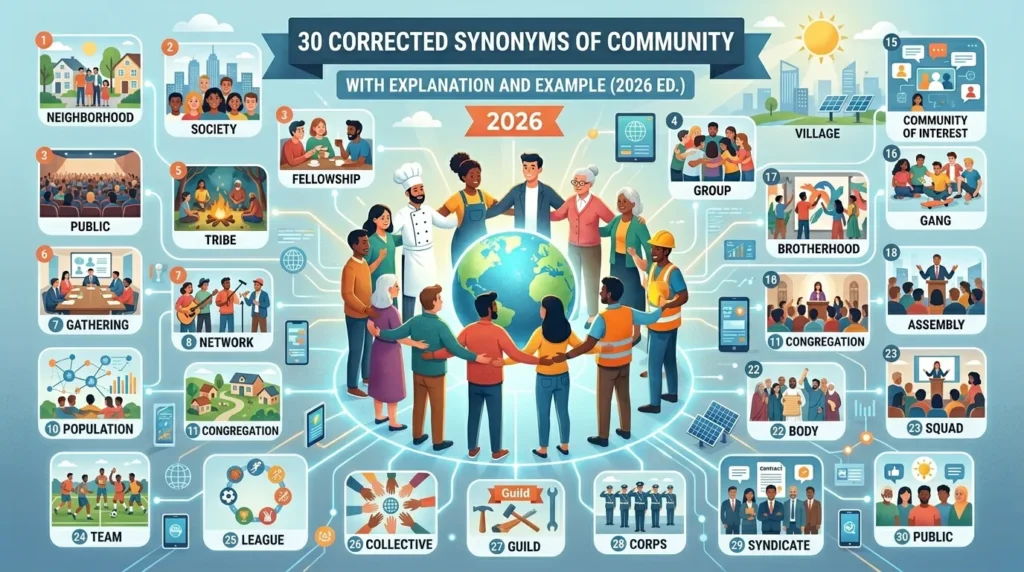
30 Synonyms of Community
1. Society (noun)
US: /səˈsaɪəti/ | UK: /səˈsaɪəti/
Meaning: a large group of people living together
Examples:
- Modern society depends on technology.
- Every society has rules.
2. Neighborhood (noun)
US: /ˈneɪbərˌhʊd/ | UK: /ˈneɪbəhʊd/
Meaning: people living in the same local area
Examples:
- The neighborhood celebrated together.
- Our neighborhood is peaceful.
3. Group (noun)
US: /ɡruːp/ | UK: /ɡruːp/
Meaning: several people together
Examples:
- The study group met online.
- A large group attended the event.
4. Population (noun)
US: /ˌpɑːpjəˈleɪʃən/ | UK: /ˌpɒpjʊˈleɪʃən/
Meaning: all people living in an area
Examples:
- The city’s population is growing.
- The rural population is smaller.
5. Public (noun)
US: /ˈpʌblɪk/ | UK: /ˈpʌblɪk/
Meaning: ordinary people in general
Examples:
- The public supported the project.
- The museum is open to the public.
6. Fellowship (noun)
US: /ˈfeləʊʃɪp/ | UK: /ˈfeləʊʃɪp/
Meaning: friendly connection among people
Examples:
- The club created strong fellowship.
- They enjoyed a sense of fellowship.
7. Association (noun)
US: /əˌsoʊsiˈeɪʃən/ | UK: /əˌsəʊsiˈeɪʃən/
Meaning: an organized group with shared goals
Examples:
- The teachers’ association held a meeting.
- She joined a local association.
8. Network (noun)
US: /ˈnetwɜːrk/ | UK: /ˈnetwɜːk/
Meaning: a connected group of people
Examples:
- Business networks help careers.
- The support network was helpful.
9. Circle (noun)
US: /ˈsɜːrkəl/ | UK: /ˈsɜːkəl/
Meaning: a close social group
Examples:
- She has a small friend circle.
- The artist joined a creative circle.
10. Clan (noun)
US: /klæn/ | UK: /klæn/
Meaning: a family or close social group
Examples:
- The clan gathered for dinner.
- Their clan is well known.
11. Tribe (noun)
US: /traɪb/ | UK: /traɪb/
Meaning: a traditional social group
Examples:
- The tribe protected its culture.
- Several families formed the tribe.
12. Team (noun)
US: /tiːm/ | UK: /tiːm/
Meaning: a group working together
Examples:
- Our team finished the project.
- The sports team practiced daily.
13. Organization (noun)
US: /ˌɔːrɡənəˈzeɪʃən/ | UK: /ˌɔːɡənaɪˈzeɪʃən/
Meaning: a formal group with a purpose
Examples:
- The charity organization helped families.
- She works for an international organization.
14. Brotherhood (noun)
US: /ˈbrʌðərˌhʊd/ | UK: /ˈbrʌðəhʊd/
Meaning: friendship and unity among people
Examples:
- The soldiers shared brotherhood.
- The club promoted brotherhood.
15. Sisterhood (noun)
US: /ˈsɪstərˌhʊd/ | UK: /ˈsɪstəhʊd/
Meaning: support among women
Examples:
- The group encouraged sisterhood.
- They built a strong sisterhood.
16. Union (noun)
US: /ˈjuːnjən/ | UK: /ˈjuːnjən/
Meaning: people joined together for a purpose
Examples:
- The workers formed a union.
- Their union became stronger.
17. Collective (noun)
US: /kəˈlektɪv/ | UK: /kəˈlektɪv/
Meaning: a group acting together
Examples:
- The art collective opened a gallery.
- A music collective performed there.
18. Commune (noun)
US: /ˈkɑːmjuːn/ | UK: /ˈkɒmjuːn/
Meaning: people living and sharing together
Examples:
- The commune shared resources.
- They lived in a peaceful commune.
19. Gathering (noun)
US: /ˈɡæðərɪŋ/ | UK: /ˈɡæðərɪŋ/
Meaning: people meeting together
Examples:
- The family gathering was joyful.
- A large gathering filled the hall.
20. Assembly (noun)
US: /əˈsembli/ | UK: /əˈsembli/
Meaning: a group gathered in one place
Examples:
- The school held an assembly.
- Citizens attended the public assembly.
21. Crowd (noun)
US: /kraʊd/ | UK: /kraʊd/
Meaning: many people together
Examples:
- The crowd cheered loudly.
- A large crowd gathered outside.
22. Audience (noun)
US: /ˈɔːdiəns/ | UK: /ˈɔːdiəns/
Meaning: people watching or listening together
Examples:
- The audience enjoyed the show.
- A young audience attended the concert.
23. Congregation (noun)
US: /ˌkɑːŋɡrɪˈɡeɪʃən/ | UK: /ˌkɒŋɡrɪˈɡeɪʃən/
Meaning: a group gathered for worship
Examples:
- The congregation prayed together.
- The church congregation grew larger.
24. Coalition (noun)
US: /ˌkoʊəˈlɪʃən/ | UK: /ˌkəʊəˈlɪʃən/
Meaning: groups joining for a common purpose
Examples:
- The parties formed a coalition.
- A community coalition solved the issue.
25. Alliance (noun)
US: /əˈlaɪəns/ | UK: /əˈlaɪəns/
Meaning: partnership between groups
Examples:
- The countries built an alliance.
- Their business alliance succeeded.
26. Partnership (noun)
US: /ˈpɑːrtnərʃɪp/ | UK: /ˈpɑːtnəʃɪp/
Meaning: people working together
Examples:
- The companies entered a partnership.
- Their partnership improved business.
27. Fellowship Group (noun)
US: /ˈfeləʊʃɪp ɡruːp/ | UK: /ˈfeləʊʃɪp ɡruːp/
Meaning: people sharing friendship and support
Examples:
- The fellowship group met weekly.
- She joined a student fellowship group.
28. Residents (noun)
US: /ˈrezɪdənts/ | UK: /ˈrezɪdənts/
Meaning: people living in a place
Examples:
- Local residents attended the meeting.
- The residents cleaned the park.
29. Citizens (noun)
US: /ˈsɪtəzənz/ | UK: /ˈsɪtɪzənz/
Meaning: people belonging to a country or city
Examples:
- The citizens voted peacefully.
- Responsible citizens follow laws.
30. Society Group (noun)
US: /səˈsaɪəti ɡruːp/ | UK: /səˈsaɪəti ɡruːp/
Meaning: people connected through shared interests
Examples:
- The science society group met monthly.
- She joined a reading society group.
Prototype Meaning
The most common meaning of community is a group of people connected through place, interests, work, culture, or relationships. People usually imagine friendly neighbors, support systems, shared activities, and cooperation.
Prototype Categorization
- Local groups: neighborhood, residents, citizens
- Social connections: fellowship, brotherhood, sisterhood
- Formal groups: organization, association, union
- Shared-interest groups: network, collective, alliance
Categorization helps writers choose the best synonym based on tone, relationship, and social setting.
Antonyms of Community
Antonyms
- Isolation (noun): being alone or separated
- Loneliness (noun): sadness from being alone
- Division (noun): separation among people
- Separation (noun): the state of being apart
- Individuality (noun): focusing on one person instead of a group
Short Questions and Answers
What does community mean?
- It means a group of people connected by place, interests, or goals.
When should community be used?
- Use it when talking about groups, neighborhoods, teamwork, or social connections.
Is community positive or negative?
- It is usually positive because it suggests support and unity.
How is it different from similar words?
- “Community” focuses on connection and belonging, while “group” is a more general term.
Conclusion
Learning synonyms of community and synonyms of community improves vocabulary and communication skills. It helps English learners describe social groups, relationships, and teamwork more clearly. Using different synonyms also avoids repetition and makes writing stronger and more engaging.These words are useful in education, business, social discussions, and daily conversation. They help writers express ideas about unity, support, and cooperation with greater accuracy. Practice using new vocabulary every day. Small vocabulary improvements can build stronger English confidence and fluency over time.

I’m Zahid Abbas, an educator, researcher, and digital publishing strategist with a passion for linguistics, grammar, and clear communication. As a content creator and SEO specialist, I craft research-driven, reader-focused content that empowers learners and makes knowledge accessible worldwide.