The word work means doing physical or mental activity to achieve something. Imagine a teacher preparing lessons, a doctor helping patients, or a student finishing homework. All of these activities are forms of work.
People use this word every day in schools, offices, homes, and businesses. It is one of the most common words in English because it describes jobs, effort, tasks, and responsibilities. However, using the same word again and again can make speaking and writing repetitive.
Learning synonyms of work helps English learners improve vocabulary and communicate more clearly. It also helps writers choose the best word for formal, casual, academic, or professional situations. In this article, you will learn the meaning of work, its pronunciation, history, grammar, and 30 useful synonyms with meanings and examples. You will also explore semantic categories, antonyms, and simple questions to strengthen your English skills.
Meaning of Work
Definition
Work (noun/verb): activity done to achieve a goal, earn money, or complete a task.
Examples
- She has a lot of work today.
- They work hard every morning.
Connotative Meaning
(Connotation means the feeling or emotion a word suggests beyond its basic meaning.)
- Positive tone: productive, responsible, successful
- Negative tone: tiring, stressful, difficult
- Neutral tone: activity or task completion
Etymology
- From Old English weorc meaning “labor, action, deed”
- Related to Germanic roots connected with activity and effort
Short History:
- Old English (450–1100): used for labor and action
- Middle English (1100–1500): expanded to jobs and craftsmanship
- Modern English (1500–Present): widely used for employment, effort, and tasks
Pronunciation (US & UK – IPA)
- US: /wɜːrk/
- UK: /wɜːk/
Syllables
- work
Affixation Pattern of Work
- Root: work
- Prefix: none
- Suffix: none
Word Formation:
- work (noun/verb)
- worker (noun)
- working (adjective/noun)
- workable (adjective)
- workload (noun)
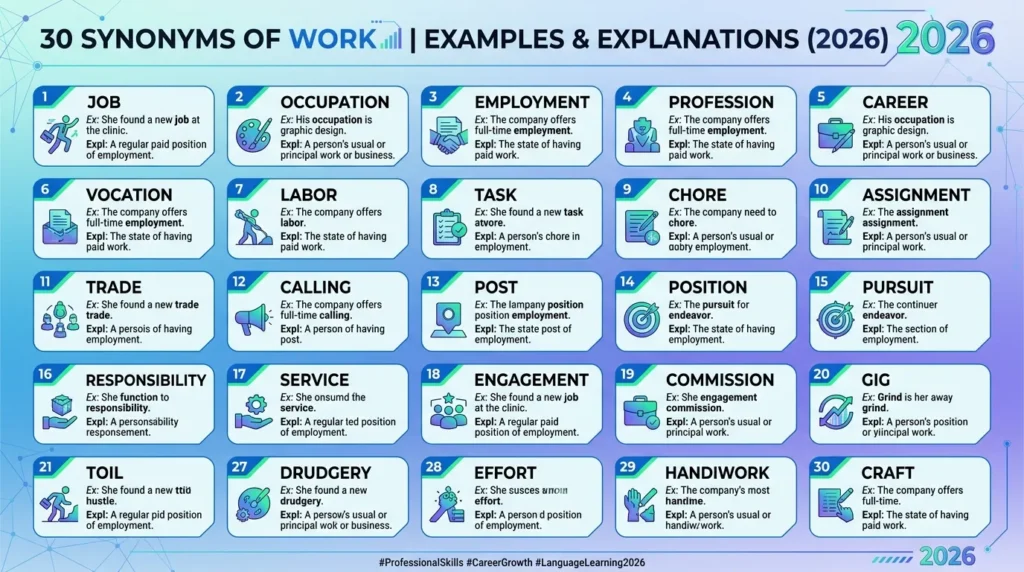
30 Synonyms of Work
1. Job (noun)
US: /dʒɑːb/ | UK: /dʒɒb/
Meaning: paid employment or task
Examples:
- She found a new job.
- My job starts at 9 a.m.
2. Labor (noun/verb)
US: /ˈleɪbər/ | UK: /ˈleɪbə/
Meaning: hard physical or mental effort
Examples:
- Farm labor is difficult.
- They labored all day.
3. Task (noun)
US: /tæsk/ | UK: /tɑːsk/
Meaning: a piece of work to complete
Examples:
- Cleaning is my daily task.
- He finished the task early.
4. Duty (noun)
US: /ˈduːti/ | UK: /ˈdjuːti/
Meaning: something you must do
Examples:
- It is her duty to help.
- Police officers perform their duties.
5. Assignment (noun)
US: /əˈsaɪnmənt/ | UK: /əˈsaɪnmənt/
Meaning: work given to someone
Examples:
- The teacher gave an assignment.
- He completed the assignment.
6. Occupation (noun)
US: /ˌɑːkjəˈpeɪʃən/ | UK: /ˌɒkjəˈpeɪʃən/
Meaning: a person’s profession or job
Examples:
- Teaching is her occupation.
- He listed his occupation on the form.
7. Profession (noun)
US: /prəˈfɛʃən/ | UK: /prəˈfeʃən/
Meaning: a skilled career
Examples:
- Medicine is a respected profession.
- She entered the legal profession.
8. Career (noun)
US: /kəˈrɪr/ | UK: /kəˈrɪə/
Meaning: long-term professional journey
Examples:
- He built a successful career.
- Nursing became her career.
9. Employment (noun)
US: /ɪmˈplɔɪmənt/ | UK: /ɪmˈplɔɪmənt/
Meaning: paid work
Examples:
- She is seeking employment.
- Stable employment is important.
10. Effort (noun)
US: /ˈɛfərt/ | UK: /ˈefət/
Meaning: energy used to do something
Examples:
- Your effort is impressive.
- He made a strong effort.
11. Toil (noun/verb)
US: /tɔɪl/ | UK: /tɔɪl/
Meaning: very hard work
Examples:
- Farmers toil in the fields.
- Years of toil brought success.
12. Grind (noun/verb)
US: /ɡraɪnd/ | UK: /ɡraɪnd/
Meaning: hard repetitive work
Examples:
- Office life can feel like a grind.
- She grinds every day.
13. Business (noun)
US: /ˈbɪznəs/ | UK: /ˈbɪznəs/
Meaning: professional activity or trade
Examples:
- He works in the family business.
- The business is growing fast.
14. Trade (noun)
US: /treɪd/ | UK: /treɪd/
Meaning: skilled manual work or business activity
Examples:
- Carpentry is a useful trade.
- He learned the plumbing trade.
15. Service (noun)
US: /ˈsɜːrvɪs/ | UK: /ˈsɜːvɪs/
Meaning: work done to help others
Examples:
- Customer service is important.
- She works in public service.
16. Craft (noun)
US: /kræft/ | UK: /krɑːft/
Meaning: skilled handmade work
Examples:
- Pottery is an ancient craft.
- He improved his writing craft.
17. Operation (noun)
US: /ˌɑːpəˈreɪʃən/ | UK: /ˌɒpəˈreɪʃən/
Meaning: organized work or activity
Examples:
- The factory operation runs smoothly.
- Police started a rescue operation.
18. Function (noun/verb)
US: /ˈfʌŋkʃən/ | UK: /ˈfʌŋkʃən/
Meaning: purpose or activity
Examples:
- The machine performs its function.
- The system functions well.
19. Mission (noun)
US: /ˈmɪʃən/ | UK: /ˈmɪʃən/
Meaning: important task or purpose
Examples:
- Their mission was successful.
- She completed the rescue mission.
20. Project (noun)
US: /ˈprɑːdʒɛkt/ | UK: /ˈprɒdʒekt/
Meaning: planned work with a goal
Examples:
- The team started a new project.
- Our science project won first prize.
21. Chore (noun)
US: /tʃɔːr/ | UK: /tʃɔː/
Meaning: routine household work
Examples:
- Washing dishes is a daily chore.
- Children should help with chores.
22. Activity (noun)
US: /ækˈtɪvəti/ | UK: /ækˈtɪvɪti/
Meaning: something people do
Examples:
- Reading is a relaxing activity.
- Outdoor activities are healthy.
23. Responsibility (noun)
US: /rɪˌspɑːnsəˈbɪləti/ | UK: /rɪˌspɒnsəˈbɪləti/
Meaning: duty or obligation
Examples:
- Parenting is a huge responsibility.
- Safety is your responsibility.
24. Undertaking (noun)
US: /ˌʌndərˈteɪkɪŋ/ | UK: /ˌʌndəˈteɪkɪŋ/
Meaning: an important task or project
Examples:
- Building the bridge was a large undertaking.
- The company started a risky undertaking.
25. Performance (noun)
US: /pərˈfɔːrməns/ | UK: /pəˈfɔːməns/
Meaning: how well work is done
Examples:
- Her performance improved greatly.
- Employee performance matters.
26. Production (noun)
US: /prəˈdʌkʃən/ | UK: /prəˈdʌkʃən/
Meaning: the process of making something
Examples:
- Food production increased this year.
- The factory handles car production.
27. Employment Duty (noun)
US: /ɪmˈplɔɪmənt ˈduːti/ | UK: /ɪmˈplɔɪmənt ˈdjuːti/
Meaning: job responsibility
Examples:
- Checking emails is an employment duty.
- Staff completed their employment duties.
28. Piecework (noun)
US: /ˈpiːsˌwɜːrk/ | UK: /ˈpiːswɜːk/
Meaning: paid work based on amount completed
Examples:
- Many tailors do piecework.
- She earned money through piecework.
29. Pursuit (noun)
US: /pərˈsuːt/ | UK: /pəˈsjuːt/
Meaning: activity done regularly or seriously
Examples:
- Music became his main pursuit.
- Writing is a creative pursuit.
30. Endeavor (noun/verb)
US: /ɪnˈdevər/ | UK: /ɪnˈdevə/
Meaning: serious attempt or effort
Examples:
- Starting a company is a major endeavor.
- They endeavored to succeed.
Prototype Meaning
The most common meaning of work is doing tasks, jobs, or activities to achieve a goal or earn money. People usually imagine offices, tools, computers, workers, or daily responsibilities when hearing this word.
Prototype Categorization
- Jobs and careers: profession, occupation, employment
- Effort and labor: toil, grind, endeavor
- Tasks and duties: assignment, chore, responsibility
- Projects and activities: mission, project, undertaking
Categorization helps writers choose the best synonym based on tone, situation, and purpose.
Antonyms of Work
Antonyms
- Rest (noun/verb): relaxation without activity
- Leisure (noun): free time without duties
- Idleness (noun): lack of work or activity
- Relaxation (noun): state of calm and rest
- Inactivity (noun): absence of action or effort
Short Questions and Answers
What does work mean?
- It means doing tasks, jobs, or activities to achieve something.
When should work be used?
- Use it when discussing jobs, effort, duties, or activities.
Is work positive or negative?
- It can be positive or negative depending on context.
How is it different from similar words?
- “Work” is general, while words like “career” or “task” are more specific.
Conclusion
Learning synonyms of work and synonyms of work improves vocabulary and communication skills. It helps English learners describe jobs, effort, duties, and activities more clearly in speaking and writing. Using different synonyms also avoids repetition and makes communication more natural.These words are useful in academic, business, professional, and everyday situations. They help writers express ideas with greater precision and confidence. Practice using new vocabulary daily in conversations, essays, and workplace communication. Small vocabulary improvements can make your English stronger, clearer, and more fluent over time.

I’m Zahid Abbas, an educator, researcher, and digital publishing strategist with a passion for linguistics, grammar, and clear communication. As a content creator and SEO specialist, I craft research-driven, reader-focused content that empowers learners and makes knowledge accessible worldwide.