The word large means big in size, amount, or importance. Imagine walking into a large shopping mall with many stores, bright lights, and hundreds of people. The synonyms of large describes something much bigger than normal.
People use the word large every day in speaking and writing because it fits many situations. We talk about large houses, large groups, large cities, and large problems. However, using the same word repeatedly can make communication less interesting.
Learning synonyms of large helps English learners improve vocabulary and express ideas more clearly. It also helps writers create stronger and more descriptive sentences. In this article, you will learn the meaning of large, its pronunciation, history, grammar, and 30 useful synonyms with examples. You will also explore semantic categories, antonyms, and simple questions that strengthen English speaking and writing skills.
Meaning of Large
Definition
Large (adjective): bigger than average in size, number, amount, or importance.
Examples
- They live in a large house.
- A large crowd gathered outside.
Connotative Meaning
(Connotation means the feeling or emotion a word suggests beyond its basic meaning.)
- Positive tone: impressive, spacious, powerful
- Negative tone: overwhelming, excessive, bulky
- Neutral tone: simply bigger than normal
Etymology
- From Old French large meaning “broad” or “wide”
- Derived from Latin largus meaning “abundant” or “generous”
Short History:
- Old English (450–1100): similar words described width and size
- Middle English (1100–1500): “large” entered English through French
- Modern English (1500–Present): widely used for size, quantity, and importance
Pronunciation (US & UK – IPA)
- US: /lɑːrdʒ/
- UK: /lɑːdʒ/
Syllables
- large
Affixation Pattern of Large
- Root: large
- Prefix: none
- Suffix: none
Word Formation:
- large (adjective)
- enlarge (verb)
- largely (adverb)
- largeness (noun)
- enlargement (noun)
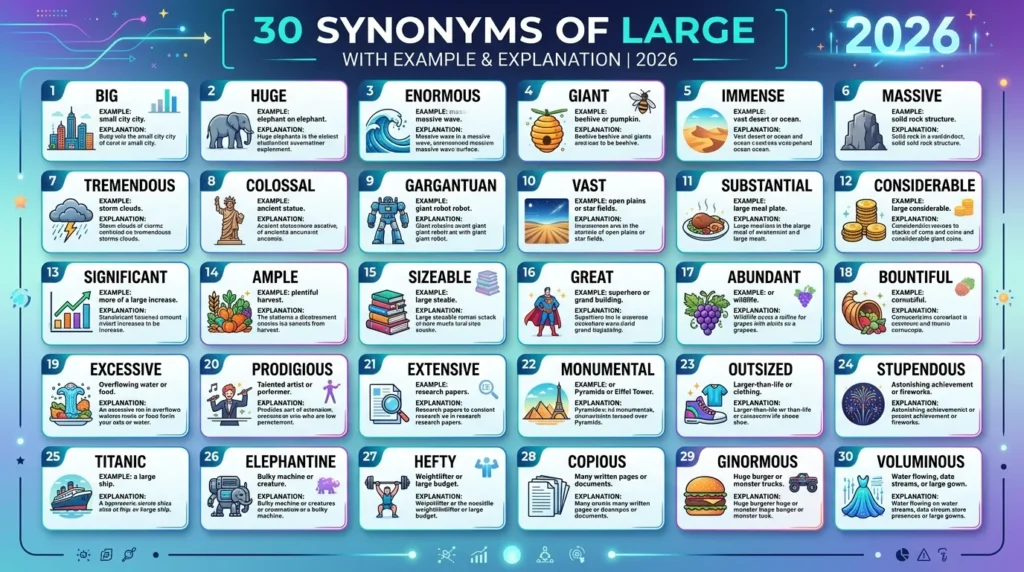
30 Synonyms of Large
1. Big (adjective)
US: /bɪɡ/ | UK: /bɪɡ/
Meaning: great in size or amount
Examples:
- They bought a big car.
- A big dog stood outside.
2. Huge (adjective)
US: /hjuːdʒ/ | UK: /hjuːdʒ/
Meaning: extremely large
Examples:
- The building is huge.
- She made a huge cake.
3. Giant (adjective/noun)
US: /ˈdʒaɪənt/ | UK: /ˈdʒaɪənt/
Meaning: very large and powerful
Examples:
- A giant tree blocked the road.
- The company became a giant business.
4. Massive (adjective)
US: /ˈmæsɪv/ | UK: /ˈmæsɪv/
Meaning: very heavy or extremely large
Examples:
- They built a massive bridge.
- The storm caused massive damage.
5. Enormous (adjective)
US: /ɪˈnɔːrməs/ | UK: /ɪˈnɔːməs/
Meaning: extremely big
Examples:
- The elephant looked enormous.
- He has an enormous collection.
6. Immense (adjective)
US: /ɪˈmens/ | UK: /ɪˈmens/
Meaning: very great in size or degree
Examples:
- The ocean seemed immense.
- She felt immense joy.
7. Vast (adjective)
US: /væst/ | UK: /vɑːst/
Meaning: very wide or extensive
Examples:
- The desert is vast.
- They own vast farmland.
8. Gigantic (adjective)
US: /dʒaɪˈɡæntɪk/ | UK: /dʒaɪˈɡæntɪk/
Meaning: extremely large
Examples:
- A gigantic ship entered the harbor.
- The statue looked gigantic.
9. Colossal (adjective)
US: /kəˈlɑːsəl/ | UK: /kəˈlɒsəl/
Meaning: extremely huge and impressive
Examples:
- The tower was colossal.
- They faced a colossal challenge.
10. Tremendous (adjective)
US: /trɪˈmendəs/ | UK: /trɪˈmendəs/
Meaning: very great in size or intensity
Examples:
- The team received tremendous support.
- A tremendous crowd arrived.
11. Mammoth (adjective)
US: /ˈmæməθ/ | UK: /ˈmæməθ/
Meaning: enormous in size
Examples:
- They started a mammoth project.
- The company made a mammoth profit.
12. Bulky (adjective)
US: /ˈbʌlki/ | UK: /ˈbʌlki/
Meaning: large and difficult to move
Examples:
- The sofa looked bulky.
- He carried a bulky bag.
13. Spacious (adjective)
US: /ˈspeɪʃəs/ | UK: /ˈspeɪʃəs/
Meaning: having a lot of space
Examples:
- The apartment is spacious.
- They sat in a spacious hall.
14. Broad (adjective)
US: /brɔːd/ | UK: /brɔːd/
Meaning: wide from side to side
Examples:
- The river is broad.
- He has broad shoulders.
15. Wide (adjective)
US: /waɪd/ | UK: /waɪd/
Meaning: measuring a great distance across
Examples:
- The road is very wide.
- She opened the door wide.
16. Grand (adjective)
US: /ɡrænd/ | UK: /ɡrænd/
Meaning: large and impressive
Examples:
- They stayed in a grand hotel.
- The wedding looked grand.
17. Extensive (adjective)
US: /ɪkˈstensɪv/ | UK: /ɪkˈstensɪv/
Meaning: covering a large area
Examples:
- The library has an extensive collection.
- Floods caused extensive damage.
18. Towering (adjective)
US: /ˈtaʊərɪŋ/ | UK: /ˈtaʊərɪŋ/
Meaning: extremely tall or impressive
Examples:
- A towering building stood nearby.
- He is a towering figure in sports.
19. Oversized (adjective)
US: /ˈoʊvərsaɪzd/ | UK: /ˈəʊvəsaɪzd/
Meaning: larger than normal
Examples:
- She wore an oversized jacket.
- The package was oversized.
20. Monumental (adjective)
US: /ˌmɑːnjəˈmentl/ | UK: /ˌmɒnjʊˈmentl/
Meaning: extremely large or important
Examples:
- They made a monumental decision.
- The building was monumental.
21. Hefty (adjective)
US: /ˈhefti/ | UK: /ˈhefti/
Meaning: large and heavy
Examples:
- He carried a hefty box.
- The company paid a hefty fine.
22. Full-Size (adjective)
US: /ˌfʊl ˈsaɪz/ | UK: /ˌfʊl ˈsaɪz/
Meaning: normal large size
Examples:
- They bought a full-size bed.
- The car is full-size.
23. Expansive (adjective)
US: /ɪkˈspænsɪv/ | UK: /ɪkˈspænsɪv/
Meaning: covering a wide area
Examples:
- The farm is expansive.
- They enjoyed the expansive view.
24. Jumbo (adjective)
US: /ˈdʒʌmboʊ/ | UK: /ˈdʒʌmbəʊ/
Meaning: unusually large
Examples:
- He ordered a jumbo sandwich.
- They flew on a jumbo jet.
25. King-Size (adjective)
US: /ˈkɪŋ saɪz/ | UK: /ˈkɪŋ saɪz/
Meaning: very large in size
Examples:
- They slept on a king-size bed.
- She bought a king-size blanket.
26. Thick (adjective)
US: /θɪk/ | UK: /θɪk/
Meaning: having a large distance between sides
Examples:
- The wall is very thick.
- He wore a thick coat.
27. Heavy (adjective)
US: /ˈhevi/ | UK: /ˈhevi/
Meaning: large in weight or amount
Examples:
- The bag feels heavy.
- Heavy rain flooded the streets.
28. Great (adjective)
US: /ɡreɪt/ | UK: /ɡreɪt/
Meaning: large in amount or importance
Examples:
- They showed great courage.
- A great number attended.
29. Sizeable (adjective)
US: /ˈsaɪzəbəl/ | UK: /ˈsaɪzəbəl/
Meaning: fairly large
Examples:
- They received a sizeable donation.
- The company owns a sizeable building.
30. Titanic (adjective)
US: /taɪˈtænɪk/ | UK: /taɪˈtænɪk/
Meaning: extremely huge or powerful
Examples:
- They faced a titanic struggle.
- The ship looked titanic.
Prototype Meaning
The most common meaning of large is something bigger than average in size, amount, or importance. People usually imagine a large building, a large crowd, or a large object taking up a lot of space.
Prototype Categorization
- Physical size: huge, gigantic, colossal
- Space and width: broad, wide, spacious
- Importance and intensity: monumental, tremendous, great
- Weight and thickness: hefty, thick, heavy
Categorization helps writers choose the best synonym based on context and tone.
Antonyms of Large
Antonyms
- Small (adjective): little in size
- Tiny (adjective): very small
- Narrow (adjective): not wide
- Miniature (adjective): extremely small
- Compact (adjective): small but efficient
Short Questions and Answers
What does large mean?
- It means bigger than average in size, amount, or importance.
When should large be used?
- Use it when describing something big or spacious.
Is large positive or negative?
- It is usually neutral, but context can make it positive or negative.
How is it different from similar words?
- “Large” is general, while “huge” or “gigantic” describe much bigger sizes.
Conclusion
Learning synonyms of large and synonyms of large improves vocabulary and communication skills. It helps English learners describe size, quantity, and importance more clearly in writing and speaking. Using different synonyms also avoids repetition and creates more natural sentences.These words are useful in daily conversations, academic writing, storytelling, and professional communication. Understanding different shades of meaning helps writers choose the perfect word for each situation. Practice using new vocabulary every day. Small daily improvements can build stronger English fluency, confidence, and communication skills over time.

I’m Zahid Abbas, an educator, researcher, and digital publishing strategist with a passion for linguistics, grammar, and clear communication. As a content creator and SEO specialist, I craft research-driven, reader-focused content that empowers learners and makes knowledge accessible worldwide.