The word memory means the ability to remember past events, information, or experiences. Imagine sitting with your family and talking about childhood moments. You smile because those memories bring joy and meaning to your life.
People use this word every day in school, work, and personal life. It is important because it helps us learn, grow, and connect with others. However, using the same word again and again can make language dull.
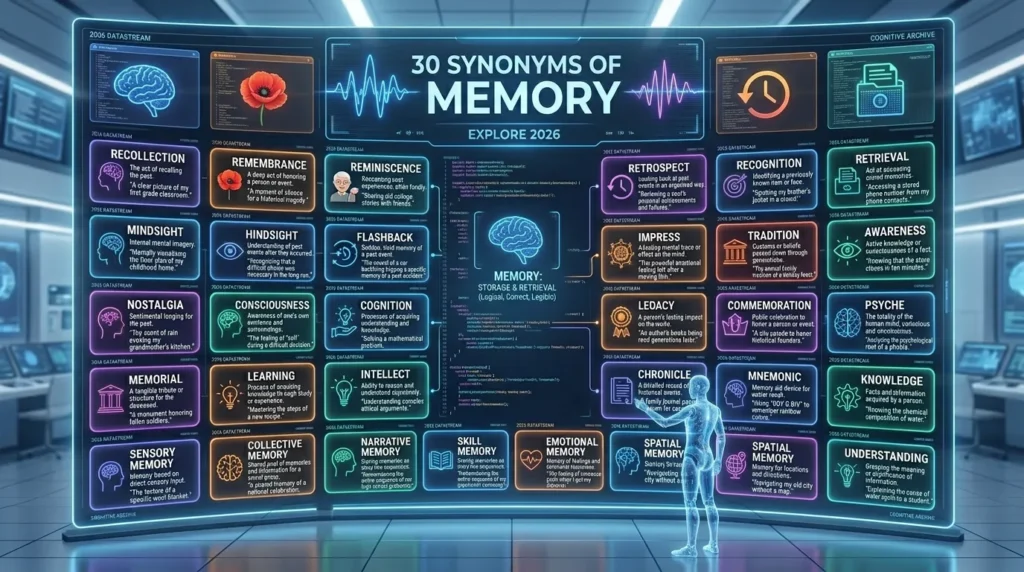
Learning synonyms of memory helps English learners improve vocabulary and express ideas in a richer way. It also helps writers create clear and engaging content. In this article, you will learn the meaning of memory, its pronunciation, history, grammar, and 30 useful synonyms with examples. You will also explore categories, antonyms, and simple questions to strengthen your English skills.
Meaning of Memory
Definition
Memory (noun): the ability to store, keep, and recall information or past experiences.
Examples
- I have a strong memory for names.
- That day is a happy memory for me.
Connotative Meaning
(Connotation means the feeling or emotion a word suggests beyond its basic meaning.)
- Positive tone: nostalgia, joy, learning
- Negative tone: regret, pain, loss
- Neutral tone: simple recall of information
Etymology
- From Latin memoria meaning “remembrance”
- Entered English through Old French
Short History:
- Old English (450–1100): words like “gemynd” were used
- Middle English (1100–1500): “memory” became common
- Modern English (1500–Present): widely used in psychology and daily speech
Pronunciation (US & UK – IPA)
- US: /ˈmeməri/
- UK: /ˈmeməri/
Syllables
- mem-o-ry
Affixation Pattern of Memory
- Root: memor
- Prefix: none
- Suffix: -y
Word Formation:
- memorize (verb)
- memory (noun)
- memorial (noun/adjective)
- memorable (adjective)
- memorization (noun)
Synonyms of Memory
1. Recall (noun)
US: /rɪˈkɔːl/ | UK: /rɪˈkɔːl/
Meaning: the act of remembering something
Examples:
- His recall is very sharp.
- She improved her recall skills.
2. Remembrance (noun)
US: /rɪˈmembrəns/ | UK: /rɪˈmembrəns/
Meaning: the act of remembering
Examples:
- They held a ceremony in remembrance.
- This day is for remembrance.
3. Recollection (noun)
US: /ˌrekəˈlekʃən/ | UK: /ˌrekəˈlekʃən/
Meaning: remembering past events
Examples:
- My recollection is clear.
- He shared his recollection.
4. Reminiscence (noun)
US: /ˌremɪˈnɪsns/ | UK: /ˌremɪˈnɪsns/
Meaning: thinking about past experiences
Examples:
- She spoke in reminiscence.
- Old songs bring reminiscence.
5. Impression (noun)
US: /ɪmˈpreʃən/ | UK: /ɪmˈpreʃən/
Meaning: a lasting effect on the mind
Examples:
- The trip left a strong impression.
- First impressions matter.
6. Thought (noun)
US: /θɔːt/ | UK: /θɔːt/
Meaning: an idea or memory in the mind
Examples:
- A happy thought came to me.
- Keep positive thoughts.
7. Mind (noun)
US: /maɪnd/ | UK: /maɪnd/
Meaning: the part that remembers and thinks
Examples:
- His mind is sharp.
- She has a strong mind.
8. Flashback (noun)
US: /ˈflæʃbæk/ | UK: /ˈflæʃbæk/
Meaning: a sudden vivid memory
Examples:
- He had a flashback.
- The smell caused a flashback.
9. Record (noun)
US: /ˈrekərd/ | UK: /ˈrekɔːd/
Meaning: stored information
Examples:
- Keep a record of events.
- The system stores records.
10. Archive (noun)
US: /ˈɑːrkaɪv/ | UK: /ˈɑːkaɪv/
Meaning: stored historical data
Examples:
- The museum has an archive.
- Files are kept in archives.
11. Knowledge (noun)
US: /ˈnɑːlɪdʒ/ | UK: /ˈnɒlɪdʒ/
Meaning: information remembered
Examples:
- He has deep knowledge.
- Learning builds knowledge.
12. Awareness (noun)
US: /əˈwer.nəs/ | UK: /əˈweə.nəs/
Meaning: knowing or remembering something
Examples:
- She has good awareness.
- Increase your awareness.
13. Memo (noun)
US: /ˈmemoʊ/ | UK: /ˈmeməʊ/
Meaning: a short written memory note
Examples:
- Write a memo.
- He sent a quick memo.
14. Chronicle (noun)
US: /ˈkrɑːnɪkl/ | UK: /ˈkrɒnɪkl/
Meaning: record of past events
Examples:
- The book is a chronicle.
- History is a chronicle.
15. Memorandum (noun)
US: /ˌmeməˈrændəm/ | UK: /ˌmeməˈrændəm/
Meaning: a written reminder
Examples:
- He wrote a memorandum.
- Keep the memorandum safe.
16. Keepsake (noun)
US: /ˈkiːpseɪk/ | UK: /ˈkiːpseɪk/
Meaning: an object that reminds you of the past
Examples:
- This ring is a keepsake.
- She kept it as a keepsake.
17. Reminder (noun)
US: /rɪˈmaɪndər/ | UK: /rɪˈmaɪndə/
Meaning: something that helps you remember
Examples:
- Set a reminder.
- The photo is a reminder.
18. Experience (noun)
US: /ɪkˈspɪriəns/ | UK: /ɪkˈspɪəriəns/
Meaning: past events remembered
Examples:
- It was a great experience.
- Learn from experience.
19. Reflection (noun)
US: /rɪˈflekʃən/ | UK: /rɪˈflekʃən/
Meaning: thinking about past events
Examples:
- He wrote a reflection.
- Deep reflection helps growth.
20. Remains (noun)
US: /rɪˈmeɪnz/ | UK: /rɪˈmeɪnz/
Meaning: what is left in memory
Examples:
- Only remains of memory exist.
- The remains tell a story.
21. Trace (noun)
US: /treɪs/ | UK: /treɪs/
Meaning: a small sign left in memory
Examples:
- There is a trace of memory.
- No trace was found.
22. Echo (noun)
US: /ˈekoʊ/ | UK: /ˈekəʊ/
Meaning: a faint memory or reminder
Examples:
- His voice is an echo.
- Memories echo in time.
23. Legacy (noun)
US: /ˈleɡəsi/ | UK: /ˈleɡəsi/
Meaning: something remembered after someone leaves
Examples:
- He left a strong legacy.
- Her work is her legacy.
24. Souvenir (noun)
US: /ˌsuːvəˈnɪr/ | UK: /ˌsuːvəˈnɪə/
Meaning: an item kept to remember a place
Examples:
- I bought a souvenir.
- This is my travel souvenir.
25. Token (noun)
US: /ˈtoʊkən/ | UK: /ˈtəʊkən/
Meaning: something that reminds of a memory
Examples:
- A small token of love.
- Keep this token safe.
26. Mental image (noun)
US: /ˈmentl ˈɪmɪdʒ/ | UK: /ˈmentl ˈɪmɪdʒ/
Meaning: a picture in the mind
Examples:
- I have a clear mental image.
- The story created a mental image.
27. Recall ability (noun)
US: /rɪˈkɔːl əˈbɪləti/ | UK: /rɪˈkɔːl əˈbɪləti/
Meaning: power to remember
Examples:
- His recall ability is strong.
- Practice improves recall ability.
28. Mindprint (noun)
US: /ˈmaɪndprɪnt/ | UK: /ˈmaɪndprɪnt/
Meaning: a lasting mark on memory
Examples:
- The event left a mindprint.
- It created a deep mindprint.
29. Mental note (noun)
US: /ˈmentl noʊt/ | UK: /ˈmentl nəʊt/
Meaning: something remembered silently
Examples:
- I made a mental note.
- She kept a mental note.
30. Cognitive store (noun)
US: /ˈkɑːɡnɪtɪv stɔːr/ | UK: /ˈkɒɡnɪtɪv stɔː/
Meaning: the brain’s storage of memory
Examples:
- The brain acts as a cognitive store.
- Memory stays in the cognitive store.
Prototype Meaning
The most common meaning of memory is the ability of the brain to store and recall information or experiences. People usually imagine remembering past events, faces, or important moments.
Prototype Categorization
- Mental ability: recall, recollection, awareness
- Emotional memory: reminiscence, reflection, legacy
- Physical reminders: keepsake, souvenir, token
- Stored data: record, archive, chronicle
Categorization helps writers choose the best synonym based on context and purpose.
Antonyms of Memory
- Forgetfulness (noun): inability to remember
- Amnesia (noun): loss of memory
- Oblivion (noun): complete forgetting
- Ignorance (noun): lack of knowledge
- Unawareness (noun): not knowing or remembering
Short Questions and Answers
What does memory mean?
- It means the ability to remember information or past events.
When should memory be used?
- Use it when talking about learning, recalling, or past experiences.
Is memory positive or negative?
- It can be both, depending on whether the memory is happy or sad.
How is it different from similar words?
- “Memory” is general, while words like “recollection” are more specific or formal.
Conclusion
Learning synonyms of memory and synonyms of memory improves vocabulary and communication skills. It helps English learners express thoughts, feelings, and past experiences more clearly. Using different synonyms also avoids repetition and makes writing more engaging.These words are useful in storytelling, academic writing, and daily conversations. They help describe mental processes, emotions, and experiences with accuracy. Practice learning and using new words every day. Small efforts can build strong English confidence and fluency over time.

I’m Zahid Abbas, an educator, researcher, and digital publishing strategist with a passion for linguistics, grammar, and clear communication. As a content creator and SEO specialist, I craft research-driven, reader-focused content that empowers learners and makes knowledge accessible worldwide.